DNA sequencing tells you the exact order of nucleotides. The MCAT focuses on Sanger sequencing (the classical chain-termination method) and recognizes that next-generation sequencing (NGS) is the modern high-throughput approach.
Sanger (Chain-Termination) Sequencing
Developed by Frederick Sanger in 1977. The reaction is like a PCR, with one important twist: the reaction mix contains a small amount of dideoxynucleotides (ddNTPs) in addition to the normal dNTPs.
A ddNTP lacks a 3’-OH. When DNA polymerase incorporates a ddNTP, no further nucleotides can be added - the chain terminates at that base.
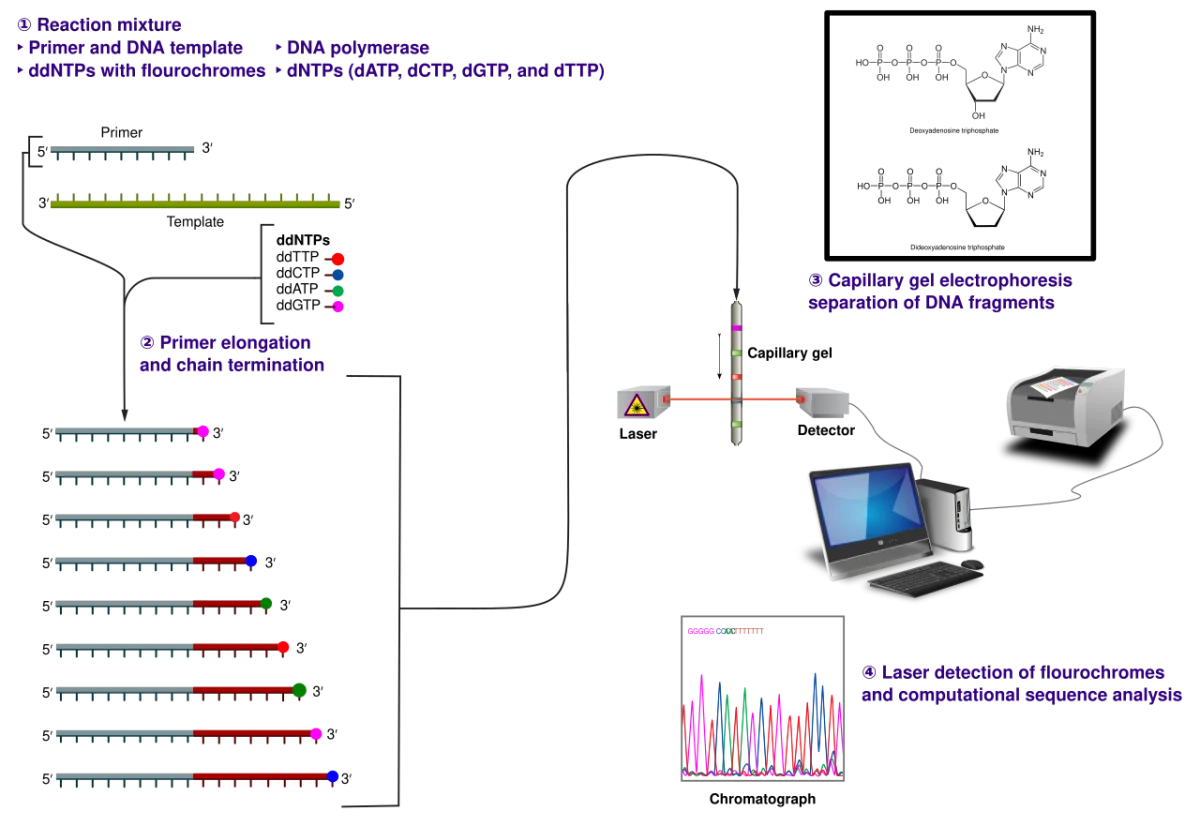
Sanger sequencing. Each reaction produces fragments of every possible length, each ending in a fluorescently labeled ddNTP. Separation by size reveals which base is at each position. Credit: Wikimedia Commons, CC BY-SA
Workflow
Mix template DNA, primer, DNA polymerase, dNTPs, and a small amount of each ddNTP (each labeled with a different fluorescent color: ddA = green, ddT = red, etc.).
The polymerase extends the primer using dNTPs. Occasionally it incorporates a ddNTP by accident and stops.
The result is a mixture of fragments of every possible length, each ending in a known fluorescent ddNTP.
Run the mixture through capillary electrophoresis (size-separation by size).
A detector reads the fluorescent color of each fragment as it passes. The order of colors = the sequence of bases.
The Chromatogram
The output of a Sanger sequencer is a chromatogram: four colored traces (one per base) with peaks at each position of the sequence. Reading the tallest peak at each position left to right gives the DNA sequence.
Next-Generation Sequencing
Modern NGS platforms (Illumina, PacBio, Nanopore) sequence billions of DNA fragments in parallel. Each platform uses different chemistry, but the general idea is the same: fragment the DNA, attach adapters, amplify, then read out each fragment in parallel. This is how the Human Genome Project went from 13 years and $3 billion (Sanger-based) to 1-2 days and $1000 (modern NGS) for a whole human genome.
You do not need to know specific NGS chemistries for the MCAT. But recognize that modern sequencing is massively parallel, not Sanger’s sequential approach.
What makes a dideoxynucleotide (ddNTP) stop DNA polymerase?
Click to reveal answer
A ddNTP lacks a 3'-OH on its sugar (in addition to lacking the 2'-OH like normal dNTPs). DNA polymerase extends by attacking the 3'-OH of the growing chain with the next nucleotide's 5'-phosphate. No 3'-OH = no attachment point for the next nucleotide = chain terminates. This is the basis of Sanger sequencing.
How is the actual DNA sequence read from a Sanger sequencing reaction?
Click to reveal answer
The reaction produces fragments of every possible length, each ending in a fluorescently labeled ddNTP (one color per base). Capillary electrophoresis separates fragments by size (shortest to longest). A detector reads the color of each fragment in order. The sequence of colors, read from shortest to longest fragment, corresponds to the DNA sequence from the primer outward.
What is the main difference between Sanger sequencing and next-generation sequencing?
Click to reveal answer
Sanger sequences one DNA fragment at a time using chain-termination chemistry. NGS sequences millions of fragments in parallel. NGS is much cheaper and faster per base but produces shorter reads. Modern whole-genome sequencing is almost entirely NGS; Sanger is still used for short, high-accuracy confirmation of specific loci (e.g., confirming a single mutation in a clinical sample).