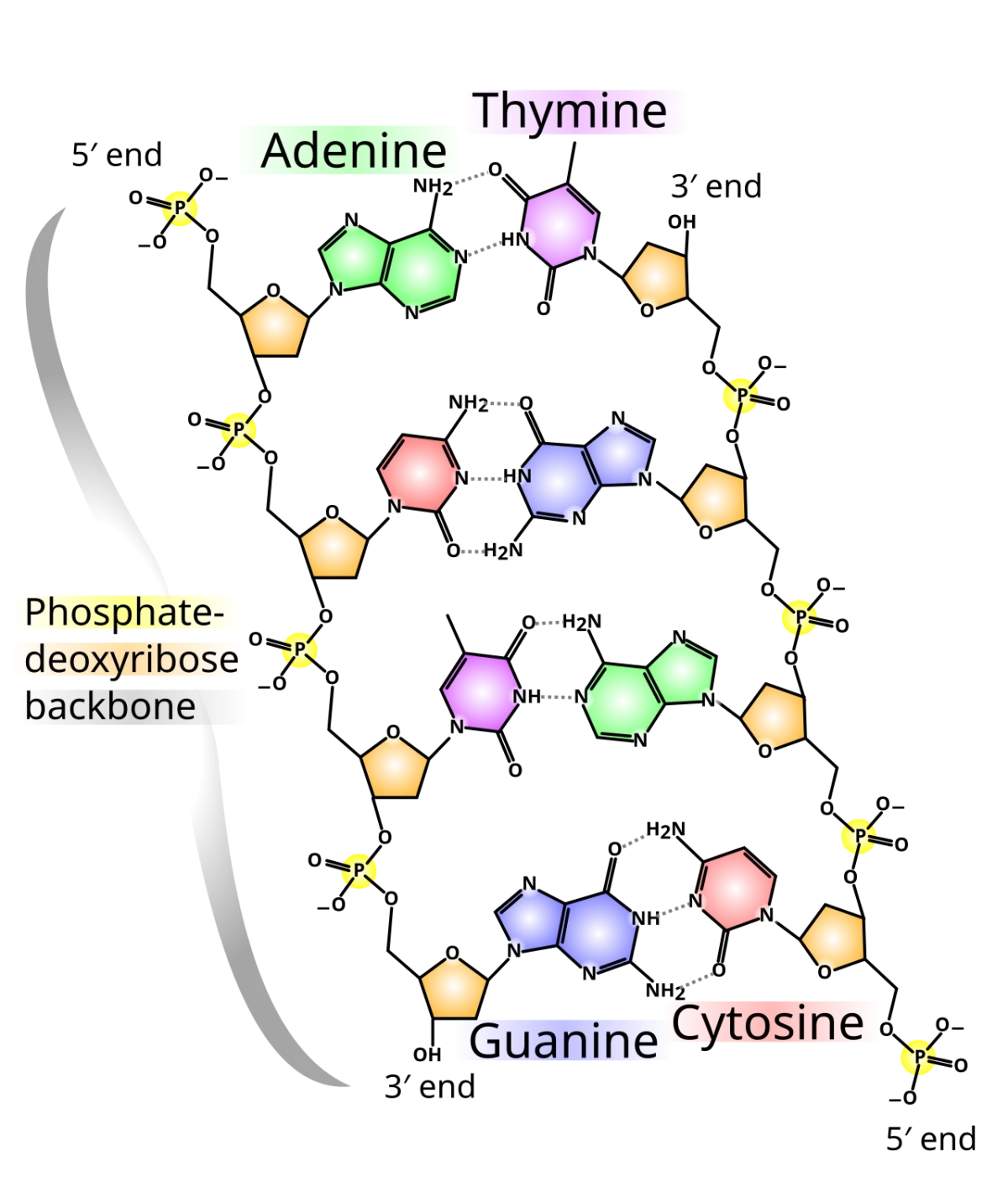
A nucleotide has three parts: a nitrogenous base, a five-carbon sugar, and a phosphate (or phosphates). Add the phosphate and it becomes a nucleoTIDE. Remove the phosphate and it is just a nucleoSIDE (sugar + base).
A nucleotide: base + sugar + phosphate. In a polynucleotide chain, the phosphate links the 5' carbon of one sugar to the 3' carbon of the next. Credit: Wikimedia Commons, CC BY-SA
The Five Bases
Two families of bases, distinguished by their ring structure:
Purines: two fused rings. Adenine (A) and guanine (G).
Pyrimidines: one ring. Cytosine (C), thymine (T), and uracil (U).
Thymine is in DNA only. Uracil is in RNA only. A, G, and C are in both.
Sugars: DNA vs. RNA
DNA uses 2-deoxyribose - C2 has no hydroxyl (just -H).
RNA uses ribose - C2 has a hydroxyl (-OH).
That single hydroxyl difference makes RNA far less chemically stable than DNA. The 2’-OH of RNA can attack the phosphodiester backbone intramolecularly, cleaving the chain. DNA, lacking this attacker, is much more stable - appropriate for long-term information storage.
Nucleoside vs. Nucleotide Naming
Base
Nucleoside (base + sugar)
Nucleotide (add phosphate)
Adenine
Adenosine (RNA) / Deoxyadenosine (DNA)
AMP, ADP, ATP
Guanine
Guanosine / Deoxyguanosine
GMP, GDP, GTP
Cytosine
Cytidine / Deoxycytidine
CMP, CDP, CTP
Thymine
Thymidine
TMP, TDP, TTP
Uracil
Uridine
UMP, UDP, UTP
The Phosphodiester Backbone
Nucleotides polymerize through phosphodiester bonds: the 5’-phosphate of one nucleotide attaches to the 3’-OH of the next. This gives the backbone its directionality. Every DNA or RNA strand has a 5’ end (free phosphate) and a 3’ end (free -OH).
Polymerases always add new nucleotides to the 3’-OH, so synthesis runs 5’ → 3’. Reading and writing conventions follow this: a sequence written as ATCG means the 5’ end has A and the 3’ end has G.
What three components make up a nucleotide, and which are present in a nucleoside?
Click to reveal answer
A nucleotide has three parts: a nitrogenous base, a five-carbon sugar, and one or more phosphate groups. A nucleoside has just the base and sugar (no phosphate). Adding a phosphate converts a nucleoside to a nucleotide.
Which bases are purines and which are pyrimidines?
Click to reveal answer
Purines (two-ring bases): adenine (A) and guanine (G). Pyrimidines (one-ring bases): cytosine (C), thymine (T, DNA only), and uracil (U, RNA only). Mnemonic: "Pure As Gold" for purines A and G.
In which direction do DNA and RNA polymerases synthesize new strands, and why?
Click to reveal answer
5' to 3'. The 3'-OH of the growing strand attacks the alpha-phosphate of an incoming 5'-triphosphate nucleotide, forming a new phosphodiester bond and releasing pyrophosphate. Without a free 3'-OH, polymerization cannot proceed - which is the basis of Sanger sequencing (adding 2',3'-dideoxy nucleotides terminates the chain).