
PCR
PCR is a molecular photocopier. Starting from one DNA molecule, PCR can produce billions of copies in a few hours. It is the foundation of nearly every modern DNA technique: forensics, diagnostics, cloning, sequencing, genetic testing.
The Cycle
Each PCR cycle has three temperature steps:
- Denaturation (~95°C): heat separates the two DNA strands.
- Annealing (~50-65°C): temperature drops, allowing short primers to bind their complementary sequences on each strand.
- Extension (~72°C): heat-stable DNA polymerase (Taq) extends each primer 5’ to 3’, doubling the target region.
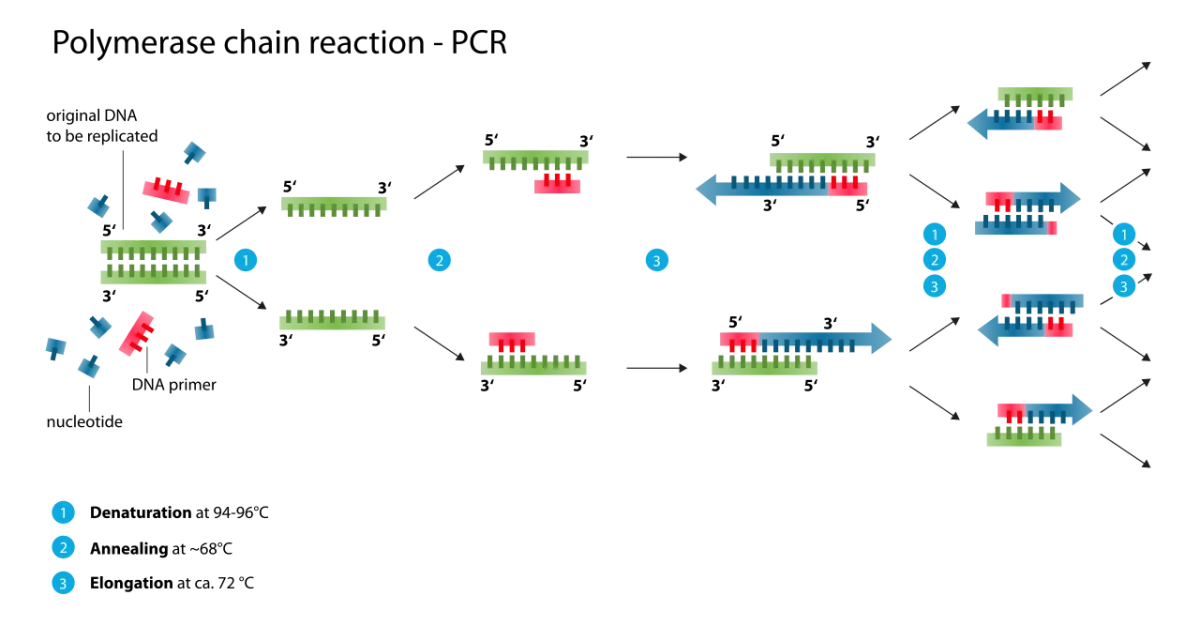
Repeat 25-35 times. One starting molecule becomes 2, then 4, then 8, and so on. After 30 cycles, you have approximately = about 1 billion copies.
Key Ingredients
- Template DNA: the starting material (one molecule is enough).
- Primers: two short (~20 nt) DNA oligonucleotides that flank the target region. One primer matches the top strand; the other, the bottom strand.
- dNTPs: the four nucleotide substrates (dATP, dTTP, dGTP, dCTP).
- Taq polymerase: a heat-stable DNA polymerase from the bacterium Thermus aquaticus. It survives 95°C without denaturing, so it does not have to be replaced each cycle.
- Buffer + Mg2+: enzymatic cofactors.
- Thermal cycler: machine that programs the temperature changes.
Specificity from Primers
PCR’s specificity comes from the primers. Only the region between the two primer binding sites is amplified. If you want to amplify exon 3 of a specific gene, you design primers that flank exon 3. Any other DNA in the sample is ignored because no primers bind there.
Variants
- RT-PCR (reverse transcription PCR): starts with RNA. A reverse transcriptase first converts RNA to complementary DNA (cDNA); then standard PCR amplifies the cDNA. Used to measure gene expression.
- qPCR (quantitative PCR): real-time PCR with a fluorescent probe that increases signal as amplification proceeds. Allows quantification of starting template. Used heavily in COVID testing.
- Multiplex PCR: multiple primer pairs in one reaction to amplify several targets simultaneously.
What are the three temperature steps of a single PCR cycle, and what happens at each?
Click to reveal answer
(1) Denaturation at ~95°C - heat separates the two DNA strands. (2) Annealing at ~55°C - primers hybridize to their complementary sequences. (3) Extension at ~72°C - Taq polymerase extends each primer in the 5' to 3' direction, doubling the target region. Repeat 25-35 times for exponential amplification.
Why is Taq polymerase essential for PCR?
Click to reveal answer
PCR repeatedly heats the reaction to 95°C to denature DNA. Most polymerases would irreversibly denature themselves at this temperature. Taq polymerase, isolated from the thermophilic bacterium Thermus aquaticus, is heat-stable and can survive repeated cycles at 95°C. This lets one dose of enzyme last through all 30+ cycles.
What determines which region of DNA is amplified by PCR?
Click to reveal answer
The two primers. Each primer is a short DNA oligonucleotide complementary to a specific sequence in the template. The region amplified is the stretch between where the two primers bind. Anything outside the primer binding sites is not efficiently amplified. Specificity of PCR comes entirely from primer design.