RNA is not just an intermediate between DNA and protein. There are multiple classes of RNA, each with a specific structural and functional role.
The central dogma, with the compartments
Information flow
1
Scroll sideways to see the whole map.
The three information-carrying molecules Cytoplasm Nucleus Where the exam sets its traps
The one arrow that runs backwardsReverse transcriptase makes DNA from RNA, which is how retroviruses such as HIV work and how a cDNA library is built. It is the reason the word dogma is a historical embarrassment rather than a law.
Why processing exists at allA eukaryotic transcript is not ready to use. The 5' cap protects it and helps the ribosome find it, the poly-A tail sets how long it survives, and splicing removes introns. Alternative splicing means one gene can produce several different proteins, which is how twenty thousand genes make far more than twenty thousand products.
Prokaryotes skip all of itNo nucleus means no separation, so a bacterial ribosome can start translating a transcript that is still being made. No cap, no tail, no introns, and polycistronic messages carrying several genes at once. Every difference follows from the missing membrane.
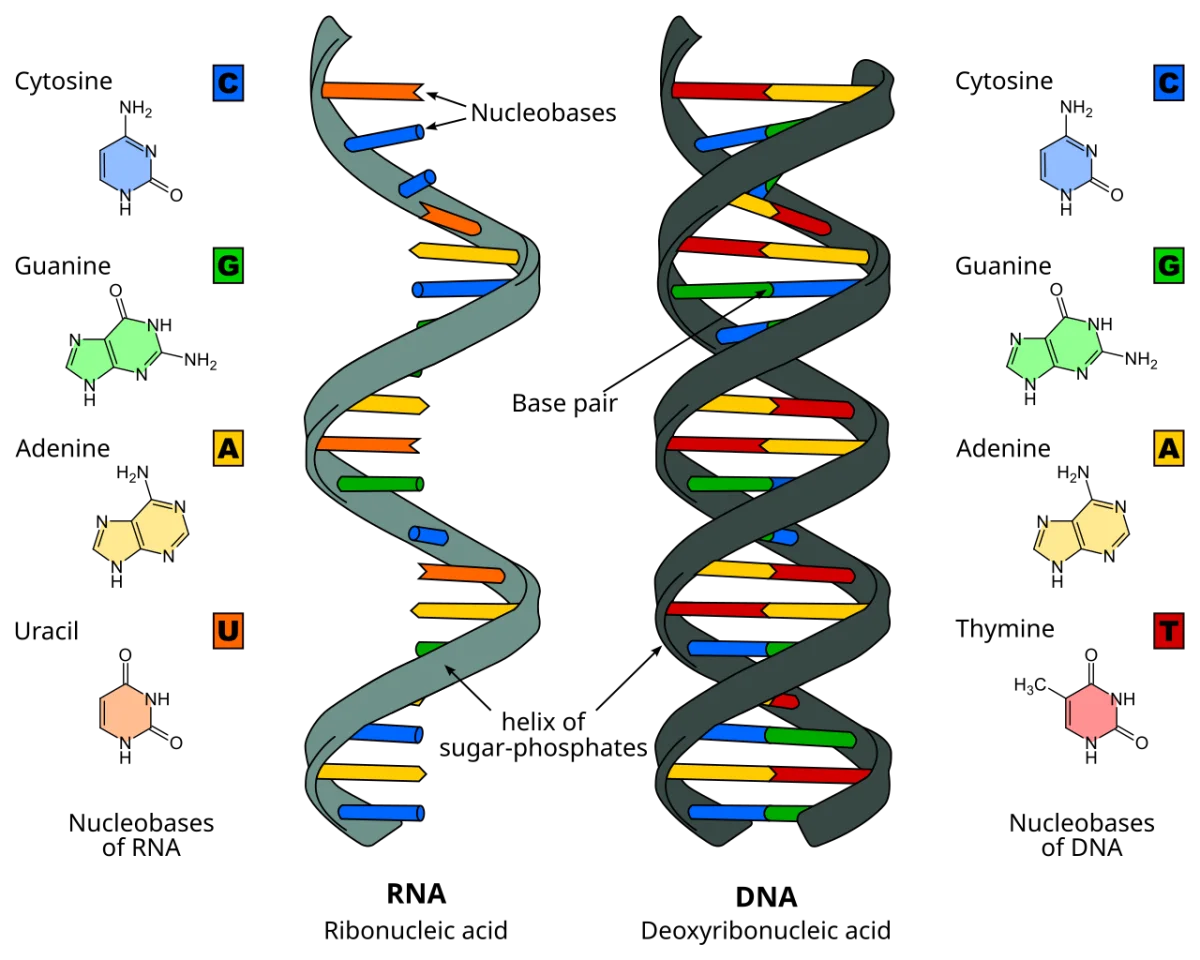
Information flows one way through three molecules, and the compartment tells you which organism you are in. If a question mentions splicing, a cap, or a tail, it is eukaryotic. If it mentions transcription and translation happening together, it is not.Key differences between DNA and RNA: ribose vs. deoxyribose sugar, uracil replaces thymine, and RNA is typically single-stranded. Credit: Wikimedia Commons, CC BY-SA
The Main Classes
| RNA type | Job | Length / notes |
|----------|-----|----------------|
| mRNA (messenger) | Encodes protein sequence | Variable, short-lived |
| tRNA (transfer) | Carries amino acids to the ribosome | ~75-90 nt, cloverleaf shape |
| rRNA (ribosomal) | Structural and catalytic part of the ribosome | Several sizes; most abundant RNA |
| snRNA (small nuclear) | Components of the spliceosome | ~100-300 nt |
| snoRNA (small nucleolar) | Guide chemical modifications of rRNA | ~60-300 nt |
| miRNA (microRNA) | Regulate gene expression by binding mRNA and silencing or degrading it | ~22 nt |
| siRNA (small interfering) | Similar to miRNA but typically exogenous | ~21-23 nt |
DNA vs. RNA at a Glance
Sugar: RNA has ribose (with 2’-OH). DNA has deoxyribose.
Bases: RNA uses uracil (U) instead of thymine (T). A, G, and C are the same.
Strand: RNA is usually single-stranded, although it can fold into complex secondary structures. DNA is almost always double-stranded.
Stability: RNA is less stable due to the 2’-OH. DNA is far more stable and therefore used for long-term storage.
Which three RNAs are the main participants in translation?
Click to reveal answer
mRNA, tRNA, and rRNA. mRNA carries the coding message. tRNA brings amino acids matching each codon. rRNA is a major structural and catalytic component of the ribosome (peptidyl transferase activity is in the 23S/28S rRNA).
What do miRNAs do?
Click to reveal answer
MicroRNAs are ~22 nt RNAs that bind complementary sequences in target mRNAs, typically in the 3’ UTR. The miRNA-RISC complex either inhibits translation or promotes degradation of the target. miRNAs are widespread regulators of gene expression and many are implicated in cancer and development.
Which sugar does RNA contain, and what key structural difference does that create vs. DNA?
Click to reveal answer
RNA contains ribose, which has a 2’-hydroxyl. DNA uses 2’-deoxyribose, which lacks the 2’-OH. The 2’-OH makes RNA more chemically reactive - it can attack the phosphodiester backbone intramolecularly - so RNA is far less stable than DNA.