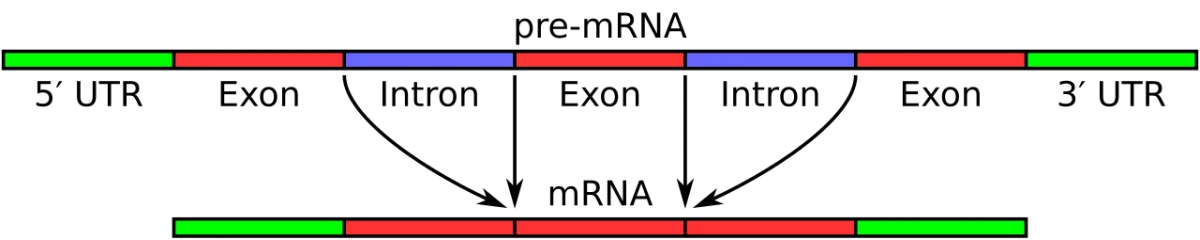
A eukaryotic pre-mRNA has to be processed before it can leave the nucleus and be translated. Three modifications happen, roughly in order: 5’ capping, splicing, and 3’ polyadenylation.
mRNA processing. A pre-mRNA gains a 5' cap, has introns removed by splicing, and gets a poly-A tail before being exported to the cytoplasm. Credit: Wikimedia Commons, CC BY-SA
5’ Cap
As soon as RNA Pol II makes the first ~25 nucleotides, a 7-methylguanosine cap is added to the 5’ end via a 5’-5’ triphosphate linkage. The cap:
Protects the 5’ end from exonucleases.
Serves as a recognition site for the ribosome during translation initiation (via cap-binding proteins).
Signals successful transcription initiation to the processing machinery.
3’ Poly-A Tail
Near the end of transcription, the AAUAAA polyadenylation signal is recognized. A cleavage factor cuts the RNA about 10-35 nucleotides downstream, and poly-A polymerase adds 100-250 A residues. The poly-A tail:
Protects the 3’ end from degradation.
Is required for efficient nuclear export.
Is progressively shortened during the mRNA’s life in the cytoplasm; when it becomes too short, the mRNA is degraded.
Splicing
Eukaryotic genes are split into coding exons and non-coding introns. Splicing removes introns and joins exons together. The machinery is the spliceosome, a large ribonucleoprotein complex made of snRNAs (U1, U2, U4, U5, U6) and associated proteins. Splicing recognizes conserved GU at the 5’ splice site and AG at the 3’ splice site.
Splicing proceeds in two transesterification steps:
A special adenosine within the intron (the branch point) attacks the 5’ splice site, forming a lariat.
The released 3’-OH of the upstream exon attacks the 3’ splice site, joining the two exons and releasing the intron lariat.
What three modifications convert a pre-mRNA into a mature eukaryotic mRNA?
Click to reveal answer
(1) Addition of a 5' cap (7-methylguanosine linked via 5'-5' triphosphate). (2) Splicing out of introns and joining of exons. (3) Cleavage near the AAUAAA signal and addition of a 100-250-nt poly-A tail at the 3' end. Together these modifications stabilize the mRNA, enable nuclear export, and prepare it for translation.
What is the spliceosome made of, and what does it do?
Click to reveal answer
The spliceosome is a large ribonucleoprotein complex made of five snRNAs (U1, U2, U4, U5, U6) and many associated proteins. It recognizes 5' (GU) and 3' (AG) splice sites and catalyzes two transesterification steps to remove each intron as a lariat and join the flanking exons.
Why is the poly-A tail important for mRNA stability?
Click to reveal answer
The poly-A tail is a buffer against 3' exonuclease degradation. Deadenylases progressively shorten the tail in the cytoplasm. When the tail becomes too short, the mRNA is rapidly degraded. Thus the poly-A tail sets the mRNA's half-life: longer initial tails and slower deadenylation produce a longer-lived mRNA.