The ribosome has two subunits. tRNAs carry amino acids. Aminoacyl-tRNA synthetases make sure each tRNA is charged with the correct amino acid. These three components, together with mRNA, do translation.
Ribosome Subunits
Cell type
Small subunit
Large subunit
Assembled
Bacterial
30S
50S
70S
Eukaryotic
40S
60S
80S
“S” is a Svedberg unit - a measure of how fast a particle sediments in a centrifuge. Svedberg units are not additive (hence 30S + 50S = 70S, not 80S - it is shape-dependent).
Each subunit contains rRNA and many ribosomal proteins. Bacterial ribosomes have 16S rRNA (small) and 23S + 5S rRNAs (large). Eukaryotic ribosomes have 18S (small) and 28S + 5.8S + 5S rRNAs (large).
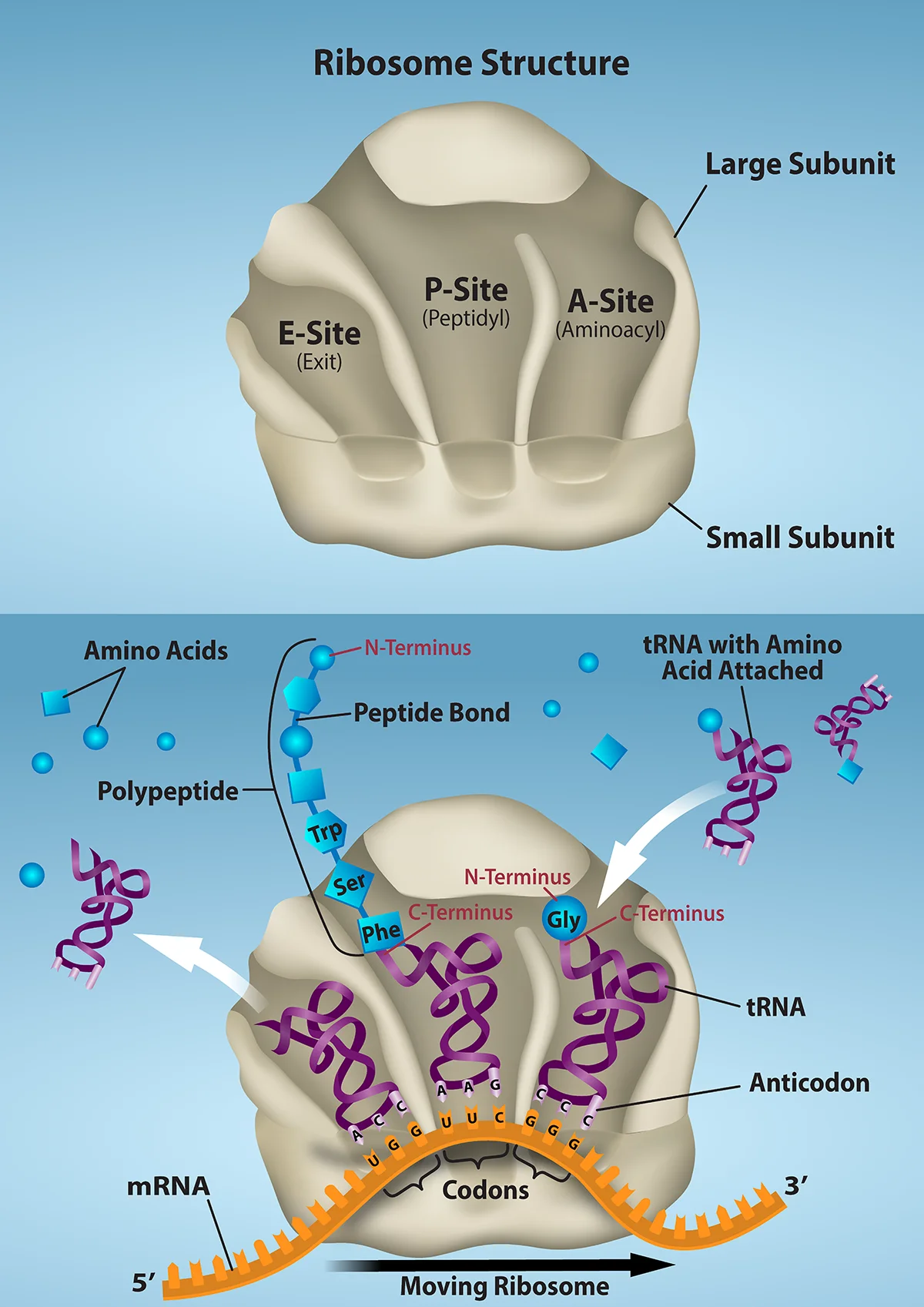
The three tRNA binding sites on the ribosome: A (aminoacyl), P (peptidyl), E (exit). tRNAs move A → P → E as the ribosome translocates. Credit: OpenStax Biology 2e, CC BY 4.0
tRNA Structure
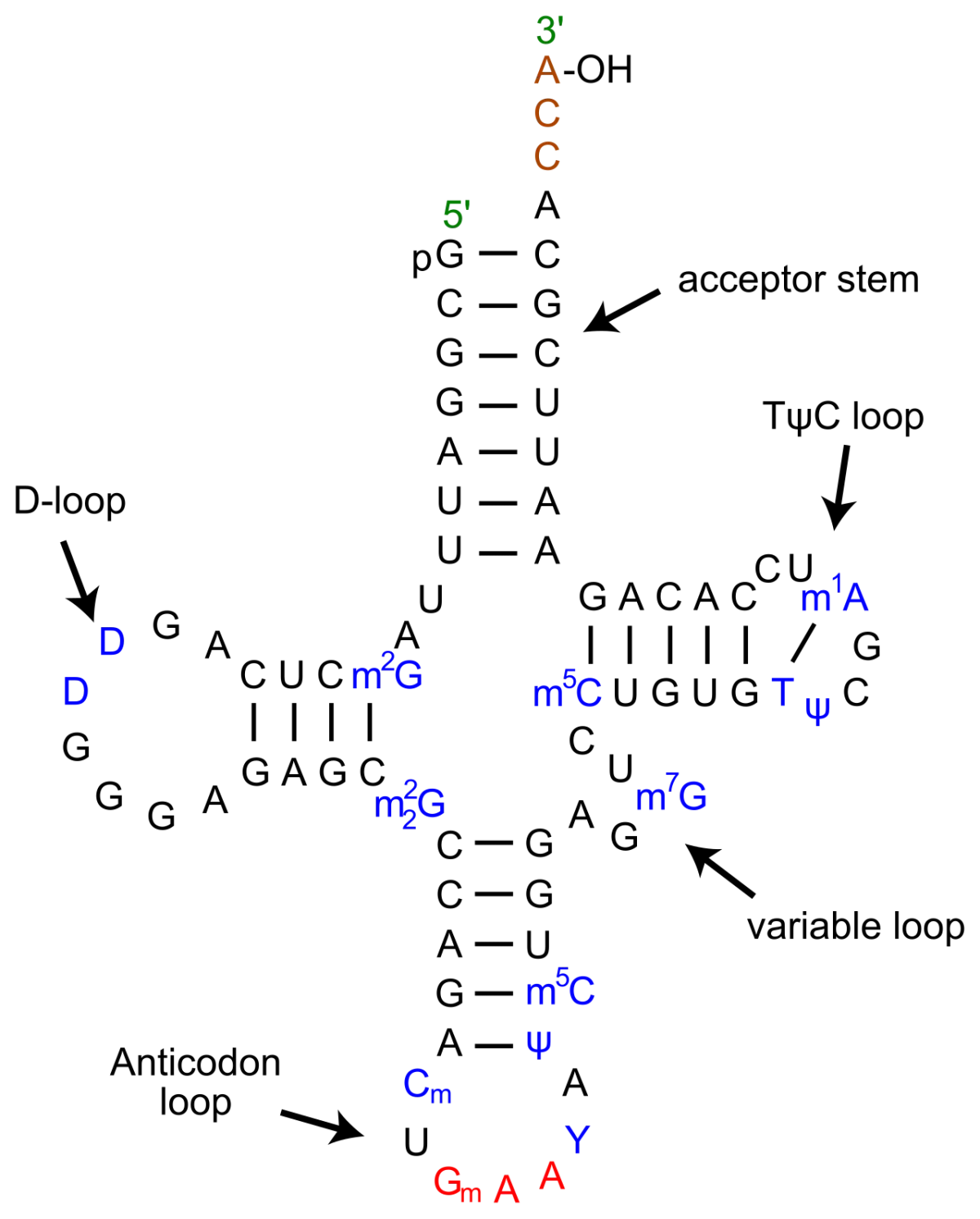
A tRNA is ~75-90 nucleotides long, folded into a cloverleaf in 2D and an L-shape in 3D. Key features:
Acceptor stem: at the 3’ end, always ending in CCA-3’. The amino acid is covalently attached to the 3’-OH of the final A.
Anticodon loop: contains the 3-nucleotide anticodon that base-pairs antiparallel with the mRNA codon.
Other loops: D-loop, T-loop, variable loop - structural and regulatory.
tRNA cloverleaf. The 3' acceptor stem ends in CCA where the amino acid is attached. The anticodon loop reads the mRNA codon. Credit: Wikimedia Commons, CC BY-SA
Aminoacyl-tRNA Synthetase - The “Second Genetic Code”
Each amino acid has its own aminoacyl-tRNA synthetase that attaches the correct amino acid to the correct tRNA. There are 20 synthetases, one per amino acid. The synthetase reads the tRNA’s structure and the amino acid’s structure, and uses ATP to catalyze the covalent attachment (aminoacyl-tRNA formation, costing 2 ATP equivalents).
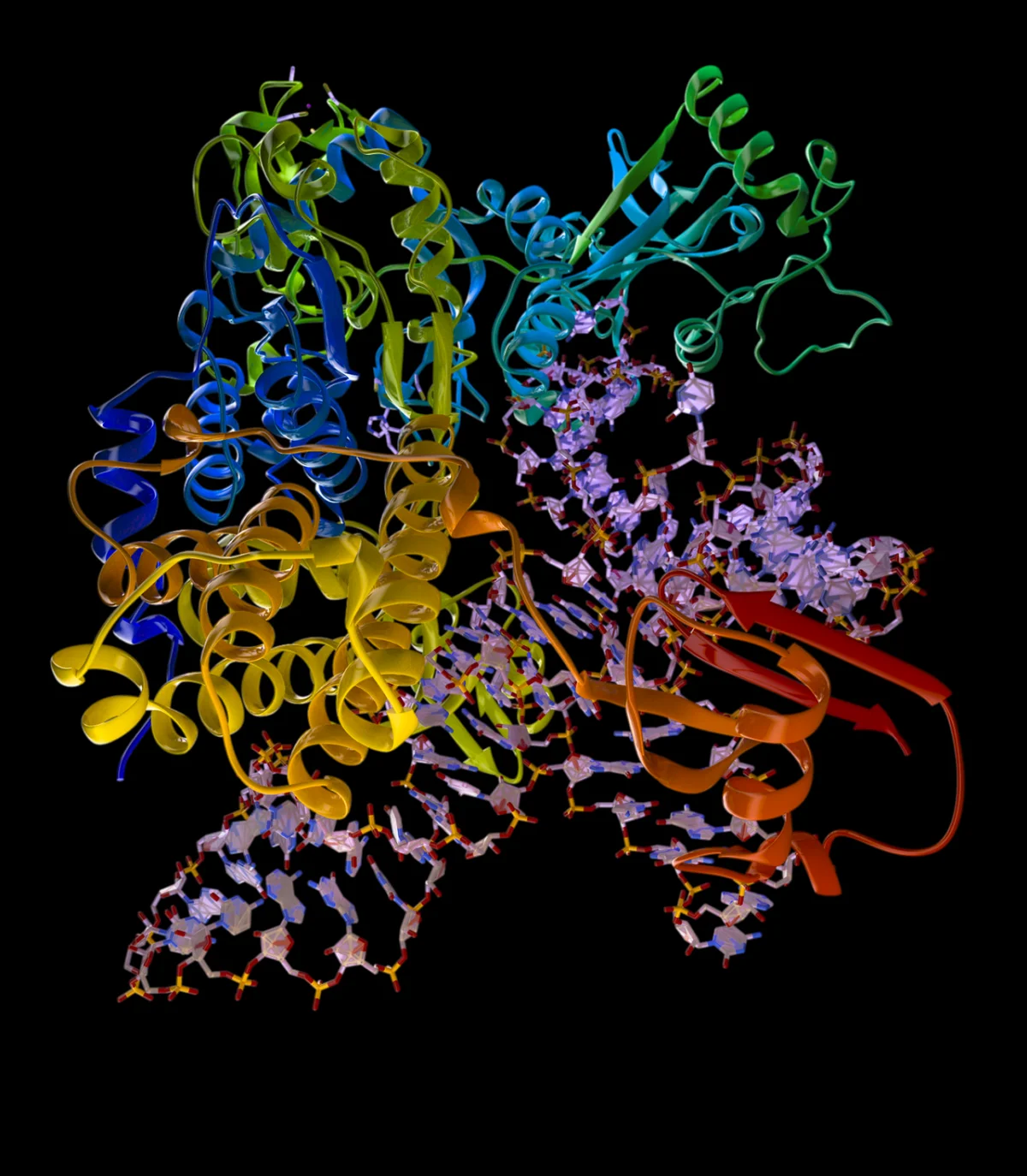
An aminoacyl-tRNA synthetase binding its cognate tRNA. The enzyme discriminates by reading structural features of both the tRNA and the amino acid, then catalyzes the covalent attachment of the amino acid to the 3'-CCA end of the tRNA. Credit: Wikimedia Commons, CC BY-SA
This charging step is the “second genetic code” - if the wrong amino acid is loaded onto a tRNA, the ribosome cannot detect the error and will insert the wrong amino acid. Some synthetases have proofreading activity to catch mischarging.
What is the Svedberg size of bacterial vs. eukaryotic ribosomes?
Click to reveal answer
Bacterial: 30S + 50S = 70S. Eukaryotic: 40S + 60S = 80S. Svedberg units are not additive (they depend on shape and mass). Bacterial mRNA typically uses the Shine-Dalgarno sequence; eukaryotic mRNA uses the Kozak sequence and cap-dependent scanning.
How many aminoacyl-tRNA synthetases does a cell need, and why?
Click to reveal answer
Twenty - one per amino acid. Each synthetase selects its amino acid and the correct tRNA, then covalently attaches the amino acid to the tRNA's 3'-CCA acceptor end. Because the ribosome cannot double-check the amino acid once attached, synthetase accuracy is critical - some have proofreading activity to reject wrong amino acids.
Where does the peptidyl transferase activity of the ribosome reside?
Click to reveal answer
In the large subunit's rRNA - specifically the 23S rRNA in bacteria (or 28S rRNA in eukaryotes). Peptide bond formation is catalyzed by RNA, not by ribosomal protein. This makes the ribosome a ribozyme (RNA-based enzyme) and supports the ancient RNA world hypothesis.