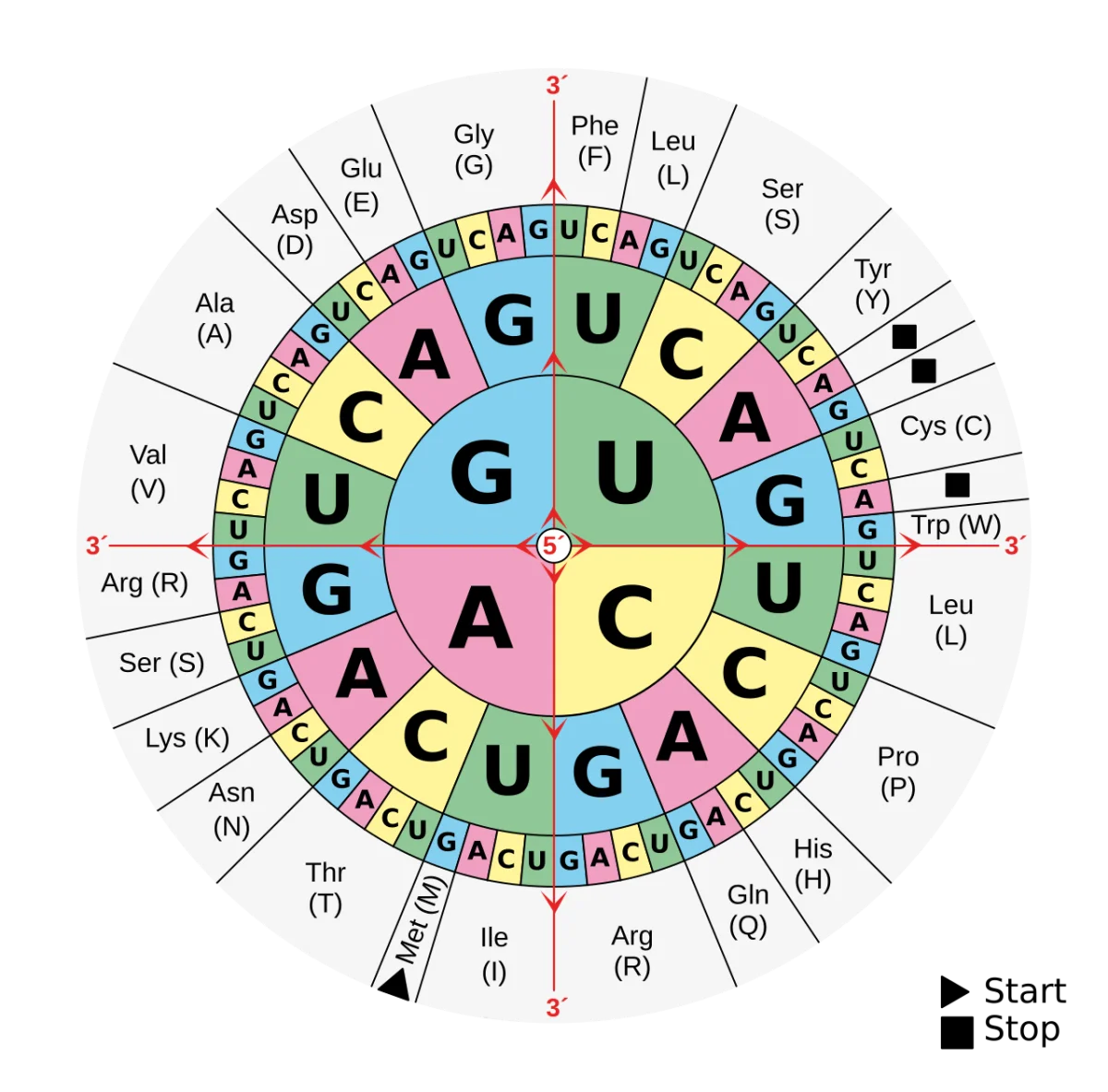
The genetic code maps 3-letter mRNA codons onto amino acids. With 4 bases and 3 positions, there are 43 = 64 possible codons. Since only 20 amino acids are encoded, most amino acids have multiple codons - the code is “degenerate.”
The standard genetic code. 64 codons encode 20 amino acids plus 3 stop codons. Most amino acids have multiple codons (degeneracy). Credit: Wikimedia Commons, CC BY-SA
Key Features
Triplet code: each amino acid is specified by 3 consecutive mRNA nucleotides.
Non-overlapping: codons are read one after another without sharing nucleotides.
Unambiguous: each codon specifies only one amino acid.
Degenerate: most amino acids are encoded by multiple codons. Only methionine (AUG) and tryptophan (UGG) have single codons.
Universal: the code is nearly identical across all organisms. A few exceptions exist in mitochondria and some protists.
Start and Stop Codons
AUG is the start codon. It codes for methionine. Translation begins with a specific initiator methionine (formyl-methionine in bacteria).
UAA, UAG, UGA are the three stop codons. They do not code for any amino acid; instead, release factors recognize them and terminate translation.
Wobble
Francis Crick proposed the wobble hypothesis in 1966. The third position of a codon (and the first position of the corresponding anticodon on tRNA) has relaxed base pairing. Non-standard pairings (G with U, inosine with A/U/C) are allowed.
Wobble lets one tRNA recognize multiple codons, reducing the number of tRNAs needed. It also makes the code more robust - mutations in the third codon position often produce silent mutations (same amino acid).
Mutation Types from the Code
Mutation
Effect
Silent
Same amino acid (often a wobble-position change)
Missense
Different amino acid
Nonsense
Creates a premature stop codon → truncated protein
Frameshift
Insertion or deletion of bases (not multiples of 3); shifts the reading frame
Frameshift mutations typically destroy the protein entirely because every downstream codon is misread and usually a premature stop arises quickly.
Which two amino acids are encoded by a single codon each, and what are those codons?
Click to reveal answer
Methionine (AUG) and tryptophan (UGG). All other amino acids have two or more codons. Because AUG is also the start codon, every protein starts with methionine (though it is often cleaved off after translation).
What are the three stop codons?
Click to reveal answer
UAA, UAG, UGA. They do not code for any amino acid. When a ribosome reads one, release factors bind instead of a tRNA, and the completed polypeptide is released. The mnemonic "U Go Away, U Are Away, U Are Gone" captures them all.
What is the wobble position, and why does it matter for the genetic code?
Click to reveal answer
The third position of a codon (and the first position of the anticodon) has relaxed base pairing - G can pair with U, inosine can pair with A/U/C, etc. Wobble lets a single tRNA recognize multiple codons, reducing the tRNA requirement. It also makes the code robust to point mutations: about 25% of random single-base changes in a coding region are silent because they fall at the wobble position.