Most reactions you have seen so far are irreversible - they go in one direction, run out of limiting reagent, and stop. But many reactions are reversible: the products can react to re-form the reactants. When a reversible reaction is placed in a closed system, something remarkable happens.
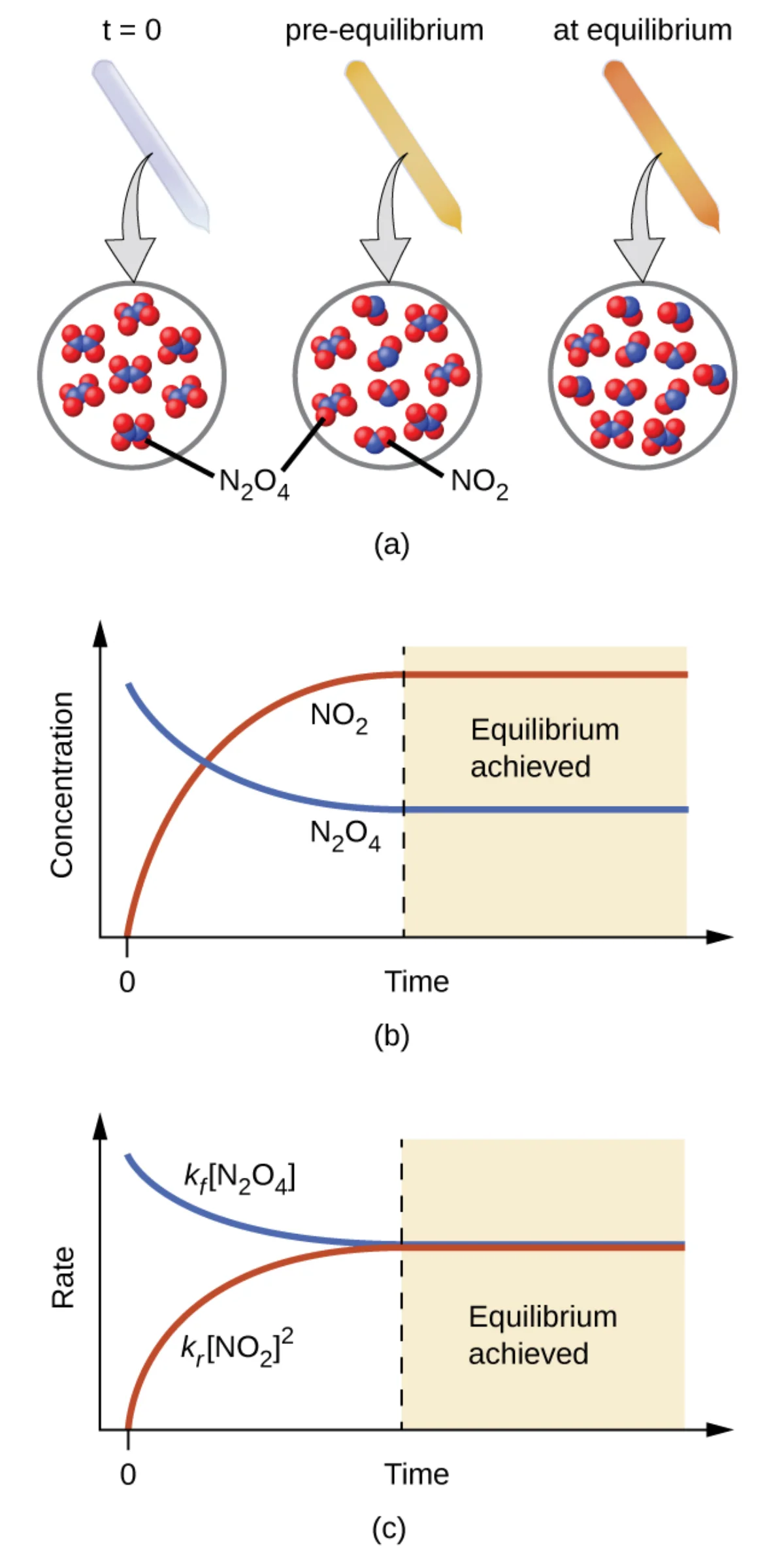
At first, the forward reaction dominates because reactants are abundant and products are scarce. As products accumulate, the reverse reaction speeds up. Eventually, the rate of the forward reaction equals the rate of the reverse reaction. Concentrations stop changing. The system has reached equilibrium.
The N₂O₄/NO₂ system approaching equilibrium. (a) Molecular view at three time points showing N₂O₄ decomposing into brown NO₂. (b) Concentration vs. time: both species level off at equilibrium. (c) Rate vs. time: forward and reverse rates converge to the same value. Credit: OpenStax Chemistry 2e, CC BY 4.0
Dynamic vs. Static Equilibrium
This is the single most important distinction in this chapter. Dynamic equilibrium means both reactions are still happening - molecules are still converting back and forth. It is not that everything stopped. A static equilibrium would mean nothing is happening at all, like a book sitting on a table.
At dynamic equilibrium:
The forward reaction rate equals the reverse reaction rate
Concentrations of all species remain constant (but not necessarily equal)
The system is at its minimum Gibbs free energy and maximum entropy
No net change is observable, even though molecular-level reactions continue
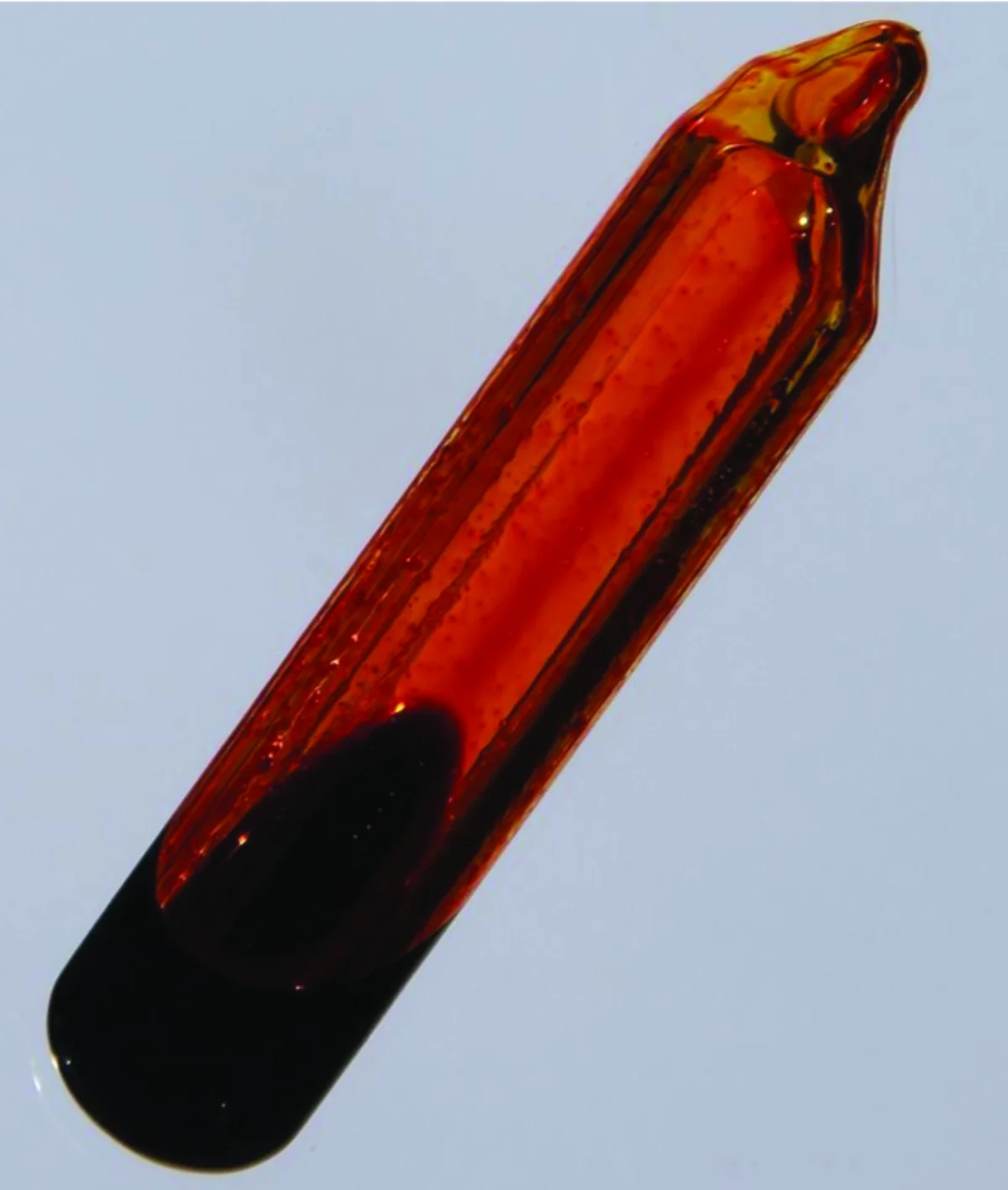
A sealed tube of bromine at equilibrium. The dark liquid bromine at the bottom is in dynamic equilibrium with the reddish-brown bromine vapor above. Molecules are constantly evaporating and condensing, but the amounts of liquid and vapor remain constant. Credit: OpenStax Chemistry 2e, CC BY 4.0
Recognizing Reversible Reactions
Reversible reactions are written with a double arrow (⇌) instead of a single arrow. For example:
N₂(g) + 3 H₂(g) ⇌ 2 NH₃(g)
This tells you that nitrogen and hydrogen can combine to form ammonia (forward), AND ammonia can decompose back into nitrogen and hydrogen (reverse). In a closed container, both processes happen simultaneously.
What Determines the Position of Equilibrium?
The “position” of equilibrium refers to the relative amounts of products and reactants at equilibrium. Two factors determine this position:
The nature of the reaction itself - encoded in the equilibrium constant K
Temperature - the only external factor that changes the value of K
Changing concentration or pressure can shift the system temporarily, but these changes do not alter K. Only temperature does. We will return to this critical point in section 6.8.
At equilibrium, the concentrations of products and reactants are equal. True or false?
Click to reveal answer
False. At equilibrium, the RATES of the forward and reverse reactions are equal. The concentrations are constant but are almost never equal to each other. The ratio of products to reactants at equilibrium is determined by K.
What is the difference between dynamic equilibrium and static equilibrium?
Click to reveal answer
Dynamic equilibrium: Forward and reverse reactions are both occurring, but at equal rates, so no net change is observed. Static equilibrium: Nothing is happening at all - no reactions in either direction. Chemical equilibrium is always dynamic.
Now that you understand what equilibrium looks like, let’s put a number on it. The equilibrium constant tells you exactly where the balance point lies - does this reaction barely make any products, or does it essentially go to completion?
The answer comes from the law of mass action. For a generic reversible reaction:
aA + bB ⇌ cC + dD
This ratio is constant at a given temperature. It does not matter how much of each substance you start with - once the system reaches equilibrium, this ratio always equals K.
Where Does Keq Come From?
The law of mass action connects equilibrium to kinetics. Consider a one-step reversible reaction:
2A ⇌ B + C
The forward rate is ratef=kf[A]2 and the reverse rate is rater=kr[B][C]. At equilibrium, these rates are equal:
kf[A]2=kr[B][C]
Rearranging gives:
Keq=krkf=[A]2[B][C]
The equilibrium constant is simply the ratio of the forward and reverse rate constants. A large Keq means kf >> kr, so the forward reaction is much faster and products are heavily favored.
What Goes in the Expression?
Not every species appears in the equilibrium expression:
Species
Include in K?
Why
Aqueous solutes (aq)
Yes
Concentration can vary
Gases (g)
Yes
Partial pressure or concentration can vary
Pure solids (s)
No
Activity = 1 by definition
Pure liquids (l)
No
Activity = 1 by definition
Interpreting the Size of K
The value of K tells you which side the equilibrium favors:
K value
Meaning
Equilibrium position
K >> 1 (e.g., 106)
Products strongly favored
Far to the right
K ≈ 1
Neither side strongly favored
Roughly balanced
K << 1 (e.g., 10−8)
Reactants strongly favored
Far to the left
Properties of K to Memorize
Reverse the reaction - the new K is 1/Koriginal
Multiply the reaction by a factor n - the new K is (Koriginal)^n
Add two reactions - the new K is K₁ × K₂
K is temperature-dependent - changing T is the ONLY way to change K
K has no units on the MCAT - it is technically based on activities, which are dimensionless
Write the equilibrium expression for: CaCO₃(s) ⇌ CaO(s) + CO₂(g)
Click to reveal answer
Keq = [CO₂] (or Kp = PCO₂). CaCO₃ and CaO are pure solids, so they do not appear in the expression. Only the gaseous CO₂ remains.
If the equilibrium constant for A ⇌ B is K = 100, what is the equilibrium constant for 2B ⇌ 2A?
Click to reveal answer
K=1/1002=1/10,000=10−4. Reversing the reaction gives 1/K = 1001. Multiplying by 2 raises it to the second power: (1/100)2=10−4.
There are two ways to express the equilibrium constant, and the MCAT expects you to know both. The difference is simply what you plug into the expression - concentrations or partial pressures.
Kc uses molar concentrations (mol/L) for all species. This is the version you have already seen.
Kp uses partial pressures (atm) for gaseous species. It is used when the problem gives you pressures instead of concentrations.
Both describe the same equilibrium. They just speak different “languages.”
When to Use Each
Use Kc when the problem gives concentrations in mol/L
Use Kp when the problem gives partial pressures in atm
For dilute aqueous solutions, Kc = Keq (they are interchangeable)
Example: Writing Kc and Kp
For the Haber process: N₂(g) + 3H₂(g) ⇌ 2NH₃(g)
Kc = [NH₃]² / ([N₂][H₂]³)
Kp = (PNH₃)² / (PN₂ × (PH₂)³)
Same structure, different units plugged in.
The Formula Connecting Kc and Kp
Key Insight: When Kp = Kc
When delta-n = 0 (the number of moles of gas is the same on both sides), then (RT)⁰ = 1, so Kp = Kc.
Example: H₂(g) + I₂(g) ⇌ 2HI(g)
delta-n = 2 - (1 + 1) = 0, so Kp = Kc for this reaction.
Worked Example
For N₂(g) + 3H₂(g) ⇌ 2NH₃(g), if Kc = 0.50 at 400°C, find Kp.
Step 1: Calculate delta-n = 2 - (1 + 3) = -2
Step 2: Convert temperature: T = 400 + 273 = 673 K
Because delta-n is negative (fewer moles of gas on the product side), Kp < Kc for this reaction.
For the reaction 2SO₂(g) + O₂(g) ⇌ 2SO₃(g), what is delta-n?
Click to reveal answer
delta-n = -1. Moles of gaseous products = 2 (SO₃). Moles of gaseous reactants = 2 + 1 = 3. delta-n = 2 - 3 = -1. Because delta-n is negative, Kp < Kc for this reaction.
When does Kp exactly equal Kc?
Click to reveal answer
When delta-n = 0 - that is, when the total moles of gaseous products equals the total moles of gaseous reactants. Example: H₂(g) + I₂(g) ⇌ 2HI(g) has delta-n = 0.
You know K tells you where equilibrium IS. But what if you are not at equilibrium yet? How do you figure out which way the reaction needs to go? That is the job of Q, the reaction quotient.
Calculating Q
Q has the exact same mathematical form as K:
The critical difference: K uses equilibrium concentrations (which are constant). Q uses current concentrations (which may or may not be at equilibrium).
Comparing Q to K
Comparison
What it means
Direction of shift
Sign of delta-G
Q < K
Too many reactants, not enough products
Forward (toward products)
Negative (spontaneous forward)
Q = K
At equilibrium
No shift
Zero
Q > K
Too many products, not enough reactants
Reverse (toward reactants)
Positive (spontaneous in reverse)
The Connection to Gibbs Free Energy
The relationship between Q, K, and delta-G is one of the most important connections on the MCAT:
When Q < K: delta-G < 0 (forward reaction is spontaneous)
When Q = K: delta-G = 0 (system is at equilibrium)
When Q > K: delta-G > 0 (reverse reaction is spontaneous)
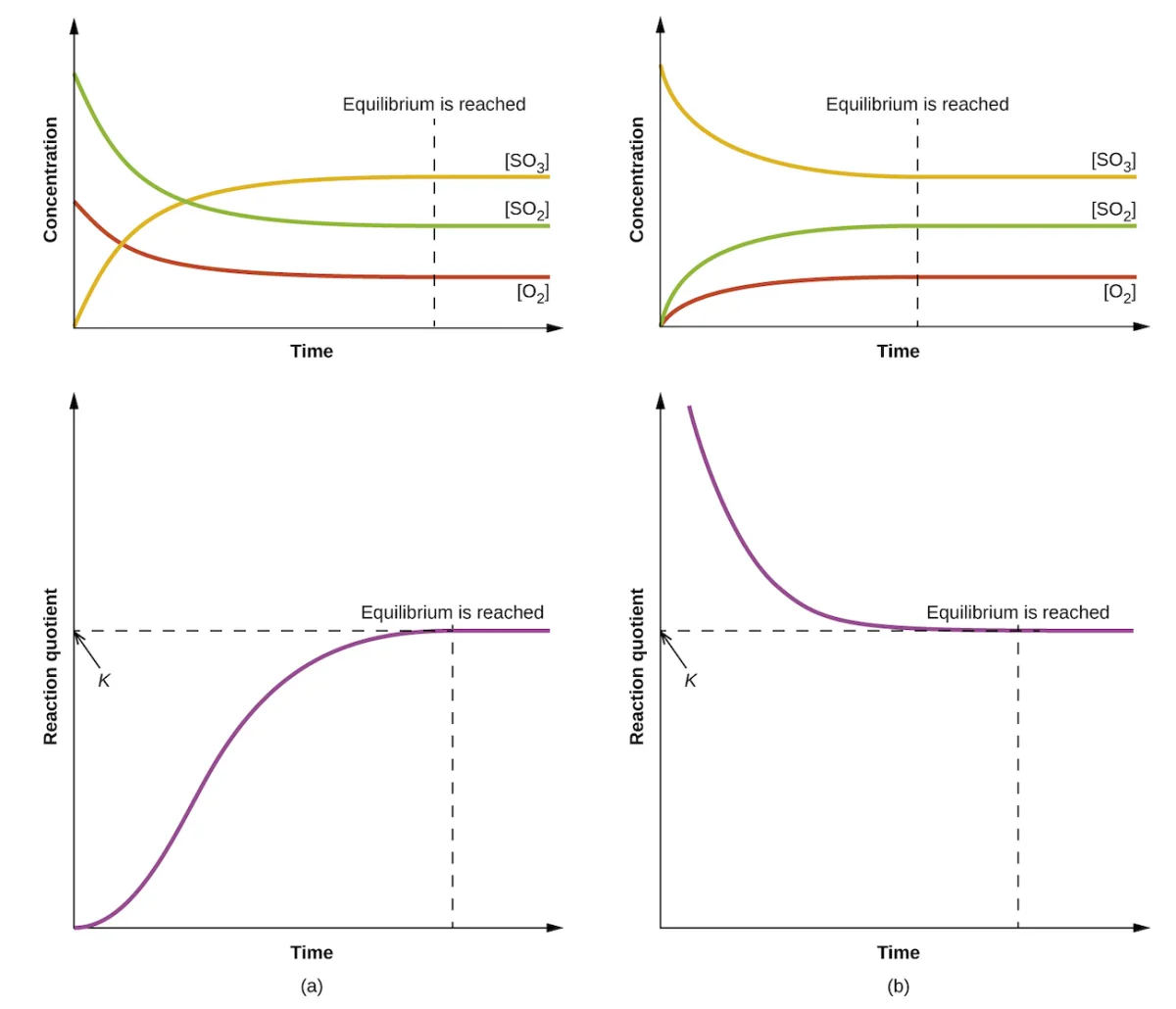
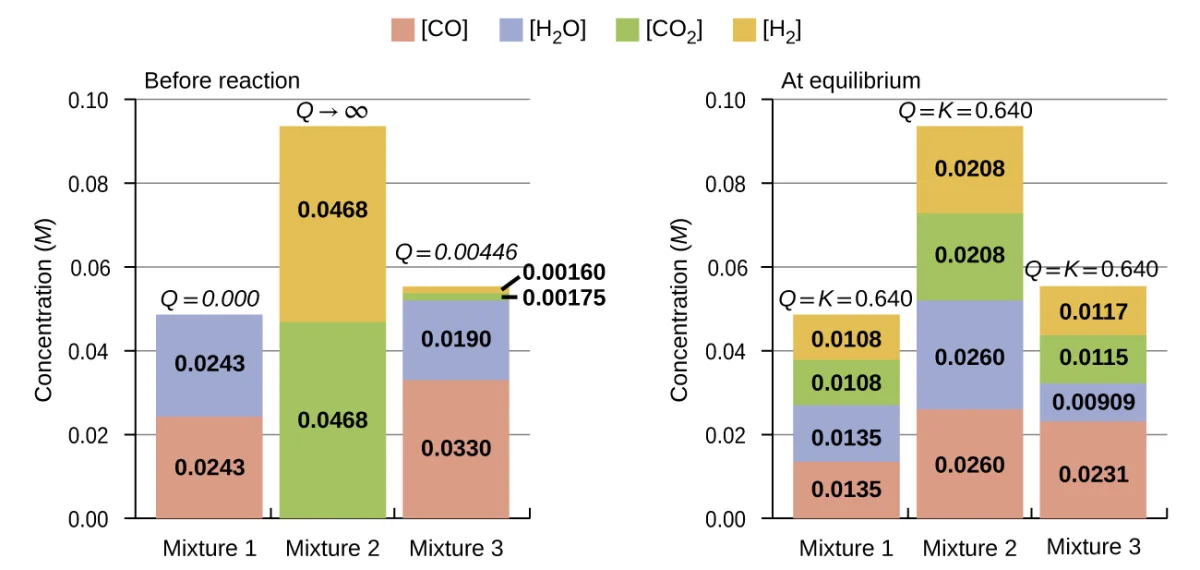
Q approaches K from both directions. (a) Starting with mostly reactants (Q < K): concentrations shift right until Q = K. (b) Starting with mostly products (Q > K): concentrations shift left until Q = K. Regardless of starting conditions, the system reaches the same equilibrium. Credit: OpenStax Chemistry 2e, CC BY 4.0Three mixtures with different starting compositions (Q = 0, Q approaching infinity, Q = 0.00446) all reach the same equilibrium (Q = K = 0.640). The equilibrium position depends only on K, not on where you start. Credit: OpenStax Chemistry 2e, CC BY 4.0
Worked Example
Consider the reaction: CO(g) + H₂O(g) ⇌ CO₂(g) + H₂(g), with K = 1.0 at a certain temperature.
If the current concentrations are [CO] = 0.1 M, [H₂O] = 0.1 M, [CO₂] = 0.5 M, [H₂] = 0.5 M, which way will the reaction shift?
Step 3: Since Q > K, there are too many products. The reaction shifts to the left (reverse direction) until Q decreases to equal K.
If Q < K for a reaction, what is the sign of delta-G and in which direction does the reaction proceed?
Click to reveal answer
delta-G is negative (the forward reaction is spontaneous). The reaction proceeds in the forward direction (toward products) until Q increases to equal K.
A reaction has K = 4.0. If [products]/[reactants] currently gives Q = 4.0, what happens?
Click to reveal answer
Nothing - the system is at equilibrium. Q = K means delta-G = 0 and there is no net shift in either direction. Both forward and reverse reactions continue at equal rates.
You now know how to calculate K and Q, and how to predict which direction a reaction shifts. Le Chatelier’s principle is the conceptual framework that ties it all together - and it is tested on virtually every MCAT.
The Principle
Le Chatelier’s principle states: if a stress is applied to a system at equilibrium, the system will shift in the direction that partially relieves that stress.
The key word is “partially.” The system never completely undoes the change - it just moves toward a new equilibrium that partially offsets whatever you did.
Three Types of Stress
Le Chatelier’s principle applies to three types of changes:
Changes in concentration (adding or removing a reactant or product)
Changes in pressure or volume (for gas-phase reactions)
Changes in temperature (the only one that changes K)
Each of the next three sections covers one of these in depth. Here is the summary table:
Stress applied
Equilibrium shifts…
Does K change?
Add reactant
Toward products (right)
No
Remove reactant
Toward reactants (left)
No
Add product
Toward reactants (left)
No
Remove product
Toward products (right)
No
Increase pressure (decrease volume)
Toward side with fewer moles of gas
No
Decrease pressure (increase volume)
Toward side with more moles of gas
No
Increase temperature
Toward endothermic direction
Yes
Decrease temperature
Toward exothermic direction
Yes
Add catalyst
No shift
No
Add inert gas at constant volume
No shift
No
How to Think About It Using Q
Le Chatelier’s principle is really just Q vs. K logic in disguise:
Add reactant - the denominator of Q gets bigger, so Q decreases below K. Since Q < K, the reaction shifts forward.
Remove product - the numerator of Q gets smaller, so Q decreases below K. Since Q < K, the reaction shifts forward.
Add product - the numerator gets bigger, Q > K, so the reaction shifts backward.
Every Le Chatelier prediction can be confirmed by checking what happens to Q relative to K.
A system at equilibrium is stressed by adding more of one reactant. In which direction does the equilibrium shift, and does K change?
Click to reveal answer
The equilibrium shifts toward products (right). Adding reactant increases the denominator of Q, making Q < K. The forward reaction speeds up to consume the excess reactant. K does NOT change - only temperature changes K.
Does adding a catalyst shift the equilibrium position?
Click to reveal answer
No. A catalyst speeds up BOTH the forward and reverse reactions equally. It helps the system reach equilibrium faster, but it does not change the equilibrium position or the value of K.
Concentration changes are the most intuitive application of Le Chatelier’s principle. The rule is simple: the system shifts away from whatever you added and toward whatever you removed.
Adding a Reactant or Removing a Product
Both of these push the reaction forward (to the right). Here is why:
Adding reactant increases the denominator of Q, so Q drops below K. The system responds by consuming the extra reactant - converting it into products - until Q climbs back up to equal K.
Removing product decreases the numerator of Q, so Q drops below K. The system responds by making more product to replace what was lost.
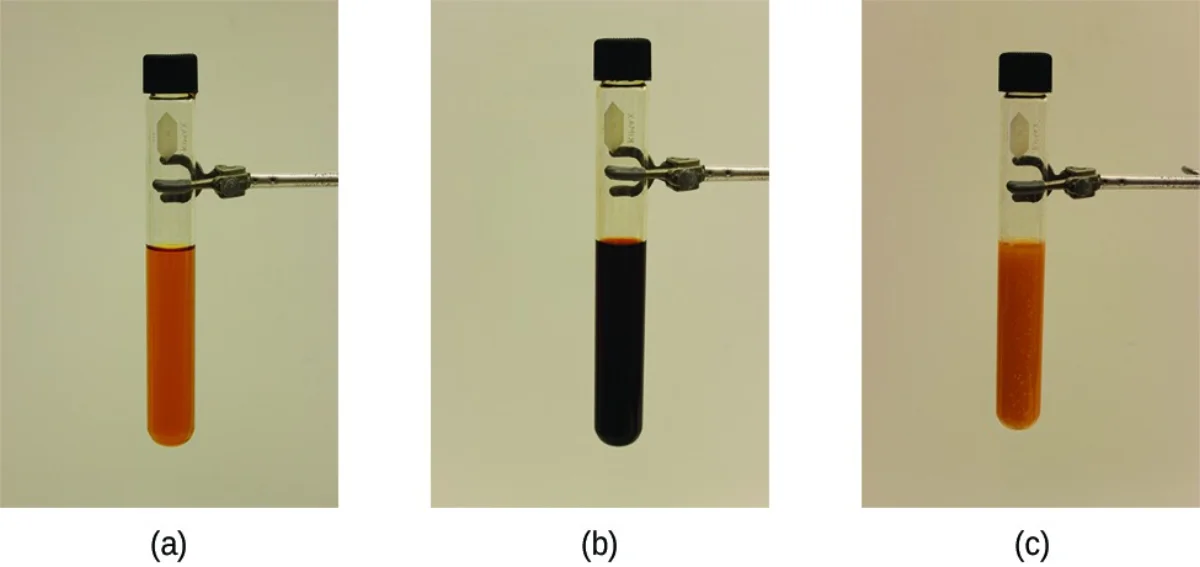
The iron thiocyanate equilibrium (Fe³+ + SCN- ⇌ FeSCN²+) demonstrates Le Chatelier's principle visually. (a) Equilibrium reference. (b) Adding more SCN- shifts right, producing more dark-red FeSCN²+. (c) Removing SCN- shifts left, lightening the color. Credit: Lumen Learning / OpenStax Chemistry 2e, CC BY 4.0
Adding a Product or Removing a Reactant
Both of these push the reaction backward (to the left).
Adding product increases the numerator of Q, so Q rises above K. The system responds by converting the excess product back into reactants.
Removing reactant decreases the denominator of Q, so Q rises above K. The system shifts left to replenish the lost reactant.
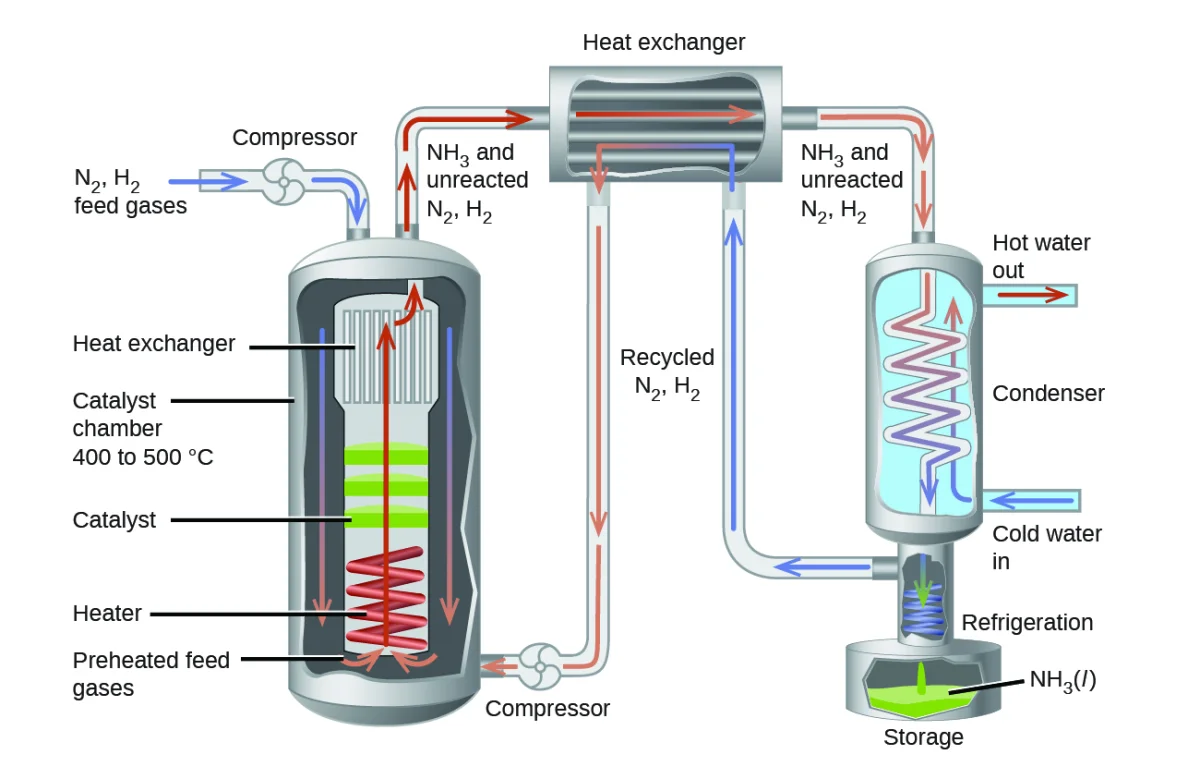
The Haber process for industrial ammonia production. Unreacted N₂ and H₂ are recycled, and NH₃ is continuously removed by condensation. Removing the product keeps Q below K, driving the equilibrium toward more ammonia production. Credit: OpenStax Chemistry 2e, CC BY 4.0
Important Exception: Pure Solids and Liquids
Adding or removing a pure solid or pure liquid does NOT shift equilibrium. Since these species do not appear in the equilibrium expression (their activity = 1), their amounts cannot change Q.
Example: CaCO₃(s) ⇌ CaO(s) + CO₂(g), K = [CO₂]
Adding more CaCO₃ does NOT shift the equilibrium because CaCO₃ is a solid and is not in the K expression. The equilibrium CO₂ pressure remains the same.
What Happens to Concentrations After the Shift?
A common misconception: if you add more reactant A and the equilibrium shifts right, does [A] end up higher, lower, or the same as before?
[A] ends up higher than the original equilibrium, but lower than right after you added it. The system partially consumes the added A, but it cannot completely remove it. The new equilibrium has higher [A] and higher [products] than the original equilibrium.
For the reaction AgCl(s) ⇌ Ag+(aq) + Cl-(aq), will adding more solid AgCl shift the equilibrium?
Click to reveal answer
No. AgCl is a pure solid and does not appear in the equilibrium expression (K = [Ag+][Cl-]). Adding more solid does not change Q, so there is no shift. The ion concentrations remain the same.
In the reaction N₂(g) + 3H₂(g) ⇌ 2NH₃(g), what happens if NH₃ is continuously removed from the reaction vessel?
Click to reveal answer
The equilibrium continuously shifts to the right (toward products). Removing NH₃ keeps Q below K, so the forward reaction is always favored. This is the principle behind industrial ammonia production - removing the product drives the reaction forward.
Pressure and volume changes only matter for reactions involving gases. Liquids and solids are essentially incompressible, so changing the pressure of the container has no effect on their concentrations.
The Core Rule
When pressure increases (or volume decreases), the system shifts toward the side with fewer moles of gas. When pressure decreases (or volume increases), the system shifts toward the side with more moles of gas.
Why? The system is trying to relieve the stress. If you squeeze the container (increase pressure), the system responds by reducing the total number of gas molecules - which reduces the pressure.
Example: The Haber Process
N₂(g) + 3H₂(g) ⇌ 2NH₃(g)
Reactant side: 1 + 3 = 4 moles of gas
Product side: 2 moles of gas
Increase pressure: Shifts right (toward 2 moles, fewer gas molecules)
Decrease pressure: Shifts left (toward 4 moles, more gas molecules)
This is why the Haber process uses high pressure (200 atm) - it pushes the equilibrium toward ammonia production.
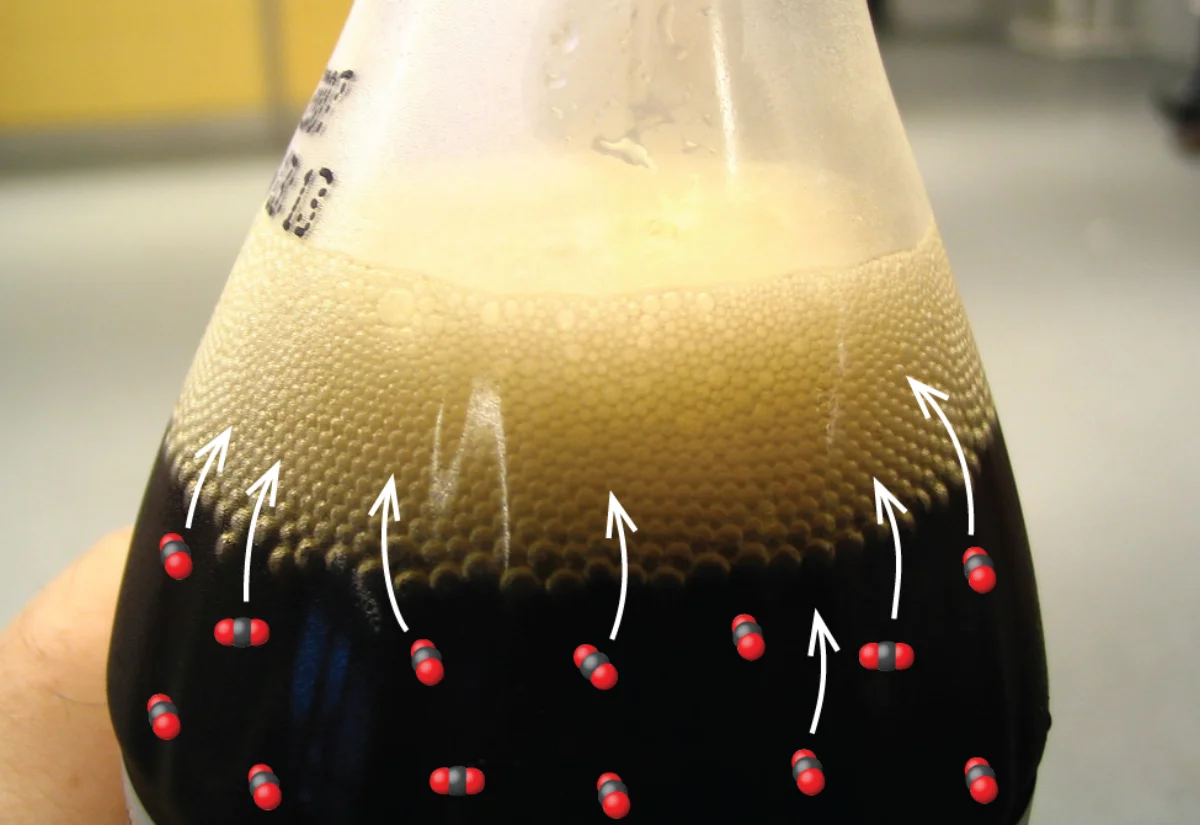
When you open a bottle of soda, the pressure drops and dissolved CO₂ escapes as bubbles. This is Le Chatelier's principle in action: decreasing the pressure above the liquid shifts the equilibrium CO₂(aq) ⇌ CO₂(g) toward the gas phase (the side with more volume). Credit: OpenStax Chemistry 2e, CC BY 4.0
When Moles of Gas Are Equal
If delta-n = 0 (same number of gas moles on both sides), pressure changes have no effect on the equilibrium.
Example: H₂(g) + I₂(g) ⇌ 2HI(g) has 2 moles of gas on each side. Changing pressure does not shift this equilibrium.
This distinction - inert gas at constant volume vs. constant pressure - is a classic MCAT trap question. Remember: partial pressures determine Q, not total pressure.
Why Does This Work? The Q Explanation
When you decrease the volume of a container, all gas concentrations increase (same moles, smaller volume). But they do not all increase equally in the Q expression - the side with more moles of gas gets “raised to higher powers” in the expression. This changes Q in a predictable direction:
If more moles of gas are in the numerator (products), Q increases above K, so the reaction shifts left
If more moles of gas are in the denominator (reactants), Q decreases below K, so the reaction shifts right
The net result: the shift always goes toward the side with fewer moles of gas.
For 2SO₂(g) + O₂(g) ⇌ 2SO₃(g), what happens if the volume of the container is halved?
Click to reveal answer
Equilibrium shifts to the right (toward SO₃). Halving the volume doubles the pressure. Reactant side has 3 moles of gas (2 + 1), product side has 2 moles. The system shifts toward the side with fewer moles of gas (products) to reduce pressure.
Argon gas is added to a sealed rigid container holding N₂O₄(g) ⇌ 2NO₂(g) at equilibrium. Does the equilibrium shift?
Click to reveal answer
No shift occurs. Adding an inert gas at constant volume increases total pressure but does NOT change the partial pressures of N₂O₄ or NO₂. Since Q depends on partial pressures, Q is unchanged and equals K. No shift.
Temperature changes are fundamentally different from concentration and pressure changes. Changing concentration or pressure shifts the equilibrium, but K stays the same. Changing temperature actually changes the value of K itself.
This is the single most important fact in this section: temperature is the ONLY factor that changes K.
The Heat-as-a-Species Trick
The easiest way to predict the effect of temperature is to treat heat as if it were a chemical species:
Exothermic reaction (delta-H < 0): heat is a “product”
A + B ⇌ C + D + heat
Endothermic reaction (delta-H > 0): heat is a “reactant”
heat + A + B ⇌ C + D
Now apply Le Chatelier’s principle as if heat were a concentration:
Summary Table
Reaction type
Increase T
Decrease T
Exothermic (delta-H < 0)
Shifts LEFT, K decreases
Shifts RIGHT, K increases
Endothermic (delta-H > 0)
Shifts RIGHT, K increases
Shifts LEFT, K decreases
Why K Changes (Unlike With Concentration/Pressure)
When you change concentration, Q changes but K stays fixed - the system shifts to bring Q back to K. But when you change temperature, K itself changes to a new value. The system then shifts so that the current Q moves toward this NEW K.
This happens because K depends on the rate constants kf and kr (recall K = kf/kr). Temperature changes both rate constants according to the Arrhenius equation, but it changes them by different amounts depending on the activation energies. The net result is that K itself changes.
Increasing temperature: Shifts left (fewer products), K decreases
Decreasing temperature: Shifts right (more products), K increases
This creates a dilemma in industrial chemistry: low temperature gives a better K (more product), but the reaction is too slow. The compromise is moderate temperature (~450 degrees C) with a catalyst to speed things up.
An exothermic reaction has K = 500 at 25 degrees C. If the temperature is raised to 100 degrees C, will K increase, decrease, or stay the same?
Click to reveal answer
K decreases. For an exothermic reaction, heat is a "product." Adding heat (raising T) shifts the equilibrium to the left, and K decreases. The new K will be less than 500.
You observe that a reaction's K value increases from 0.01 to 0.50 when temperature rises from 300 K to 400 K. Is this reaction exothermic or endothermic?
Click to reveal answer
Endothermic. K increased with increasing temperature. For endothermic reactions, heat is a "reactant," so adding heat shifts the equilibrium right and increases K. For exothermic reactions, K would decrease with temperature.
Students often assume that a catalyst “pushes” the reaction toward products. This is wrong - and the MCAT knows you might think this. A catalyst makes the reaction reach equilibrium faster, but it does not change where that equilibrium lies.
What a Catalyst Does
Lowers the activation energy for both the forward and reverse reactions by the same amount
Speeds up both reactions equally, so the ratio kf/kr stays the same
Reaches equilibrium faster - the system gets to equilibrium in seconds instead of hours
Does not change K, Q, or the equilibrium position
Is not consumed in the reaction - it participates but is regenerated
What a Catalyst Does NOT Do
Does NOT change the equilibrium constant K
Does NOT shift the equilibrium position
Does NOT change the concentrations of products or reactants at equilibrium
Does NOT change delta-G or delta-H for the reaction
Does NOT appear in the equilibrium expression
Two Types of Catalysts
Type
Definition
Example
Homogeneous
Same phase as the reactants
H+ ions catalyzing an esterification in aqueous solution
Heterogeneous
Different phase from the reactants
Platinum surface catalyzing a gas-phase reaction; enzymes (solid catalyst in aqueous environment)
Energy Diagram With and Without a Catalyst
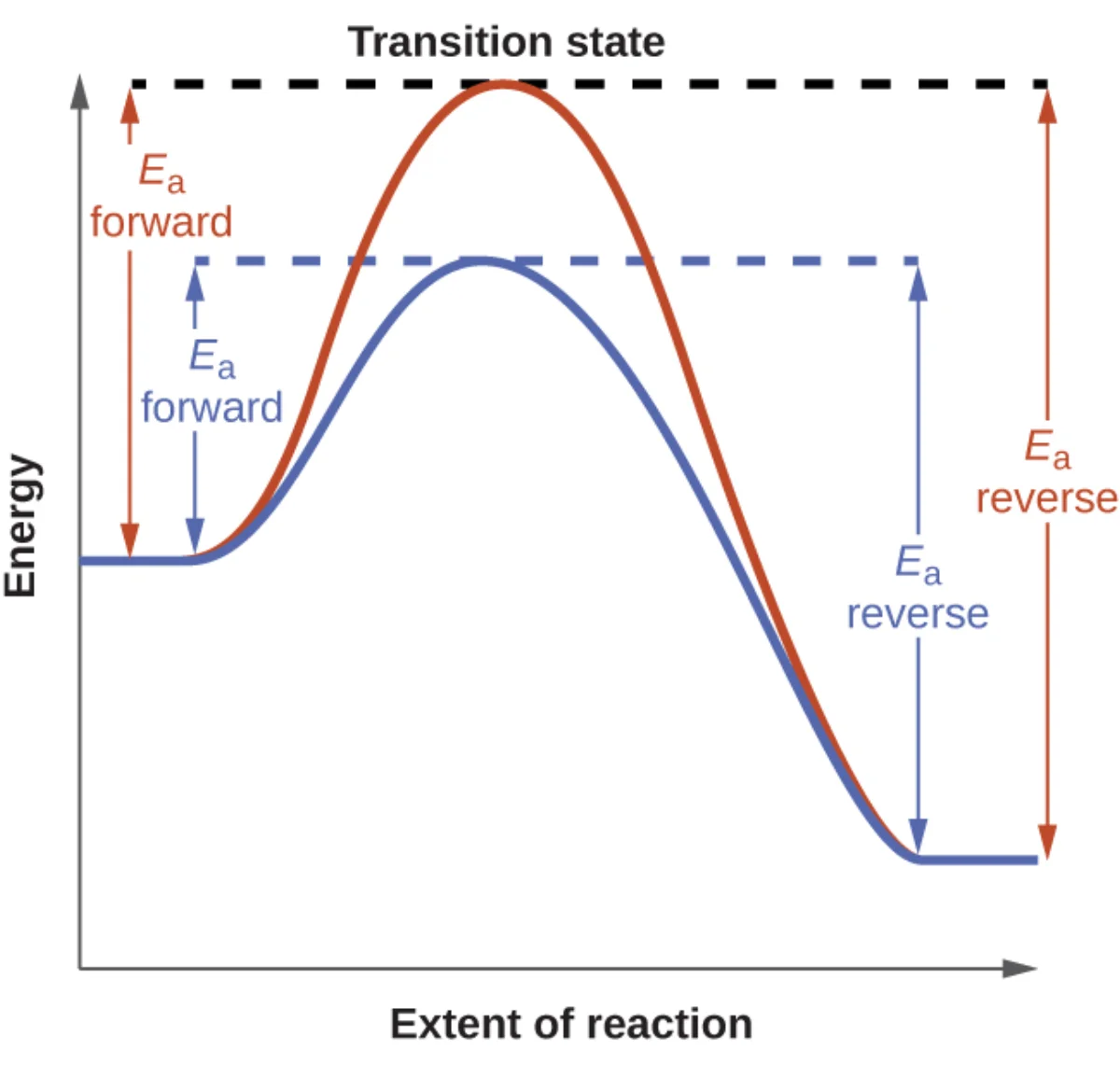
A catalyst (blue curve) lowers the activation energy for both the forward and reverse reactions compared to the uncatalyzed pathway (red curve). The reactant and product energy levels are unchanged, so delta-H and delta-G are the same. Only the barrier height (Ea) decreases. Credit: OpenStax Chemistry 2e, CC BY 4.0
On a reaction coordinate diagram, a catalyst lowers the peak (transition state) without changing the starting energy (reactants) or ending energy (products). The activation energy for both the forward and reverse reactions decreases by the same amount. Since delta-G = G(products) - G(reactants), and neither of those changes, delta-G is unchanged.
A reaction reaches equilibrium with [A] = 0.3 M and [B] = 0.7 M without a catalyst. If the same reaction is run with a catalyst, what are the equilibrium concentrations?
Click to reveal answer
[A] = 0.3 M and [B] = 0.7 M - exactly the same. A catalyst does not change the equilibrium position or K. The system reaches the same equilibrium concentrations, just faster.
A catalyst lowers the activation energy of the forward reaction by 20 kJ/mol. By how much does it lower the activation energy of the reverse reaction?
Click to reveal answer
Also 20 kJ/mol. A catalyst lowers the activation energy for BOTH directions equally. This is why K does not change - the ratio kf/kr remains the same when both rate constants increase by the same factor.
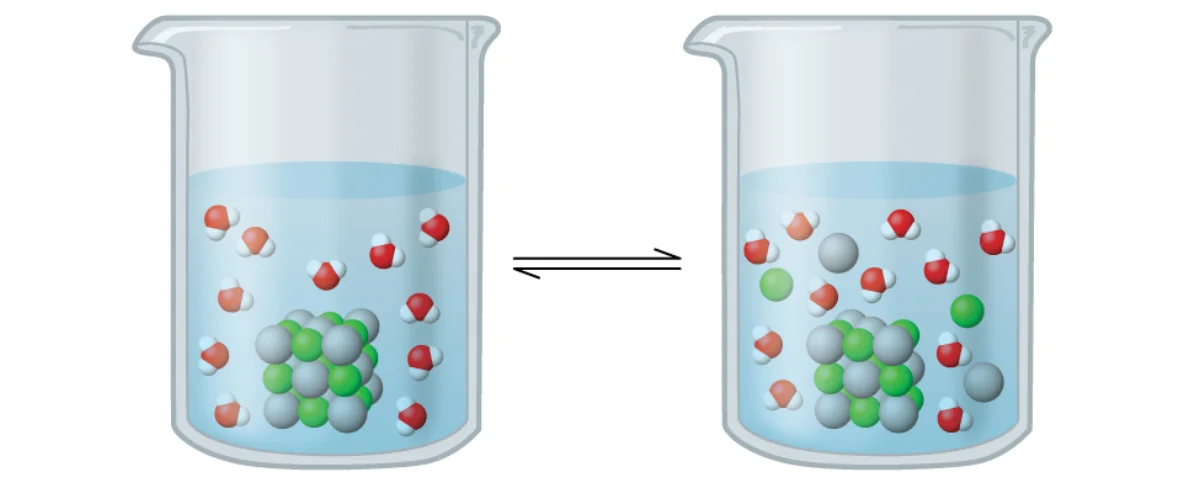
The solubility product (Ksp) is just the equilibrium constant for an ionic solid dissolving in water. Everything you learned about K applies here - Ksp is simply K applied to the specific case of dissolution.
Dissolution equilibrium: an ionic solid dissolves (ions leave the lattice) and precipitates (ions rejoin the lattice) simultaneously. At equilibrium, the rate of dissolution equals the rate of precipitation, and the ion concentrations remain constant. Credit: OpenStax Chemistry 2e, CC BY 4.0
Writing the Ksp Expression
For the dissolution of a generic ionic solid:
AxBy(s) ⇌ xA^(y+)(aq) + yB^(x-)(aq)
Examples
Compound
Dissolution reaction
Ksp expression
AgCl
AgCl(s) ⇌ Ag+(aq) + Cl-(aq)
Ksp = [Ag+][Cl-]
CaF₂
CaF₂(s) ⇌ Ca²+(aq) + 2F-(aq)
Ksp = [Ca²+][F-]²
Fe(OH)₃
Fe(OH)₃(s) ⇌ Fe³+(aq) + 3OH-(aq)
Ksp = [Fe³+][OH-]³
Notice how the coefficient (2 for F-, 3 for OH-) becomes the exponent.
Ksp and Molar Solubility
Molar solubility (s) is the number of moles of solid that dissolve per liter of solution to form a saturated solution. You can calculate s from Ksp:
Example: Find the molar solubility of AgCl (Ksp=1.8×10⁻¹⁰).
AgCl(s) ⇌ Ag+(aq) + Cl-(aq)
If s moles dissolve, then [Ag+] = s and [Cl-] = s.
Ksp=(s)(s)=s2
s=1.8×10⁻¹⁰≈1.3×10⁻⁵ M
Example: Find the molar solubility of CaF₂ (Ksp=3.9×10⁻¹¹).
CaF₂(s) ⇌ Ca²+(aq) + 2F-(aq)
If s moles dissolve, then [Ca²+] = s and [F-] = 2s.
Ksp=(s)(2s)2=4s3
s=(Ksp/4)1/3=(3.9×10−11/4)1/3≈(9.75×10−12)1/3≈2.1×10−4 M
Predicting Precipitation: Qsp vs. Ksp
Just as Q vs. K predicts reaction direction, Qsp vs. Ksp predicts whether a precipitate will form:
Comparison
Solution is…
What happens
Qsp < Ksp
Unsaturated
More solid can dissolve; no precipitate
Qsp = Ksp
Saturated
At equilibrium; no net change
Qsp > Ksp
Supersaturated
Precipitation occurs until Qsp = Ksp
A solution contains [Ag+]=1.0×10⁻³ M and [Cl−]=1.0×10⁻⁵ M. The Ksp of AgCl is 1.8×10⁻¹⁰. Will a precipitate form?
Click to reveal answer
Yes, a precipitate will form.Qsp=[Ag+][Cl−]=(1.0×10⁻³)(1.0×10⁻⁵)=1.0×10⁻⁸. Since Qsp (10−8) > Ksp (1.8×10⁻¹⁰), the solution is supersaturated and AgCl will precipitate.
Can you compare the molar solubility of two salts just by looking at their Ksp values?
Click to reveal answer
Only if they produce the same number and ratio of ions. You can directly compare Ksp for AgCl vs. AgBr (both 1:1 salts). But you cannot directly compare Ksp for AgCl (1:1) vs. CaF₂ (1:2) without calculating molar solubility, because the Ksp-to-solubility relationship depends on stoichiometry.
The common ion effect is Le Chatelier’s principle applied to solubility. It explains why a salt is less soluble in a solution that already contains one of its ions.
How It Works
Consider dissolving AgCl in a solution of 0.10 M NaCl:
AgCl(s) ⇌ Ag+(aq) + Cl-(aq), Ksp=1.8×10⁻¹⁰
In pure water, s≈1.3×10⁻⁵ M (as we calculated in the previous section).
But in 0.10 M NaCl, there is already 0.10 M Cl- in solution. This is the “common ion” - the Cl- is shared between NaCl and AgCl.
Step 1: Set up the Ksp expression with the common ion already present.
[Ag+] = s (from dissolved AgCl)
[Cl-] = 0.10 + s ≈ 0.10 (since s will be tiny compared to 0.10)
Step 2: Solve for s. Ksp=[Ag+][Cl−]=(s)(0.10)=1.8×10⁻¹⁰
s=1.8×10⁻¹⁰/0.10=1.8×10−9 M
Result: AgCl is about 7,000 times LESS soluble in 0.10 M NaCl than in pure water. The common ion (Cl-) dramatically suppressed the solubility.
Why Does This Happen? (Q vs. Ksp)
Adding a common ion increases the ion product Qsp above Ksp. Since Qsp > Ksp, the system is supersaturated and shifts left (toward solid formation). Precipitation continues until the ion concentrations drop enough that Qsp = Ksp again.
Applications
Laboratory separations: The common ion effect is used to selectively precipitate compounds. If you have a solution containing both Ag+ and Cu²+ and you add NaCl, the AgCl (very low Ksp) precipitates while CuCl₂ (high solubility) stays in solution. Adding excess Cl- drives the precipitation of AgCl even further.
Buffer solutions: Buffers contain a weak acid and its conjugate base (or a weak base and its conjugate acid). The common ion effect explains why a buffer resists pH changes - the common ion from the salt suppresses the dissociation of the weak acid or base.
Common Ion vs. Non-Common Ion
Adding NaCl to a saturated AgCl solution decreases solubility (common ion: Cl-).
Adding NaNO₃ to a saturated AgCl solution has essentially no effect - Na+ and NO₃- are not part of the AgCl equilibrium, so they do not change Qsp.
Will PbCl₂ be more soluble in pure water or in 0.1 M NaCl solution?
Click to reveal answer
More soluble in pure water. The NaCl solution already contains Cl- ions (the common ion). This shifts the dissolution equilibrium of PbCl₂ to the left, reducing its solubility. The common ion effect suppresses solubility.
Does the common ion effect change the value of Ksp?
Click to reveal answer
No. Ksp is a constant at a given temperature - it does not change when you add a common ion. The common ion changes Q (making Q > Ksp), which causes the equilibrium to shift left. The molar solubility decreases, but Ksp itself is unchanged.
Every quantitative equilibrium problem on the MCAT follows the same framework. You set up a table, plug into the K expression, and solve for an unknown. That framework is the ICE table - and once you master it, every equilibrium calculation becomes a fill-in-the-blank exercise.
What ICE Stands For
Row
What it represents
How you fill it in
I (Initial)
Concentrations before any reaction occurs
Given in the problem
C (Change)
How much each species changes as the system reaches equilibrium
Use stoichiometric ratios with variable x
E (Equilibrium)
Concentrations at equilibrium
E = I + C (add the rows)
Setting Up the Table
Step 1: Write the balanced equation and the K expression.
Step 2: Create the ICE table with one column per species.
Step 3: Fill in the Initial row from the problem.
Step 4: Fill in the Change row using stoichiometric ratios. The species that increases gets +x (scaled by its coefficient), and the species that decreases gets -x (scaled by its coefficient). To determine which direction the reaction proceeds, compare Q (the reaction quotient calculated from initial concentrations) to K: if Q < K, the reaction goes forward (products increase); if Q > K, it goes backward (reactants increase).
Step 5: Add I + C to get the Equilibrium row.
Step 6: Substitute the Equilibrium expressions into the K equation and solve for x.
A flask initially contains 0.100 M H₂ and 0.100 M I₂ with no HI. Find the equilibrium concentrations.
Step 1: Kc = [HI]² / ([H₂][I₂]) = 50.0
Step 2-5: Build the ICE table. Since Q = 0 and K = 50, Q < K, so the reaction goes forward (products increase, reactants decrease).
H₂
I₂
2HI
I
0.100
0.100
0
C
-x
-x
+2x
E
0.100 - x
0.100 - x
2x
Step 6: Plug into K:
50.0 = (2x)² / ((0.100 - x)(0.100 - x))
50.0 = (2x)² / (0.100 - x)²
Take the square root of both sides (a shortcut when both sides are perfect squares):
√50.0 = 2x / (0.100 − x)
7.07 = 2x / (0.100 - x)
7.07(0.100 - x) = 2x
0.707 = 2x + 7.07x = 9.07x
x = 0.0780
Equilibrium concentrations:
[H₂] = 0.100 - 0.078 = 0.022 M
[I₂] = 0.100 - 0.078 = 0.022 M
[HI] = 2(0.078) = 0.156 M
Check: K = (0.156)² / (0.022)(0.022) = 0.0243 / 0.000484 = 50.2 (close to 50.0 - rounding accounts for the difference).
Worked Example 2: The Small-x Approximation
Consider: N₂O₄(g) ⇌ 2NO₂(g), Kc=4.6×10⁻³
A flask initially contains 0.500 M N₂O₄. Find equilibrium concentrations.
N₂O₄
2NO₂
I
0.500
0
C
-x
+2x
E
0.500 - x
2x
Kc=(2x)2/(0.500−x)=4x2/(0.500−x)
This leads to a quadratic, but K is very small (10−3) compared to the initial concentration (0.500). This tells us that very little N₂O₄ will decompose, so x will be very small compared to 0.500.
The approximation: Assume x << 0.500, so 0.500 - x ≈ 0.500.
4x2/0.500=4.6×10−3
4x2=2.3×10−3
x2=5.75×10⁻⁴
x = 0.024
Check the approximation: x / 0.500 = 0.024 / 0.500 = 4.8%. Since this is less than 5%, the approximation is valid.
When Can You Use the Small-x Approximation?
The approximation works when K is much smaller than the initial concentration:
K relative to [Initial]
Can you approximate?
Reasoning
K << [Initial] (by ~100x or more)
Yes
Very little reaction occurs; x is tiny
K ≈ [Initial]
No
Significant reaction occurs; x is comparable to [Initial]
K >> [Initial]
No
Reaction goes nearly to completion; different setup needed
ICE Tables for Ksp
ICE tables work for solubility equilibria too. The only difference: the solid does not get a column (its activity is 1).
Molar solubility is the number of moles of a salt that dissolve per liter of solution. We label it “s” in ICE tables. If s moles of PbI₂ dissolve, then s moles of Pb²⁺ appear in solution - and 2s moles of I⁻ appear (because each formula unit releases 2 iodide ions).
Example: Find the molar solubility of PbI₂ (Ksp=9.8×10⁻⁹).
PbI₂(s) ⇌ Pb²+(aq) + 2I-(aq)
Pb²+
2I-
I
0
0
C
+s
+2s
E
s
2s
Ksp=[Pb2+][I−]2=(s)(2s)2=4s3
9.8×10−9=4s3
s3=2.45×10⁻⁹
s=32.45×10⁻⁹≈1.35×10⁻³ M
The molar solubility is 1.35×10⁻³ M. This means [Pb2+]=1.35×10⁻³ M and [I−]=2.70×10⁻³ M at equilibrium.
ICE Tables With a Common Ion
When solving for solubility in a solution that already contains a common ion, the initial concentration of that ion is NOT zero.
Example: Find the molar solubility of PbI₂ in 0.10 M NaI solution.
Pb²+
2I-
I
0
0.10
C
+s
+2s
E
s
0.10 + 2s
Ksp=(s)(0.10+2s)2=9.8×10⁻⁹
Since Ksp is tiny and the common ion concentration is 0.10, s will be extremely small. Approximate: 0.10 + 2s ≈ 0.10.
(s)(0.10)2=9.8×10⁻⁹
s(0.01)=9.8×10⁻⁹
s=9.8×10⁻⁷ M
Compare this to 1.35×10⁻³ M in pure water - the common ion reduced solubility by over 1,000-fold.
Common ICE Table Mistakes
Forgetting stoichiometric ratios. If the coefficient is 2, the change is 2x, not x.
Wrong sign on the Change row. If the reaction goes forward, reactants decrease (-x) and products increase (+x).
Approximating when K is not small enough. Always check the 5% rule after solving.
Including a solid in the table. Solids do not appear in ICE tables or K expressions.
Forgetting the common ion. If a common ion is already present, its initial concentration is NOT zero.
In an ICE table, if a product has a coefficient of 3 in the balanced equation, what goes in the Change row for that species?
Click to reveal answer
+3x. The Change row must reflect stoichiometric ratios. If the reaction proceeds forward and the product's coefficient is 3, then the change is +3x. If you defined x as the change for a species with coefficient 1, then all other changes are scaled by their coefficients.
You set up an ICE table and find x = 0.08 M. The initial concentration you subtracted x from was 0.50 M. Is the small-x approximation valid?
Click to reveal answer
Yes, the approximation is valid. x / [Initial] = 0.08 / 0.50 = 16%. Wait - 16% exceeds the 5% rule, so the approximation is actually NOT valid. You need to go back and solve without the approximation (use the quadratic formula). Always check the 5% rule after solving.
Why does an ICE table for a Ksp problem not include a column for the solid?
Click to reveal answer
Because pure solids have an activity of 1 and do not appear in the equilibrium expression. The Ksp expression only includes the dissolved ions. As long as some solid is present, the equilibrium is maintained regardless of how much solid there is.