You know K tells you where equilibrium IS. But what if you are not at equilibrium yet? How do you figure out which way the reaction needs to go? That is the job of Q, the reaction quotient.
Calculating Q
Q has the exact same mathematical form as K:
The critical difference: K uses equilibrium concentrations (which are constant). Q uses current concentrations (which may or may not be at equilibrium).
Comparing Q to K
Comparison
What it means
Direction of shift
Sign of delta-G
Q < K
Too many reactants, not enough products
Forward (toward products)
Negative (spontaneous forward)
Q = K
At equilibrium
No shift
Zero
Q > K
Too many products, not enough reactants
Reverse (toward reactants)
Positive (spontaneous in reverse)
The Connection to Gibbs Free Energy
The relationship between Q, K, and delta-G is one of the most important connections on the MCAT:
When Q < K: delta-G < 0 (forward reaction is spontaneous)
When Q = K: delta-G = 0 (system is at equilibrium)
When Q > K: delta-G > 0 (reverse reaction is spontaneous)
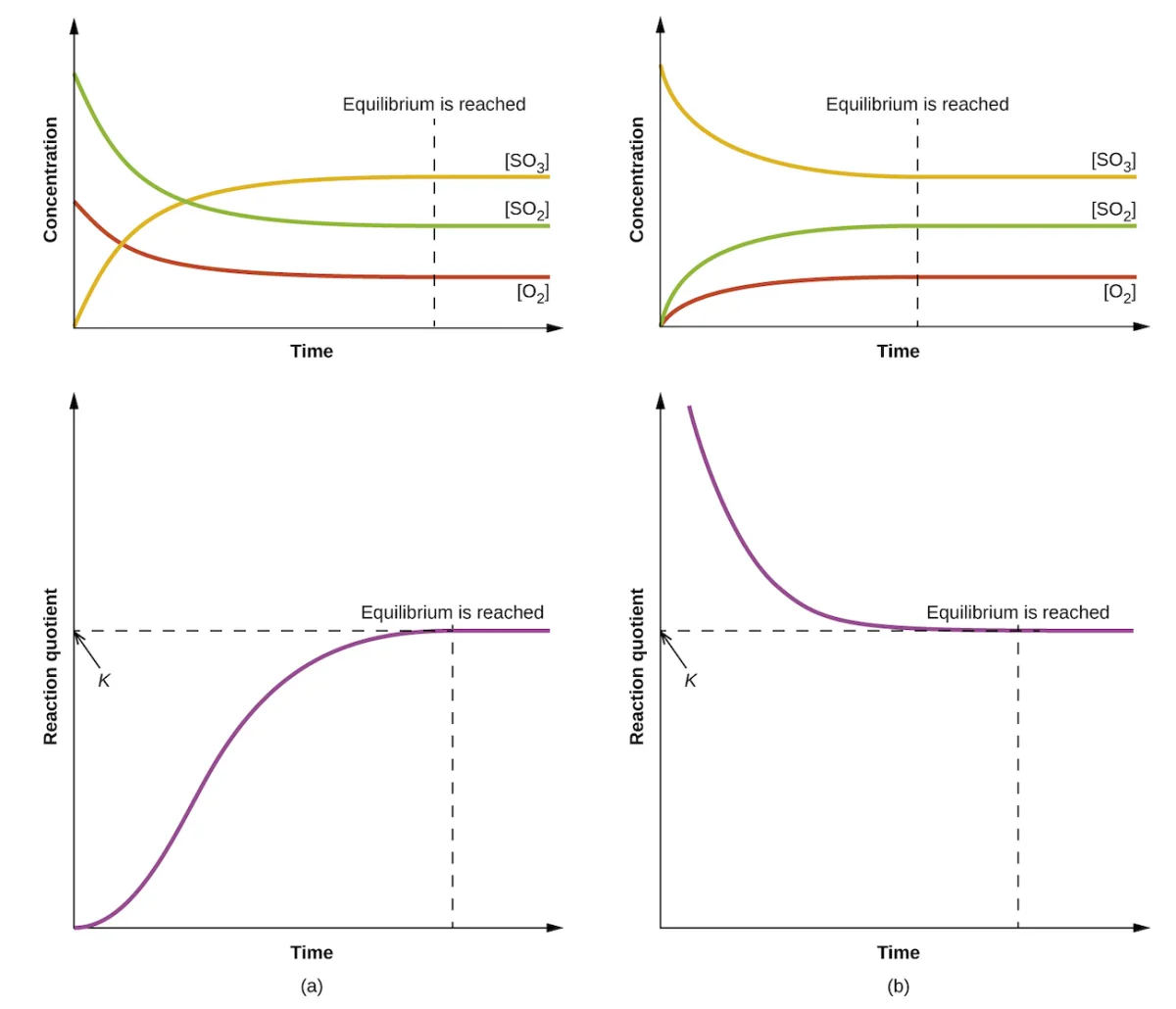
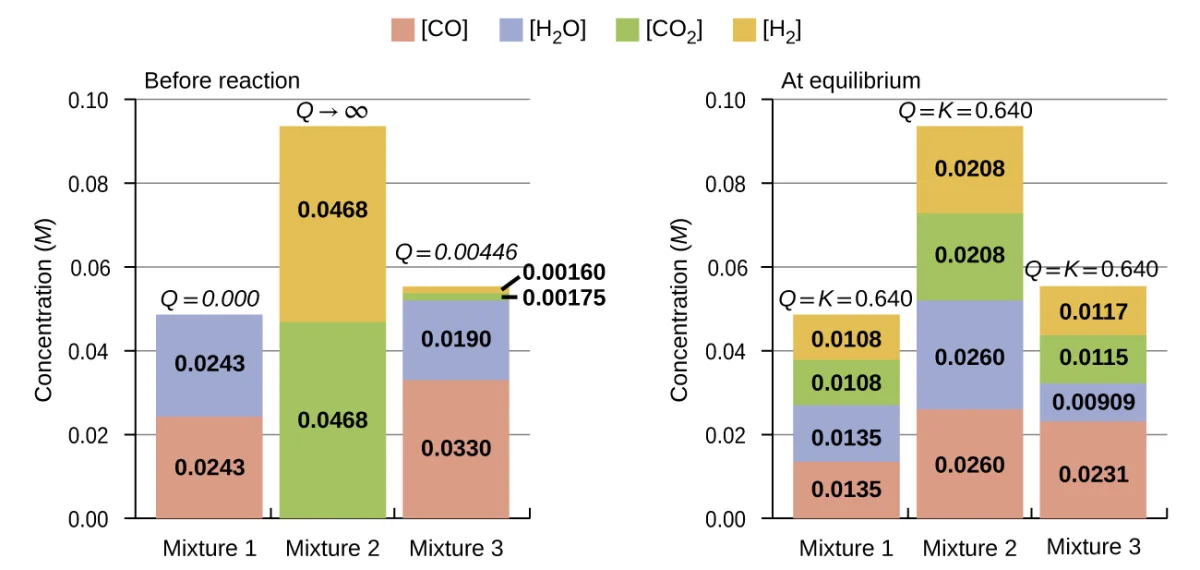
Q approaches K from both directions. (a) Starting with mostly reactants (Q < K): concentrations shift right until Q = K. (b) Starting with mostly products (Q > K): concentrations shift left until Q = K. Regardless of starting conditions, the system reaches the same equilibrium. Credit: OpenStax Chemistry 2e, CC BY 4.0Three mixtures with different starting compositions (Q = 0, Q approaching infinity, Q = 0.00446) all reach the same equilibrium (Q = K = 0.640). The equilibrium position depends only on K, not on where you start. Credit: OpenStax Chemistry 2e, CC BY 4.0
Worked Example
Consider the reaction: CO(g) + H₂O(g) ⇌ CO₂(g) + H₂(g), with K = 1.0 at a certain temperature.
If the current concentrations are [CO] = 0.1 M, [H₂O] = 0.1 M, [CO₂] = 0.5 M, [H₂] = 0.5 M, which way will the reaction shift?
Step 3: Since Q > K, there are too many products. The reaction shifts to the left (reverse direction) until Q decreases to equal K.
If Q < K for a reaction, what is the sign of delta-G and in which direction does the reaction proceed?
Click to reveal answer
delta-G is negative (the forward reaction is spontaneous). The reaction proceeds in the forward direction (toward products) until Q increases to equal K.
A reaction has K = 4.0. If [products]/[reactants] currently gives Q = 4.0, what happens?
Click to reveal answer
Nothing - the system is at equilibrium. Q = K means delta-G = 0 and there is no net shift in either direction. Both forward and reverse reactions continue at equal rates.