Concentration changes are the most intuitive application of Le Chatelier’s principle. The rule is simple: the system shifts away from whatever you added and toward whatever you removed.
Adding a Reactant or Removing a Product
Both of these push the reaction forward (to the right). Here is why:
Adding reactant increases the denominator of Q, so Q drops below K. The system responds by consuming the extra reactant - converting it into products - until Q climbs back up to equal K.
Removing product decreases the numerator of Q, so Q drops below K. The system responds by making more product to replace what was lost.
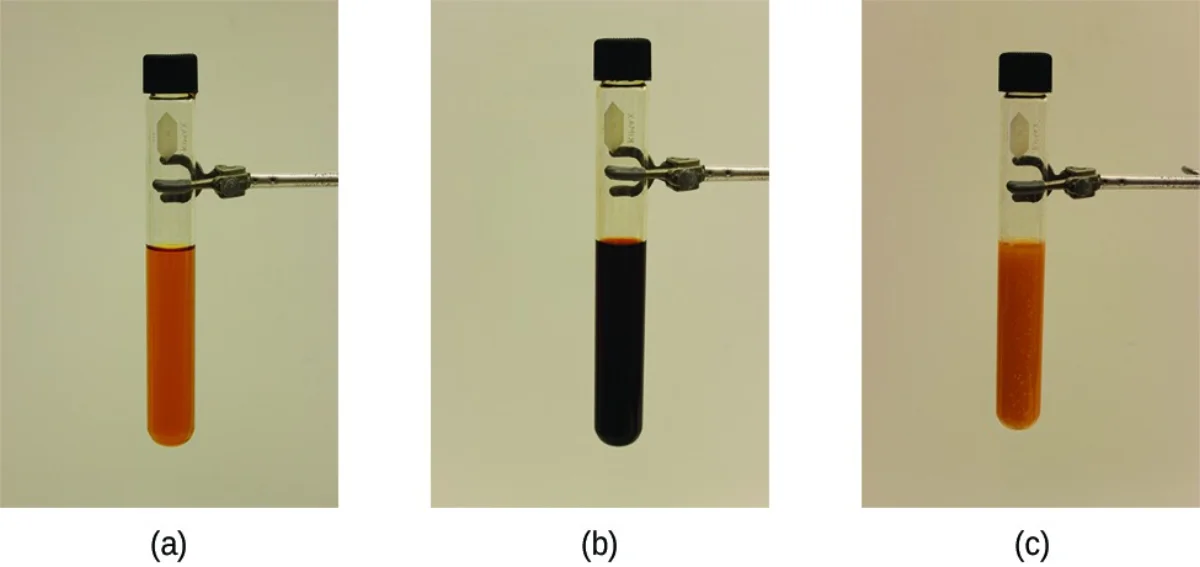
The iron thiocyanate equilibrium (Fe³+ + SCN- ⇌ FeSCN²+) demonstrates Le Chatelier's principle visually. (a) Equilibrium reference. (b) Adding more SCN- shifts right, producing more dark-red FeSCN²+. (c) Removing SCN- shifts left, lightening the color. Credit: Lumen Learning / OpenStax Chemistry 2e, CC BY 4.0
Adding a Product or Removing a Reactant
Both of these push the reaction backward (to the left).
Adding product increases the numerator of Q, so Q rises above K. The system responds by converting the excess product back into reactants.
Removing reactant decreases the denominator of Q, so Q rises above K. The system shifts left to replenish the lost reactant.
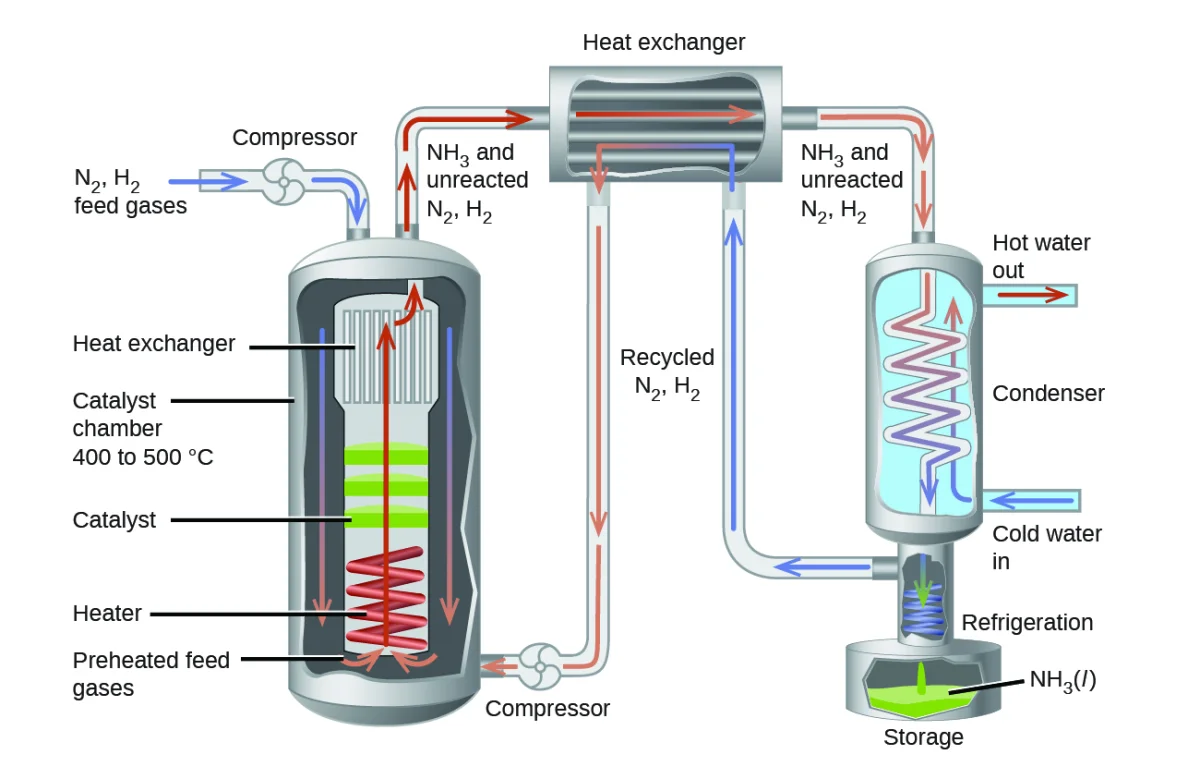
The Haber process for industrial ammonia production. Unreacted N₂ and H₂ are recycled, and NH₃ is continuously removed by condensation. Removing the product keeps Q below K, driving the equilibrium toward more ammonia production. Credit: OpenStax Chemistry 2e, CC BY 4.0
Important Exception: Pure Solids and Liquids
Adding or removing a pure solid or pure liquid does NOT shift equilibrium. Since these species do not appear in the equilibrium expression (their activity = 1), their amounts cannot change Q.
Example: CaCO₃(s) ⇌ CaO(s) + CO₂(g), K = [CO₂]
Adding more CaCO₃ does NOT shift the equilibrium because CaCO₃ is a solid and is not in the K expression. The equilibrium CO₂ pressure remains the same.
What Happens to Concentrations After the Shift?
A common misconception: if you add more reactant A and the equilibrium shifts right, does [A] end up higher, lower, or the same as before?
[A] ends up higher than the original equilibrium, but lower than right after you added it. The system partially consumes the added A, but it cannot completely remove it. The new equilibrium has higher [A] and higher [products] than the original equilibrium.
For the reaction AgCl(s) ⇌ Ag+(aq) + Cl-(aq), will adding more solid AgCl shift the equilibrium?
Click to reveal answer
No. AgCl is a pure solid and does not appear in the equilibrium expression (K = [Ag+][Cl-]). Adding more solid does not change Q, so there is no shift. The ion concentrations remain the same.
In the reaction N₂(g) + 3H₂(g) ⇌ 2NH₃(g), what happens if NH₃ is continuously removed from the reaction vessel?
Click to reveal answer
The equilibrium continuously shifts to the right (toward products). Removing NH₃ keeps Q below K, so the forward reaction is always favored. This is the principle behind industrial ammonia production - removing the product drives the reaction forward.