Most reactions you have seen so far are irreversible - they go in one direction, run out of limiting reagent, and stop. But many reactions are reversible: the products can react to re-form the reactants. When a reversible reaction is placed in a closed system, something remarkable happens.
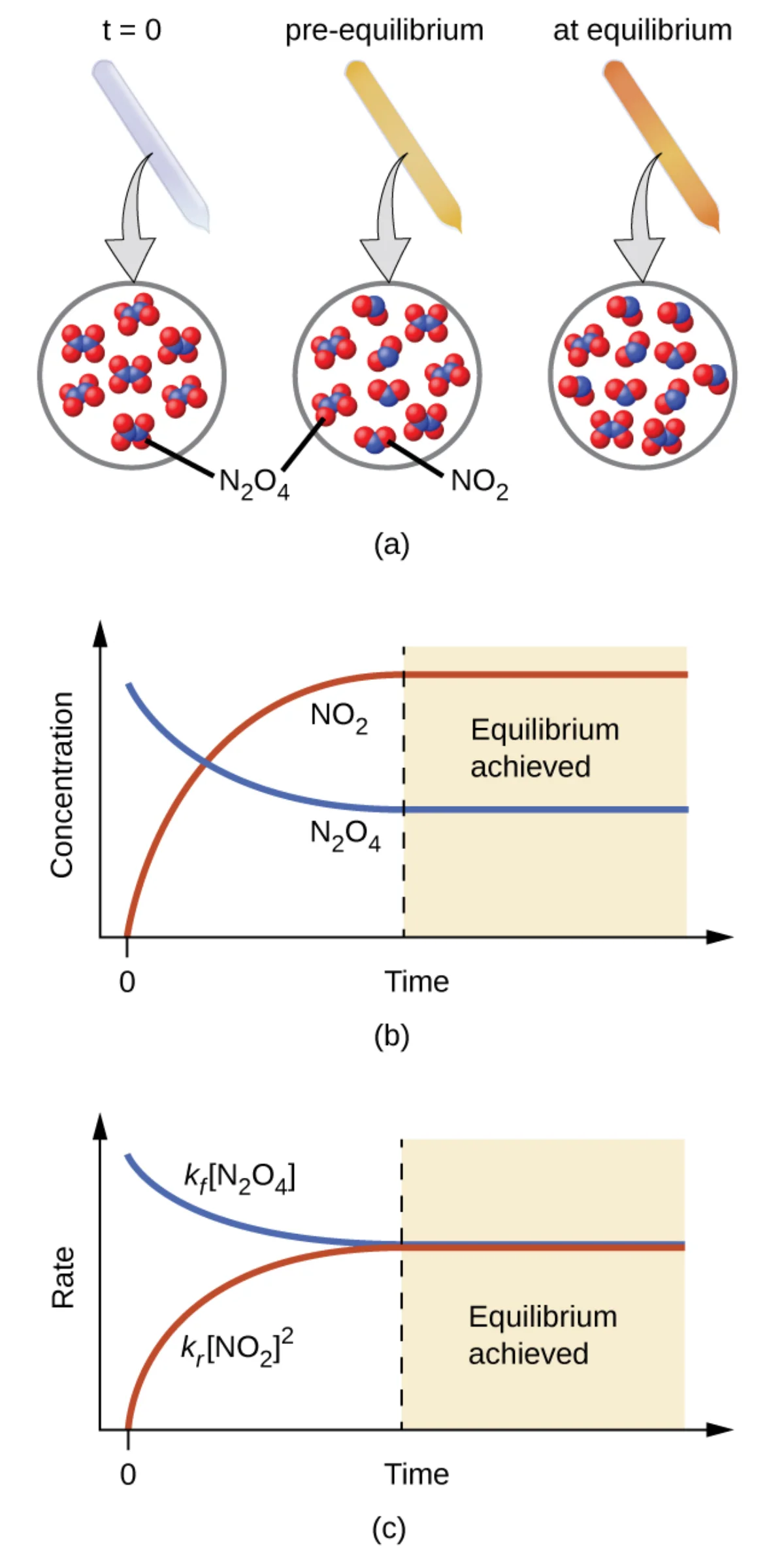
At first, the forward reaction dominates because reactants are abundant and products are scarce. As products accumulate, the reverse reaction speeds up. Eventually, the rate of the forward reaction equals the rate of the reverse reaction. Concentrations stop changing. The system has reached equilibrium.
The N₂O₄/NO₂ system approaching equilibrium. (a) Molecular view at three time points showing N₂O₄ decomposing into brown NO₂. (b) Concentration vs. time: both species level off at equilibrium. (c) Rate vs. time: forward and reverse rates converge to the same value. Credit: OpenStax Chemistry 2e, CC BY 4.0
Dynamic vs. Static Equilibrium
This is the single most important distinction in this chapter. Dynamic equilibrium means both reactions are still happening - molecules are still converting back and forth. It is not that everything stopped. A static equilibrium would mean nothing is happening at all, like a book sitting on a table.
At dynamic equilibrium:
The forward reaction rate equals the reverse reaction rate
Concentrations of all species remain constant (but not necessarily equal)
The system is at its minimum Gibbs free energy and maximum entropy
No net change is observable, even though molecular-level reactions continue
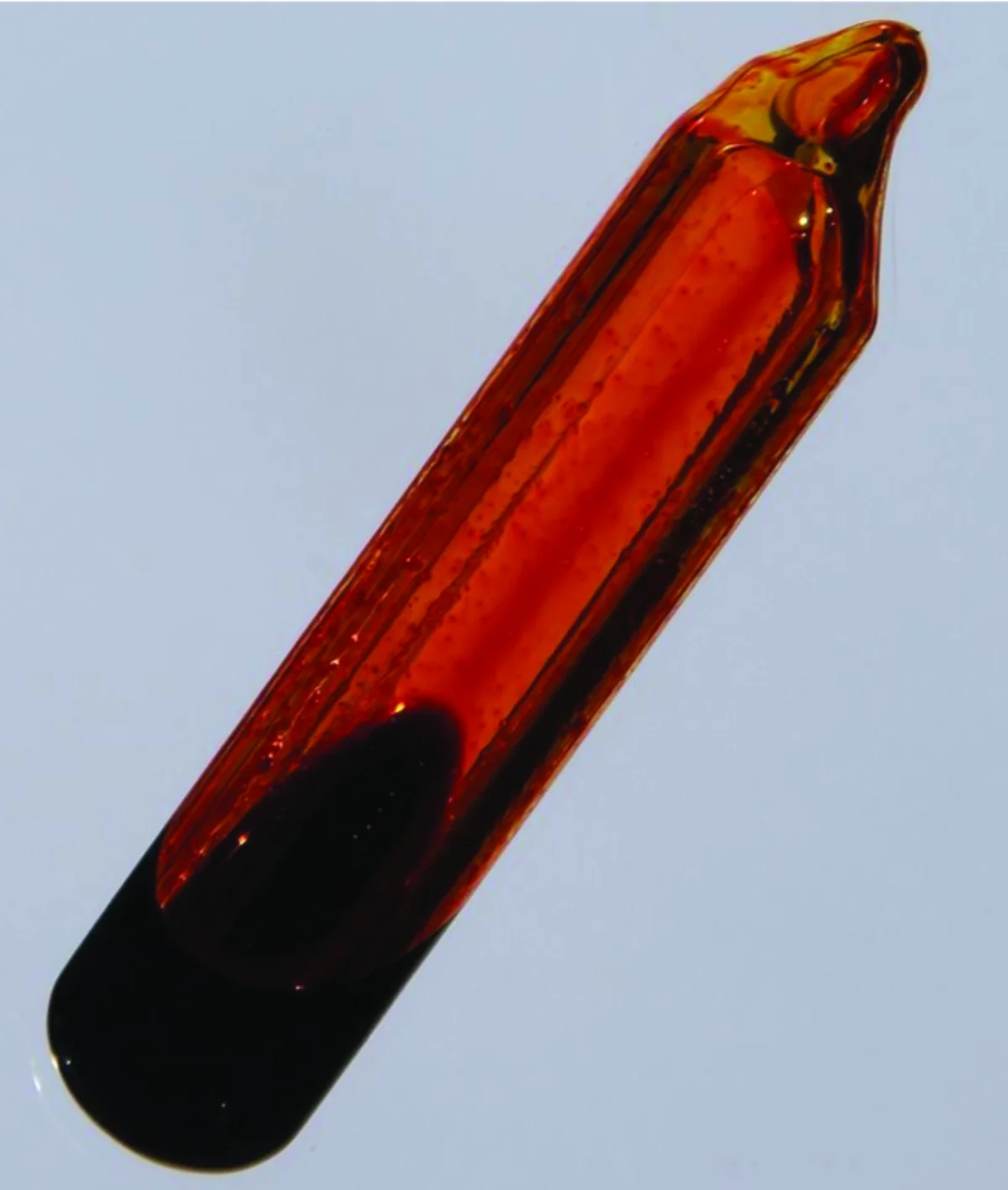
A sealed tube of bromine at equilibrium. The dark liquid bromine at the bottom is in dynamic equilibrium with the reddish-brown bromine vapor above. Molecules are constantly evaporating and condensing, but the amounts of liquid and vapor remain constant. Credit: OpenStax Chemistry 2e, CC BY 4.0
Recognizing Reversible Reactions
Reversible reactions are written with a double arrow (⇌) instead of a single arrow. For example:
N₂(g) + 3 H₂(g) ⇌ 2 NH₃(g)
This tells you that nitrogen and hydrogen can combine to form ammonia (forward), AND ammonia can decompose back into nitrogen and hydrogen (reverse). In a closed container, both processes happen simultaneously.
What Determines the Position of Equilibrium?
The “position” of equilibrium refers to the relative amounts of products and reactants at equilibrium. Two factors determine this position:
The nature of the reaction itself - encoded in the equilibrium constant K
Temperature - the only external factor that changes the value of K
Changing concentration or pressure can shift the system temporarily, but these changes do not alter K. Only temperature does. We will return to this critical point in section 6.8.
At equilibrium, the concentrations of products and reactants are equal. True or false?
Click to reveal answer
False. At equilibrium, the RATES of the forward and reverse reactions are equal. The concentrations are constant but are almost never equal to each other. The ratio of products to reactants at equilibrium is determined by K.
What is the difference between dynamic equilibrium and static equilibrium?
Click to reveal answer
Dynamic equilibrium: Forward and reverse reactions are both occurring, but at equal rates, so no net change is observed. Static equilibrium: Nothing is happening at all - no reactions in either direction. Chemical equilibrium is always dynamic.