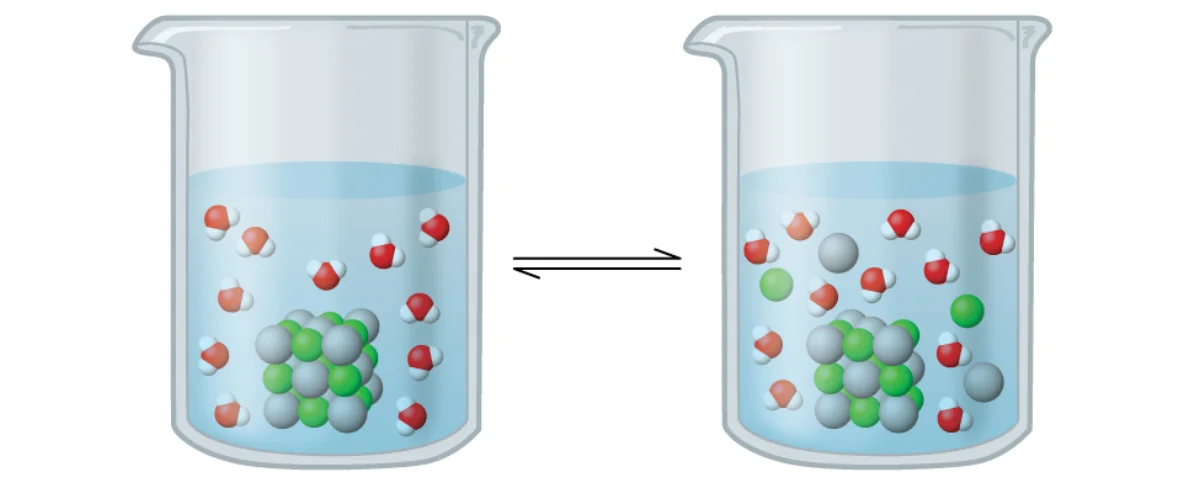
The solubility product (Ksp) is just the equilibrium constant for an ionic solid dissolving in water. Everything you learned about K applies here - Ksp is simply K applied to the specific case of dissolution.
Dissolution equilibrium: an ionic solid dissolves (ions leave the lattice) and precipitates (ions rejoin the lattice) simultaneously. At equilibrium, the rate of dissolution equals the rate of precipitation, and the ion concentrations remain constant. Credit: OpenStax Chemistry 2e, CC BY 4.0
Writing the Ksp Expression
For the dissolution of a generic ionic solid:
AxBy(s) ⇌ xA^(y+)(aq) + yB^(x-)(aq)
Examples
Compound
Dissolution reaction
Ksp expression
AgCl
AgCl(s) ⇌ Ag+(aq) + Cl-(aq)
Ksp = [Ag+][Cl-]
CaF₂
CaF₂(s) ⇌ Ca²+(aq) + 2F-(aq)
Ksp = [Ca²+][F-]²
Fe(OH)₃
Fe(OH)₃(s) ⇌ Fe³+(aq) + 3OH-(aq)
Ksp = [Fe³+][OH-]³
Notice how the coefficient (2 for F-, 3 for OH-) becomes the exponent.
Ksp and Molar Solubility
Molar solubility (s) is the number of moles of solid that dissolve per liter of solution to form a saturated solution. You can calculate s from Ksp:
Example: Find the molar solubility of AgCl (Ksp=1.8×10⁻¹⁰).
AgCl(s) ⇌ Ag+(aq) + Cl-(aq)
If s moles dissolve, then [Ag+] = s and [Cl-] = s.
Ksp=(s)(s)=s2
s=1.8×10⁻¹⁰≈1.3×10⁻⁵ M
Example: Find the molar solubility of CaF₂ (Ksp=3.9×10⁻¹¹).
CaF₂(s) ⇌ Ca²+(aq) + 2F-(aq)
If s moles dissolve, then [Ca²+] = s and [F-] = 2s.
Ksp=(s)(2s)2=4s3
s=(Ksp/4)1/3=(3.9×10−11/4)1/3≈(9.75×10−12)1/3≈2.1×10−4 M
Predicting Precipitation: Qsp vs. Ksp
Just as Q vs. K predicts reaction direction, Qsp vs. Ksp predicts whether a precipitate will form:
Comparison
Solution is…
What happens
Qsp < Ksp
Unsaturated
More solid can dissolve; no precipitate
Qsp = Ksp
Saturated
At equilibrium; no net change
Qsp > Ksp
Supersaturated
Precipitation occurs until Qsp = Ksp
A solution contains [Ag+]=1.0×10⁻³ M and [Cl−]=1.0×10⁻⁵ M. The Ksp of AgCl is 1.8×10⁻¹⁰. Will a precipitate form?
Click to reveal answer
Yes, a precipitate will form.Qsp=[Ag+][Cl−]=(1.0×10⁻³)(1.0×10⁻⁵)=1.0×10⁻⁸. Since Qsp (10−8) > Ksp (1.8×10⁻¹⁰), the solution is supersaturated and AgCl will precipitate.
Can you compare the molar solubility of two salts just by looking at their Ksp values?
Click to reveal answer
Only if they produce the same number and ratio of ions. You can directly compare Ksp for AgCl vs. AgBr (both 1:1 salts). But you cannot directly compare Ksp for AgCl (1:1) vs. CaF₂ (1:2) without calculating molar solubility, because the Ksp-to-solubility relationship depends on stoichiometry.