
Catalysts and Equilibrium
Students often assume that a catalyst “pushes” the reaction toward products. This is wrong - and the MCAT knows you might think this. A catalyst makes the reaction reach equilibrium faster, but it does not change where that equilibrium lies.
What a Catalyst Does
- Lowers the activation energy for both the forward and reverse reactions by the same amount
- Speeds up both reactions equally, so the ratio / stays the same
- Reaches equilibrium faster - the system gets to equilibrium in seconds instead of hours
- Does not change K, Q, or the equilibrium position
- Is not consumed in the reaction - it participates but is regenerated
What a Catalyst Does NOT Do
- Does NOT change the equilibrium constant K
- Does NOT shift the equilibrium position
- Does NOT change the concentrations of products or reactants at equilibrium
- Does NOT change delta-G or delta-H for the reaction
- Does NOT appear in the equilibrium expression
Two Types of Catalysts
| Type | Definition | Example |
|---|---|---|
| Homogeneous | Same phase as the reactants | H+ ions catalyzing an esterification in aqueous solution |
| Heterogeneous | Different phase from the reactants | Platinum surface catalyzing a gas-phase reaction; enzymes (solid catalyst in aqueous environment) |
Energy Diagram With and Without a Catalyst
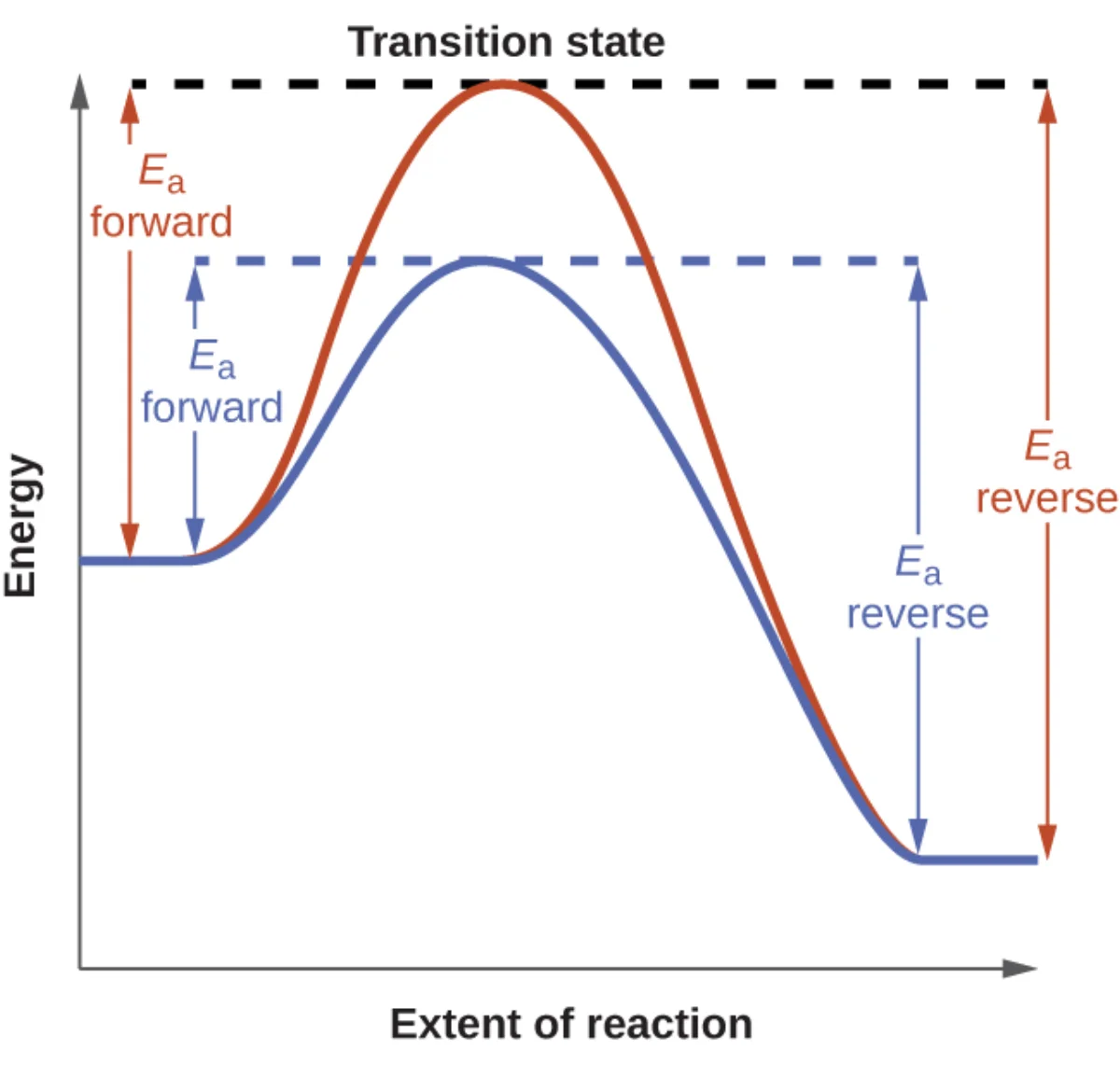
On a reaction coordinate diagram, a catalyst lowers the peak (transition state) without changing the starting energy (reactants) or ending energy (products). The activation energy for both the forward and reverse reactions decreases by the same amount. Since delta-G = G(products) - G(reactants), and neither of those changes, delta-G is unchanged.
A reaction reaches equilibrium with [A] = 0.3 M and [B] = 0.7 M without a catalyst. If the same reaction is run with a catalyst, what are the equilibrium concentrations?
Click to reveal answer
[A] = 0.3 M and [B] = 0.7 M - exactly the same. A catalyst does not change the equilibrium position or K. The system reaches the same equilibrium concentrations, just faster.
A catalyst lowers the activation energy of the forward reaction by 20 kJ/mol. By how much does it lower the activation energy of the reverse reaction?
Click to reveal answer
Also 20 kJ/mol. A catalyst lowers the activation energy for BOTH directions equally. This is why K does not change - the ratio / remains the same when both rate constants increase by the same factor.