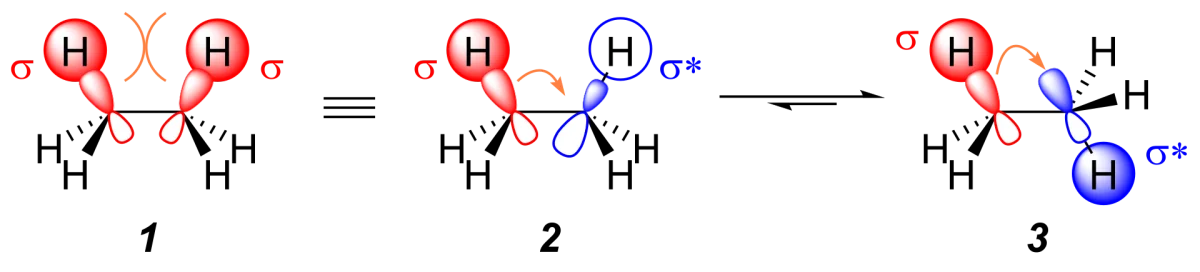
Most organic reactions start as an acid-base interaction in disguise. An alcohol attacking a carbonyl is a Lewis base donating electrons to a Lewis acid. An E2 elimination is a base pulling off a proton while a pi bond forms. Even nucleophilic substitution is really a Lewis-base nucleophile meeting a Lewis-acid electrophile. If you can see acid-base chemistry everywhere, you can see mechanism everywhere.
Organic chemists use two overlapping definitions of acids and bases. The Brønsted-Lowry definition centers on protons; the Lewis definition centers on electrons. You need both. Brønsted-Lowry is simpler and handles 80% of what the MCAT asks about. Lewis is more general and handles the other 20% - the interactions that do not involve a proton at all.
Brønsted-Lowry: Proton Donors and Acceptors
A Brønsted-Lowry acid donates a proton (H⁺). A Brønsted-Lowry base accepts a proton. That is the entire definition.
When an acid gives up its proton, what is left behind is the conjugate base. When a base picks up a proton, the result is the conjugate acid. Every acid-base reaction produces a conjugate pair on each side of the arrow.
The classic example: HCl + H₂O → Cl⁻ + H₃O⁺.
HCl is the acid. Cl⁻ is its conjugate base.
H₂O is the base. H₃O⁺ is its conjugate acid.
Notice the pattern: an acid and its conjugate base differ by exactly one proton. That is all “conjugate” means - remove a proton from the acid and you get its conjugate base. Add a proton to the base and you get its conjugate acid.
Identifying the Proton Being Transferred
In an organic passage, spotting the acid and base usually means identifying which hydrogen moves. Look at the reactants before the arrow and the products after. If a hydrogen has jumped from one molecule to another, you are looking at a Brønsted-Lowry reaction.
Example: ethanol (CH₃CH₂OH) plus sodium hydride (NaH) produces sodium ethoxide (CH₃CH₂O⁻Na⁺) plus H₂.
Ethanol donated its O-H proton → ethanol is the acid.
Hydride (H⁻) accepted the proton → hydride is the base.
Ethoxide is the conjugate base of ethanol.
H₂ is the conjugate acid of hydride.
The hydrogen on oxygen moves to hydride. That is the whole event. Everything else in the equation is just spectators or counterions.
Amphoteric Species
Some molecules can behave as either an acid or a base depending on their partner. Water is the classic example - it accepts a proton from HCl (acts as base) but donates a proton to NH₃ (acts as acid). Molecules that can go either way are called amphoteric or amphiprotic.
Amino acids are amphoteric in biology: the carboxylic acid group donates a proton while the amine accepts one, producing the zwitterion that is the dominant form at physiological pH. This becomes critical in Biochemistry Ch 1; recognize the acid-base logic now.
Lewis Acids and Bases: The Electron-Pair View
A Lewis acid accepts an electron pair. A Lewis base donates an electron pair. The Lewis framework shifts the focus from protons to electrons, which is exactly how organic chemists think about mechanism.
Every Brønsted acid-base reaction is also a Lewis reaction:
The Brønsted base donates a lone pair of electrons to a proton on the Brønsted acid.
That makes the base a Lewis base (electron-pair donor) and the proton on the acid the target of that pair (Lewis-acid-like).
But the Lewis definition extends further. Consider boron trifluoride (BF₃) reacting with ammonia (NH₃). No proton moves, yet an acid-base reaction occurs: nitrogen donates its lone pair into boron’s empty p orbital, forming a new N-B bond. BF₃ is the Lewis acid (accepts the pair); NH₃ is the Lewis base (donates the pair). The product is an adduct (F₃B-NH₃), not a conjugate acid + conjugate base.
Typical Lewis Acids in Organic Chemistry
Most common organic Lewis acids have empty orbitals hungry for electrons:
Carbonyl carbons (C=O): the oxygen pulls electron density away, leaving the carbon partially positive and ready to accept a nucleophile’s electron pair.
Carbocations (R₃C⁺): an empty p orbital on an sp²-hybridized carbon, eager to form a new bond.
Metal cations with empty d orbitals: Mg²⁺, Zn²⁺, Fe³⁺, AlCl₃, BF₃.
Electron-poor halogens like Br⁺ (generated from Br₂ + a Lewis acid catalyst).
Typical Lewis Bases in Organic Chemistry
Lewis bases have lone pairs or loosely held electrons ready to donate:
Water, alcohols, ethers - lone pairs on oxygen.
Amines - lone pair on nitrogen.
Carbanions (R₃C⁻) - a filled sp³ orbital.
Hydroxide, alkoxides, halides - negatively charged species with lone pairs.
Pi bonds (alkenes, alkynes, aromatic rings) - the pi electrons themselves can act as a base when faced with a strong electrophile.
The Curved-Arrow Signature of Acid-Base Reactions
In every Brønsted or Lewis acid-base event, a curved double-headed arrow begins at the electron source (the base’s lone pair or pi bond) and points to the electron sink (a proton on the acid, or the empty orbital on the Lewis acid). This arrow notation is the theme of Section 4.8. The moment you see curved arrows in a mechanism, you should ask: “Who is the base? Who is the acid?” Identifying those two roles almost always unlocks the rest.
When to Use Which Framework
Use Brønsted-Lowry whenever a proton is being transferred. Simpler, faster, and directly tells you the conjugate pairs.
Use Lewis whenever there is no proton transfer (carbonyl addition, electrophilic attack on alkenes, coordination to metal centers) or when you need to see the full electron-pair logic.
In practice, organic chemists use both interchangeably. A carbonyl addition by hydroxide is “OH⁻ is a nucleophile” (mechanism view), “OH⁻ is a Lewis base attacking the Lewis acid carbonyl carbon” (Lewis view), and “OH⁻ is the conjugate base of water, strong enough to donate its lone pair into an electrophile” (Brønsted + Lewis view). All three descriptions are correct - they are just different lenses on the same event.
In the reaction CH₃OH + NaNH₂ → CH₃O⁻Na⁺ + NH₃, identify the acid, base, conjugate acid, and conjugate base.
Click to reveal answer
CH₃OH is the acid; NH₂⁻ is the base; CH₃O⁻ is the conjugate base; NH₃ is the conjugate acid. Methanol donates its O-H proton to amide (NH₂⁻). The methanol loses H⁺ to become methoxide (conjugate base). The amide gains H⁺ to become ammonia (conjugate acid). Sodium is a spectator ion.
Why is BF₃ considered a Lewis acid but not a Brønsted-Lowry acid?
Click to reveal answer
BF₃ has no proton to donate, so it cannot be a Brønsted-Lowry acid. But it has an empty p orbital on boron, so it accepts electron pairs - making it a Lewis acid. This is the textbook example that shows why the Lewis definition is broader than the Brønsted-Lowry definition. All Brønsted acids are Lewis acids, but not all Lewis acids are Brønsted acids.
Putting It Together
When you read a mechanism, quickly classify each step:
Is a proton moving? → Brønsted acid-base step.
Is an electron pair flowing into an empty orbital with no proton involved? → Lewis acid-base step (equivalent to a nucleophile-electrophile step, which is the same thing).
Are two neutral molecules forming a new bond by sharing electrons? → Lewis acid-base adduct formation.
The next section moves from definitions to quantities: how pKa tells you how strong an acid is, and how comparing pKa values lets you predict which direction a reaction will run.
pKa is the single most useful number in organic chemistry. Given the pKa of two acids, you can predict which way a reaction will run, which hydrogen will be pulled off preferentially, and whether a base is strong enough to do the job you need. Internalize the pKa values of a dozen common functional groups and you will save yourself from memorizing hundreds of individual reactions.
The MCAT will not ask you to calculate a pKa. What it will ask is whether a reaction occurs and which side of the equilibrium is favored. Both answers come from comparing pKa values.
Definition: Ka and pKa
An acid in water establishes an equilibrium:
HA ⇌ H⁺ + A⁻
The acid dissociation constant is:
Ka = [H⁺][A⁻] / [HA]
A bigger Ka means more dissociation, which means a stronger acid. But Ka values span twenty orders of magnitude, so chemists use the logarithm:
A handful of pKa values covers almost every MCAT question. Anchor these in your head:
Species
pKa
Notes
HI
−10
Strongest of the common acids
HCl
−7
Very strong
H₃O⁺
−1.7
Protonated water
HF
3.2
Only “weak” hydrohalic acid
Carboxylic acid (RCOOH)
4-5
Acetic acid = 4.76
Ammonium (NH₄⁺)
9.2
Protonated amine
Phenol (ArOH)
10
Aromatic alcohol
Water (H₂O)
15.7
Reference point
Alcohol (ROH)
16-18
Ethanol = 16
Terminal alkyne (RC≡CH)
25
sp hybridization effect
Ester alpha-H
25
Flanked by one carbonyl
Ketone/aldehyde alpha-H
20
Flanked by one carbonyl
1,3-dicarbonyl alpha-H
10-13
Flanked by two carbonyls
Ammonia (NH₃)
38
Very weak acid
Alkane (R-H)
50
Essentially non-acidic
Learn the family trends: hydrohalic acids first, then carboxylic acids (4-5), ammoniums (9-10), phenols (10), alcohols (16-18), alpha-carbons (20-25 for one carbonyl, 10-13 for two), amines (38), alkanes (50). You do not need exact values - you need relative order and typical magnitudes.
Why a Stronger Acid Has a Weaker Conjugate Base
Strong acid means the proton dissociates easily. That happens when the conjugate base is stable - it can hold the extra electron pair without trouble. Conversely, a weak acid has a conjugate base that is desperate to reclaim the proton (the conjugate base is unstable as an anion).
That is why hydroxide (OH⁻, conjugate base of water at pKa 16) is a stronger base than chloride (Cl⁻, conjugate base of HCl at pKa −7). Water is a weaker acid than HCl, so its conjugate base hangs on to protons more tightly.
Predicting the Direction of an Acid-Base Reaction
Here is the central rule: the equilibrium lies on the side of the weaker acid (the side with the higher pKa).
In other words: a reaction proceeds in the direction that converts a stronger acid into a weaker one (and a stronger base into a weaker one).
Example: does acetic acid (pKa 4.76) react with sodium hydroxide (conjugate acid of hydroxide is water, pKa 15.7)?
Forward direction: acetic acid (pKa 4.76) → acetate + water. Water is the product acid with pKa 15.7.
The reaction converts acetic acid (stronger, pKa 4.76) into water (weaker, pKa 15.7).
Equilibrium lies far to the right - favored by about 10^(15.7 − 4.76) ≈ 1011.
Yes, the reaction occurs and essentially goes to completion.
Second example: does methanol (pKa 16) react with sodium hydride (NaH - conjugate acid is H₂, pKa ≈ 36)?
Forward: methanol → methoxide + H₂. H₂ is much weaker (pKa 36) than methanol (pKa 16).
Equilibrium lies on the weaker-acid side (H₂), so strongly to the right.
Again yes - this is how methoxide is actually generated in a lab.
Third example: does ethanol (pKa 16) deprotonate acetone (alpha-H pKa ≈ 20)?
Forward: acetone → enolate + ethanol. Ethanol is weaker acid (pKa 16) than acetone (pKa 20). Wait - that is the wrong way around. Let me re-read.
Actually: if ethanol removes a proton from acetone, the forward direction is ethanol → ethoxide + acetone-enolate. But we started with acetone being the acid here. If ethanol’s O-H proton is what exists in solution, then ethanol is not the base; we need a base like NaH or LDA to remove the alpha-H.
The practical takeaway: if your proposed base is a weaker acid’s conjugate base than your target acid, the reaction is unfavorable. You need a stronger base (higher pKa conjugate acid) than your target acid. This is why deprotonating a ketone alpha-carbon (pKa 20) requires LDA (conjugate acid pKa 36), not hydroxide (pKa 15.7).
The 10-Unit Rule of Thumb
A quick mental estimate: if the two pKa values differ by at least 10, the reaction goes essentially to completion (equilibrium constant ~1010 favoring the weaker acid). If they differ by 1-3 units, the reaction is close to 50-50 and may or may not be practically useful.
Example: acetic acid (pKa 4.76) + water (pKa 15.7) → acetate + H₃O⁺. The difference is about 11, so yes - essentially complete in the forward direction. But the reverse (acetate + H₃O⁺ → acetic acid + water) is the direction in a strongly acidic solution, so we flip the lens: at low pH, acetate exists mostly as acetic acid; at high pH, mostly as acetate. This is the Henderson-Hasselbalch logic (see General Chemistry Ch 10).
Ka, pKa, and pH Together
The Henderson-Hasselbalch equation ties these together:
pH = pKa + log([A⁻] / [HA])
When pH = pKa, the protonated and deprotonated forms are in equal amounts. At pH two units below pKa, the acid form dominates roughly 100:1. Two units above, the base form dominates 100:1.
For MCAT biology: the carboxylic acid of an amino acid has pKa around 2. At pH 7 (physiological), the COOH is 5 units above its pKa, so it is roughly 99.999% deprotonated (COO⁻). The amine has pKa around 9. At pH 7, the amine is 2 units below its pKa, so it is roughly 99% protonated (NH₃⁺). That is the zwitterion.
A proposed reaction uses sodium ethoxide (pKa of ethanol = 16) to deprotonate acetone (pKa of alpha-H = 20). Is this reaction favored? Why or why not?
Click to reveal answer
No, it is not favored. The forward reaction would produce ethanol (pKa 16) from ethoxide, and enolate from acetone. Equilibrium favors the weaker acid side; since ethanol (pKa 16) is a stronger acid than acetone (pKa 20), equilibrium lies to the LEFT - meaning ethoxide is not basic enough to meaningfully deprotonate acetone. You would need LDA or another stronger base (conjugate acid pKa > 20) to drive the reaction forward.
Rank these from most acidic to least acidic: terminal alkyne H, alcohol O-H, carboxylic acid O-H, water O-H, alkane C-H.
Click to reveal answer
Carboxylic acid (pKa ~4) > water (pKa 15.7) > alcohol (pKa ~16-18) > terminal alkyne (pKa ~25) > alkane (pKa ~50). Carboxylic acid wins by a lot because its conjugate base is resonance-stabilized across two oxygens. Water and alcohols are similar (the oxygen holds the negative charge). Terminal alkynes are much less acidic because the conjugate base (acetylide) is an sp carbon. Alkanes are basically non-acidic - their conjugate bases are sp³ carbanions with no stabilization.
The next section explains WHY these pKa values differ so much - the ARIO framework for ranking acidity from molecular structure alone.
Every MCAT pKa comparison can be reduced to one rule: the more stable the conjugate base, the more acidic the molecule. Every factor that stabilizes a negative charge makes the corresponding H⁺ easier to release. Every factor that destabilizes a negative charge makes the acid weaker.
Four structural factors determine conjugate-base stability. In decreasing order of importance, they spell out ARIO: Atom, Resonance, Induction, Orbital. Run through them in order and you can rank any two protons for acidity without looking up a pKa table.
A: Atom (Electronegativity and Size)
When comparing acids where the proton sits on different atoms, compare the atom that bears the negative charge in the conjugate base. Two features of that atom matter:
Across a period (same row): more electronegative = more stable anion = stronger acid.
Compare the pKas across C-H, N-H, O-H, F-H in row 2:
CH₄: pKa ≈ 50 (C is least electronegative)
NH₃: pKa ≈ 38
H₂O: pKa ≈ 15.7
HF: pKa ≈ 3.2 (F is most electronegative)
As you move right across the periodic table, the atom better tolerates a negative charge, so the conjugate base is more stable and the acid is stronger.
Down a group (same column): bigger atom = more stable anion = stronger acid.
Compare HF, HCl, HBr, HI:
HF: pKa 3.2
HCl: pKa −7
HBr: pKa −9
HI: pKa −10
Counterintuitive at first - fluorine is the most electronegative, yet HF is the weakest of these acids. Size wins. A bigger atom spreads a negative charge over more volume, reducing charge density and stabilizing the anion. Polarizability also increases down the group, which helps further. The size effect dominates electronegativity when comparing down a column.
R: Resonance
If the conjugate base can delocalize its negative charge over multiple atoms through resonance, it is much more stable than an anion on a single atom. Resonance stabilization is so powerful it usually beats Induction and Orbital effects.
The classic comparison: ethanol (pKa 16) vs. acetic acid (pKa 4.76). Both have an O-H proton; both produce an oxygen anion. So “Atom” does not distinguish them. The difference is resonance:
Ethoxide (CH₃CH₂O⁻): the negative charge sits entirely on the alkoxide oxygen. No resonance partner.
Acetate (CH₃COO⁻): the negative charge is delocalized equally over both oxygens via resonance. The anion is symmetric, with each O-C bond order 1.5.
Spreading the charge over two equivalent oxygens lowers the energy of the conjugate base by roughly 11 pKa units - a factor of 1011 in Ka. Massive effect.
Another classic: phenol (pKa 10) vs. ethanol (pKa 16). Phenoxide delocalizes the negative charge into the aromatic ring, hitting three ring positions. Ethoxide has no such option. Phenol is about a million times more acidic than ethanol despite both being alcohols.
Alpha-carbon acidity follows the same logic. A C-H alpha to one carbonyl has pKa ~20 (enolate resonance spreads charge to oxygen). A C-H alpha to two carbonyls (1,3-dicarbonyls like malonate and acetoacetate) has pKa ~10-13 - the carbanion can resonate onto both oxygens at once.
I: Induction
Electronegative atoms nearby pull electron density through sigma bonds. This inductive effect stabilizes a negative charge that sits on a neighboring atom. Induction is weaker than resonance but can decide close comparisons.
Compare the pKas:
Acetic acid (CH₃COOH): pKa 4.76
Chloroacetic acid (ClCH₂COOH): pKa 2.87
Dichloroacetic acid (Cl₂CHCOOH): pKa 1.29
Trichloroacetic acid (Cl₃CCOOH): pKa 0.65
Each additional chlorine pulls electron density away from the carboxylate, stabilizing the negative charge and lowering pKa - but not by a constant amount. The steps shrink: about 1.9 units for the first chlorine, about 1.6 for the second, about 0.6 for the third. Each new chlorine is pulling on a carboxyl group the earlier ones have already drained, so the inductive effect attenuates as the groups accumulate. It also falls off sharply with distance - a chlorine two or three carbons away has only a small influence.
Induction is through-sigma-bond (through the “backbone” of the molecule). Resonance is through-pi-bond (through delocalized orbitals). A molecule can have both.
O: Orbital (s-character)
The more s-character an orbital has, the closer its electron density sits to the nucleus, which stabilizes a lone pair (and thus a negative charge).
sp orbital: 50% s-character
sp² orbital: 33% s-character
sp³ orbital: 25% s-character
Compare C-H acids with the same atom (carbon) and no resonance or induction to help:
sp³ alkane (R-CH₃, like ethane): pKa ~50
sp² alkene (R-CH=CH₂, vinyl H): pKa ~44
sp alkyne (R-C≡C-H, terminal H): pKa ~25
A terminal alkyne is much more acidic than a comparable alkene or alkane. The acetylide anion (conjugate base) places the lone pair in an sp orbital, which holds it tightly and at lower energy. This is why terminal alkynes can be deprotonated by NaNH₂ (amide, pKa 38) - the alkyne’s pKa (25) is about 13 units below amide’s. They cannot be deprotonated by hydroxide (pKa of water 15.7 - not strong enough for a pKa 25 proton).
Putting ARIO to Work
When asked to rank acidity, run through ARIO in order:
Atom: Do the conjugate bases live on different atoms? If yes, compare electronegativity (same period) or size (same group). Usually decisive.
Resonance: If same atom, can one conjugate base delocalize the charge? If yes, that side wins.
Induction: If same atom and same resonance profile, does one side have more or closer electron-withdrawing groups? That side is more acidic.
Orbital: If everything else is equal, compare the hybridization of the orbital holding the conjugate-base lone pair.
Example comparison: which is more acidic, phenol or cyclohexanol?
Atom: both give an oxygen anion. Tie.
Resonance: phenoxide resonates into the aromatic ring. Cyclohexanoxide does not. Phenol wins here - it is about six pKa units more acidic (10 vs. 16).
Second example: which is more acidic, acetaldehyde alpha-H or ethanol O-H?
Atom: alpha-H gives a carbanion (C⁻); ethanol gives an alkoxide (O⁻). Oxygen is more electronegative, so O⁻ is more stable. Atom says ethanol wins.
But wait - the alpha-carbanion of acetaldehyde is stabilized by resonance onto oxygen (enolate form). Once we factor in resonance, the enolate is essentially an oxygen anion too. Yet the actual numbers: acetaldehyde alpha-H pKa ≈ 17, ethanol O-H pKa ≈ 16. Very close. Ethanol is slightly more acidic because the O-H proton sits directly on oxygen from the start, while the alpha-H path requires a tautomer rearrangement.
This example shows ARIO is a ranking tool, not a precision calculator. When the answer is very close, look at the details.
Rank from most to least acidic: ethanol, acetic acid, 2,4-pentanedione (a 1,3-diketone), water.
Click to reveal answer
Acetic acid (pKa 4.76) > 2,4-pentanedione (pKa ~9) > water (pKa 15.7) > ethanol (pKa 16). Acetic acid wins via resonance onto two equivalent oxygens. 2,4-pentanedione has a central alpha-C between two carbonyls, so its conjugate base delocalizes onto both oxygens - close to acetic acid but not quite as strong because the charge is on carbon before resonance redistributes. Water edges out ethanol because the alkyl group in ethanol donates electron density slightly, destabilizing the alkoxide.
Explain why terminal alkynes can be deprotonated by NaNH₂ but not by NaOH.
Click to reveal answer
A base must have a conjugate acid pKa greater than the target acid's pKa. Terminal alkyne pKa ≈ 25. NaNH₂ has conjugate acid NH₃ (pKa ≈ 38), which is 13 units higher than the alkyne - so deprotonation is strongly favored. NaOH has conjugate acid H₂O (pKa 15.7), which is 10 units BELOW the alkyne pKa - so hydroxide is not nearly strong enough. The orbital effect (sp hybridization) makes alkynes acidic enough for amide base but not hydroxide.
The next three sections cover how molecules behave in reactions: nucleophiles (electron donors), electrophiles (electron acceptors), and leaving groups (the pieces that walk away).
Every bond-forming step in an organic mechanism starts with a nucleophile - an electron-rich species that attacks an electron-poor center. Alcohols attack carbonyls. Amines attack alkyl halides. Water attacks carbocations. Grignards attack esters. Your mental model for nucleophiles is the engine of mechanism.
A nucleophile is simply a Lewis base acting in a bond-forming step. The term shifts the focus from “this molecule donates electrons” (the Lewis view) to “this molecule attacks an electrophile to form a new bond” (the mechanism view). Same species, different role.
A nucleophile (electron-rich, here NH₃) attacks an electrophile (electron-poor, here a carbocation) by donating an electron pair. The curved arrow starts at the electron source and points to the electron sink. Credit: Wikimedia Commons, CC BY-SA
Three Features of a Strong Nucleophile
What makes one nucleophile more reactive than another? Three factors:
Charge - a negatively charged species is usually a better nucleophile than its neutral form. Hydroxide (OH⁻) beats water (H₂O). Alkoxide (RO⁻) beats alcohol (ROH). Amide (NH₂⁻) beats amine (NH₃). Having a full negative charge means a full lone pair is ready to donate.
Basicity - more basic = more nucleophilic, in most cases. A strong base is willing to donate its lone pair, whether to a proton (basicity) or to a carbon (nucleophilicity). The two properties track together for most species in common solvents.
Atom polarizability / size - in protic solvents, bigger and more polarizable atoms are better nucleophiles because their electron cloud deforms more easily to form a new bond. This is the effect that reverses the expected order for halides in water.
Charge: Anions Beat Neutrals
The rule: the anion is almost always a better nucleophile than its neutral conjugate acid. HO⁻ >> H₂O. RO⁻ >> ROH. H₂N⁻ >> H₃N. HS⁻ >> H₂S. RCOO⁻ >> RCOOH.
Why? An anion has its lone pair fully available. A neutral molecule has the same lone pair but distributed over different orbitals, some of which are tied up with the proton.
Practical takeaway: when you see a neutral nucleophile (water, alcohol, amine), check if there is a base nearby that could deprotonate it. If yes, the anion is the real attacker. If no (acidic or neutral conditions), the neutral species attacks directly.
Basicity Usually Predicts Nucleophilicity - But Not Always
In a single column (same atom), basicity and nucleophilicity track almost perfectly:
F⁻ is more basic than Cl⁻ (conjugate acid HF pKa 3, HCl pKa −7). In an aprotic solvent, F⁻ is also a better nucleophile.
OH⁻ is more basic than RCOO⁻ (water pKa 15.7 vs. carboxylic acid pKa 4). OH⁻ is a better nucleophile.
Across a row, the same relationship holds:
NH₂⁻ (amide) > OH⁻ (hydroxide) > F⁻ (fluoride). Both basicity and nucleophilicity decrease across a row.
When Basicity and Nucleophilicity Diverge
Two situations break the link:
Steric bulk destroys nucleophilicity but not basicity. Tert-butoxide (tBuO⁻) is a strong base - its conjugate acid (tert-butanol) has pKa ~18. But tBuO⁻ is a terrible nucleophile because the three methyl groups on the adjacent carbon physically prevent it from approaching an electrophilic carbon. Students running an SN2 reaction avoid tBuO⁻ because it will do E2 (removing a proton from the periphery) instead of attacking carbon. LDA (lithium diisopropylamide) is another bulky strong base used specifically because it cannot act as a nucleophile.
Protic solvents invert nucleophilicity down a group. In protic solvents (those with O-H or N-H bonds: water, alcohols), small anions like F⁻ are heavily hydrogen-bonded. The solvent shell physically surrounds the anion and reduces its ability to attack. Larger anions (I⁻, Br⁻) are less tightly solvated because the charge is spread over a larger surface, so they remain more reactive. In protic solvents, nucleophilicity is: I⁻ > Br⁻ > Cl⁻ > F⁻ - the exact opposite of their basicity ranking.
In aprotic solvents (those without O-H or N-H: DMSO, DMF, acetone, acetonitrile), there is no strong hydrogen bonding to the anion. The “naked” anion is free to attack, and nucleophilicity tracks basicity: F⁻ > Cl⁻ > Br⁻ > I⁻. This matters for SN2 reactions and is a classic MCAT distinction.
Common Nucleophiles Ranked
A rough ranking that covers most MCAT reactions (in a standard polar aprotic solvent):
Carbanions (R⁻) - essentially infinite nucleophilicity, unstable as free species but delivered by Grignards and organolithiums.
Hydride (H⁻) - from LiAlH₄ and NaBH₄ reagents. Attacks carbonyls.
Amides (R₂N⁻), alkoxides (RO⁻), hydroxide (OH⁻), sulfides (RS⁻) - “strong” nucleophiles that are also strong bases.
Amines (R₃N), alcohols (ROH), sulfides (R₂S) - neutral nucleophiles; good enough for SN2 with reactive substrates.
Water, carboxylates, halides - weaker neutral or weakly charged nucleophiles.
Sulfur nucleophiles are underappreciated: they are bigger and more polarizable than oxygen analogs, so they are often better nucleophiles even when they are weaker bases. HS⁻ attacks alkyl halides faster than HO⁻ in many cases.
Solvent Effects in Detail
Solvent type
Examples
Nucleophilicity order for halides
Protic
H₂O, MeOH, EtOH
I⁻ > Br⁻ > Cl⁻ > F⁻ (size wins)
Polar aprotic
DMSO, DMF, acetone, acetonitrile
F⁻ > Cl⁻ > Br⁻ > I⁻ (basicity wins)
Nonpolar
hexane, Et₂O
Often irrelevant - ionic nucleophiles barely dissolve
DMSO (dimethyl sulfoxide) is the classic polar aprotic solvent - it dissolves the cations (via its oxygen lone pairs) but cannot hydrogen-bond to anions. This leaves the nucleophile anion free to attack.
Soft vs. Hard Nucleophiles
A related concept: hard nucleophiles are small, high-charge-density species (F⁻, OH⁻, NH₃) that prefer to attack “hard” electrophiles (H⁺, small carbocations, strongly polarized carbonyls). Soft nucleophiles are larger, more polarizable species (I⁻, RS⁻, CN⁻) that prefer “soft” electrophiles (large alkyl halides, conjugate additions to Michael acceptors). The rule: hard prefers hard, soft prefers soft. This explains why soft sulfur nucleophiles are great for Michael additions (1,4-addition to enones) while hard alkoxides prefer direct carbonyl attack (1,2-addition).
Nucleophile vs. Base in Elimination
The same molecule can act as a nucleophile (attacks carbon, forms a bond) or as a base (attacks a proton on an adjacent carbon, causes elimination). The distinction matters:
Small, strong-base nucleophiles (MeO⁻, EtO⁻) tend to do both. Product mix depends on substrate.
Bulky strong bases (tBuO⁻, LDA) only do elimination.
Weak, polarizable nucleophiles (I⁻, RS⁻) prefer substitution (act as nucleophile, not base).
In DMSO (polar aprotic), rank F⁻, Cl⁻, Br⁻, I⁻ from most to least nucleophilic. Now rank them in methanol (polar protic). Why are the rankings different?
Click to reveal answer
In DMSO: F⁻ > Cl⁻ > Br⁻ > I⁻ (basicity ranks the order). In methanol: I⁻ > Br⁻ > Cl⁻ > F⁻ (size ranks the order, because protic solvents solvate small anions tightly via H-bonding, reducing their ability to attack). Protic solvents "cage" small highly-charged anions; aprotic solvents leave them free.
Why does tert-butoxide (tBuO⁻) act as a base in elimination but rarely as a nucleophile in substitution, despite being very basic?
Click to reveal answer
Steric bulk. The three methyl groups around the oxygen physically prevent tBuO⁻ from approaching the electrophilic carbon in an SN2 attack - there is no room. But reaching a proton on the edge of the substrate (for E2 elimination) is easy. Basicity comes from having a lone pair; nucleophilicity requires the lone pair to get close to a carbon center. Bulk kills the second but not the first.
Next: what makes a good electrophile - the partner on the other side of every mechanism arrow.
An electrophile is the partner that accepts electrons from a nucleophile. Where nucleophiles are “electron-rich attackers,” electrophiles are “electron-poor targets.” Every bond-forming step pairs a nucleophile with an electrophile. If you can spot the electrophile in an organic molecule, you can predict where the nucleophile will strike.
Electrophiles come in three main flavors: full positive charges, polarized bonds, and strained/activated systems. Knowing these categories lets you scan a molecule and immediately mark “attack here.”
Type 1: Full Positive Charges (Carbocations)
A carbocation has three bonds and an empty p orbital. The carbon wants an eighth electron to complete its octet, and any nucleophile with a lone pair will do. Carbocations are the most reactive electrophiles in organic chemistry - they react with water, alcohols, halides, even relatively unreactive pi bonds.
Carbocations are named by the number of alkyl groups attached:
Methyl cation (CH₃⁺) - essentially nonexistent; never forms in solution.
Primary (1°) - CH₂⁺ with one R - very unstable, forms rarely.
Secondary (2°) - CHR₂⁺ - borderline; forms in some SN1 reactions.
Tertiary (3°) - CR₃⁺ - common intermediate in SN1/E1; stable enough to exist for microseconds.
Resonance-stabilized cations (allyl, benzyl) - extra-stable because the positive charge delocalizes.
Section 4.9 explores carbocation stability in detail. For now, know that more substituted carbons stabilize a positive charge better, so tertiary cations appear in mechanisms while primary cations almost never do.
Type 2: Polarized Sigma Bonds
The most common electrophiles in MCAT reactions are carbons bonded to electronegative atoms. The electronegative atom pulls electron density toward itself, leaving the carbon partially positive (δ⁺). That partial positive charge is a target for nucleophiles.
Common polarized electrophiles:
Functional group
Electrophilic atom
Example
Alkyl halide (R-X)
Carbon bonded to halogen
CH₃-Br
Alcohol (R-OH, after protonation)
Carbon bonded to oxygen
CH₃-OH₂⁺
Sulfonate ester (R-OMs, R-OTs)
Carbon bonded to sulfonate O
CH₃-OTs
Protonated amine ↛ (too stable)
N/A; amines do not make good electrophiles
Alkyl halides and sulfonate esters are the workhorse electrophiles for substitution and elimination reactions. The halogen or sulfonate pulls electrons, the carbon becomes δ⁺, and the nucleophile (or base) arrives.
Type 3: Polarized Pi Bonds (Carbonyls)
The C=O carbonyl is the single most important electrophile in organic chemistry. The oxygen is much more electronegative than carbon and holds the pi electrons closer to itself, leaving the carbon with significant δ⁺ character. Every reaction of aldehydes, ketones, carboxylic acids, esters, amides, and acid halides starts with a nucleophile attacking that electrophilic carbon.
Carbonyl electrophilicity depends on what else is attached:
Acyl halides (R-CO-Cl, R-CO-Br): most electrophilic. Two electron-withdrawing groups pull hard on the carbonyl carbon.
Anhydrides (R-CO-O-CO-R): very electrophilic. Still strong withdrawal from both sides.
Aldehydes (R-CO-H): quite electrophilic. Only the alkyl and H groups, neither donating strongly.
Ketones (R-CO-R’): less electrophilic. Two alkyl groups donate electron density to the carbonyl carbon, softening the δ⁺.
Esters (R-CO-OR’): moderately less electrophilic. The second oxygen donates a lone pair by resonance, stabilizing the C=O and reducing the partial positive on the carbonyl carbon.
Amides (R-CO-NR₂’): least electrophilic of common carbonyls. The nitrogen lone pair strongly donates into the C=O system, essentially neutralizing the electrophilicity of the carbonyl carbon. Amides are very unreactive.
This order - acyl halides > anhydrides > aldehydes ≈ ketones > esters > amides - is the reactivity ladder of carboxylic acid derivatives, covered in Ch 9.
Type 4: Polarized Pi Bonds in Alpha-Beta Unsaturated Systems
A C=C double bond alpha-beta to a carbonyl (an enone) has a SECOND electrophilic site - the beta-carbon. The carbonyl conjugates with the C=C pi bond, placing partial positive character on both the carbonyl carbon AND the beta-carbon. Soft nucleophiles prefer the beta-carbon (1,4-addition, also called Michael addition); hard nucleophiles prefer the carbonyl carbon (1,2-addition).
Enones are covered in Ch 7. For now: any alpha-beta unsaturated carbonyl has TWO electrophilic sites, and the choice between them depends on the nucleophile’s hardness.
Scanning a Molecule for Electrophiles
On an MCAT passage, train yourself to mark electrophilic carbons in a couple of seconds:
Any C bonded to a halogen (F, Cl, Br, I) is electrophilic.
Any C double-bonded to O (carbonyl) is electrophilic at that C.
Any C bonded to OR (ether) is only electrophilic after protonation of the O - usually not a direct target.
Any C bonded to a strong-acid-derived leaving group (OTs, OMs, OTf) is electrophilic.
The beta-carbon of an alpha-beta unsaturated carbonyl is electrophilic (Michael acceptor).
Carbocations, if present, are electrophilic everywhere (attack on the positive carbon).
Activated Electrophiles
Sometimes a neutral molecule is only a weak electrophile until something activates it:
Acid catalysis protonates a carbonyl oxygen, pulling even more electron density off the carbon and making it a much stronger electrophile. This is why acetal formation, ester hydrolysis, and enol tautomerization are often acid-catalyzed.
Lewis acid catalysis (BF₃, AlCl₃, FeBr₃) coordinates to a lone pair on the electrophile, pulling electron density off just like a proton would.
Oxidation converts weak electrophiles (alcohols, amines) into stronger ones (carbonyls, imines). This is part of why oxidation is such a useful synthetic move.
Electrophile vs. Lewis Acid - Same Thing Under Two Names
In older literature and in inorganic chemistry, “Lewis acid” is the standard term. In organic chemistry, “electrophile” is the standard term. They describe the same species: electron-pair acceptors. A carbonyl carbon, a carbocation, and BF₃ are all electrophiles AND Lewis acids. Which word you use depends on your lens: mechanism (electrophile) vs. general bonding (Lewis acid).
Rank the following carbonyls from most to least electrophilic at the carbonyl carbon: acetyl chloride (CH₃COCl), acetone (CH₃COCH₃), acetamide (CH₃CONH₂), acetaldehyde (CH₃CHO).
Click to reveal answer
Acetyl chloride > acetaldehyde > acetone > acetamide. Acetyl chloride's chlorine pulls electrons via strong induction, amplifying C=O polarization. Acetaldehyde has just an H neighbor, not a donor. Acetone has two alkyl donors softening the carbonyl. Acetamide's nitrogen donates its lone pair by resonance, dramatically reducing electrophilicity. This is the reactivity ladder for carboxylic acid derivatives.
In an alpha-beta unsaturated ketone (enone), there are two electrophilic carbons. Which one is attacked by a soft nucleophile like a thiolate, and which by a hard nucleophile like a Grignard?
Click to reveal answer
Soft nucleophile (thiolate) attacks the beta-carbon (1,4-conjugate/Michael addition). Hard nucleophile (Grignard) attacks the carbonyl carbon (1,2-direct addition). The beta-carbon is a softer, more polarizable electrophile suited to soft partners. The carbonyl carbon is harder with high charge density, suited to hard nucleophiles. This hard-hard / soft-soft preference is called HSAB (hard-soft acid-base) theory.
Next: leaving groups - the molecules that have to walk away for a substitution or elimination to work.
No substitution or elimination reaction happens without a leaving group. Whatever was attached to the electrophilic carbon has to leave to make room for the new bond from the nucleophile. A reaction with a good leaving group flies. A reaction with a bad leaving group grinds to a halt.
The rule is simple: a good leaving group is a stable anion (weak base) that is happy to walk off with the electron pair. The corollary: strong bases like hydroxide and amide are terrible leaving groups because they are not stable as anions - they grab electrons aggressively and try to come back.
The Big Rule: Weak Bases Are Good Leaving Groups
The conjugate base of a strong acid is a weak base - which makes it a stable anion - which makes it a good leaving group. Memorize this chain:
Strong acid (low pKa) → very weak conjugate base → excellent leaving group.
Triflate gets no number on purpose. Triflic acid is a superacid, and water levels every acid stronger than H₃O⁺, so nothing that strong has a measured aqueous pKa. The figure often printed for it (around −14) is an extrapolated estimate carrying a couple of units of uncertainty, and it is quoted on scales that are not interchangeable, so it is not a value you can subtract from −3. Learn triflate’s position at the top of the table, not a number.
The Halide Order: I > Br > Cl >> F
Iodide is a better leaving group than bromide, which is better than chloride, which is much better than fluoride. This matches the pKa ranking (HI most acidic, HF least) and the anion stability ranking (I⁻ most stable, F⁻ least).
A common MCAT misconception: “fluorine is the most electronegative, so it must be a great leaving group.” Wrong. Electronegativity pulls electron density through the sigma bond while both atoms are still attached. But leaving means CARRYING AWAY a full negative charge. A big, polarizable atom like iodide handles that charge better than a small hard atom like fluoride. Size and polarizability win.
The Special Cases: Water, Alcohols, and Amines
Hydroxide (OH⁻) is a terrible leaving group. But we convert alcohols into something useful all the time. How? Two tricks:
Trick 1: Protonate the OH first. In acidic conditions, R-OH becomes R-OH₂⁺ (oxonium). Now the leaving group is water (H₂O, conjugate acid pKa 15.7 — wait, that is the pKa of water, not the leaving group). Actually, after protonation, the LEAVING GROUP is water (neutral H₂O, which came from the protonated OH). The pKa that matters is the pKa of the conjugate acid of the leaving group: H₃O⁺ with pKa −1.7. So water-as-leaving-group has effective pKa −1.7, which is a good leaving group.
In short: protonating an alcohol turns a terrible leaving group (OH⁻) into a good one (H₂O).
Trick 2: Convert the OH into a sulfonate ester. React the alcohol with tosyl chloride (TsCl) or mesyl chloride (MsCl) to install a tosylate (OTs) or mesylate (OMs) group. These are both excellent leaving groups (pKa of their conjugate acids is −3 and −2, respectively). The ROH is now set up for any SN1/SN2/E1/E2 reaction, and the leaving-group problem is solved.
Tosylate in particular is a workhorse in organic synthesis: it is stable enough to handle in lab yet leaves cleanly when the time comes. Section 5.4 covers mesylates and tosylates in detail.
Similar logic applies to amines. NH₂⁻ is a terrible leaving group. But amines can be protonated in strong acid (R-NH₃⁺), making NH₃ the leaving group (pKa of its conjugate acid NH₄⁺ is 9.2 - still not great but at least possible).
Two practical takeaways:
If a reaction involves an alcohol leaving, look for acid catalysis or a tosylate/mesylate intermediate.
Direct SN2 on an unmodified alcohol (R-OH) does not work - the OH⁻ refuses to leave.
The Sulfonate Leaving Groups
Tosylates (OTs), mesylates (OMs), triflates (OTf) - these are sulfur-based leaving groups derived from strong sulfonic acids. Their structures:
Triflate: O-SO₂-CF₃ (trifluoromethanesulfonate). Conjugate acid triflic acid, a superacid and one of the strongest acids known - too strong for water to measure, so it carries no pKa alongside −2 and −3.
All three carry a negative charge on a resonance-stabilized sulfonate system with three oxygens sharing the charge. That extensive delocalization is what makes them such good leaving groups. Triflates are so good they can leave at low temperatures in under a second.
Why Carboxylates Are Only Mediocre Leaving Groups
RCOO⁻ has a pKa around 4-5 for its conjugate acid - so it is a weak base and should be a decent leaving group. But in practice, carboxylates are only okay. The reason: carboxylate is a more stable anion than, say, chloride, but the C-O bond to the main carbon chain is a normal single bond (not as long or polarizable as C-I). So while the anion is stable after leaving, the activation energy to break the C-O bond is higher than for C-I.
In amide hydrolysis and Fischer esterification, carboxylate can appear as a leaving group only under assistance (protonation). In acyl substitution on acid anhydrides or acid halides, the better leaving group (chloride or carboxylate) leaves first.
The Role of Leaving Group in the Reaction Rate
For SN1 and E1 reactions (rate-limited by ionization):
Rate = k[substrate]. The leaving group quality matters enormously because the LG must leave before anything else happens.
I⁻ leaves fastest, F⁻ leaves essentially never.
For SN2 and E2 reactions (rate-limited by the collision with nucleophile/base):
Rate = k[substrate][nucleophile] or k[substrate][base]. LG still matters but slightly less, because the LG leaves simultaneously with nucleophile attack.
Still, I > Br > Cl > F holds.
For all substitution and elimination: bad leaving group = no reaction. Before attempting any substitution, always check that you have a leaving group you can work with.
Why can ethanol (CH₃CH₂-OH) not be directly converted to ethyl chloride (CH₃CH₂-Cl) by simply mixing it with NaCl?
Click to reveal answer
Because OH⁻ is a terrible leaving group. For the proposed SN2 to work, hydroxide would have to leave the carbon and chloride would have to replace it. But hydroxide (conjugate acid pKa 15.7) is far too basic to leave. In practice, you need either (a) acid catalyst to protonate the OH and let H₂O leave, or (b) convert the OH to a tosylate/mesylate first, or (c) use a different reagent entirely (like SOCl₂ or PBr₃, which convert -OH to -Cl or -Br via a different mechanism).
A researcher wants to run SN2 on a 2° alcohol but is struggling with slow kinetics. Which ONE reagent would most improve the reaction rate?
Click to reveal answer
Tosyl chloride (TsCl) - to convert the OH into a tosylate (OTs) leaving group. The original -OH is a terrible LG (pKa of water is 15.7). After TsCl treatment, the alcohol becomes an OTs (pKa −3), which leaves almost instantly in SN2. This single step fixes the leaving-group bottleneck without changing the reactive stereochemistry of the substrate.
The next section covers a bookkeeping tool that shows up constantly in organic redox problems: how to assign oxidation states to carbon.
Every organic chemist knows that oxidation is loss and reduction is gain. But applied to carbon, “loss” and “gain” are not always obvious - a carbon atom rarely gains or loses an electron outright. Instead, organic oxidation typically means adding bonds to oxygen or removing bonds to hydrogen. Reduction is the opposite: adding bonds to hydrogen or removing bonds to oxygen.
Oxidation states are a formal bookkeeping tool. They give you a number you can compare before and after a reaction to confirm a redox event happened and to tally how many electrons moved. Even if you rarely calculate them explicitly in a mechanism, knowing how they work lets you instantly classify any organic transformation as oxidation, reduction, or neither.
Assigning Oxidation State to a Specific Carbon
The formal rules:
Assign electronegativities. In a C-X bond, the more electronegative atom “owns” both electrons.
Count electrons around the carbon.
Compare to the neutral free atom (4 valence electrons for carbon).
Oxidation state = 4 − (electrons carbon owns).
In practice, here is the faster rule of thumb:
Each C-H bond contributes −1 to the carbon’s oxidation state. (Carbon is more electronegative than H, so C gets the electrons; it “gains” one.)
Each C-O, C-N, C-halogen bond contributes +1 to the carbon’s oxidation state. (Electronegative atom wins; C “loses” one.)
Each C-C bond contributes 0. (Equal electronegativity; split evenly.)
Sum the contributions and you have the oxidation state of that carbon.
The Carbon Oxidation Ladder
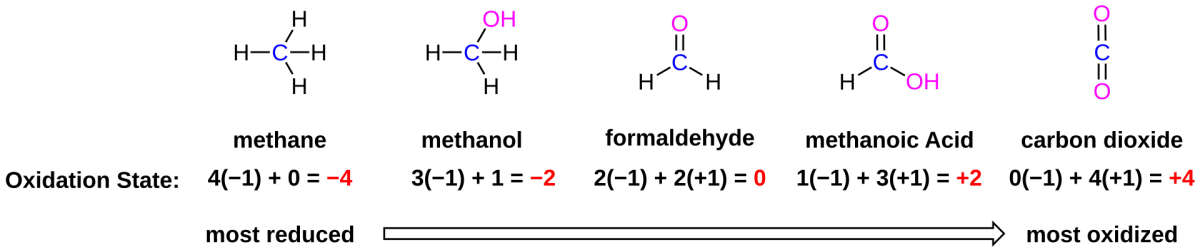
The clearest way to see organic redox is the methane → CO₂ ladder:
Compound
Formula (for C)
Bonds at C
Oxidation state
Methane
CH₄
4 C-H
−4
Methanol
CH₃OH
3 C-H, 1 C-O
−2
Formaldehyde
CH₂O
2 C-H, 2 C-O (double bond = 2 bonds to O)
0
Formic acid
HCOOH
1 C-H, 3 C-O
+2
Carbon dioxide
CO₂
4 C-O
+4
Each step up the ladder adds one C-O bond or removes one C-H bond. That is why this sequence represents progressive oxidation of a single carbon.
Oxidation states of carbon in methane (−4), methanol (−2), formaldehyde (0), methanoic (formic) acid (+2), and carbon dioxide (+4). Each step up the ladder replaces a C-H bond with a C-O bond. Credit: Wikimedia Commons, CC BY-SA
Organic Redox Signals: Watch the Heteroatoms
You rarely need to calculate oxidation states explicitly. Instead, scan the functional group changes:
1° alcohol → aldehyde: gain one C-O bond (C=O replaces C-OH but C lost one C-H to get there). Oxidation.
Aldehyde → carboxylic acid: gain one more C-O bond. Oxidation.
Ketone → 2° alcohol: reverse (reduction - add one C-H, lose a C-O bond).
Alkene → alkane: gain two C-H bonds, lose no C-O bonds. Reduction.
Alkane → alkyl halide: lose one C-H, gain one C-X. Oxidation.
Alcohol → ether: no change at carbon (still one C-O bond, just a different oxygen partner). Neither.
The MCAT exploits this pattern: “which of the following is an oxidation?” is answered by counting C-O/C-H shifts.
Common Organic Oxidizing Agents
These reagents take hydrogens off a substrate (or add oxygens, usually amounting to the same thing):
In biochem, “oxidation” often means the substrate donated a hydride to NAD⁺; “reduction” means NADH donated a hydride to the substrate. The ladder logic still applies - ethanol to acetaldehyde to acetic acid is a standard NAD⁺-catalyzed oxidation sequence in liver alcohol metabolism.
Tracking Oxidation in Multi-Step Reactions
For MCAT passages with multi-step mechanisms, confirm redox balance by tallying:
Before: oxidation state of key carbon.
After: oxidation state of that carbon.
Change: increase = oxidation, decrease = reduction, zero = no redox.
Change = +3 − (−1) = +4. A four-electron oxidation (matching 2 × NADH in the biochemistry pathway, or one strong chemical oxidant like Jones).
What is the oxidation state of the central carbon in formaldehyde (HCHO)?
Click to reveal answer
0. The central carbon has two C-H bonds (−1 each, total −2), one C=O double bond (+1 for each of the two bond pairs, total +2), and no C-C bonds. Sum = −2 + 2 = 0. Formaldehyde sits in the middle of the carbon oxidation ladder.
Classify the following as oxidation, reduction, or neither: (a) 2-propanol → acetone, (b) ethene → ethane, (c) methanol → methoxide, (d) acetaldehyde → ethanol.
Click to reveal answer
(a) Oxidation - gain a C=O, lose a C-H. (b) Reduction - add two C-H bonds to the pi system. (c) Neither - only a proton is removed; oxidation state of carbon is unchanged. (d) Reduction - add a C-H bond (formally two, if you count the reverse of oxidation); the C=O is reduced to C-OH.
The next section explains the visual grammar of all these mechanisms: curved arrows, which show electrons flowing between source and sink.
If mechanism is the grammar of organic chemistry, curved arrows are the alphabet. Every single reaction you will ever see in an organic textbook - every MCAT mechanism question - is expressed using two kinds of curved arrows. Once you know how to read and draw them, mechanisms stop being memorization and start being logic puzzles.
The single most important rule: a curved arrow shows where electrons are moving. It does NOT show atoms moving. The tail of the arrow starts at the electron source; the head of the arrow points to the electron sink (where the electrons end up). If you can identify the source and sink in each step, you can draw the arrows automatically.
Two Types of Arrows
Organic mechanism uses exactly two arrow styles:
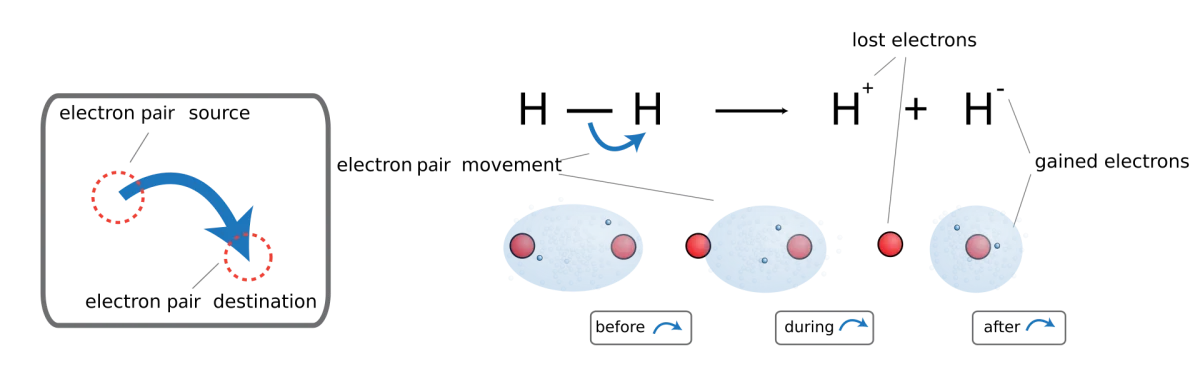
Double-headed curved arrow - represents the movement of a pair of electrons. Used in essentially all ionic (polar) mechanisms. The tail comes from a lone pair or a bond; the head points to an atom, an empty orbital, or the space where a new bond will form.
A double-headed curved arrow represents the flow of a pair of electrons. Used in polar (ionic) mechanisms. Credit: Wikimedia Commons, CC BY-SA 4.0
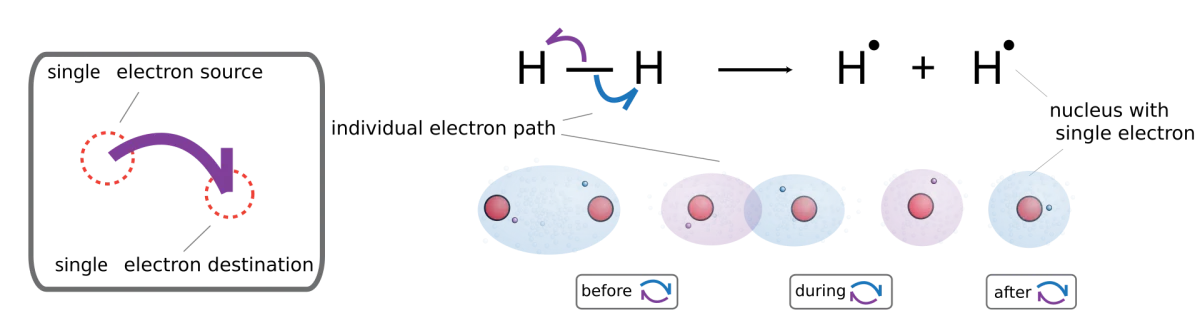
Single-headed curved arrow (fishhook) - represents the movement of a single electron. Used in radical mechanisms only. A bond breaking homolytically produces two fishhooks, one pointing each way.
A single-headed curved arrow (fishhook) represents the movement of a single electron. Used only in radical (homolytic) mechanisms. Credit: Wikimedia Commons, CC BY-SA 4.0
If your mechanism involves ions or polar intermediates, use double-headed arrows. If it involves radicals (odd electrons, homolytic bond cleavage), use fishhooks. Mixing these is a common student error and a clear sign the mechanism is drawn wrong.
Four Rules for Drawing Arrows Correctly
Tail at the source (electrons), head at the destination. Never the reverse. An arrow from an empty orbital to a lone pair is wrong, even if it “looks” right.
Arrows move electrons, not atoms. Atoms go along for the ride. If an atom “moves” in your drawing, it is because a new bond formed there - but the arrow itself shows only the electron motion.
Conserve electrons and formal charges. Check that the total charge is the same before and after each arrow. If a step creates a formal charge imbalance, an arrow is missing.
Do not combine arrows. Each arrow represents one elementary event: one bond forming or one bond breaking. If a step has two changes happening, draw two separate arrows.
The Three Types of Elementary Events
Every curved arrow in a polar mechanism represents one of three events:
Event 1: Bond breaking heterolytically. A bond breaks, and both electrons go to one atom (forming an anion) while the other atom becomes cation or neutral. The arrow starts at the bond and points toward the atom that keeps the electrons.
Example: H-Br → H⁺ + Br⁻. Arrow starts at the H-Br bond, points toward Br.
Event 2: Bond forming. A nucleophile’s lone pair attacks an electrophile. The arrow starts at the lone pair and points to the electrophilic atom.
Example: OH⁻ attacks a carbocation. Arrow starts at oxygen’s lone pair, points to the positive carbon.
Event 3: Bond moving (resonance or pi-shift). An existing bond shifts to a new location. Two arrows are usually needed: one to move the pi bond to a new position, another to move any displaced electrons.
Example: allyl cation resonance. Arrow moves the C=C to a new position; simultaneously, the positive charge shifts to the other end.
Sample Mechanism: SN2
The SN2 mechanism has exactly two arrows:
Arrow 1: nucleophile’s lone pair → attack the electrophilic carbon. A new C-Nu bond forms.
Arrow 2: the C-LG bond → LG atom. The LG departs with both electrons.
Both arrows are drawn in the same step because SN2 is concerted. Total: two arrows, one step. If you can draw these two arrows correctly, you have the mechanism.
Sample Mechanism: E2
Also concerted, also two arrows:
Arrow 1: base’s lone pair → attack the beta-H. A new base-H bond forms.
Arrow 2: the C-H bond → adjacent carbon (not to H). A new C=C pi bond forms.
Arrow 3: the C-LG bond → LG atom. The LG departs.
Three arrows, one step. All drawn together. The difference from SN2: the base is attacking the proton, and the electrons that were in the C-H bond become the new pi bond.
Arrow 1: carbonyl oxygen’s lone pair → H of the acid. A new O-H bond forms.
Arrow 2: the H-X bond → halide. The halide leaves with both electrons.
Step 2: Nucleophile attacks activated carbonyl.
Arrow 1: nucleophile’s lone pair → carbonyl carbon. A new C-Nu bond forms.
Arrow 2: the C=O pi bond → oxygen. The positive charge migrates onto oxygen, which becomes neutral… wait, the oxygen was already positively charged from protonation. So this arrow neutralizes it. Check your formal charges at each step.
Step 3: Deprotonation.
Arrow 1: base’s lone pair → H on the newly-added nucleophile. A new base-H bond forms.
Arrow 2: the Nu-H bond → Nu. The H+ leaves as a proton on the base.
Four or five arrows total across three steps. Each step isolates one elementary event, and each arrow does exactly one thing.
Common Arrow-Pushing Mistakes
Drawing arrows from H to a nucleophile in protonation. Wrong. The arrow goes from the nucleophile’s lone pair to the H. The H has no lone pair to donate - it is the electrophile.
Missing a bond-breaking arrow. When a nucleophile attacks a C-LG substrate, you must also show the LG leaving. Otherwise the carbon ends up with 5 bonds.
Drawing arrows on spectator atoms. Sodium, potassium, and other counterions usually do not participate in the mechanism - do not include them in your arrows.
Mixing arrow types. If you are drawing an ionic mechanism, use double-headed arrows throughout. If you switch to fishhooks mid-mechanism, something is wrong (or the mechanism is actually a radical one).
Drawing an arrow from an empty orbital. Empty orbitals accept electrons; they do not donate them. The source must have electrons.
Reading Arrows Backwards
A powerful diagnostic: if you cannot tell what a mechanism is doing, try running the arrows backwards. Every forward arrow has an equivalent backward arrow (the reverse reaction). If the backward mechanism makes sense (going from products to reactants), your forward arrows are probably right. If the backward version is nonsensical, there is an error.
Running arrows backward also teaches you about equilibria. Most organic reactions are reversible in principle, and the forward/reverse arrow patterns are mirror images. Esterification (forward) and ester hydrolysis (backward) use exactly the same arrows in reverse order.
A student draws an arrow from a methyl cation (CH₃⁺) toward a lone pair on water, attempting to show water’s attack on the cation. Is the arrow correct?
Click to reveal answer
No. The arrow is backwards. The cation has an empty orbital - it is the electron SINK, not the source. The water has the lone pair - it is the electron SOURCE. The arrow should go FROM the water’s lone pair TO the cation’s empty orbital. Every arrow points from electrons to emptiness, not the other way around.
How many curved arrows does a complete E2 mechanism require, and what does each one show?
Click to reveal answer
Three arrows. Arrow 1: base’s lone pair to the beta-hydrogen (forming the new base-H bond). Arrow 2: the C-H bond to the adjacent carbon (forming the new pi bond). Arrow 3: the C-LG bond to the leaving group (LG leaves with both electrons). All three happen in the same concerted step.
The next section explains why some of the intermediates in these mechanisms exist at all - the stability rules for carbocations.
Practice: Draw the Arrows Yourself
Theory is one thing; putting arrows onto a page is another. Drag a curved arrow on the canvas below from an electron source (a lone pair or a bond) to its destination. The tool validates each arrow against the expected mechanism and explains where you went wrong if you pick an incorrect source or sink. Three warm-up problems cover the core MCAT patterns: acid-base, SN2, and E2.
Arrow-pushing practice
Interactive
Ammonia abstracts a proton from HCl. Draw the single curved arrow that shows electron flow.
Carbocations are the critical intermediates in SN1 and E1 reactions. Their stability determines whether a reaction goes fast, slow, or not at all. The rules are simple: the more substituted the carbocation, the more stable it is; resonance delocalization makes it even more stable; and if a rearrangement can form a more stable cation, it will.
If you can rank any two carbocations by stability in under five seconds, you can predict SN1/E1 outcomes, spot potential rearrangements, and identify likely intermediates on any passage. This ranking is the foundation of Ch 5’s SN1/E1 decision work.
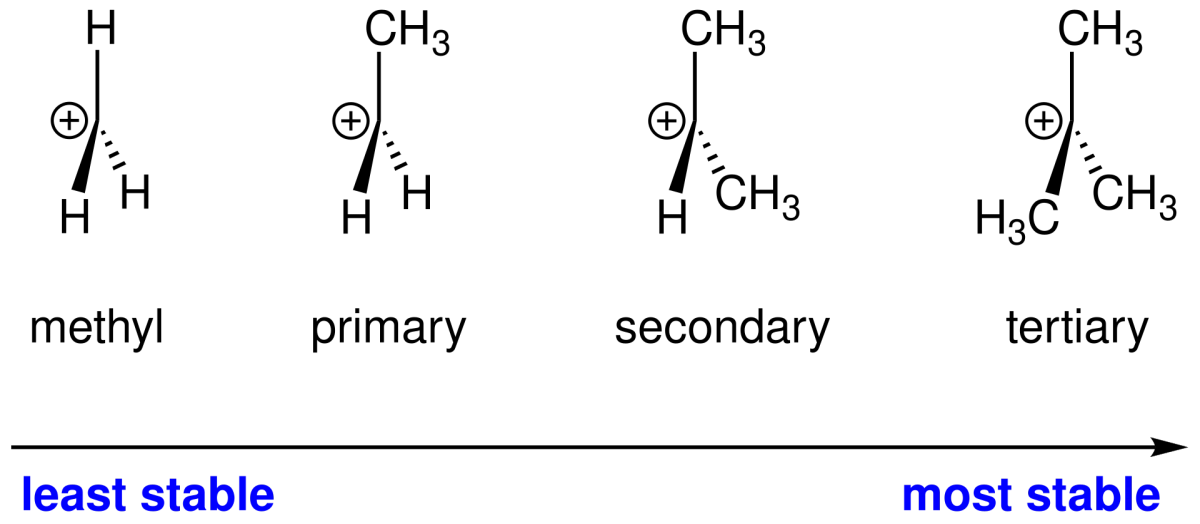
The classic carbocation stability series: methyl < primary < secondary < tertiary. Each additional alkyl group stabilizes the positive charge through hyperconjugation and induction. Credit: Wikimedia Commons, CC BY-SA
An allyl cation (CH₂=CH-CH₂⁺) is about as stable as a 2°-3° alkyl cation. A benzyl cation (C₆H₅-CH₂⁺) is comparable. Combine the two (a 3° allyl cation) and you get an especially stable cation that dominates any mechanism it can form.
Why More Substituted = More Stable
Two effects are at work. You need both to explain the full trend.
Effect 1: Inductive donation. Alkyl groups are weakly electron-donating (relative to hydrogen). A methyl group next to a positive carbon pushes some electron density toward the positive center, reducing the formal charge on that single atom. More alkyl groups = more donation = more stabilization.
Effect 2: Hyperconjugation. This is the big one. The C-H bonds on adjacent carbons overlap with the empty p orbital on the cation. The bond pair in the neighboring sp³ C-H partially “donates” into the empty p orbital, delocalizing electron density and lowering the energy of the cation. Each adjacent C-H bond that can align with the empty orbital contributes.
More adjacent C-H bonds = more hyperconjugation = more stable cation.
Hyperconjugation: the sigma bond of an adjacent C-H overlaps with the empty p orbital on the carbocation, donating electron density and stabilizing the positive charge. Credit: Wikimedia Commons, CC BY-SA
Resonance Stabilization: Allyl and Benzyl
Adjacent pi systems provide even more stabilization than alkyl donation. The empty p orbital on the cation lines up with the pi system of a nearby alkene or aromatic ring, delocalizing the positive charge over multiple atoms.
Allyl cation (CH₂=CH-CH₂⁺): the positive charge is equally shared between the end carbons. The C=C pi bond and the empty p orbital merge into a three-center, two-electron system. Energy is distributed over two carbons instead of one.
Benzyl cation (Ph-CH₂⁺): the positive charge delocalizes into the benzene ring’s aromatic pi system, spreading the charge to the ortho and para positions of the ring. Three resonance contributors plus the original Kekulé structure combine to stabilize the cation significantly.
Allyl and benzyl cations are so stable that they form preferentially in mechanisms even over tertiary alkyl cations if resonance is available. Para-methoxybenzyl cations (with an additional donor on the ring) are even more stabilized - routinely used as “protecting groups” in synthesis because they form cleanly under mild conditions.
Adjacent Heteroatoms: Lone-Pair Donation
A lone pair on an adjacent heteroatom can stabilize a cation through resonance:
Oxocarbenium ion (C⁺-OR): the oxygen donates a lone pair into the empty p orbital, forming a partial double bond with positive charge now shared on oxygen. Very stable.
Iminium ion (C⁺-NR₂): similar idea with nitrogen lone pair. Even more stable because N is less electronegative than O, so it shares the charge more willingly.
This is why acetals and aminals form stable cationic intermediates in mechanisms. In Ch 6, the acetal formation mechanism relies heavily on oxocarbenium intermediates.
Destabilizing Effects
Not everything helps. Some structures destabilize a cation:
Electron-withdrawing groups nearby (Cl, Br, -CF₃, -NO₂) pull electron density away and amplify the positive charge. A carbon with a neighboring CF₃ group has a much less stable cation.
Anti-aromatic rings destabilize if the cation is in the ring and makes the system 4n pi electrons. Cyclopentadienyl cation, for example, is strongly destabilized because removing one electron from the ring system produces a 4-pi-electron anti-aromatic species.
sp or sp² cation centers (outside of allyl/benzyl, where resonance helps) are generally less stable than sp² carbocations on sp³ carbons. Vinyl cations and phenyl cations are exceptionally unstable.
Carbocation Rearrangements
Here is a fundamental rule that catches every student the first time: carbocations rearrange whenever a more stable cation is possible. If a 2° cation sits next to a carbon with an H or an alkyl group that would produce a 3° cation upon migration, the rearrangement will happen - fast.
Two common rearrangements:
1,2-Hydride shift: a hydrogen with its bond pair migrates from an adjacent carbon to the cation, swapping the positive charge.
1,2-Alkyl shift (usually methyl): an alkyl group with its bond pair migrates from an adjacent carbon to the cation.
Both occur because they convert a less stable cation into a more stable one. Rearrangements are especially common in SN1/E1 mechanisms because the cation is relatively long-lived (microseconds rather than femtoseconds).
Example: 2-bromobutane ionizes to a 2° cation, which does not rearrange because shifting would give another 2° cation. But 3-bromo-2,2-dimethylbutane ionizes to a 2° cation that can rearrange via a methyl shift from the adjacent quaternary carbon, producing a 3° cation. The products reflect the rearrangement, and students who ignore rearrangements predict the wrong product.
Impact on Mechanism Choice
Substrate type → preferred mechanism (from Ch 5):
Methyl / 1° substrate → SN2/E2 only (cation too unstable to form; SN1/E1 never happen).
2° substrate → mix of mechanisms; depends on nucleophile, base, and solvent.
3° substrate → SN1/E1 favored (cation is stable enough to form); SN2 is blocked by steric bulk.
Allyl / benzyl substrate → SN1/E1 or SN2 all work well; fast in either case because the cation is stable AND the substrate is not too hindered.
Rank these cations from most to least stable: methyl, tert-butyl (3° alkyl), allyl (CH₂=CHCH₂⁺), isopropyl (2° alkyl).
Click to reveal answer
Tert-butyl > allyl ≈ isopropyl > methyl. Tertiary alkyl with 9 hyperconjugating C-H bonds is the most stable. Allyl and secondary alkyl are close - allyl's resonance delocalizes charge over 2 carbons; isopropyl has 6 hyperconjugating C-H bonds. Methyl has zero stabilization. Note: in some contexts 3° > benzyl > allyl > 2° > 1° > methyl is the common textbook ranking; individual stability depends on the full substrate context.
In the ionization of 2-chloro-3,3-dimethylbutane under SN1 conditions, will the initially formed cation rearrange? If so, to what?
Click to reveal answer
Yes, it rearranges via a 1,2-methyl shift. Initial ionization gives a 2° cation on C2. The adjacent C3 is quaternary (carrying three methyl groups). One of those methyls can migrate to C2 with its bond pair, converting C2 to 3° and leaving the new cation on C3 (now 3°). Products will reflect the rearranged 3° cation, not the original 2° cation. This is a classic MCAT scenario for recognizing carbocation rearrangements.
The next section does the same job for the opposite species: carbanions, where the ranking rules are all inverted.
Carbanions are the mirror image of carbocations. Where cations have an empty orbital and a positive charge, carbanions have a filled orbital with a lone pair and a negative charge. And where the stability trend for cations is 3° > 2° > 1° > methyl, the trend for carbanions runs in reverse: methyl > 1° > 2° > 3°.
The reason is the same physics, just flipped. Alkyl groups donate electron density. A positive charge welcomes that donation (hence more substituted = more stable cation). A negative charge is repelled by additional electron density, so fewer alkyl donors = more stable anion.
The Stability Order
From most to least stable (for simple alkyl carbanions):
Note: all alkyl carbanions are unstable as free species; this ranking describes their relative stability. Alkyl carbanions only exist as reactive intermediates, usually stabilized by a metal counterion (e.g., in Grignards and organolithiums).
Adjacent electron-withdrawing groups flip the trend - they stabilize carbanions rather than destabilizing them. So the most stable carbanions in practice are those next to a carbonyl (enolates) or other strong withdrawing groups.
This is how enolates, nitromethane anions, and malonates are so stable. A carbanion with a lone pair adjacent to a C=O pi bond can delocalize the negative charge onto the oxygen via resonance. The result is essentially an oxygen anion (alkoxide-like), which is much more stable than a carbon anion.
Enolate of acetone (pKa alpha-H = 20): the anion has the negative charge split between the alpha-carbon and the carbonyl oxygen.
Malonate dianion (pKa alpha-H = 13): the central carbanion delocalizes onto BOTH flanking carbonyl oxygens. The conjugate base of malonate is extremely stable.
Nitromethane anion (pKa = 10): the carbanion delocalizes onto two oxygens of the NO₂ group.
These stabilizing groups are why alpha-carbon acidity (Section 4.3, orbital-R factor) is so pronounced.
As discussed in Section 4.3, orbitals with more s-character sit closer to the nucleus and stabilize a lone pair (or negative charge) better:
sp³ carbanion (25% s-character): alkyl anion - least stable.
sp² carbanion (33% s-character): vinyl anion - more stable.
sp carbanion (50% s-character): acetylide anion - most stable of these three.
Terminal alkynes can be deprotonated by NaNH₂ because the acetylide ion (sp) is stable enough to exist as a discrete anion. Vinyl and alkyl anions require much stronger bases (n-BuLi, tBuLi) and are usually generated in situ with no isolation.
Common Stable Carbanions in Organic Chemistry
Memorize these as the carbanion menu:
Carbanion
Source
Approximate pKa of C-H
Acetylide (R-C≡C⁻)
Terminal alkyne + NaNH₂
25
Enolate (alpha-H of ketone/aldehyde)
Ketone + strong base (LDA, NaH)
20 (for ketones), 17 (for aldehydes)
Stabilized alpha-H (1,3-dicarbonyl, nitro)
Diketone/malonate + NaOEt
10-13
Grignard carbanion (R-MgX)
R-X + Mg
N/A (prepared via oxidative insertion)
Organolithium (R-Li)
R-X + Li metal
N/A
Ylides (R₃P⁺-CR₂⁻)
Phosphonium salt + base
varies
Why Grignards Work
A Grignard reagent (R-MgX) is a carbon-magnesium bond with a strong polarization. The C-Mg bond is polarized so that the carbon carries significant partial negative charge (δ⁻ on C, δ⁺ on Mg). In effect, you have a carbanion stabilized by a magnesium counterion.
The carbanion character is strong enough that the carbon acts as a powerful nucleophile. Grignards attack carbonyls readily - too readily, in fact. They react with water, alcohols, and any acidic proton instantly, which is why Grignards must be kept bone-dry. One drop of water destroys them.
Organolithium reagents (R-Li) are even more carbanion-like because the C-Li bond is more polarized than C-Mg. n-BuLi is commonly used to deprotonate extremely weak acids (pKa > 30) that amide bases cannot touch.
Enolates: The MCAT’s Favorite Carbanions
Enolates dominate Ch 7. Quick preview:
Base removes the alpha-H of a carbonyl (alpha-C is the carbon directly bonded to C=O).
Resulting anion has two resonance forms: the carbanion form (charge on alpha-C) and the enolate form (charge on the oxygen, with C=C between alpha-C and carbonyl-C).
The enolate form is the major contributor because negative charge is better on oxygen than carbon.
Enolates attack other electrophiles: another carbonyl (aldol), an alkyl halide (alpha-alkylation), an alpha-beta unsaturated carbonyl (Michael addition).
The pKa anchors (Section 4.3) are essential here. An alpha-H of a ketone (pKa 20) is deprotonated by LDA (conjugate acid amine pKa 36) but not by ethoxide (pKa 16). A 1,3-dicarbonyl alpha-H (pKa 10-13) can be deprotonated by hydroxide or ethoxide - much easier to form.
Ylides: Neutral Carbanion Equivalents
Some species behave as carbanions without a formal negative charge. Ylides are the most common example:
Phosphonium ylide (Wittig reagent, R₃P⁺-CR₂⁻): the adjacent positive phosphorus stabilizes the carbanion. Used to convert ketones to alkenes.
Sulfur ylides: similar structure with sulfur as the stabilizing positive atom.
Ylides are neutral overall but have significant carbanion character at the carbon. The phosphonium Wittig reagent is a key player in making defined-geometry alkenes from carbonyls - covered in Ch 10.
Carbanion vs. Strong Base: Same Molecule, Different Role
A molecule with a carbanion is also a strong base. In fact, the stronger the carbanion, the stronger the base (because the conjugate acid - the protonated carbon - has a high pKa). This means carbanion reagents can be used as:
Nucleophiles (attack an electrophilic carbon to form a new C-C bond).
Bases (remove a proton from a nearby acid).
Which role wins depends on the substrate. Carbanions with no steric bulk attached (methyl lithium, phenyl lithium) tend to attack as nucleophiles. Bulky carbanions (sec-BuLi, tert-BuLi, LDA) tend to act as bases because their steric bulk prevents nucleophilic attack on hindered carbons.
Students often treat Grignards as “always nucleophiles” and organolithiums as “always bases,” but both can do both. The substrate and conditions decide.
Rank these carbanions from most to least stable: methyl carbanion (CH₃⁻), acetylide (HC≡C⁻), acetone enolate, tert-butyl carbanion.
Click to reveal answer
Acetone enolate > acetylide > methyl > tert-butyl. Enolate wins because the negative charge delocalizes onto oxygen. Acetylide is next because sp hybridization (50% s-character) holds the lone pair tightly. Methyl beats tert-butyl because alkyl donors destabilize carbanions (the reverse of carbocations - tert-butyl has three alkyl donors that push electrons onto an already-negative carbon).
Why does a Grignard reagent fail if any water is present in the reaction?
Click to reveal answer
The Grignard's carbanionic carbon is extremely basic and reacts with any acidic proton immediately, including O-H bonds in water. The reaction R-MgX + H-O-H → R-H + Mg(OH)X happens essentially instantly. The Grignard is destroyed and converted to an alkane, with no carbon-carbon bond formation. Same holds for alcohols, amines, and any protic solvent. Grignards must be handled in dry ether or THF.
The last two sections cover less-common but still testable topics: free radicals (odd-electron species) and the thermodynamic-vs-kinetic choice that decides which product dominates.
Radicals are species with an unpaired electron. They are the oddballs of organic chemistry: neither positively nor negatively charged, drawn with a single dot instead of curved arrows, and reacting via fishhook single-electron pushes. The MCAT does not test radical chemistry in great depth, but it does test the core mechanism of radical halogenation, the stability ranking of radicals, and the reasoning behind the famous bromine-chlorine selectivity difference.
A radical forms when a bond breaks homolytically - each atom walks away with one electron. Radicals are highly reactive because they are missing one electron from a normal pair, and they will seize an electron from almost any source to complete the pair.
Radical Stability Parallels Carbocation Stability
The stability trend for radicals mirrors carbocations:
Why? Radicals have an unpaired electron in a p orbital. The same hyperconjugation and induction effects that stabilize a positive p-orbital vacancy also stabilize a single-electron p orbital. Adjacent alkyl groups donate a small amount of electron density into the half-filled orbital, stabilizing the radical.
Allyl and benzyl radicals get additional stabilization from resonance into adjacent pi systems, just like their cationic counterparts.
Radical Halogenation: The Core Reaction
Radical halogenation replaces a C-H bond with a C-X bond using molecular halogen (Cl₂ or Br₂) and a spark of light or heat to kick off the radical chain. The overall reaction:
R-H + X₂ → R-X + HX
The mechanism has three stages:
Stage 1: Initiation. A halogen molecule is homolytically split by light or heat:
X₂ + heat/light → 2 X• (two halogen radicals)
Each halogen now has an unpaired electron and is reactive.
Stage 2: Propagation. This is where the product actually forms, and it involves two steps that repeat many times:
Step 2a: X• + R-H → HX + R• (the halogen radical steals a hydrogen, producing HX and an alkyl radical)
Step 2b: R• + X₂ → R-X + X• (the alkyl radical attacks a new X₂ molecule, producing the product R-X and regenerating a halogen radical)
The regenerated halogen radical goes back to step 2a and the cycle continues. Thousands of product molecules can form from a single initiation event because propagation is a self-sustaining chain.
Stage 3: Termination. Two radicals find each other and combine, removing both from the system:
X• + X• → X₂
R• + R• → R-R
R• + X• → R-X
Termination ends the chain. Because radical concentrations are very low, termination steps are rare compared to propagation steps - which is why a tiny amount of initiator can produce a lot of product.
Br₂ vs. Cl₂: The Selectivity Difference
Here is where the MCAT loves to test:
Bromination (Br₂) is highly selective. On a propane molecule (which has both 1° and 2° C-H bonds), bromination gives almost exclusively 2-bromopropane, not 1-bromopropane. The 2° C-H is ~97 times more reactive than the 1° C-H.
Chlorination (Cl₂) is much less selective. On the same propane, chlorination gives a mixture roughly matching the statistical ratio of 1° to 2° hydrogens, with only a small preference for 2°. The 2° C-H is only ~4 times more reactive than the 1° C-H.
Why the difference? Two reasons interlock:
Reason 1: Bond dissociation energies. The C-H bond must break in the rate-limiting propagation step. Br• is less reactive than Cl•, so the transition state for Br-H formation looks more like a radical intermediate (late transition state). A late transition state means the stability of the resulting radical dominates the transition-state energy - and the 2° radical is much more stable than the 1° radical. So bromination strongly prefers the path that gives the more stable radical.
Reason 2: Hammond’s postulate. For a highly exothermic step (like chlorination’s H-abstraction), the transition state looks more like the starting material (early TS). The differences between 1° and 2° C-H are not amplified in the TS because the TS is not yet very radical-like. For a less exothermic step (bromination’s H-abstraction), the TS looks more like the radical product (late TS), amplifying the stability differences.
The takeaway: bromination is selective for the most substituted C-H because it has a late transition state; chlorination is unselective because it has an early transition state. This is a classic Hammond’s postulate application, and MCAT passages test it.
Benzylic and Allylic Halogenation
Radical halogenation is especially favorable at benzylic and allylic positions (C-H bonds adjacent to a benzene ring or alkene, respectively). The resulting radicals are resonance-stabilized, which makes the abstraction step faster AND more selective.
NBS (N-bromosuccinimide) is a reagent designed to selectively brominate allylic or benzylic C-H bonds at low bromine concentration (to prevent alkene addition side reactions). NBS halogenation follows the same three-stage mechanism, just with a controlled source of Br₂.
Oxygen Radicals in Biology
Radical chemistry is not just a lab curiosity. Reactive oxygen species (ROS) - superoxide (O₂•⁻), hydroxyl radical (HO•), peroxyl radicals (ROO•) - are central to oxidative stress, inflammation, and cancer biology. The same mechanism logic applies: a radical abstracts an H from a biomolecule (DNA, lipid, protein), producing a new radical that continues the chain.
Antioxidants (vitamin E, vitamin C) work as radical chain terminators. They donate an H atom to a propagating radical, forming a stabilized “antioxidant radical” that is too stable to continue the chain. This is covered in more detail in Biochemistry Ch 11.
In the radical bromination of 2-methylpropane (isobutane), what is the major product and why?
Click to reveal answer
2-bromo-2-methylpropane (tert-butyl bromide). Isobutane has nine 1° C-H bonds and one 3° C-H bond. Despite the statistical disadvantage (9:1), bromination is so selective for the more stable radical that the 3° bromide product dominates. The 3° radical is much more stable than a 1° radical (three alkyl groups donating via hyperconjugation vs. one), and bromination's late transition state amplifies this difference.
What is the rate-limiting propagation step in radical halogenation, and why does its transition state character (early vs. late) determine selectivity?
Click to reveal answer
Rate-limiting step: H abstraction (X• + R-H → H-X + R•). For bromination, this step is weakly exothermic (or mildly endothermic) because Br-H is weak and C-H is strong. A weakly exothermic step has a late transition state that looks like the radical product - stability differences between 1°, 2°, 3° radicals translate to big differences in activation energy. For chlorination, the step is strongly exothermic, giving an early transition state where radical character is small - all C-H bonds look similar, so selectivity is low. This is Hammond's postulate applied to radical halogenation.
The final section connects back to reaction outcomes: when two products are possible, which one do you get - the kinetic product (formed faster) or the thermodynamic product (lower energy)?
When a reaction can produce two different products, which one do you actually get? Sometimes the answer is the most stable product (the one with the lowest free energy). Sometimes the answer is the product that forms the fastest, even if it is higher in energy than an alternative. The difference is thermodynamic control vs. kinetic control, and knowing which applies lets you predict products that would otherwise seem contradictory.
The choice hinges on one question: is the reaction reversible under the conditions?
If yes (usually at high temperature, long reaction time), the products equilibrate and the most stable (lowest-energy) product dominates. This is thermodynamic control.
If no (usually at low temperature, short reaction time), the products are trapped where they first formed. The fastest-forming product dominates, regardless of stability. This is kinetic control.
The Energy Diagram
Picture a reaction with two possible products, A and B:
Product A has a lower activation energy (faster to form) but higher product energy (less stable).
Product B has a higher activation energy (slower to form) but lower product energy (more stable).
At low temperature, most molecules do not have enough energy to get over either barrier quickly, but the lower barrier (for A) wins the race. Once A forms, there is not enough energy to reverse A back to starting material and try again. A dominates.
At high temperature (or long reaction time), enough energy is available to cross both barriers. Both products form AND both products can reverse back to starting material. The system equilibrates, and over time the population shifts toward the lower-energy product B. B dominates.
Classic Example: Addition of HBr to 1,3-Butadiene
This is the textbook example. 1,3-Butadiene is a conjugated diene, and HBr addition gives two possible products:
1,2-addition product (3-bromo-1-butene): faster to form. Lower activation energy because the cation intermediate forms on the more stable secondary position closer to the proton attack site.
1,4-addition product (1-bromo-2-butene): slower to form but more stable thermodynamically. The C=C double bond in the 1,4-product is internal and disubstituted (more stable than terminal), whereas the 1,2-product has a terminal monosubstituted alkene.
At −80°C: 80% 1,2-product, 20% 1,4-product. Kinetic control.
At 40°C: 20% 1,2-product, 80% 1,4-product. Thermodynamic control.
Same reactants, same reaction mechanism, only the temperature changes. The ratio of products shifts dramatically because at high temperature the reaction becomes reversible and equilibrates to the more stable product.
Enolate Formation: Kinetic vs. Thermodynamic Enolates
Another important example from Ch 7:
Asymmetric ketones (ketones with two different alpha-carbons) have two possible enolates depending on which alpha-H is removed:
Kinetic enolate: the less substituted alpha-H is removed. Less steric hindrance means faster deprotonation. This enolate has the LESS substituted C=C double bond.
Thermodynamic enolate: the more substituted alpha-H is removed. More steric hindrance means slower deprotonation but the resulting enolate has the MORE substituted (more stable) C=C.
How do you choose which one forms? Reagent and conditions:
LDA at −78°C: gives the kinetic enolate. LDA is bulky (cannot reach the more hindered alpha-H), and low temperature prevents equilibration.
NaH or KH at room temperature: gives the thermodynamic enolate. Less steric block, reversible deprotonation, reaches the more stable product.
This control is important in synthesis and sometimes appears on MCAT passages when an aldol product’s regiochemistry is in question.
Hammond’s Postulate: How Product Stability Affects TS Energy
Hammond’s postulate connects thermodynamics and kinetics:
For an exothermic (energetically downhill) step, the transition state looks like the starting material (early TS). The TS is low in energy, and product stability has little effect on activation energy.
For an endothermic (energetically uphill) step, the transition state looks like the product (late TS). The TS is high in energy, and product stability strongly affects activation energy - more stable products have lower activation energies even in this direction.
For a thermoneutral step, the TS is somewhere in between.
This is why selectivity in radical bromination is so high: the H-abstraction step is roughly thermoneutral/slightly endothermic, with a late TS. The stability of the resulting radical translates directly to the stability of the TS. Chlorination’s H-abstraction is much more exothermic with an early TS, so radical stability matters less and selectivity is low.
Driving Thermodynamically Unfavorable Reactions
Sometimes you need a product that is higher in energy than the starting material (the reaction would “want” to run in reverse). Three standard tricks:
Remove the product as it forms (distillation, precipitation). By Le Chatelier’s principle, removing the product drives the equilibrium forward.
Couple to an energetically favorable reaction (like ATP hydrolysis in biology). This is the biochemical trick for driving thermodynamically uphill reactions in cells.
Use excess of one reagent to push the equilibrium toward the product side.
Energy Diagrams Show It All
A well-drawn energy diagram tells you kinetic vs. thermodynamic at a glance:
Look at the activation energies of the forward steps. The lowest Ea gives the kinetic product.
Look at the energies of the final products. The lowest product energy gives the thermodynamic product.
If these two are different products, the temperature will decide the outcome.
If the lowest Ea and the lowest product energy belong to the same product, there is no conflict - that product is the winner regardless of conditions.
MCAT-Level Summary
For any “two-product” question on the MCAT:
Identify the two possible products.
Determine which is lower in energy (thermodynamic product).
Determine which forms faster (kinetic product - usually has the lower-energy TS).
Read the conditions: low T + short time = kinetic product; high T + long time = thermodynamic product; reaction irreversibility = kinetic.
Pick the answer consistent with the conditions.
1,3-butadiene + HBr at −80°C gives mostly 3-bromo-1-butene (the 1,2-product). At 40°C it gives mostly 1-bromo-2-butene (the 1,4-product). Explain this observation in kinetic vs. thermodynamic terms.
Click to reveal answer
At low T, the reaction is under kinetic control: the faster-forming 1,2-product is trapped because there is not enough energy to reverse it. At high T, the reaction is under thermodynamic control: both products form and can interconvert, reaching equilibrium favoring the more stable 1,4-product (because its C=C is disubstituted and more stable). Same mechanism, same starting materials - only temperature decides the outcome.
A ketone has two different alpha-carbons. LDA at −78°C generates the kinetic enolate; NaH at 50°C generates the thermodynamic enolate. Which enolate has the more substituted C=C, and why?
Click to reveal answer
The thermodynamic enolate has the more substituted C=C. More substituted alkenes are more stable (hyperconjugation, induction). NaH at 50°C allows deprotonation to equilibrate, reaching the more stable enolate. LDA at −78°C does not allow equilibration - it removes whichever proton is easiest to reach (the less hindered alpha-H), producing the less substituted enolate (kinetic). The bulky LDA cannot easily reach the more hindered alpha-H.
What This Chapter Gives You
You now have the master toolkit for every organic reaction to come:
Acids and bases (Brønsted and Lewis).
pKa and the rule of equilibrium pointing to the weaker acid.
ARIO framework for ranking acidity from structure.
Nucleophiles and electrophiles - the partners in every bond-forming step.
Leaving groups and how to activate them.
Oxidation states of carbon and the OIL RIG ladder.
Curved arrow pushing - the grammar of mechanism.
Carbocation and carbanion stability rules.
Radical stability and the Br₂ vs. Cl₂ selectivity.
Kinetic vs. thermodynamic control.
Every reaction chapter in this book (Chs 5 through 10) applies these tools to a specific family of compounds. When you hit a reaction you have never seen before, ask: “Who is the nucleophile? Who is the electrophile? What is the leaving group? What intermediate is most stable? Am I under kinetic or thermodynamic control?” The answers come from this chapter.