
Oxidation States of Carbon
Every organic chemist knows that oxidation is loss and reduction is gain. But applied to carbon, “loss” and “gain” are not always obvious - a carbon atom rarely gains or loses an electron outright. Instead, organic oxidation typically means adding bonds to oxygen or removing bonds to hydrogen. Reduction is the opposite: adding bonds to hydrogen or removing bonds to oxygen.
Oxidation states are a formal bookkeeping tool. They give you a number you can compare before and after a reaction to confirm a redox event happened and to tally how many electrons moved. Even if you rarely calculate them explicitly in a mechanism, knowing how they work lets you instantly classify any organic transformation as oxidation, reduction, or neither.
Assigning Oxidation State to a Specific Carbon
The formal rules:
- Assign electronegativities. In a C-X bond, the more electronegative atom “owns” both electrons.
- Count electrons around the carbon.
- Compare to the neutral free atom (4 valence electrons for carbon).
- Oxidation state = 4 − (electrons carbon owns).
In practice, here is the faster rule of thumb:
- Each C-H bond contributes −1 to the carbon’s oxidation state. (Carbon is more electronegative than H, so C gets the electrons; it “gains” one.)
- Each C-O, C-N, C-halogen bond contributes +1 to the carbon’s oxidation state. (Electronegative atom wins; C “loses” one.)
- Each C-C bond contributes 0. (Equal electronegativity; split evenly.)
Sum the contributions and you have the oxidation state of that carbon.
The Carbon Oxidation Ladder
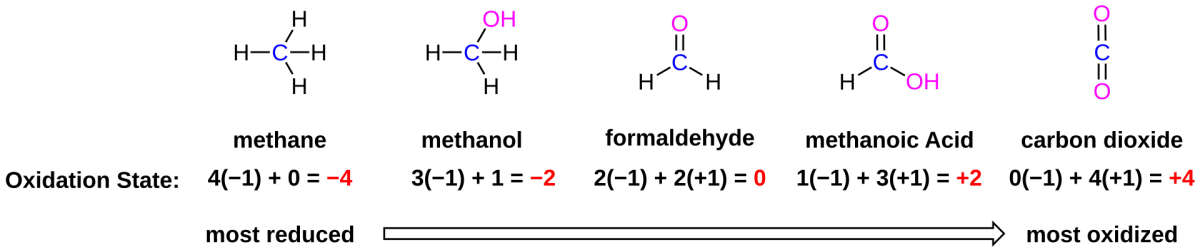
The clearest way to see organic redox is the methane → CO₂ ladder:
| Compound | Formula (for C) | Bonds at C | Oxidation state |
|---|---|---|---|
| Methane | CH₄ | 4 C-H | −4 |
| Methanol | CH₃OH | 3 C-H, 1 C-O | −2 |
| Formaldehyde | CH₂O | 2 C-H, 2 C-O (double bond = 2 bonds to O) | 0 |
| Formic acid | HCOOH | 1 C-H, 3 C-O | +2 |
| Carbon dioxide | CO₂ | 4 C-O | +4 |
Each step up the ladder adds one C-O bond or removes one C-H bond. That is why this sequence represents progressive oxidation of a single carbon.
Organic Redox Signals: Watch the Heteroatoms
You rarely need to calculate oxidation states explicitly. Instead, scan the functional group changes:
- 1° alcohol → aldehyde: gain one C-O bond (C=O replaces C-OH but C lost one C-H to get there). Oxidation.
- Aldehyde → carboxylic acid: gain one more C-O bond. Oxidation.
- Ketone → 2° alcohol: reverse (reduction - add one C-H, lose a C-O bond).
- Alkene → alkane: gain two C-H bonds, lose no C-O bonds. Reduction.
- Alkane → alkyl halide: lose one C-H, gain one C-X. Oxidation.
- Alcohol → ether: no change at carbon (still one C-O bond, just a different oxygen partner). Neither.
The MCAT exploits this pattern: “which of the following is an oxidation?” is answered by counting C-O/C-H shifts.
Common Organic Oxidizing Agents
These reagents take hydrogens off a substrate (or add oxygens, usually amounting to the same thing):
- PCC (pyridinium chlorochromate) - mild. 1° alcohol → aldehyde (stops). 2° alcohol → ketone.
- Jones reagent / CrO₃ / Na₂Cr₂O₇ in H₂SO₄ - strong. 1° alcohol → carboxylic acid (goes all the way). 2° alcohol → ketone.
- DMP (Dess-Martin periodinane) - mild, modern equivalent of PCC.
- KMnO₄ (permanganate) - very harsh. Oxidizes alcohols aggressively, cleaves alkenes.
- Ag(NH₃)₂⁺ (Tollens’ reagent) - specific for aldehydes → carboxylic acids. Produces silver mirror.
Common Organic Reducing Agents
These reagents add hydrogens (or sometimes remove oxygens):
- NaBH₄ (sodium borohydride) - mild. Reduces aldehydes and ketones to alcohols. Does NOT reduce esters, carboxylic acids, or amides.
- LiAlH₄ (lithium aluminum hydride) - strong. Reduces essentially every carbonyl (aldehyde, ketone, ester, carboxylic acid, amide) to its most reduced form.
- H₂ / Pd, Pt, Ni catalyst - reduces alkenes and alkynes to alkanes.
- Zn/Hg in HCl (Clemmensen) or H₂NNH₂ / KOH (Wolff-Kishner) - reduces carbonyls (C=O) all the way to -CH₂-.
Biological Oxidation-Reduction
Biological redox uses enzymes and cofactors instead of chromium or lithium reagents:
- NAD⁺ / NADH - the universal hydride carrier. NAD⁺ oxidizes a substrate (pulls off a hydride); NADH reduces a substrate (delivers a hydride).
- FAD / FADH₂ - similar role, can accept two electrons + two protons.
- O₂ - the ultimate electron acceptor in cellular respiration.
- Cytochromes, iron-sulfur proteins - electron-transport chain redox centers.
In biochem, “oxidation” often means the substrate donated a hydride to NAD⁺; “reduction” means NADH donated a hydride to the substrate. The ladder logic still applies - ethanol to acetaldehyde to acetic acid is a standard NAD⁺-catalyzed oxidation sequence in liver alcohol metabolism.
Tracking Oxidation in Multi-Step Reactions
For MCAT passages with multi-step mechanisms, confirm redox balance by tallying:
- Before: oxidation state of key carbon.
- After: oxidation state of that carbon.
- Change: increase = oxidation, decrease = reduction, zero = no redox.
Example: ethanol to acetic acid.
- Ethanol C1 (the -OH carbon): 2 C-H + 1 C-O + 1 C-C = −2 + 1 + 0 = −1.
- Acetic acid C1 (the COOH carbon): 0 C-H + 3 C-O + 1 C-C = 0 + 3 + 0 = +3.
- Change = +3 − (−1) = +4. A four-electron oxidation (matching 2 × NADH in the biochemistry pathway, or one strong chemical oxidant like Jones).
The next section explains the visual grammar of all these mechanisms: curved arrows, which show electrons flowing between source and sink.