
Carbocation Stability
Carbocations are the critical intermediates in SN1 and E1 reactions. Their stability determines whether a reaction goes fast, slow, or not at all. The rules are simple: the more substituted the carbocation, the more stable it is; resonance delocalization makes it even more stable; and if a rearrangement can form a more stable cation, it will.
If you can rank any two carbocations by stability in under five seconds, you can predict SN1/E1 outcomes, spot potential rearrangements, and identify likely intermediates on any passage. This ranking is the foundation of Ch 5’s SN1/E1 decision work.
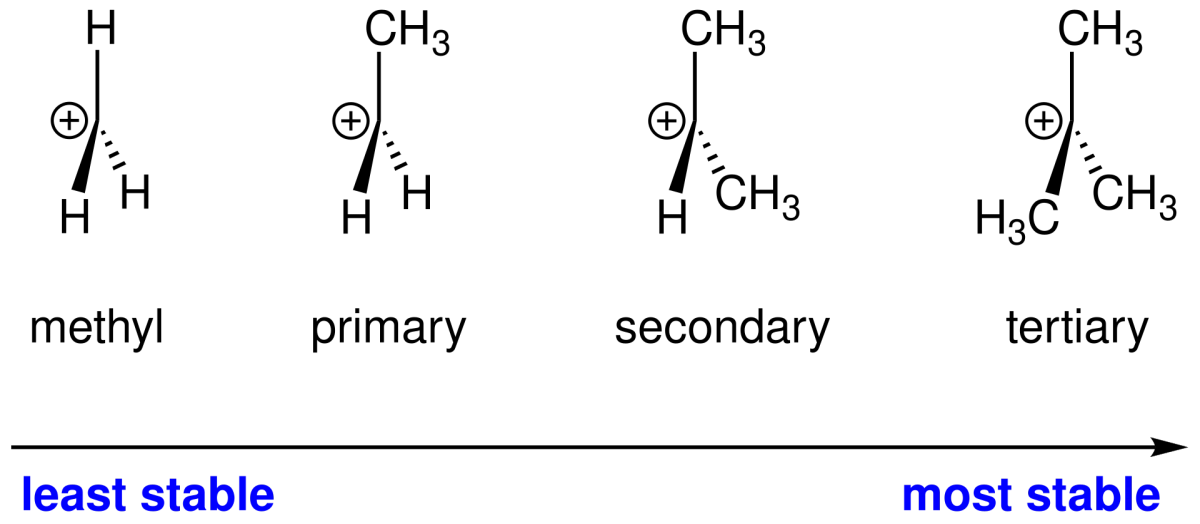
The Stability Order
From least to most stable:
Methyl (CH₃⁺) < 1° (RCH₂⁺) < 2° (R₂CH⁺) < 3° (R₃C⁺)
And for resonance-stabilized cations:
3° < allyl / benzyl < 3° allyl / 3° benzyl
An allyl cation (CH₂=CH-CH₂⁺) is about as stable as a 2°-3° alkyl cation. A benzyl cation (C₆H₅-CH₂⁺) is comparable. Combine the two (a 3° allyl cation) and you get an especially stable cation that dominates any mechanism it can form.
Why More Substituted = More Stable
Two effects are at work. You need both to explain the full trend.
Effect 1: Inductive donation. Alkyl groups are weakly electron-donating (relative to hydrogen). A methyl group next to a positive carbon pushes some electron density toward the positive center, reducing the formal charge on that single atom. More alkyl groups = more donation = more stabilization.
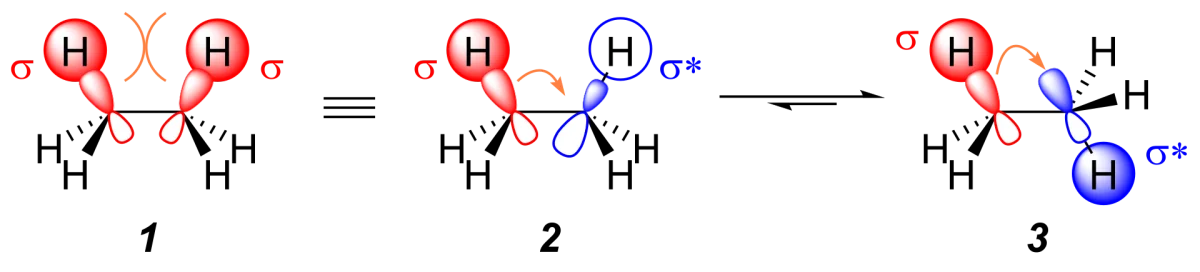
Effect 2: Hyperconjugation. This is the big one. The C-H bonds on adjacent carbons overlap with the empty p orbital on the cation. The bond pair in the neighboring sp³ C-H partially “donates” into the empty p orbital, delocalizing electron density and lowering the energy of the cation. Each adjacent C-H bond that can align with the empty orbital contributes.
- Methyl cation: 0 adjacent sp³ carbons → 0 hyperconjugating C-H bonds.
- 1° cation: 1 adjacent sp³ carbon → typically 3 hyperconjugating C-H bonds.
- 2° cation: 2 adjacent sp³ carbons → typically 6 hyperconjugating C-H bonds.
- 3° cation: 3 adjacent sp³ carbons → typically 9 hyperconjugating C-H bonds.
More adjacent C-H bonds = more hyperconjugation = more stable cation.
Resonance Stabilization: Allyl and Benzyl
Adjacent pi systems provide even more stabilization than alkyl donation. The empty p orbital on the cation lines up with the pi system of a nearby alkene or aromatic ring, delocalizing the positive charge over multiple atoms.
Allyl cation (CH₂=CH-CH₂⁺): the positive charge is equally shared between the end carbons. The C=C pi bond and the empty p orbital merge into a three-center, two-electron system. Energy is distributed over two carbons instead of one.
Benzyl cation (Ph-CH₂⁺): the positive charge delocalizes into the benzene ring’s aromatic pi system, spreading the charge to the ortho and para positions of the ring. Three resonance contributors plus the original Kekulé structure combine to stabilize the cation significantly.
Allyl and benzyl cations are so stable that they form preferentially in mechanisms even over tertiary alkyl cations if resonance is available. Para-methoxybenzyl cations (with an additional donor on the ring) are even more stabilized - routinely used as “protecting groups” in synthesis because they form cleanly under mild conditions.
Adjacent Heteroatoms: Lone-Pair Donation
A lone pair on an adjacent heteroatom can stabilize a cation through resonance:
- Oxocarbenium ion (C⁺-OR): the oxygen donates a lone pair into the empty p orbital, forming a partial double bond with positive charge now shared on oxygen. Very stable.
- Iminium ion (C⁺-NR₂): similar idea with nitrogen lone pair. Even more stable because N is less electronegative than O, so it shares the charge more willingly.
This is why acetals and aminals form stable cationic intermediates in mechanisms. In Ch 6, the acetal formation mechanism relies heavily on oxocarbenium intermediates.
Destabilizing Effects
Not everything helps. Some structures destabilize a cation:
- Electron-withdrawing groups nearby (Cl, Br, -CF₃, -NO₂) pull electron density away and amplify the positive charge. A carbon with a neighboring CF₃ group has a much less stable cation.
- Anti-aromatic rings destabilize if the cation is in the ring and makes the system 4n pi electrons. Cyclopentadienyl cation, for example, is strongly destabilized because removing one electron from the ring system produces a 4-pi-electron anti-aromatic species.
- sp or sp² cation centers (outside of allyl/benzyl, where resonance helps) are generally less stable than sp² carbocations on sp³ carbons. Vinyl cations and phenyl cations are exceptionally unstable.
Carbocation Rearrangements
Here is a fundamental rule that catches every student the first time: carbocations rearrange whenever a more stable cation is possible. If a 2° cation sits next to a carbon with an H or an alkyl group that would produce a 3° cation upon migration, the rearrangement will happen - fast.
Two common rearrangements:
1,2-Hydride shift: a hydrogen with its bond pair migrates from an adjacent carbon to the cation, swapping the positive charge.
1,2-Alkyl shift (usually methyl): an alkyl group with its bond pair migrates from an adjacent carbon to the cation.
Both occur because they convert a less stable cation into a more stable one. Rearrangements are especially common in SN1/E1 mechanisms because the cation is relatively long-lived (microseconds rather than femtoseconds).
Example: 2-bromobutane ionizes to a 2° cation, which does not rearrange because shifting would give another 2° cation. But 3-bromo-2,2-dimethylbutane ionizes to a 2° cation that can rearrange via a methyl shift from the adjacent quaternary carbon, producing a 3° cation. The products reflect the rearrangement, and students who ignore rearrangements predict the wrong product.
Impact on Mechanism Choice
Substrate type → preferred mechanism (from Ch 5):
- Methyl / 1° substrate → SN2/E2 only (cation too unstable to form; SN1/E1 never happen).
- 2° substrate → mix of mechanisms; depends on nucleophile, base, and solvent.
- 3° substrate → SN1/E1 favored (cation is stable enough to form); SN2 is blocked by steric bulk.
- Allyl / benzyl substrate → SN1/E1 or SN2 all work well; fast in either case because the cation is stable AND the substrate is not too hindered.
The next section does the same job for the opposite species: carbanions, where the ranking rules are all inverted.