
Curved Arrow Pushing
If mechanism is the grammar of organic chemistry, curved arrows are the alphabet. Every single reaction you will ever see in an organic textbook - every MCAT mechanism question - is expressed using two kinds of curved arrows. Once you know how to read and draw them, mechanisms stop being memorization and start being logic puzzles.
The single most important rule: a curved arrow shows where electrons are moving. It does NOT show atoms moving. The tail of the arrow starts at the electron source; the head of the arrow points to the electron sink (where the electrons end up). If you can identify the source and sink in each step, you can draw the arrows automatically.
Two Types of Arrows
Organic mechanism uses exactly two arrow styles:
- Double-headed curved arrow - represents the movement of a pair of electrons. Used in essentially all ionic (polar) mechanisms. The tail comes from a lone pair or a bond; the head points to an atom, an empty orbital, or the space where a new bond will form.
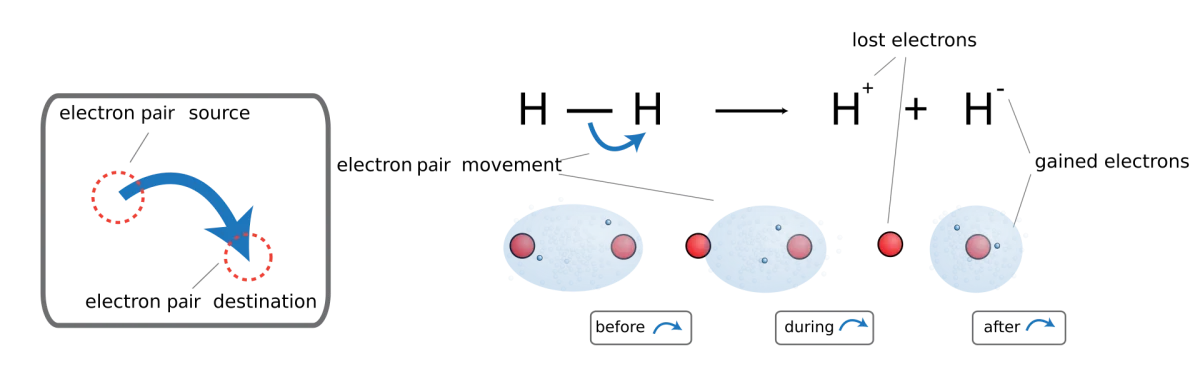
- Single-headed curved arrow (fishhook) - represents the movement of a single electron. Used in radical mechanisms only. A bond breaking homolytically produces two fishhooks, one pointing each way.
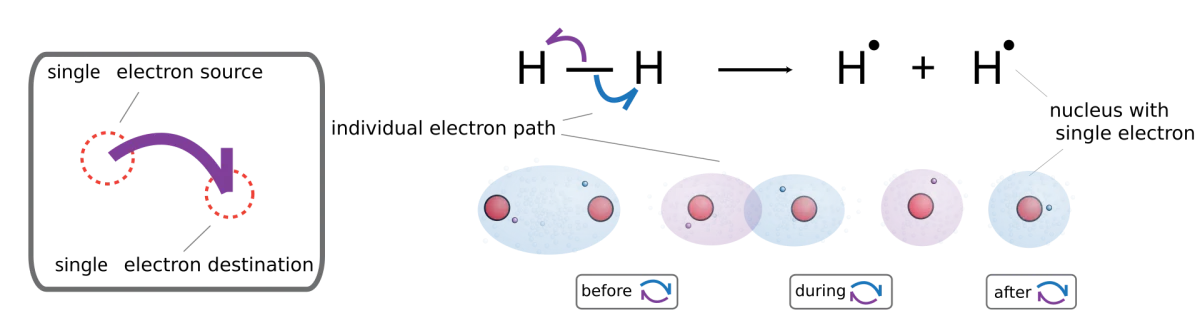
If your mechanism involves ions or polar intermediates, use double-headed arrows. If it involves radicals (odd electrons, homolytic bond cleavage), use fishhooks. Mixing these is a common student error and a clear sign the mechanism is drawn wrong.
Four Rules for Drawing Arrows Correctly
- Tail at the source (electrons), head at the destination. Never the reverse. An arrow from an empty orbital to a lone pair is wrong, even if it “looks” right.
- Arrows move electrons, not atoms. Atoms go along for the ride. If an atom “moves” in your drawing, it is because a new bond formed there - but the arrow itself shows only the electron motion.
- Conserve electrons and formal charges. Check that the total charge is the same before and after each arrow. If a step creates a formal charge imbalance, an arrow is missing.
- Do not combine arrows. Each arrow represents one elementary event: one bond forming or one bond breaking. If a step has two changes happening, draw two separate arrows.
The Three Types of Elementary Events
Every curved arrow in a polar mechanism represents one of three events:
Event 1: Bond breaking heterolytically. A bond breaks, and both electrons go to one atom (forming an anion) while the other atom becomes cation or neutral. The arrow starts at the bond and points toward the atom that keeps the electrons.
Example: H-Br → H⁺ + Br⁻. Arrow starts at the H-Br bond, points toward Br.
Event 2: Bond forming. A nucleophile’s lone pair attacks an electrophile. The arrow starts at the lone pair and points to the electrophilic atom.
Example: OH⁻ attacks a carbocation. Arrow starts at oxygen’s lone pair, points to the positive carbon.
Event 3: Bond moving (resonance or pi-shift). An existing bond shifts to a new location. Two arrows are usually needed: one to move the pi bond to a new position, another to move any displaced electrons.
Example: allyl cation resonance. Arrow moves the C=C to a new position; simultaneously, the positive charge shifts to the other end.
Sample Mechanism: SN2
The SN2 mechanism has exactly two arrows:
- Arrow 1: nucleophile’s lone pair → attack the electrophilic carbon. A new C-Nu bond forms.
- Arrow 2: the C-LG bond → LG atom. The LG departs with both electrons.
Both arrows are drawn in the same step because SN2 is concerted. Total: two arrows, one step. If you can draw these two arrows correctly, you have the mechanism.
Sample Mechanism: E2
Also concerted, also two arrows:
- Arrow 1: base’s lone pair → attack the beta-H. A new base-H bond forms.
- Arrow 2: the C-H bond → adjacent carbon (not to H). A new C=C pi bond forms.
- Arrow 3: the C-LG bond → LG atom. The LG departs.
Three arrows, one step. All drawn together. The difference from SN2: the base is attacking the proton, and the electrons that were in the C-H bond become the new pi bond.
Sample Mechanism: Acid-Catalyzed Carbonyl Addition
Three-step sequence:
Step 1: Protonate the carbonyl.
- Arrow 1: carbonyl oxygen’s lone pair → H of the acid. A new O-H bond forms.
- Arrow 2: the H-X bond → halide. The halide leaves with both electrons.
Step 2: Nucleophile attacks activated carbonyl.
- Arrow 1: nucleophile’s lone pair → carbonyl carbon. A new C-Nu bond forms.
- Arrow 2: the C=O pi bond → oxygen. The positive charge migrates onto oxygen, which becomes neutral… wait, the oxygen was already positively charged from protonation. So this arrow neutralizes it. Check your formal charges at each step.
Step 3: Deprotonation.
- Arrow 1: base’s lone pair → H on the newly-added nucleophile. A new base-H bond forms.
- Arrow 2: the Nu-H bond → Nu. The H+ leaves as a proton on the base.
Four or five arrows total across three steps. Each step isolates one elementary event, and each arrow does exactly one thing.
Common Arrow-Pushing Mistakes
- Drawing arrows from H to a nucleophile in protonation. Wrong. The arrow goes from the nucleophile’s lone pair to the H. The H has no lone pair to donate - it is the electrophile.
- Missing a bond-breaking arrow. When a nucleophile attacks a C-LG substrate, you must also show the LG leaving. Otherwise the carbon ends up with 5 bonds.
- Drawing arrows on spectator atoms. Sodium, potassium, and other counterions usually do not participate in the mechanism - do not include them in your arrows.
- Mixing arrow types. If you are drawing an ionic mechanism, use double-headed arrows throughout. If you switch to fishhooks mid-mechanism, something is wrong (or the mechanism is actually a radical one).
- Drawing an arrow from an empty orbital. Empty orbitals accept electrons; they do not donate them. The source must have electrons.
Reading Arrows Backwards
A powerful diagnostic: if you cannot tell what a mechanism is doing, try running the arrows backwards. Every forward arrow has an equivalent backward arrow (the reverse reaction). If the backward mechanism makes sense (going from products to reactants), your forward arrows are probably right. If the backward version is nonsensical, there is an error.
Running arrows backward also teaches you about equilibria. Most organic reactions are reversible in principle, and the forward/reverse arrow patterns are mirror images. Esterification (forward) and ester hydrolysis (backward) use exactly the same arrows in reverse order.
No. The arrow is backwards. The cation has an empty orbital - it is the electron SINK, not the source. The water has the lone pair - it is the electron SOURCE. The arrow should go FROM the water’s lone pair TO the cation’s empty orbital. Every arrow points from electrons to emptiness, not the other way around.
Three arrows. Arrow 1: base’s lone pair to the beta-hydrogen (forming the new base-H bond). Arrow 2: the C-H bond to the adjacent carbon (forming the new pi bond). Arrow 3: the C-LG bond to the leaving group (LG leaves with both electrons). All three happen in the same concerted step.
The next section explains why some of the intermediates in these mechanisms exist at all - the stability rules for carbocations.
Practice: Draw the Arrows Yourself
Theory is one thing; putting arrows onto a page is another. Drag a curved arrow on the canvas below from an electron source (a lone pair or a bond) to its destination. The tool validates each arrow against the expected mechanism and explains where you went wrong if you pick an incorrect source or sink. Three warm-up problems cover the core MCAT patterns: acid-base, SN2, and E2.
Arrow-pushing practice
Ammonia abstracts a proton from HCl. Draw the single curved arrow that shows electron flow.
Step 1 of 1