
Intermolecular Forces
Imagine a crowd of people at a concert. Some are holding hands with a partner (strong connection, hard to separate). Others are just standing close enough that their shoulders brush occasionally (weak connection, easy to move apart). And some are strangers who happen to bump into each other randomly for a split second before drifting away.
These three levels of “connection” mirror the three main types of intermolecular forces. Hydrogen bonds are like holding hands - strong and directional. Dipole-dipole interactions are like shoulder brushing - moderate and orientation-dependent. London dispersion forces are like random bumping - weak, fleeting, but always present between everyone.
Intermolecular forces (IMFs) are the attractions between separate molecules. They are much weaker than intramolecular bonds (the covalent bonds within a molecule), but they determine nearly every physical property the MCAT tests: boiling point, melting point, solubility, viscosity, and surface tension.
London Dispersion Forces (LDF)
London dispersion forces are the weakest intermolecular force, but they are universal - every molecule experiences them, even nonpolar ones like helium and methane.
LDF arise from temporary, instantaneous dipoles. At any given moment, the electrons in a molecule are not perfectly evenly distributed. A brief asymmetry in electron distribution creates a temporary dipole on one molecule, which induces a temporary dipole in a neighboring molecule. The two temporary dipoles attract each other for a fleeting instant.
Key factors affecting LDF strength:
1. Molecular size / surface area. Larger molecules with more electrons have stronger LDF. More electrons mean larger, more frequent temporary dipoles. This is why boiling points increase as you go down a homologous series: pentane (bp 36 degrees C) > butane (bp -1 degrees C) > propane (bp -42 degrees C).
2. Molecular shape. Long, thin molecules have more surface area in contact with neighbors than compact, spherical molecules. This is why n-pentane (bp 36 degrees C) boils higher than neopentane (bp 9.5 degrees C) - same molecular formula, but n-pentane is long and has more contact area.
3. Polarizability. Atoms with loosely held electrons (large atomic radius, many electron shells) are more polarizable and have stronger LDF. Iodine compounds have stronger LDF than fluorine compounds.
Dipole-Dipole Interactions
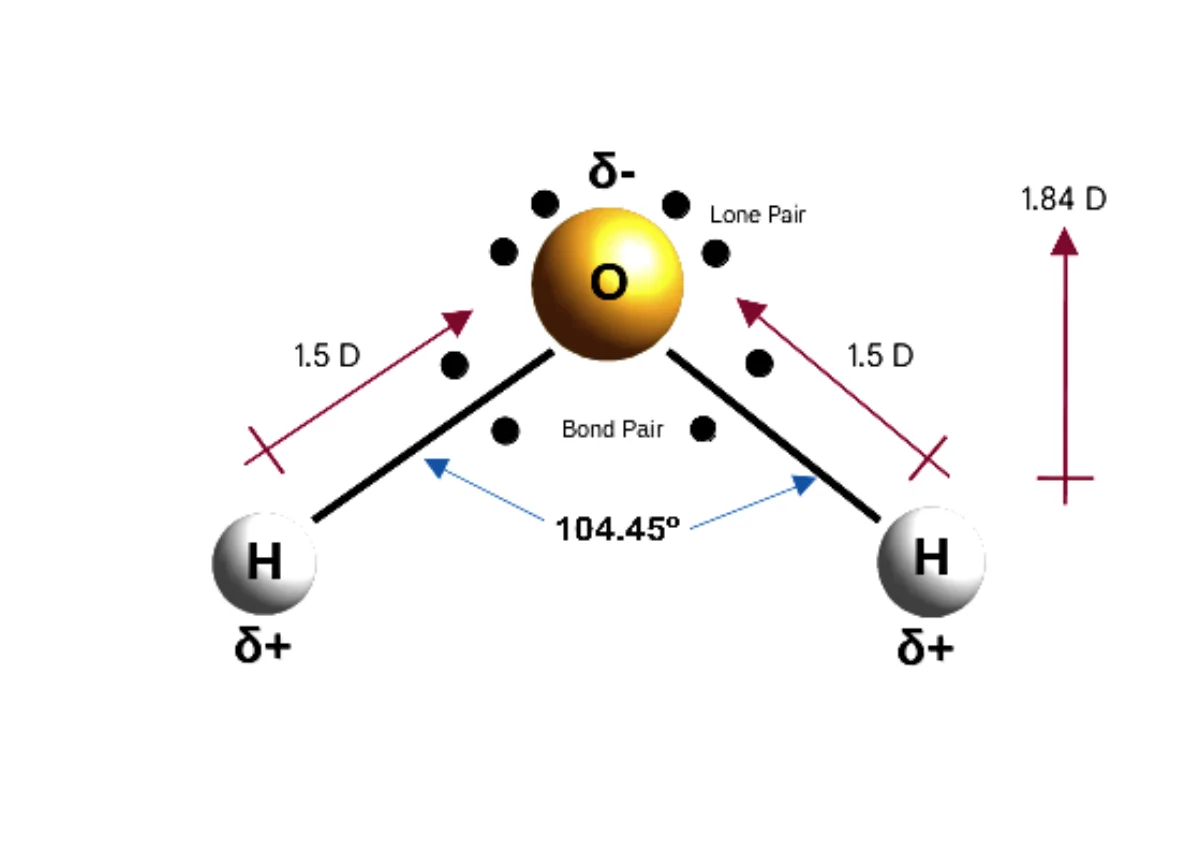
Dipole-dipole forces occur between polar molecules. The partial positive end of one molecule is attracted to the partial negative end of a neighboring molecule.
These are stronger than LDF for molecules of similar size because they are permanent attractions (not just fleeting), but they are weaker than hydrogen bonds. Dipole-dipole forces are significant for molecules with moderate polarity (dipole moment > about 1 D).
For example, acetone (CH3COCH3, bp 56 degrees C) boils higher than propane (C3H8, bp -42 degrees C) despite having a similar molecular weight. Both experience LDF, but acetone’s polar C=O bond creates permanent dipole-dipole attractions between molecules.
Hydrogen Bonding
Hydrogen bonding is a special, unusually strong type of dipole-dipole interaction. It occurs when a hydrogen atom bonded to a highly electronegative atom (F, O, or N) is attracted to a lone pair on a nearby F, O, or N atom.
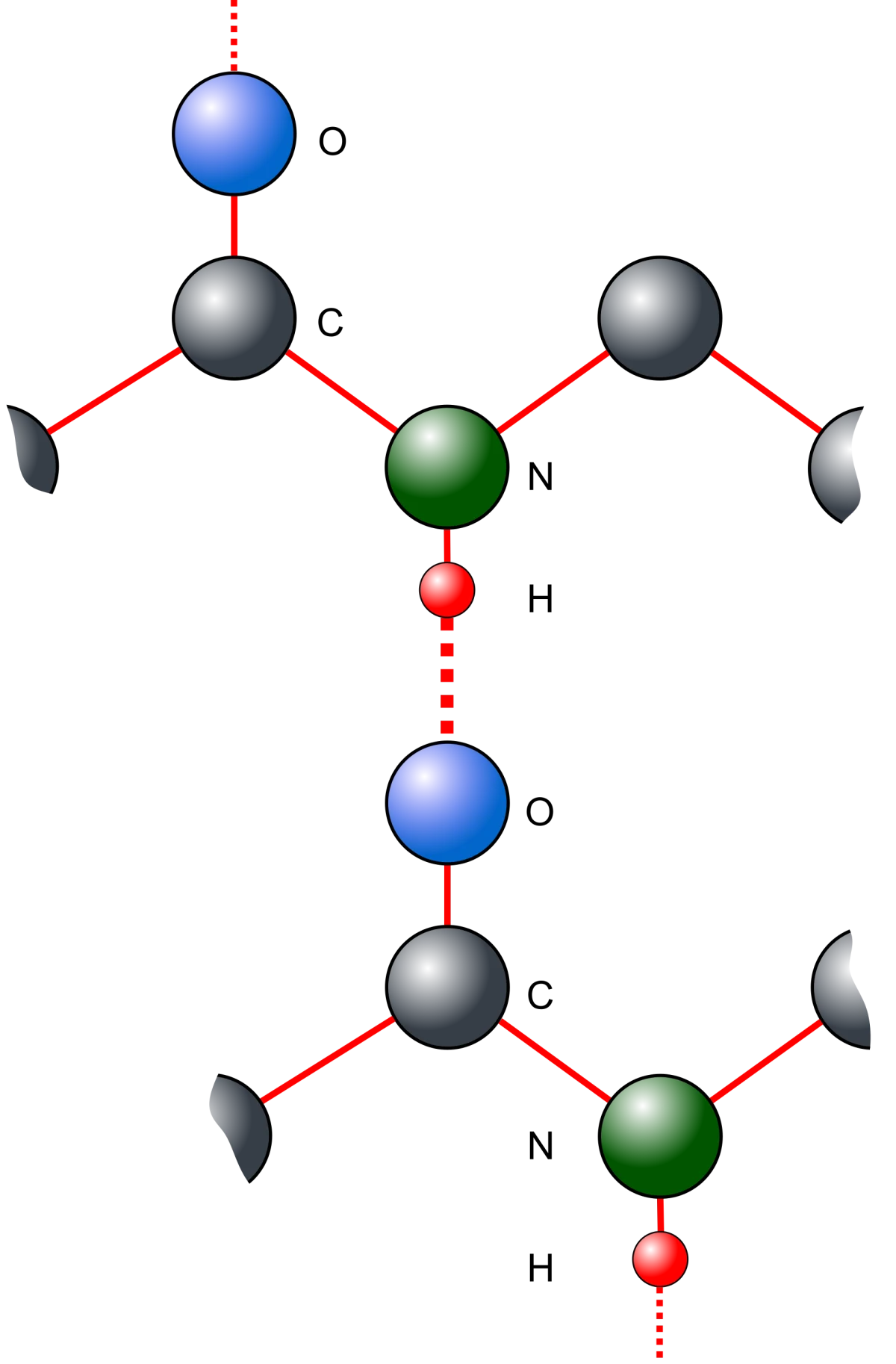
The requirements are specific:
- Hydrogen bond donor: An H atom covalently bonded to F, O, or N (written as X-H, where X = F, O, or N)
- Hydrogen bond acceptor: A lone pair on a nearby F, O, or N atom
- Both the donor and acceptor must be present for hydrogen bonding to occur
Hydrogen bonding explains many unusual properties of water and biological molecules:
- Water’s anomalously high boiling point (100 degrees C vs. -60 degrees C predicted by size alone)
- The structure of DNA (base pairs held together by hydrogen bonds)
- Protein folding (hydrogen bonds stabilize alpha-helices and beta-sheets)
- The solubility of polar organic molecules in water
Ranking IMF Strength
| Force | Relative strength | Requirements | Example |
|---|---|---|---|
| Ion-ion (ionic) | Strongest | Full charges | NaCl |
| Ion-dipole | Very strong | Ion + polar molecule | Na+ in water |
| Hydrogen bonding | Strong | H bonded to F, O, or N near lone pair on F, O, or N | Water-water |
| Dipole-dipole | Moderate | Polar molecules | Acetone-acetone |
| London dispersion | Weakest (but universal) | All molecules | Hexane-hexane |
IMF and Boiling Points in Organic Chemistry
The MCAT frequently asks you to rank boiling points of organic compounds. Use this decision tree:
Step 1: Can the molecule hydrogen bond? (Does it have N-H, O-H, or F-H?) If yes, it will have a relatively high boiling point for its size.
Step 2: Is the molecule polar? If yes (but no H-bonding), dipole-dipole forces give it a moderate boiling point boost.
Step 3: How big is the molecule? Larger molecules have stronger LDF and higher boiling points, regardless of polarity.
Step 4: What is the molecular shape? Branching decreases surface area and weakens LDF, lowering the boiling point.
Boiling Point Practice
| Compound | MW (g/mol) | IMF present | Boiling point |
|---|---|---|---|
| Ethane (C2H6) | 30 | LDF only | -89 degrees C |
| Formaldehyde (CH2O) | 30 | LDF + dipole-dipole | -19 degrees C |
| Methanol (CH3OH) | 32 | LDF + dipole-dipole + H-bonding | 65 degrees C |
| Ethanol (CH3CH2OH) | 46 | LDF + dipole-dipole + H-bonding | 78 degrees C |
| Propane (C3H8) | 44 | LDF only | -42 degrees C |
| Acetone (CH3COCH3) | 58 | LDF + dipole-dipole | 56 degrees C |
Notice the pattern: molecules with hydrogen bonding have dramatically higher boiling points than those with only LDF, even when molecular weights are similar (methanol at 65 degrees C vs. ethane at -89 degrees C).
IMF and Solubility
The rule “like dissolves like” is a direct consequence of intermolecular forces:
- Polar solutes dissolve in polar solvents because the solute-solvent IMFs (dipole-dipole, H-bonding) are strong enough to compensate for breaking solute-solute and solvent-solvent interactions.
- Nonpolar solutes dissolve in nonpolar solvents because the weak LDF between solute and solvent are comparable to the LDF being broken.
- Polar solutes do NOT dissolve well in nonpolar solvents because the weak LDF with the solvent cannot compensate for the strong dipole-dipole or H-bonding being broken.
In organic chemistry, this determines which solvents to use for reactions and separations. It also explains why cell membranes (nonpolar lipid bilayers) are permeable to nonpolar molecules but block polar and charged species.
Hydrogen Bonding in Specific Functional Groups
| Functional group | Can donate H-bonds? | Can accept H-bonds? | Example |
|---|---|---|---|
| Alcohol (-OH) | Yes (O-H) | Yes (lone pairs on O) | Ethanol |
| Carboxylic acid (-COOH) | Yes (O-H) | Yes (lone pairs on O) | Acetic acid |
| Amine (-NH2, -NHR) | Yes (N-H) | Yes (lone pair on N) | Methylamine |
| Amide (-CONH2) | Yes (N-H) | Yes (lone pairs on O and N) | Acetamide |
| Ether (-O-) | No | Yes (lone pairs on O) | Diethyl ether |
| Aldehyde/Ketone (C=O) | No | Yes (lone pairs on O) | Acetone |
| Ester (-COOR) | No | Yes (lone pairs on O) | Ethyl acetate |
| Alkane | No | No | Hexane |
A molecule that can both donate and accept hydrogen bonds (like an alcohol) forms more extensive H-bonding networks and has a higher boiling point than one that can only accept (like an ether of similar size).