Every separation technique exploits a property difference between the components of a mixture. If the components have identical properties, they cannot be separated. The more differences you can exploit (or the larger the differences), the easier the separation.
Key Properties Exploited
Property
Technique
Boiling point
Distillation
Polarity / solubility in water vs. organic
Extraction
Acid-base behavior
Acid-base extraction
Solubility at different temperatures
Recrystallization
Affinity for silica, alumina, reverse-phase
TLC, column chromatography
Volatility / gas-phase behavior
Gas chromatography
Polarity in a high-pressure mobile phase
HPLC
Size
Gel filtration, SDS-PAGE
Charge (for proteins)
Ion exchange, native gel
Choosing the right technique means matching the biggest property difference in the mixture to the technique that exploits it.
Partition Coefficient
A key concept for liquid-liquid separations is the partition coefficient (K):
K = [A]_organic / [A]_aqueous
A high K means the molecule prefers the organic layer; a low K means it prefers the aqueous layer. By choosing appropriate solvents, you can drive a compound into one layer with high selectivity.
The partition coefficient depends on polarity, charge, and H-bonding ability. Neutral nonpolar compounds → high K (organic). Charged or highly polar compounds → low K (aqueous).
Orthogonal Separations
Complex mixtures often need TWO or more separation techniques applied in sequence, each exploiting a different property. This is called an orthogonal separation strategy:
2D-PAGE: separates proteins by isoelectric point (1st dimension) + molecular weight (2nd dimension).
LC-MS: liquid chromatography separates by polarity, then mass spectrometry separates by mass.
GC-MS: gas chromatography separates by volatility, then MS identifies by mass.
Orthogonal strategies resolve mixtures that a single technique cannot handle.
Efficiency Metrics
Resolution (R): how well two adjacent peaks are separated. High R = baseline separation.
Selectivity (α): the ratio of retention times of two components. Higher α = better inherent separation.
Plate number (N): how “sharp” the peaks are. More plates = narrower peaks = better resolution.
For MCAT purposes, focus on qualitative concepts: what makes a separation good, what makes it fail, and how to improve it.
General Rules
Like dissolves like: polar dissolves polar, nonpolar dissolves nonpolar. Basis of extraction and chromatography.
Lower boiling point distills first: in simple distillation, the more volatile component is collected first.
Smaller particles move faster in gel: size-exclusion and SDS-PAGE separate by size.
Charged species move in electric fields: ion exchange and electrophoresis.
A mixture contains a carboxylic acid (pKa 4) and a neutral hydrocarbon. What ONE separation technique would cleanly separate them, and what property does it exploit?
Click to reveal answer
Acid-base extraction. The carboxylic acid can be deprotonated by aqueous NaOH, converting it to its sodium salt (water-soluble carboxylate anion). The neutral hydrocarbon stays in the organic layer. After separating the two layers in a separatory funnel, you have the hydrocarbon in the organic layer and the carboxylate in the aqueous layer. Acidifying the aqueous layer regenerates the free carboxylic acid. This exploits the acid-base property difference: one component is ionizable (COOH becomes COO⁻ in base), the other is not.
Liquid-liquid extraction separates mixtures based on polarity differences. A mixture is shaken with two immiscible solvents (typically water + an organic solvent like ether or dichloromethane). Polar compounds go to the aqueous layer; nonpolar compounds go to the organic layer. The layers are separated in a separatory funnel.
Separatory funnel for liquid-liquid extraction. The aqueous layer (often at the bottom if denser) and organic layer (often at the top if less dense) are separated by gravity after shaking. Different compounds partition preferentially into one layer based on polarity. Credit: Wikimedia Commons, CC BY-SA
Common Solvent Pairs
Organic
Density
Notes
Diethyl ether
0.71
Lighter than water (top layer); volatile and flammable
Ethyl acetate
0.90
Lighter than water (top)
Hexane
0.66
Very nonpolar; good for nonpolar extractions
Dichloromethane (DCM)
1.33
Denser than water (bottom); good solvent for many organics
Chloroform
1.49
Denser than water (bottom); less common
Petroleum ether
~0.65
Very nonpolar, volatile
Always know which layer is the organic (top or bottom) based on density.
Practical Protocol
Load the mixture into a separatory funnel.
Add the two solvents.
Stopper, invert, vent (release pressure; important for volatile solvents).
Shake vigorously to maximize mixing.
Let the layers separate (1-2 minutes for simple systems; longer for emulsions).
Drain the bottom layer out the stopcock.
Pour the top layer out the top.
Multiple Small Extractions
For maximum recovery, do THREE smaller extractions rather than one large one. This is because the partition coefficient is a ratio, not a fraction:
If a compound partitions 1:4 (organic:aqueous) and you extract 100 mL aqueous with 100 mL organic:
Single extraction: 20% of the compound goes to the organic layer.
Three 33 mL extractions: ~49% ends up in combined organic layers (better recovery).
Rule: multiple small extractions > one big extraction for the same total volume of organic solvent.
Partition Coefficient and Equilibrium
K = [A]_organic / [A]_aqueous.
For a single extraction, the fraction remaining in the original (aqueous) layer is:
f = 1 / (1 + K × Vorg / Vaq).
For n extractions with equal volumes of organic:
fn = [1 / (1 + K × Vorg / Vaq)]ⁿ.
Smaller Vorg per extraction but more extractions give a lower final fn (more compound removed).
When Extraction Fails
Some mixtures cannot be separated by simple extraction:
If all components are very polar (all in aqueous) or all nonpolar (all in organic).
If the compound decomposes during the extraction.
If an emulsion forms and does not break.
For these cases, use chromatography or other techniques.
Drying Organic Layers
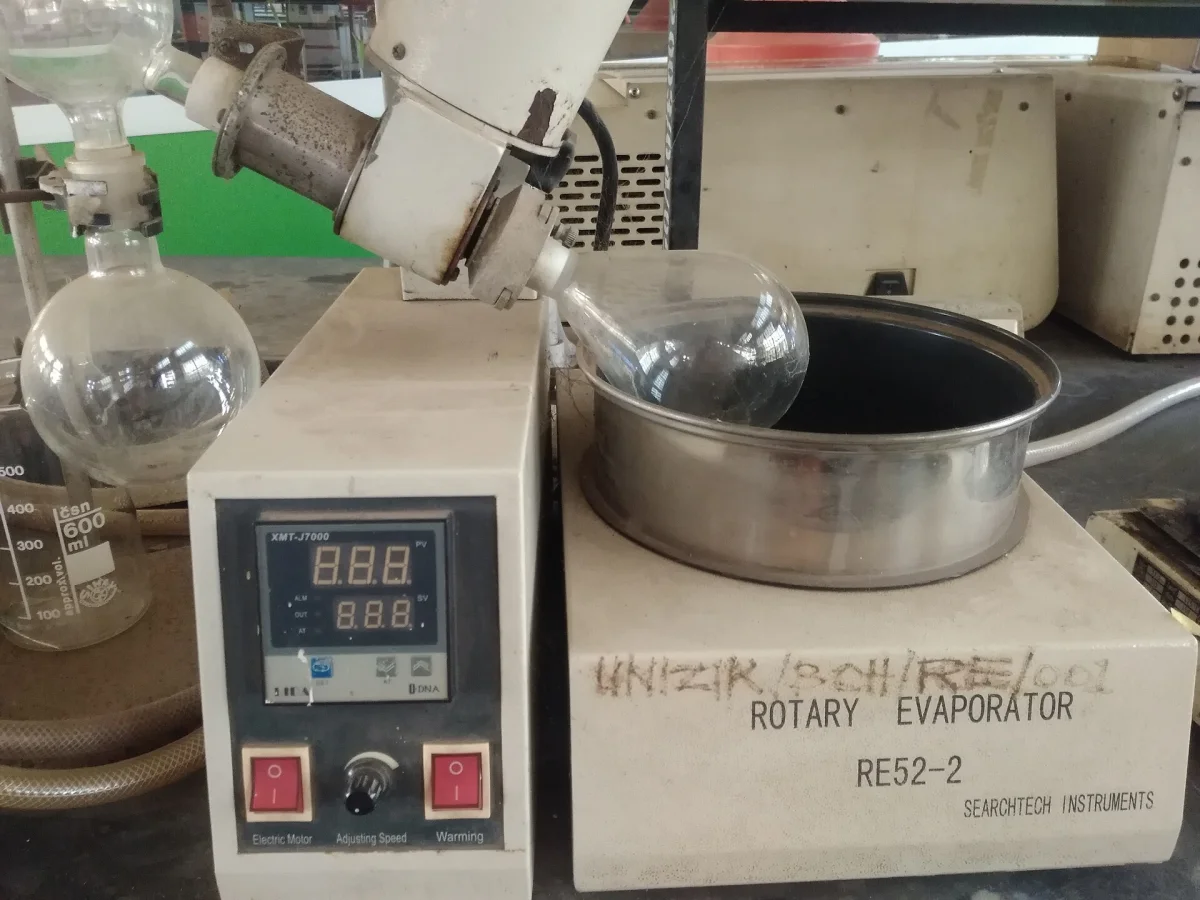
After extraction, the organic layer often has traces of water. Dry with an anhydrous desiccant like Na₂SO₄ or MgSO₄. The desiccant absorbs the water; the dry organic solution is then filtered or decanted for further use. Solvent is then removed on a rotary evaporator (“rotovap”):
Rotary evaporator: the sample flask rotates in a heated water bath under reduced pressure; solvent evaporates rapidly and condenses into a collection flask. The standard way to remove solvent from an organic product after extraction or column chromatography. Credit: Wikimedia Commons, CC BY-SA
In a liquid-liquid extraction using 100 mL water and 100 mL diethyl ether, why would three 33 mL ether extractions give better recovery of a compound than one 100 mL extraction?
Click to reveal answer
The partition coefficient is a ratio, not a fraction. Each extraction removes a fixed proportion of what is left in the aqueous layer. After n extractions with the same total volume of ether split into n portions, the fraction remaining in water is [1/(1+K×Vorg/Vaq)]^n. With three 33 mL extractions vs. one 100 mL extraction, you multiply the "fraction remaining" three times instead of once - but each individual fraction is closer to 1, so the overall product is smaller. Mathematically: more small extractions always beats one big extraction for the same total organic volume.
Acid-base extraction is a clever variant of liquid-liquid extraction where the pH of the aqueous layer is adjusted to selectively ionize specific compounds, forcing them into the aqueous layer. By doing two or three sequential extractions at different pH, you can separate a mixture into acidic, basic, and neutral components.
The Principle: Ionize to Dissolve
Neutral organic compounds dissolve preferentially in the organic layer. Charged organic compounds dissolve preferentially in the aqueous layer.
An organic acid (RCOOH, pKa 4-5) is neutral below its pKa (goes to organic layer). Above its pKa, it is deprotonated (RCOO⁻, goes to aqueous layer).
An organic base (RNH₂, conjugate acid pKa 9-10) is neutral above its pKa (goes to organic layer). Below its pKa, it is protonated (RNH₃⁺, goes to aqueous layer).
A phenol (ArOH, pKa 10) is neutral below its pKa (organic). Above its pKa, it is deprotonated (ArO⁻, aqueous).
A neutral compound (hydrocarbon, alcohol, ether, ester, ketone, aldehyde) has no acid-base sensitivity at reasonable pH - stays in organic layer regardless.
Standard Separation Sequence
For a mixture of a carboxylic acid, an amine, and a neutral compound dissolved in an organic solvent:
Step 1: Wash with aqueous 5% NaOH. This deprotonates the carboxylic acid (pKa 4-5 << 14) to carboxylate anion, which goes into the aqueous layer. The amine stays neutral (not basic enough to be deprotonated). The neutral compound stays in organic.
After Step 1: organic layer has amine + neutral. Aqueous layer has sodium carboxylate.
Step 2: Wash the organic layer with aqueous 5% HCl. This protonates the amine (pKa ~10 >> 1) to ammonium cation, which goes into the aqueous layer. The neutral compound stays in organic.
After Step 2: organic layer has neutral compound only. Second aqueous layer has ammonium chloride.
Step 3: Wash the organic layer with water to remove any remaining acids or bases.
Step 4: Dry, filter, and evaporate to recover the neutral compound.
Step 5: Recovering each component:
Aqueous layer 1: acidify with HCl → carboxylic acid precipitates or can be extracted back into ether.
Aqueous layer 2: basify with NaOH → amine precipitates or can be extracted back into ether.
Phenols: The Intermediate Case
Phenols (pKa ~10) are too weak to be deprotonated by NaHCO₃ (carbonic acid pKa ~6) but are deprotonated by NaOH (water pKa ~16). So you can distinguish:
NaHCO₃ wash: extracts only carboxylic acid (pKa ~5). Phenol and everything else stay in organic.
NaOH wash: extracts both carboxylic acid AND phenol.
Using NaHCO₃ first, then NaOH, separates carboxylic acid from phenol:
Step 2: NaOH wash → aqueous layer gets only phenol.
Practical Tips
Use DILUTE acid/base (5-10%). Concentrated acid/base can cause emulsions and degradation.
Emulsions can be broken by adding brine (saturated NaCl), changing temperature, or filtering through Celite.
Keep track of which layer has which component. A simple table helps.
Biological Parallel: Drug Pharmacokinetics
Acid-base extraction principles govern drug distribution in the body:
Weakly acidic drugs (aspirin, pKa ~3.5) are uncharged in the stomach (pH 1-2) and absorbed there.
Weakly basic drugs (amphetamine, pKa ~10) are charged in the stomach (pH 1-2) and stay in the GI lumen; they absorb in the small intestine (pH 6-7) where they are less ionized.
Lipid-soluble (neutral, nonpolar) drugs cross membranes easily; ionized forms do not.
This pH-dependent partitioning is why drug pKa and environmental pH together determine absorption, distribution, and excretion.
Describe how to separate a mixture of benzoic acid, aniline, and naphthalene using acid-base extraction.
Click to reveal answer
Step 1: Dissolve the mixture in an organic solvent (like ether). Step 2: Wash with aqueous 5% HCl. Aniline (basic amine) is protonated to anilinium chloride and goes into the aqueous layer. Organic layer retains benzoic acid + naphthalene. Step 3: Wash the organic layer with aqueous 5% NaOH. Benzoic acid is deprotonated to sodium benzoate and goes into the aqueous layer. Organic layer retains only naphthalene. Step 4: Recover each: (a) basify the aniline aqueous layer with NaOH and extract back into ether to get free aniline; (b) acidify the benzoate aqueous layer with HCl to precipitate benzoic acid; (c) evaporate the organic layer to obtain naphthalene.
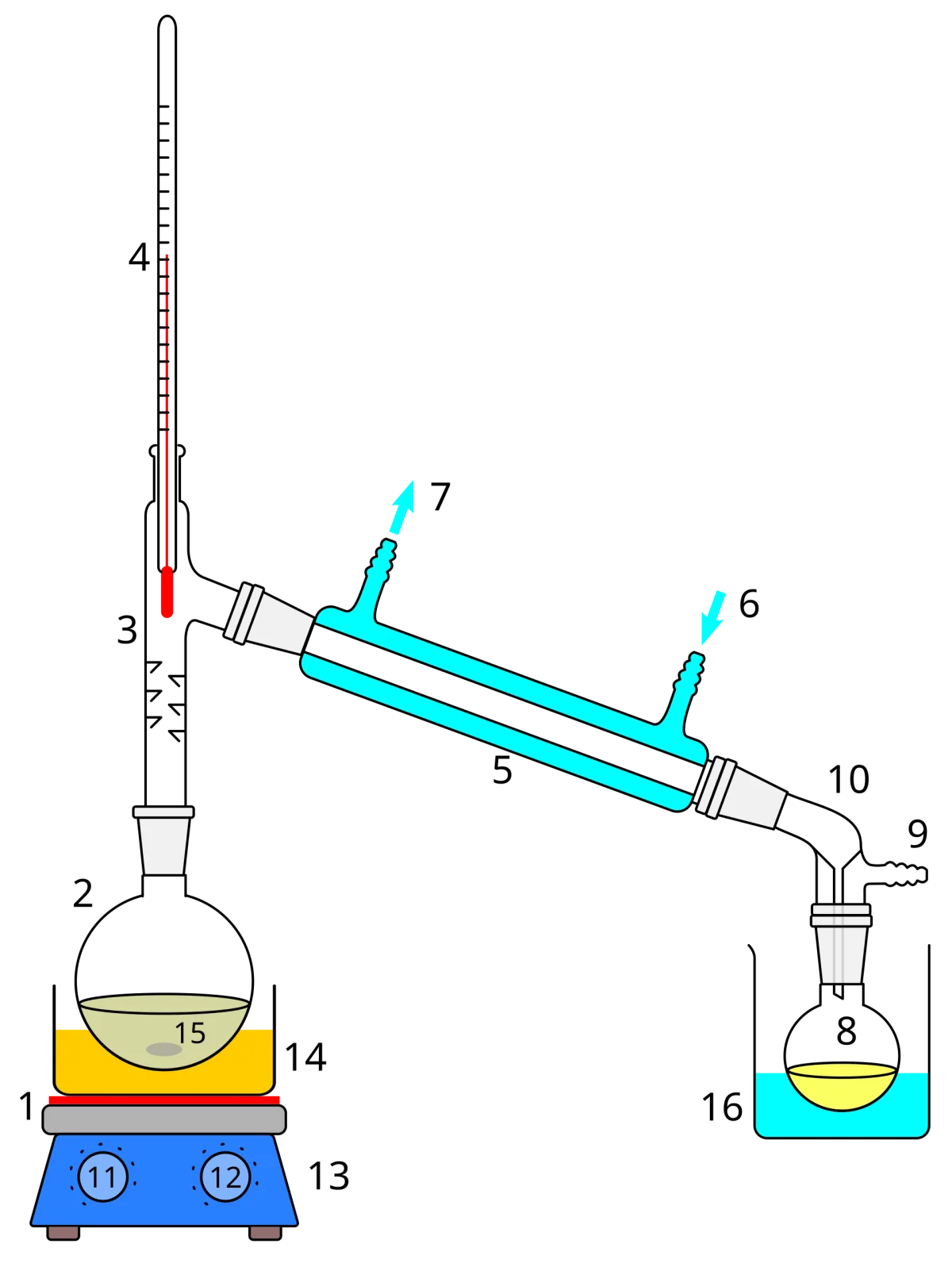
Distillation separates components of a liquid mixture based on differences in boiling point. The mixture is heated; the lower-boiling component vaporizes first; the vapor is condensed in a cooler region and collected. The higher-boiling component stays in the distillation flask until it is its turn to vaporize.
Simple distillation apparatus: heated flask, thermometer reading vapor temperature, water-cooled condenser, and receiving flask for the distillate. Credit: Wikimedia Commons, CC BY-SA
Simple Distillation
Simple distillation works when components differ in boiling point by at least 25°C. The apparatus consists of:
Distillation flask (where the mixture is heated).
Thermometer (measures vapor temperature at the junction).
Condenser (water-cooled tube where vapor condenses).
Receiving flask (collects the distillate).
Collect fractions based on temperature:
Initial fraction: impurities with lower bp than the target.
Main fraction: the desired component, distilled at its boiling point.
Final fraction: higher-bp impurities and residue.
Only the main fraction is kept for further use.
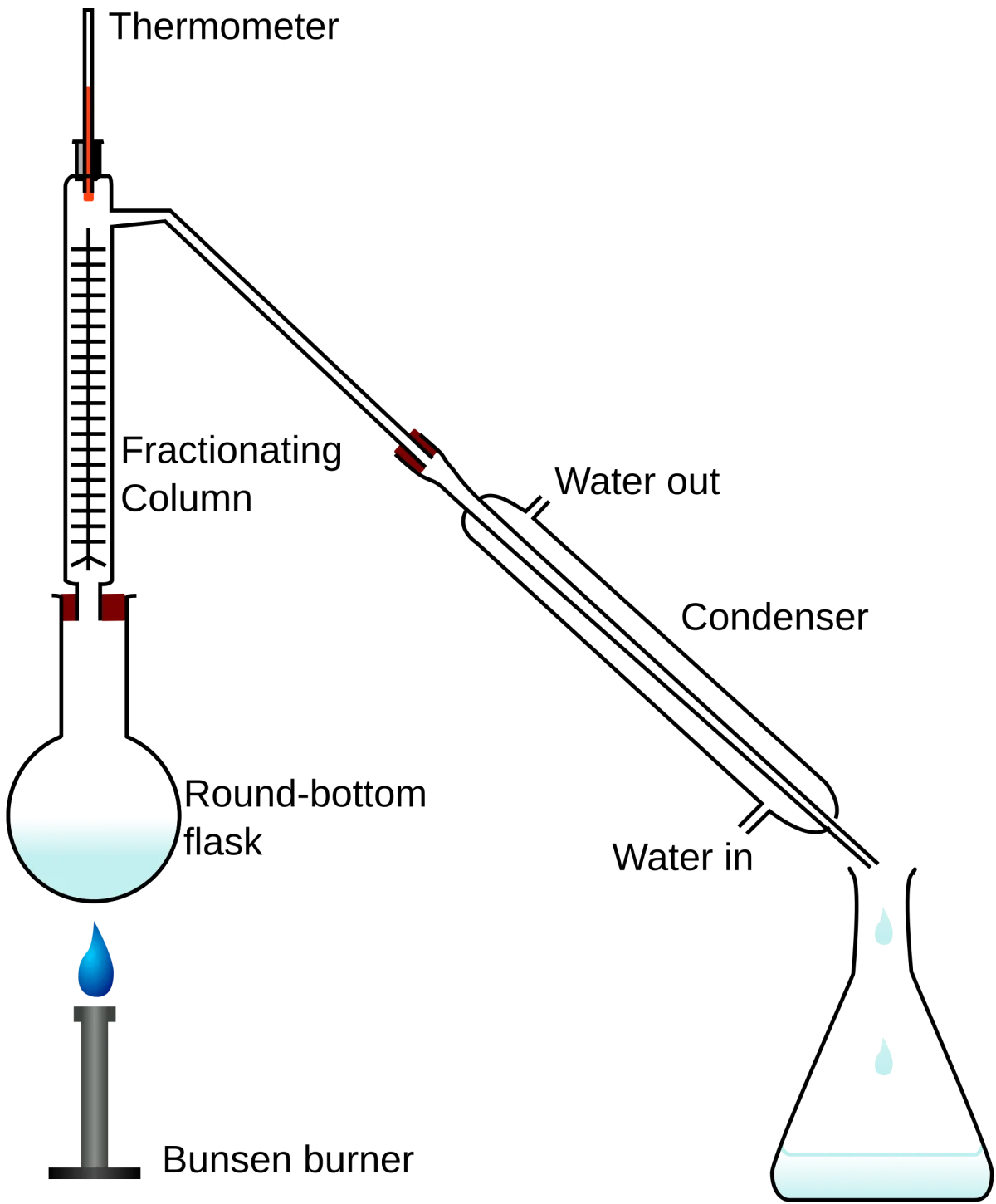
Fractional Distillation
When boiling points differ by less than 25°C, simple distillation gives a mixture, not a pure component. Fractional distillation adds a fractionating column (vertical packed tube) between the flask and the condenser. The column provides multiple “theoretical plates” - each plate is equivalent to a mini-distillation.
As vapor rises through the column, it repeatedly condenses and re-evaporates on the packing material. Each cycle enriches the vapor in the lower-boiling component. By the time vapor reaches the top, it is nearly pure (for enough plates).
Fractional distillation can separate components differing by as little as 1-2°C if the column is tall enough. Industrial distillation (petroleum refining, chemical manufacturing) uses columns tens of meters tall with hundreds of theoretical plates.
Fractional distillation apparatus: packed column between the flask and condenser provides many theoretical plates, allowing separation of liquids with close boiling points. Credit: Wikimedia Commons, CC BY-SA
What Goes In, What Comes Out
When distilling a mixture of two miscible liquids:
Initially, vapor has roughly the composition predicted by Raoult’s law: enriched in the lower-bp component.
The temperature at the thermometer stays relatively constant while the lower-bp component distills (its bp is the “plateau”).
Once the lower-bp component is exhausted, temperature jumps to the higher-bp component’s boiling point, and it begins distilling.
Stop when only residue remains.
Azeotropes
Some mixtures form azeotropes - constant-boiling mixtures that cannot be fully separated by distillation. Examples:
Ethanol-water forms a 95.6% ethanol / 4.4% water azeotrope at 78.2°C. Pure ethanol cannot be obtained by distillation alone; a desiccant or special techniques (like drying over molecular sieves) are needed for 100% ethanol.
HCl-water forms an azeotrope at 108.5°C with 20.2% HCl.
Many binary systems have azeotropes - a major complication in industrial distillation.
Collecting a Distillation Fraction
During a distillation, the main fraction is collected when:
Temperature stabilizes at (or near) the boiling point of the desired component.
The steady-state temperature is maintained while this component distills.
Monitor the thermometer closely. Fluctuations or gradual rises signal a transition or multi-component distillate - time to switch receivers.
Practical Issues
Bumping (sudden boiling of superheated liquid) can be prevented by boiling chips or magnetic stirring.
Foaming can slow distillation; use antifoam or lower heat.
Distillation under air is risky for oxygen-sensitive compounds; use inert atmosphere (N₂, Ar).
Decomposition at high temperature may be avoided by vacuum distillation (Section 12.5).
A mixture contains ethanol (bp 78°C), water (bp 100°C), and 1-butanol (bp 118°C). Describe how you would separate them via distillation.
Click to reveal answer
Use fractional distillation (or simple distillation if careful): (1) Heat the mixture. Ethanol vaporizes first; temperature plateaus at ~78°C while ethanol distills out. Collect as the first fraction. Note: pure ethanol is unattainable due to the ethanol-water azeotrope; you get ~95.6% ethanol. (2) Temperature rises to 100°C; water distills next. Collect as second fraction. (3) Temperature rises to 118°C; 1-butanol distills last. Collect as the final fraction. Each distinct temperature plateau corresponds to one component.
Vacuum distillation applies reduced pressure to the distillation system, lowering the boiling points of all components. This allows you to distill high-boiling compounds at lower temperatures, preventing thermal decomposition.
Why Reduced Pressure Lowers Boiling Points
At any temperature, a liquid has a vapor pressure. Boiling occurs when the vapor pressure equals the external (atmospheric) pressure. Under vacuum, the external pressure is lower, so boiling can occur at a lower temperature.
Rule of thumb: dropping the pressure by a factor of 10 lowers the boiling point by roughly 25-40°C. Going from 760 torr (atmospheric) to 76 torr (mild vacuum) lowers most boiling points by ~25°C. Going to 7.6 torr (stronger vacuum) lowers another ~25°C.
When to Use Vacuum Distillation
High-boiling compounds that decompose before reaching their atmospheric bp. Vacuum distillation lets them distill intact.
Heat-sensitive compounds (many natural products, peptides, drugs) that need to avoid high temperatures.
Isolating trace impurities that would otherwise be lost.
Many industrial distillations (petroleum refining, pharmaceutical manufacture) are done under vacuum for efficiency and product stability.
Setup
A vacuum distillation setup adds:
Vacuum pump (water aspirator for mild vacuum; oil pump for stronger vacuum).
Vacuum gauge to monitor pressure.
Trap (cold trap with liquid N₂ or dry ice/acetone) to protect the pump from solvent vapors.
Vacuum-tight fittings and joints (grease the ground-glass joints to ensure seal).
Clausius-Clapeyron in Action
The relationship between vapor pressure and temperature is given by the Clausius-Clapeyron equation:
ln(P₂/P₁) = -ΔHvap/R × (1/T₂ - 1/T₁)
This tells you how much the boiling point drops as you reduce pressure. For a compound with ΔHvap = 40 kJ/mol:
Atmospheric (760 torr): normal bp.
10760 = 76 torr: bp about 30-40°C lower.
1076 = 7.6 torr: bp about 60-80°C lower total.
On the MCAT, you will not need to do this calculation, but recognize the principle: lower pressure = lower bp.
Example: Glycerol Distillation
Glycerol (propane-1,2,3-triol) has atmospheric bp 290°C. Heating it to 290°C causes significant decomposition. Under vacuum (10 torr), glycerol boils at ~180°C - easily distillable without decomposition.
Practical Tips
Always check for leaks in the system before starting.
Start heating gently; sudden boiling under reduced pressure causes severe bumping.
Use a cooling bath in the receiving flask to prevent loss of volatile distillate.
Record the vapor temperature AND the pressure. Without both, boiling point data are meaningless.
A natural product has a boiling point of 280°C at atmospheric pressure but decomposes above 200°C. How would you purify it by distillation?
Click to reveal answer
Use vacuum distillation. Reducing the pressure lowers the boiling point. At 20-50 torr, for example, the compound's boiling point might drop to 170-180°C, well below the decomposition threshold. Vacuum distillation is the standard solution for heat-sensitive or high-bp compounds. Simple atmospheric distillation would destroy the compound before it could distill.
Recrystallization is the primary method for purifying solid organic compounds. The compound is dissolved in hot solvent, and the solution is allowed to cool slowly. Because solubility decreases with temperature, the compound crystallizes out of solution as the solvent cools. Impurities (present in smaller amounts) remain dissolved in the cold solvent and are removed by filtration.
Recrystallization: heat dissolves the compound in a minimum of hot solvent; slow cooling allows the compound to form pure crystals while impurities remain in solution. Filtration separates the pure crystals from the mother liquor. Credit: Wikimedia Commons, CC BY-SA
The Principle
Solubility generally increases with temperature. For a compound with a steep temperature-solubility curve (solubility varies greatly between room temperature and boiling point of the solvent), recrystallization works well.
Protocol:
Dissolve the crude solid in a minimum volume of hot solvent. The solvent should boil at a temperature below the compound’s melting point.
If the solution has color from impurities, add decolorizing carbon (activated charcoal) and filter hot to remove the carbon + impurities.
Allow the solution to cool slowly to room temperature, then to ice-bath temperature (0°C) or colder.
Pure compound crystallizes out. Impurities (in smaller amount) stay dissolved in the cold solvent (the “mother liquor”).
Filter the crystals, wash with a small amount of cold solvent, and dry.
Choosing the Right Solvent
A good recrystallization solvent:
Dissolves the compound well when hot but poorly when cold. Steep solubility-temperature curve.
Does not react with the compound. No acid-sensitive substrate in acidic solvent, etc.
Boils above the compound’s melting point minus ~30°C (so the compound dissolves fully in hot solvent without melting).
Is volatile enough to evaporate from the crystals during drying.
Common recrystallization solvents: water, ethanol, methanol, ethyl acetate, hexane, acetone, benzene (though benzene is a carcinogen and less used now).
Mixed Solvents
If no single solvent has the right solubility profile, use a mixed solvent (two miscible solvents, one that dissolves the compound well and one that does not). Example:
Dissolve the compound in hot ethanol.
Add hot water carefully until the solution becomes slightly cloudy (compound starts to precipitate).
Heat gently until the cloudiness just clears.
Cool slowly.
The mixed solvent’s solubility curve can be tuned by adjusting the ratio.
Factors Affecting Crystal Quality
Slow cooling gives larger, purer crystals. Fast cooling (sudden plunge into ice) gives smaller crystals and trapped impurities.
Seed crystals (a tiny amount of the pure product added to the cooling solution) nucleate crystallization and ensure ordered crystal growth.
Scratching the flask wall creates nucleation sites for reluctant systems.
Adding a second solvent (anti-solvent) that reduces solubility can trigger crystallization in stubborn cases.
Theoretical Yield of Recrystallization
Yield is never 100% because some compound remains dissolved in the cold mother liquor. Typical yields: 60-80% after one recrystallization. Multiple recrystallizations further purify the crystals (at the cost of more losses).
Mother Liquor Recovery
The mother liquor still contains some of the desired compound. It can be concentrated (by evaporating solvent) and recrystallized again to recover more. Each subsequent crop is usually purer but smaller.
What two criteria should a solvent meet to be a good recrystallization solvent?
Click to reveal answer
(1) Steep temperature-solubility curve: the compound dissolves well in hot solvent but poorly in cold solvent. This ensures good dissolution for the initial crystallization step AND good recovery as the compound falls out of solution on cooling. (2) Does not react with or decompose the compound: no chemical interaction between solvent and compound at elevated temperature. Additional considerations: should boil below compound's melting point, should be volatile enough to dry from crystals, and ideally non-toxic. Common examples: water, ethanol, methanol, ethyl acetate, hexane.
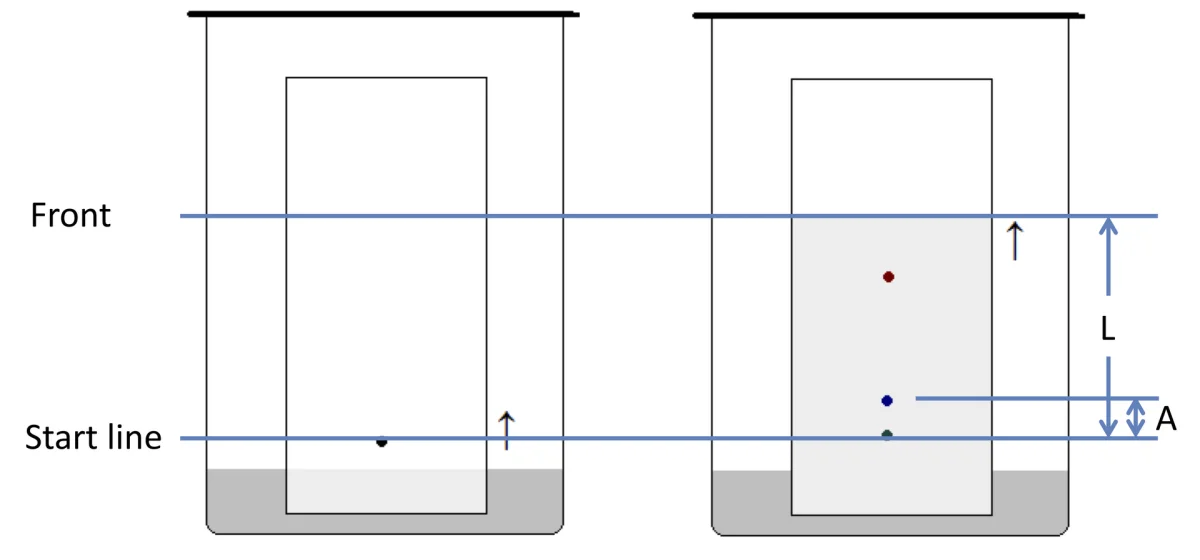
Thin-layer chromatography (TLC) is a fast, cheap, qualitative separation technique used in almost every organic chemistry lab. A TLC plate is a glass, plastic, or aluminum backing coated with a thin layer of adsorbent (usually silica gel, ~0.25 mm thick). A drop of the mixture is spotted at the bottom, and the plate is placed in a jar with the mobile phase (solvent).
As solvent travels up the plate by capillary action, compounds move along with it. Different compounds move at different speeds depending on their interaction with the silica (stationary phase) vs. the solvent (mobile phase).
TLC workflow: spot sample near the bottom; place plate in developing solvent; capillary action carries solvent up the plate, separating compounds by their polarity-driven affinity for silica. Visualize under UV or with staining reagents. Credit: Wikimedia Commons, CC BY-SA
The Rf Value
The retention factor (Rf) is:
Rf = (distance compound traveled) / (distance solvent front traveled)
Values range from 0 (compound stuck at the origin) to 1 (compound moved with the solvent front).
High Rf (greater than 0.6): the compound is nonpolar (or the solvent is very polar) - moves far.
Low Rf (less than 0.3): the compound is polar (or the solvent is nonpolar) - sticks near the origin.
Ideal Rf: 0.3-0.6 - good separation and detection.
If two compounds have very different Rf values, they can be separated; if their Rf values are similar, try a different solvent.
Calculating Rf: measure the distance the compound traveled from the baseline, and divide by the distance the solvent front traveled. Values range from 0 (didn’t move) to 1 (moved with the solvent). Two compounds with different Rf’s are separable. Credit: Wikimedia Commons, CC BY-SA
Interactive Simulator
Spot compounds at the baseline, slide the eluent polarity from 100% hexane to 100% methanol, and press Develop to migrate the solvent front up the plate. Rf values update live from a lookup table of common MCAT compounds so you can see how solvent choice changes separation.
TLC plate simulator
Interactive
Lane
Compound
Rf
1
Benzyl alcohol
0.42
2
Acetone
0.50
3
Benzoic acid
0.12
Why Polarity Matters
Silica gel is polar (Si-OH groups on the surface). Polar compounds bind to silica tightly via H-bonding and dipole-dipole interactions. They move slowly.
Nonpolar compounds have little affinity for silica. They are carried along with the solvent and move faster.
The mobile phase can be tuned: more polar solvent (like methanol, acetic acid) pulls compounds off silica faster. Nonpolar solvent (hexane) keeps them stuck.
Reaction monitoring: spot starting material and reaction mixture side by side. As reaction proceeds, the starting material spot disappears and a new product spot appears.
Purity check: one spot = pure compound; multiple spots = mixture.
Identification: comparing Rf with a known standard can identify a compound.
Scale-up planning: TLC Rf data predict column chromatography behavior.
Typical TLC Workflow
Cut a TLC plate (5-8 cm tall).
Draw a light pencil line ~1 cm from the bottom.
Spot samples along the line using a fine capillary (~0.5-1 mm spots, well-spaced).
Place the plate in a jar containing ~0.5 cm of developing solvent (do NOT let solvent touch the spots).
Cover the jar; let the solvent rise by capillary action.
When the solvent front is ~1 cm from the top, remove the plate.
Mark the solvent front immediately with pencil.
Dry and visualize.
Measure distances to calculate Rf.
On a TLC plate run with 1:1 ethyl acetate/hexane, compound A has Rf 0.2, compound B has Rf 0.7. Which compound is more polar? How would you change the solvent to make both spots closer to Rf 0.5?
Click to reveal answer
Compound A (Rf 0.2) is more polar - it stuck to the silica and moved less. Compound B (Rf 0.7) is less polar. To bring both to Rf ~0.5: compound A (too low Rf) needs a more polar mobile phase to pull it off silica faster. Compound B (too high Rf) needs a less polar mobile phase to slow it down. We cannot fix both with a single solvent change - we have to find a middle ground. Switching to 2:1 or 3:1 ethyl acetate/hexane (more polar) would raise A’s Rf but also raise B’s further. A better approach: switch to DCM/methanol or another solvent system entirely to find a blend where both Rf’s are in the 0.3-0.6 range.
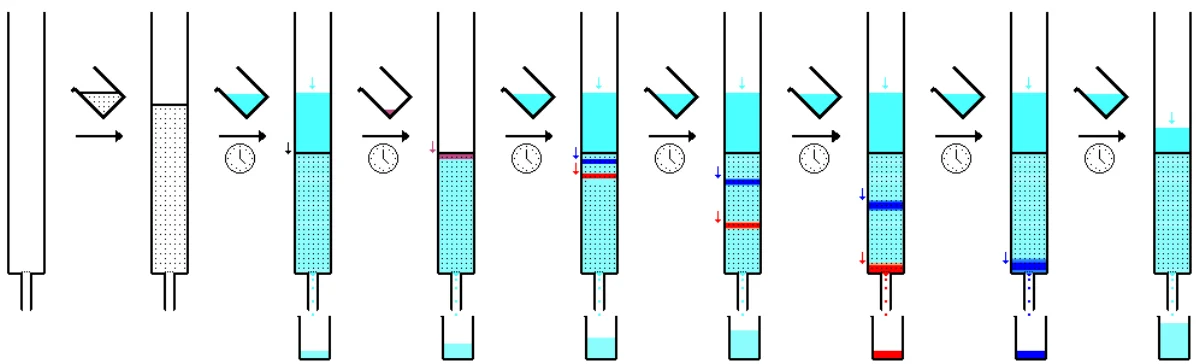
Column chromatography is the preparative-scale version of TLC. Instead of a thin plate, a vertical glass column is packed with silica gel (or another stationary phase). The mixture is loaded at the top, and solvent (the eluent) is passed through. Different compounds elute at different rates based on polarity, just like in TLC.
Column chromatography separates compounds as they pass through a packed silica column. Less polar compounds elute first; more polar compounds stick longer. Credit: Wikimedia Commons, CC BY-SA
The Setup
Pack a glass column with silica gel slurried in nonpolar solvent.
Apply the mixture as a concentrated solution at the top (or pre-adsorb on silica and layer on top).
Continuously elute with solvent; collect fractions in test tubes or flasks.
Monitor each fraction by TLC (or UV detector for semi-automated systems).
Combine fractions containing only the desired compound; evaporate solvent; isolate pure product.
Elution Order (Normal Phase)
Compounds elute in order of INCREASING polarity:
Alkanes first (most nonpolar).
Then ethers, esters, ketones.
Then alcohols, amines.
Then carboxylic acids (often stick strongly).
Highly polar compounds may require a more polar solvent (methanol, acetic acid) to dislodge them.
Gradient Elution
For complex mixtures, start with a nonpolar solvent and gradually increase polarity. A typical gradient:
The least polar compounds elute first in nonpolar solvent; progressively more polar compounds come off as solvent polarity increases.
Flash Chromatography
Standard gravity columns take hours. Flash chromatography uses compressed air or nitrogen to push solvent through the column faster (30-60 minutes). Shorter columns with smaller silica particles give sharp separations. Most modern lab chromatography is “flash” style.
Detection and Fraction Collection
Fractions are monitored by:
TLC: spot each fraction on TLC plate; identify which fractions contain which compounds.
UV detection: for automated systems, an inline UV detector outputs a chromatogram showing when each compound elutes.
Visual: colored compounds are visible in the column as they migrate.
Scale-Up Considerations
Column chromatography can handle:
Milligram scale: standard lab setup.
Gram scale: bigger columns, more silica.
Industrial scale: specialized large-column systems, but often other techniques (crystallization, distillation) are preferred at scale.
Common Pitfalls
Overloading the column: too much sample relative to silica gives poor resolution.
Air bubbles: disrupt the flow and cause channeling.
Running the column dry: cracks the silica, ruins the separation.
Choosing the wrong solvent: too polar = everything comes off at once; too nonpolar = nothing moves.
Relating Rf to Column Retention
TLC Rf predicts column behavior:
Rf ~0.3 on TLC = good compound retention on column.
Rf ~0.5-0.6 = fast elution.
Rf ~0 = too sticky; won’t elute with that solvent.
Scouting a solvent system on TLC first saves time when setting up the column.
A chemist runs column chromatography on a mixture of an alcohol (A), a ketone (K), and a nonpolar alkene (N). In what order do they elute from a normal-phase silica column?
Click to reveal answer
Elution order (first to last): Alkene (N) → Ketone (K) → Alcohol (A). Normal-phase silica is polar. Nonpolar compounds (the alkene) have little affinity for silica and move fastest through the column with the solvent. Ketones are moderately polar (C=O dipole but no H-bond donor) and elute next. Alcohols are most polar (both H-bond donor and acceptor) and stick strongly to silica - eluted last or require more polar solvent. This elution order is predictable from the Rf ranking on TLC.
Gas chromatography (GC) separates volatile compounds in the gas phase. It is used for small, volatile organic molecules that can be vaporized without decomposition. GC is fast, sensitive, and highly automated - one injection can resolve dozens of peaks in minutes.
How GC Works
A small volume of sample (typically 1 μL in solvent) is injected into a heated port where it vaporizes.
A carrier gas (usually helium, sometimes nitrogen or hydrogen) sweeps the vapor through a long, coiled capillary column inside a temperature-controlled oven.
The column’s inner walls are coated with a liquid stationary phase.
Compounds with higher affinity for the stationary phase are retained longer; compounds with higher volatility pass through faster.
At the end of the column, a detector (FID, TCD, or mass spec) registers each compound as it emerges.
The output is a chromatogram: peaks vs. time. Each peak is a compound; its retention time and peak area are the key data.
What Gets Separated
Only volatile, thermally stable compounds can be analyzed by GC. Typical targets:
Solvents and alcohols.
Hydrocarbons, fatty acid methyl esters.
Small organic compounds (MW < 500 usually).
Volatile flavors and fragrances.
What does NOT work:
Large biomolecules (proteins, DNA) - too heavy, non-volatile.
Ionic salts - do not vaporize.
Thermally labile compounds - decompose at injection temperature.
For these, use HPLC or another technique.
Retention Time
Retention time (tR) is the time for a compound to pass from injection to detection. It depends on:
Boiling point: low bp = faster movement (less time in stationary phase’s liquid film).
Column interactions: polar column retains polar compounds more strongly.
Temperature: higher oven temperature = faster movement for everything.
Programmed temperature GC (temperature ramps up during the run) is standard for complex mixtures.
Common Detectors
Detector
Abbreviation
What it measures
Use
Flame ionization
FID
Carbon ions in a flame
Most organic compounds
Thermal conductivity
TCD
Heat transfer in carrier gas
Simple, universal
Electron capture
ECD
Electronegative atoms
Halogens, nitro groups
Mass spectrometry
MS
Mass-to-charge ratio
Full identification (GC-MS)
GC-MS combines separation (GC) with identification (MS). It is the gold standard for analyzing complex mixtures - the GC gives you retention time, the MS gives you the molecular structure of each peak.
Quantification
Peak area is proportional to the amount of compound (when using an appropriate detector like FID). Calibration with known standards allows quantitative analysis:
Drug testing (forensic analysis).
Food quality control.
Environmental analysis (pesticides, pollutants).
GC vs. HPLC
Feature
GC
HPLC
Mobile phase
Gas (usually He)
Liquid (usually water/MeCN mix)
Temperature
40-350°C
Room temp (or slightly heated)
Volatile compounds
Yes
Yes
Non-volatile compounds
No
Yes
Thermally labile compounds
No
Yes
Speed
Fast (minutes)
Slower (15-60 min typical)
Resolution
Very high
Very high
For MCAT: GC = volatile small molecules. HPLC = non-volatile, large, or thermally labile.
A forensic analyst wants to identify volatile compounds in a blood sample. She has two options: GC-MS or HPLC. Which technique should she choose and why?
Click to reveal answer
GC-MS. For volatile compounds in a biological sample (like alcohol, toxic solvents, or some drugs of abuse), GC-MS is ideal: GC separates the volatile components quickly, MS identifies each peak by its mass spectrum. HPLC could work but is slower and less sensitive for small volatile molecules. For non-volatile analytes like proteins or large drug molecules, HPLC (often HPLC-MS) would be preferred. The volatility of the target analyte decides the choice.
HPLC (high-performance liquid chromatography) is column chromatography performed under high pressure with small stationary phase particles, giving dramatically improved resolution. It handles samples that cannot be analyzed by GC: non-volatile molecules, thermally unstable compounds, ionic species, biological macromolecules.
The HPLC Setup
Pump: delivers solvent at high pressure (up to 400 bar).
Injector: introduces the sample (typically 1-100 μL) into the flowing solvent.
Column: packed with small (3-5 μm) silica particles, bonded with specific chemistry (C18 is most common).
Detector: measures compounds as they elute. Common: UV/Vis, fluorescence, MS, electrochemical.
Computer: records the chromatogram and controls the system.
Reverse-Phase HPLC (Most Common)
In reverse-phase HPLC, the stationary phase is NONPOLAR (typically C18 alkyl chains bonded to silica), and the mobile phase is POLAR (water + acetonitrile or methanol).
Nonpolar compounds interact strongly with the stationary phase → retained longer.
Polar compounds prefer the polar mobile phase → elute faster.
This is the OPPOSITE of TLC and normal-phase column chromatography.
Reverse-phase HPLC dominates pharmaceutical and biochemical analysis because water-based mobile phases are compatible with biological samples and drug molecules.
Normal-Phase HPLC
Rare today. Uses polar silica column + nonpolar mobile phase. Similar to column chromatography but with better resolution.
Isocratic vs. Gradient Elution
Isocratic: constant mobile phase composition throughout the run. Simple but cannot resolve wide-polarity mixtures.
Gradient: mobile phase composition changes during the run (e.g., from 90% water / 10% acetonitrile to 10% water / 90% acetonitrile over 30 minutes). Resolves complex mixtures.
Gradient elution is the standard for complex samples in pharmaceutical QC, proteomics, and drug discovery.
Detection
UV/Vis detector: most compounds absorb in the UV (200-280 nm). Simple, sensitive, and the default for most HPLC.
Fluorescence: for fluorescent molecules or those tagged with a fluorophore.
Mass spectrometry (LC-MS): combines HPLC separation with MS identification. The go-to for proteomics, metabolomics, and drug metabolism studies.
Applications
Drug purity analysis: verify that a pharmaceutical meets specification (99%+ purity).
Pharmaceutical drug discovery: analyze compound libraries.
Amino acid analysis: separate and quantify amino acids in protein hydrolysates.
Metabolite profiling: identify small molecules in biological samples (metabolomics).
Environmental analysis: pesticides, pollutants in water and soil.
Typical Retention Times
HPLC runs typically take 15-60 minutes. Peaks emerge at specific retention times characteristic of each compound. Standards are run in parallel to confirm identity.
HPLC in Drug Development
Every approved pharmaceutical drug is characterized by HPLC during development and manufacturing:
Analytical HPLC: monitors purity (standard: ≥99% drug, ≤0.1% any single impurity).
Preparative HPLC: purifies drug candidates at gram-to-kilogram scale.
LC-MS: elucidates drug metabolism and degradation products.
LC-MS: The Power Combo
Coupling HPLC to mass spectrometry gives:
Retention time from HPLC → one piece of identification.
Mass spectrum from MS → second piece of identification + structural information.
LC-MS/MS (tandem MS) adds even more specificity: the first MS selects one mass, fragments it, and the second MS analyzes the fragments. Essential for clinical diagnostics, doping tests, and metabolomics.
In reverse-phase HPLC with a C18 column and a water/acetonitrile mobile phase, in what order do these compounds elute: glycine (highly polar amino acid), caffeine (moderately polar), ibuprofen (nonpolar)?
Click to reveal answer
Elution order (first to last): Glycine → caffeine → ibuprofen. In reverse phase, the stationary phase is nonpolar (C18) and the mobile phase is polar (water/acetonitrile). Polar compounds have little affinity for the C18 stationary phase and elute first with the polar solvent. Nonpolar compounds bind strongly to C18 and elute last. This is the OPPOSITE of normal-phase behavior.
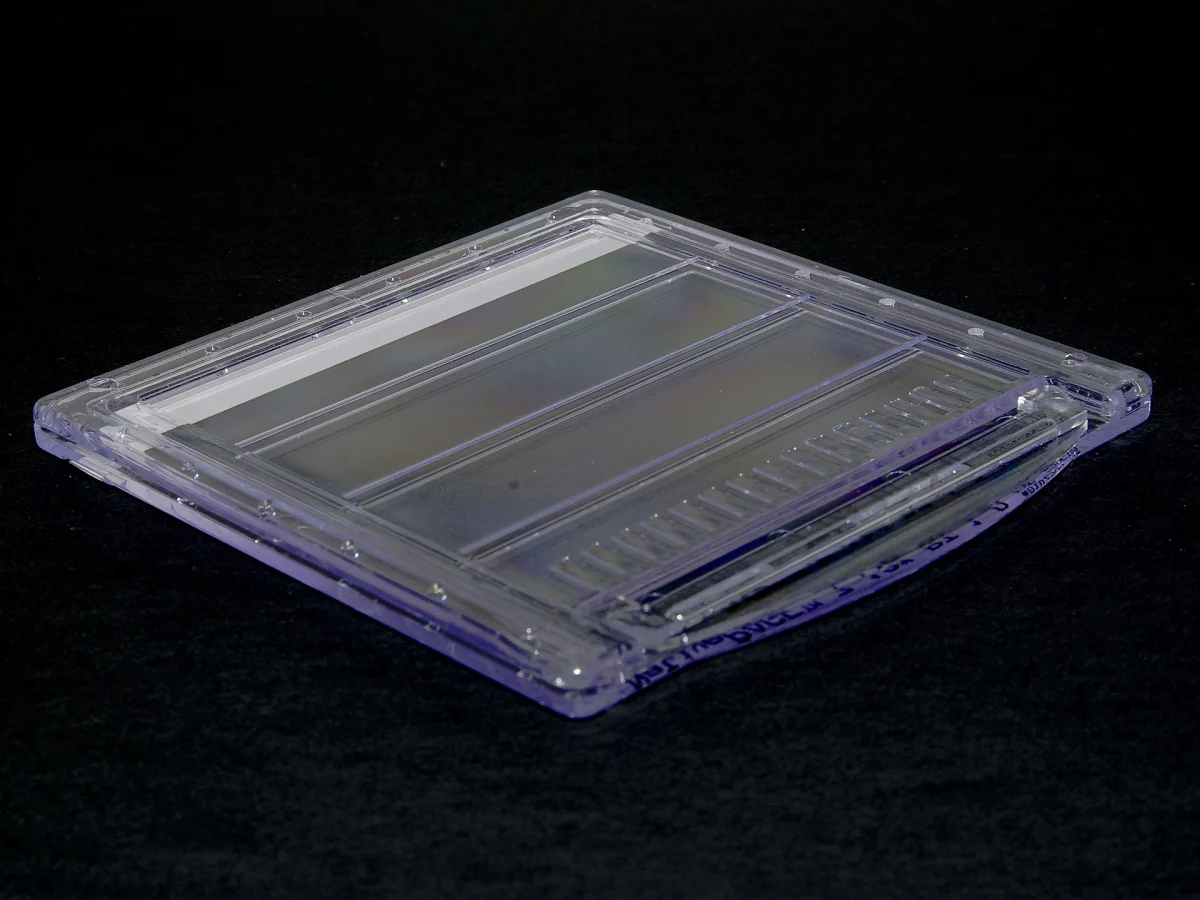
Gel electrophoresis separates charged macromolecules (proteins, DNA, RNA) by applying an electric field across a gel matrix. Molecules migrate through the gel’s pores based on their charge, size, and shape. Different gel types and conditions select for different properties.
SDS-PAGE gel with protein bands. SDS coats all proteins with negative charge proportional to length, so separation is purely by size - smaller proteins migrate farther toward the anode. Credit: Wikimedia Commons, CC BY-SA
SDS-PAGE: Size-Based Protein Separation
SDS-PAGE (sodium dodecyl sulfate-polyacrylamide gel electrophoresis) is the standard technique for separating proteins by molecular weight.
Denaturation: proteins are boiled in SDS (sodium dodecyl sulfate, an anionic detergent) and a reducing agent (β-mercaptoethanol or DTT). SDS coats the protein uniformly, denatures it into a linear shape, and gives it a large negative charge proportional to its length. Reducing agent breaks disulfide bonds.
Gel loading: the prepared protein samples are loaded into wells at the top of a polyacrylamide gel.
Electrophoresis: an electric field pulls the negatively charged proteins toward the positive electrode (anode, bottom). Small proteins move fast through the gel’s pore network; large proteins are slowed.
Staining: after electrophoresis, the gel is stained (Coomassie blue, silver stain, or fluorescent stains like SYPRO) to visualize proteins.
Because SDS overwhelms the native charge differences between proteins, SDS-PAGE separates PURELY BY SIZE. A molecular weight marker ladder is run alongside to estimate each band’s MW.
Why Smaller Proteins Move Faster
The polyacrylamide gel has a porous network. Small proteins squeeze through easily; large proteins get physically caught in the mesh. The gel acts as a molecular sieve, size-selectively.
Gel percentage controls pore size:
Low % (4-8%): large pores, good for big proteins (>100 kDa).
High % (12-15%): small pores, good for small proteins (<30 kDa).
Native Gel Electrophoresis
Native PAGE omits SDS and denaturation. Proteins retain their folded structure and native charge. Separation is by:
Size (still pore-size-dependent).
Charge (charged proteins move faster).
Shape (compact vs. extended proteins migrate differently).
Native gels preserve biological activity - useful for studying protein-protein interactions or enzyme activity within the gel.
Isoelectric Focusing (IEF)
IEF uses a pH gradient in the gel. Proteins stop migrating when they reach the pH equal to their pI (where they have no net charge). IEF separates proteins by pI rather than size.
2D-PAGE
Combining IEF (first dimension) and SDS-PAGE (second dimension) gives 2D-PAGE:
First, separate by pI using IEF.
Then rotate 90° and separate by size using SDS-PAGE.
The result is a 2D scatter of protein spots, each with a unique (pI, MW) pair. 2D-PAGE is the classic tool of proteomics, revealing hundreds to thousands of protein spots in a single experiment.
DNA Gel Electrophoresis
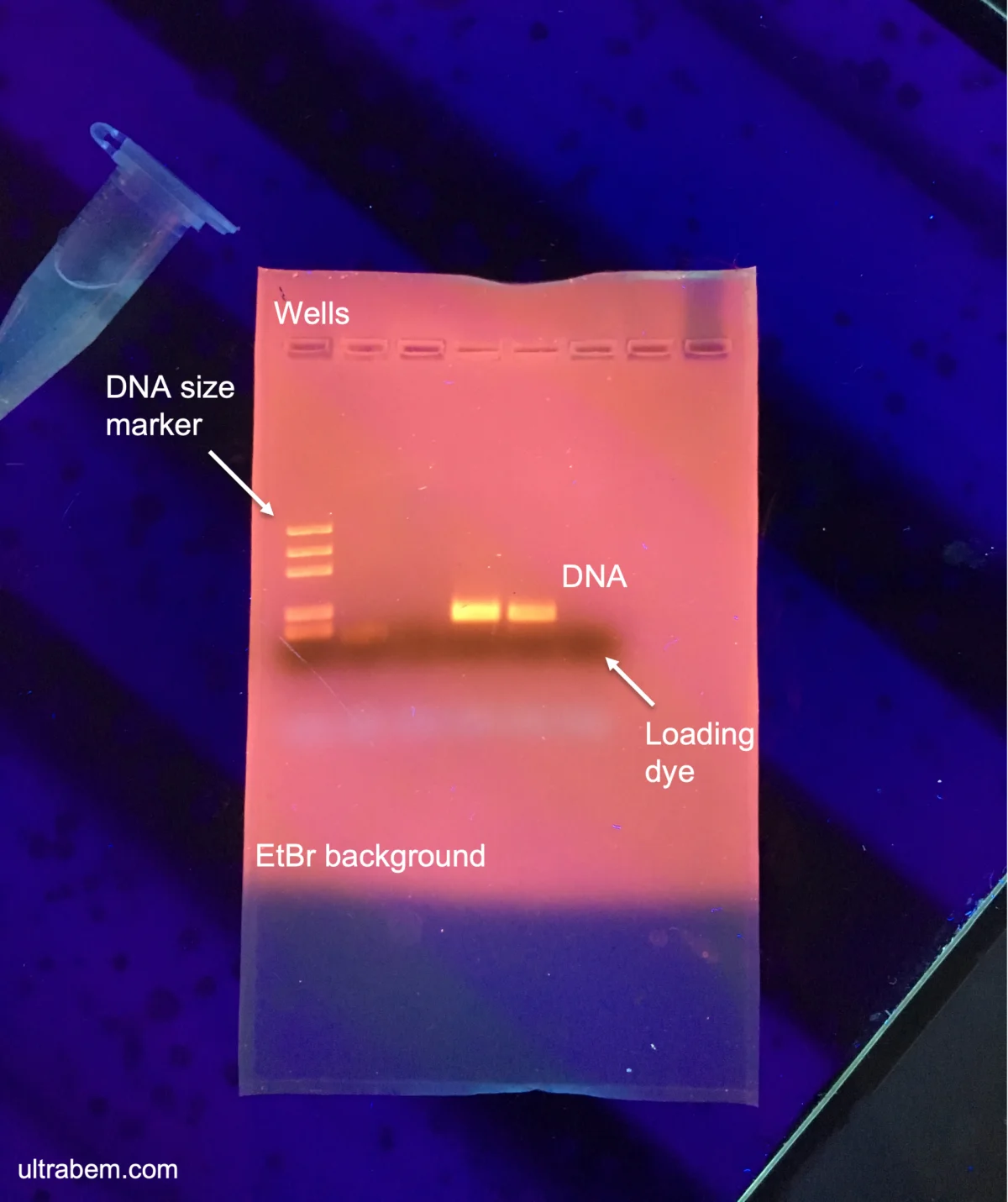
DNA electrophoresis uses AGAROSE gel (not polyacrylamide) for larger molecules:
DNA is already negatively charged (from its phosphate backbone).
Smaller DNA fragments move faster.
Ethidium bromide or SYBR Safe stains DNA for visualization.
Used in PCR, cloning, and restriction analysis.
Agarose gel of DNA fragments stained with a fluorescent dye. The ladder (left lane) marks known sizes; sample bands are sized by interpolation. Smaller fragments migrate faster (farther down the gel); larger fragments are slowed by the gel mesh. Credit: Wikimedia Commons, CC BY-SA
Molecular Weight Ladders
A reference “ladder” (mixture of proteins or DNA fragments of known sizes) is run alongside samples. Comparing band positions to the ladder lets you estimate each band’s MW.
Common protein markers: 10, 15, 25, 37, 50, 75, 100, 150, 250 kDa.
Common DNA markers: 100 bp, 500 bp, 1 kb, 2 kb, 5 kb, 10 kb.
A researcher runs SDS-PAGE on a mixture of a 50 kDa enzyme and a 20 kDa regulatory protein. Which one runs faster (further down the gel), and why?
Click to reveal answer
The 20 kDa regulatory protein runs faster. SDS coats both proteins with the same charge/mass ratio, so they carry similar charge per length. The gel's porous network acts as a sieve: smaller proteins squeeze through easily, larger ones are slowed. The 20 kDa protein's smaller size lets it travel farther toward the anode in the same time. After staining, the 20 kDa band is lower on the gel (farther from the wells) than the 50 kDa band.
On the MCAT, separation questions test whether you can match a mixture’s key property difference to the best separation technique. This section is the decision framework.
The Master Decision Table
Mixture contains
Best technique
Exploits
Two liquids with different bp (>25°C)
Simple distillation
Boiling point
Two liquids with similar bp (<25°C)
Fractional distillation
Boiling point
A compound with high bp + decomposition risk
Vacuum distillation
Boiling point (at reduced pressure)
A solid organic compound + impurities
Recrystallization
Solubility vs. temperature
Organic acid + neutral compound
Acid-base extraction
pKa (ionizability)
Organic base + neutral compound
Acid-base extraction
pKa
Acid + base + neutral in one organic mixture
Sequential acid-base extraction
pKa
Polar + nonpolar in organic solvent
Liquid-liquid extraction
Polarity
Multiple organics to analyze qualitatively
TLC
Polarity on silica
Multiple organics to purify preparatively
Column chromatography
Polarity on silica
Volatile small organics (MW < 500)
GC
Volatility + stationary phase interactions
Non-volatile or thermally labile
HPLC
Polarity with liquid mobile phase
Biomolecules (proteins, DNA)
Gel electrophoresis
Size (+/- charge)
Proteins by pI
IEF
Isoelectric point
Proteins by two dimensions
2D-PAGE
pI + size
Common MCAT Scenarios
Scenario 1: “A mixture contains a volatile ester (MW 74) and a less volatile alcohol (MW 116). What is the best separation method?”
Answer: Simple distillation. Ester bp ~60°C, alcohol bp ~125°C. Distill the ester first.
Scenario 2: “You have a mixture of aspirin (aromatic carboxylic acid) and benzocaine (aromatic amine ester) in dichloromethane. How do you separate them?”
Answer: Acid-base extraction. Aspirin’s COOH is deprotonated by NaOH → aqueous layer. Benzocaine’s amine is protonated by HCl → different aqueous layer. Three-way separation recovers each.
Scenario 3: “A crude product of a reaction contains the desired alcohol product and several byproducts. How to purify?”
Answer: Column chromatography. Load onto silica; elute with a solvent gradient; collect fractions; identify by TLC and combine those with only the desired product.
Scenario 4: “A bacterial cell extract contains dozens of proteins. How to analyze?”
Answer: SDS-PAGE (1D) for size-based analysis. 2D-PAGE (2D) for comprehensive proteomic analysis. Combined with Western blot for specific detection.
Scenario 5: “A DNA restriction digest produced fragments of 500 bp, 1500 bp, and 5000 bp. How to size-separate?”
Answer: Agarose gel electrophoresis. Low % agarose (0.8%) resolves the three fragments by size; ethidium bromide staining visualizes them under UV.
Multi-Step Strategy
Many real-world purifications use MULTIPLE techniques in sequence. Example: purifying a natural product from plant tissue:
Grind plant material in a polar solvent to extract water-soluble compounds.
Liquid-liquid extraction (water + ether) to separate hydrophilic from hydrophobic.
Column chromatography on the organic layer to separate the target from other organics.
You have a complex mixture of plant alkaloids (nitrogen-containing natural products) dissolved in methanol. You want to (a) separate them analytically and (b) identify the most abundant compound. What is the best combined technique?
Click to reveal answer
LC-MS (HPLC coupled to mass spectrometry). HPLC separates the alkaloids by polarity in a liquid mobile phase (compatible with the methanol extract); MS identifies each peak by its mass and fragmentation pattern. Alkaloids are non-volatile and can be thermally unstable, so GC is less suitable. The LC-MS combination provides both analytical separation and structural identification in one run - the modern standard for natural product analysis.