
Column Chromatography
Column chromatography is the preparative-scale version of TLC. Instead of a thin plate, a vertical glass column is packed with silica gel (or another stationary phase). The mixture is loaded at the top, and solvent (the eluent) is passed through. Different compounds elute at different rates based on polarity, just like in TLC.
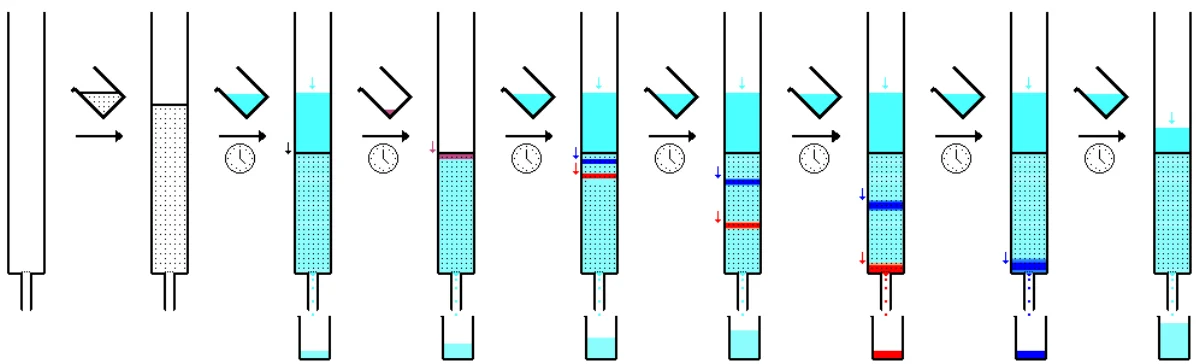
The Setup
- Pack a glass column with silica gel slurried in nonpolar solvent.
- Apply the mixture as a concentrated solution at the top (or pre-adsorb on silica and layer on top).
- Continuously elute with solvent; collect fractions in test tubes or flasks.
- Monitor each fraction by TLC (or UV detector for semi-automated systems).
- Combine fractions containing only the desired compound; evaporate solvent; isolate pure product.
Elution Order (Normal Phase)
Compounds elute in order of INCREASING polarity:
- Alkanes first (most nonpolar).
- Then ethers, esters, ketones.
- Then alcohols, amines.
- Then carboxylic acids (often stick strongly).
Highly polar compounds may require a more polar solvent (methanol, acetic acid) to dislodge them.
Gradient Elution
For complex mixtures, start with a nonpolar solvent and gradually increase polarity. A typical gradient:
- 100% hexane → 10% ethyl acetate/hexane → 50% ethyl acetate/hexane → 100% ethyl acetate → 5% methanol/ethyl acetate → 20% methanol/ethyl acetate.
The least polar compounds elute first in nonpolar solvent; progressively more polar compounds come off as solvent polarity increases.
Flash Chromatography
Standard gravity columns take hours. Flash chromatography uses compressed air or nitrogen to push solvent through the column faster (30-60 minutes). Shorter columns with smaller silica particles give sharp separations. Most modern lab chromatography is “flash” style.
Detection and Fraction Collection
Fractions are monitored by:
- TLC: spot each fraction on TLC plate; identify which fractions contain which compounds.
- UV detection: for automated systems, an inline UV detector outputs a chromatogram showing when each compound elutes.
- Visual: colored compounds are visible in the column as they migrate.
Scale-Up Considerations
Column chromatography can handle:
- Milligram scale: standard lab setup.
- Gram scale: bigger columns, more silica.
- Industrial scale: specialized large-column systems, but often other techniques (crystallization, distillation) are preferred at scale.
Common Pitfalls
- Overloading the column: too much sample relative to silica gives poor resolution.
- Air bubbles: disrupt the flow and cause channeling.
- Running the column dry: cracks the silica, ruins the separation.
- Choosing the wrong solvent: too polar = everything comes off at once; too nonpolar = nothing moves.
Relating Rf to Column Retention
TLC Rf predicts column behavior:
- Rf ~0.3 on TLC = good compound retention on column.
- Rf ~0.5-0.6 = fast elution.
- Rf ~0 = too sticky; won’t elute with that solvent.
Scouting a solvent system on TLC first saves time when setting up the column.