Extraction
Liquid-liquid extraction separates mixtures based on polarity differences. A mixture is shaken with two immiscible solvents (typically water + an organic solvent like ether or dichloromethane). Polar compounds go to the aqueous layer; nonpolar compounds go to the organic layer. The layers are separated in a separatory funnel.

Common Solvent Pairs
| Organic | Density | Notes |
|---|---|---|
| Diethyl ether | 0.71 | Lighter than water (top layer); volatile and flammable |
| Ethyl acetate | 0.90 | Lighter than water (top) |
| Hexane | 0.66 | Very nonpolar; good for nonpolar extractions |
| Dichloromethane (DCM) | 1.33 | Denser than water (bottom); good solvent for many organics |
| Chloroform | 1.49 | Denser than water (bottom); less common |
| Petroleum ether | ~0.65 | Very nonpolar, volatile |
Always know which layer is the organic (top or bottom) based on density.
Practical Protocol
- Load the mixture into a separatory funnel.
- Add the two solvents.
- Stopper, invert, vent (release pressure; important for volatile solvents).
- Shake vigorously to maximize mixing.
- Let the layers separate (1-2 minutes for simple systems; longer for emulsions).
- Drain the bottom layer out the stopcock.
- Pour the top layer out the top.
Multiple Small Extractions
For maximum recovery, do THREE smaller extractions rather than one large one. This is because the partition coefficient is a ratio, not a fraction:
If a compound partitions 1:4 (organic:aqueous) and you extract 100 mL aqueous with 100 mL organic:
- Single extraction: 20% of the compound goes to the organic layer.
- Three 33 mL extractions: ~49% ends up in combined organic layers (better recovery).
Rule: multiple small extractions > one big extraction for the same total volume of organic solvent.
Partition Coefficient and Equilibrium
K = [A]_organic / [A]_aqueous.
For a single extraction, the fraction remaining in the original (aqueous) layer is:
f = 1 / (1 + K × / ).
For n extractions with equal volumes of organic:
= [1 / (1 + K × / )]ⁿ.
Smaller per extraction but more extractions give a lower final (more compound removed).
When Extraction Fails
Some mixtures cannot be separated by simple extraction:
- If all components are very polar (all in aqueous) or all nonpolar (all in organic).
- If the compound decomposes during the extraction.
- If an emulsion forms and does not break.
For these cases, use chromatography or other techniques.
Drying Organic Layers
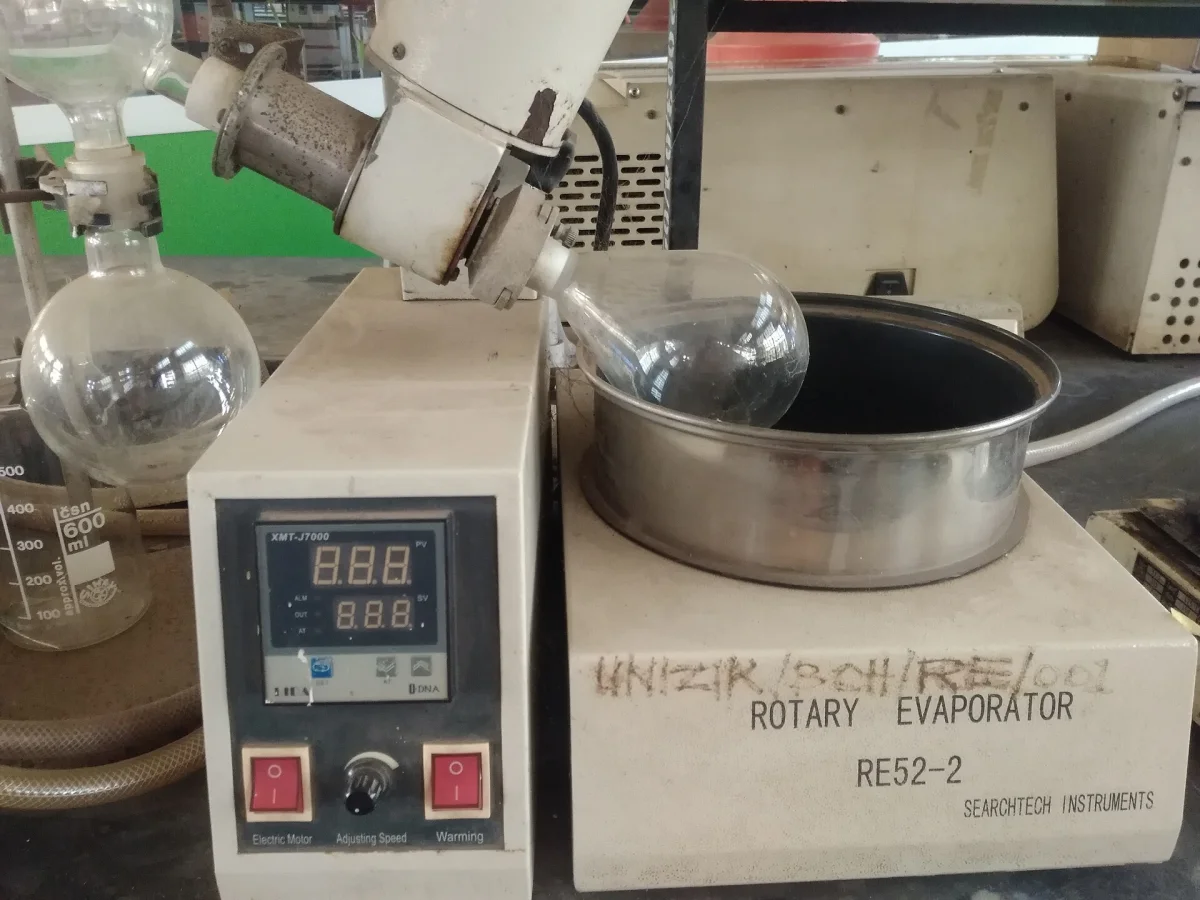
After extraction, the organic layer often has traces of water. Dry with an anhydrous desiccant like Na₂SO₄ or MgSO₄. The desiccant absorbs the water; the dry organic solution is then filtered or decanted for further use. Solvent is then removed on a rotary evaporator (“rotovap”):