
Distillation
Distillation separates components of a liquid mixture based on differences in boiling point. The mixture is heated; the lower-boiling component vaporizes first; the vapor is condensed in a cooler region and collected. The higher-boiling component stays in the distillation flask until it is its turn to vaporize.
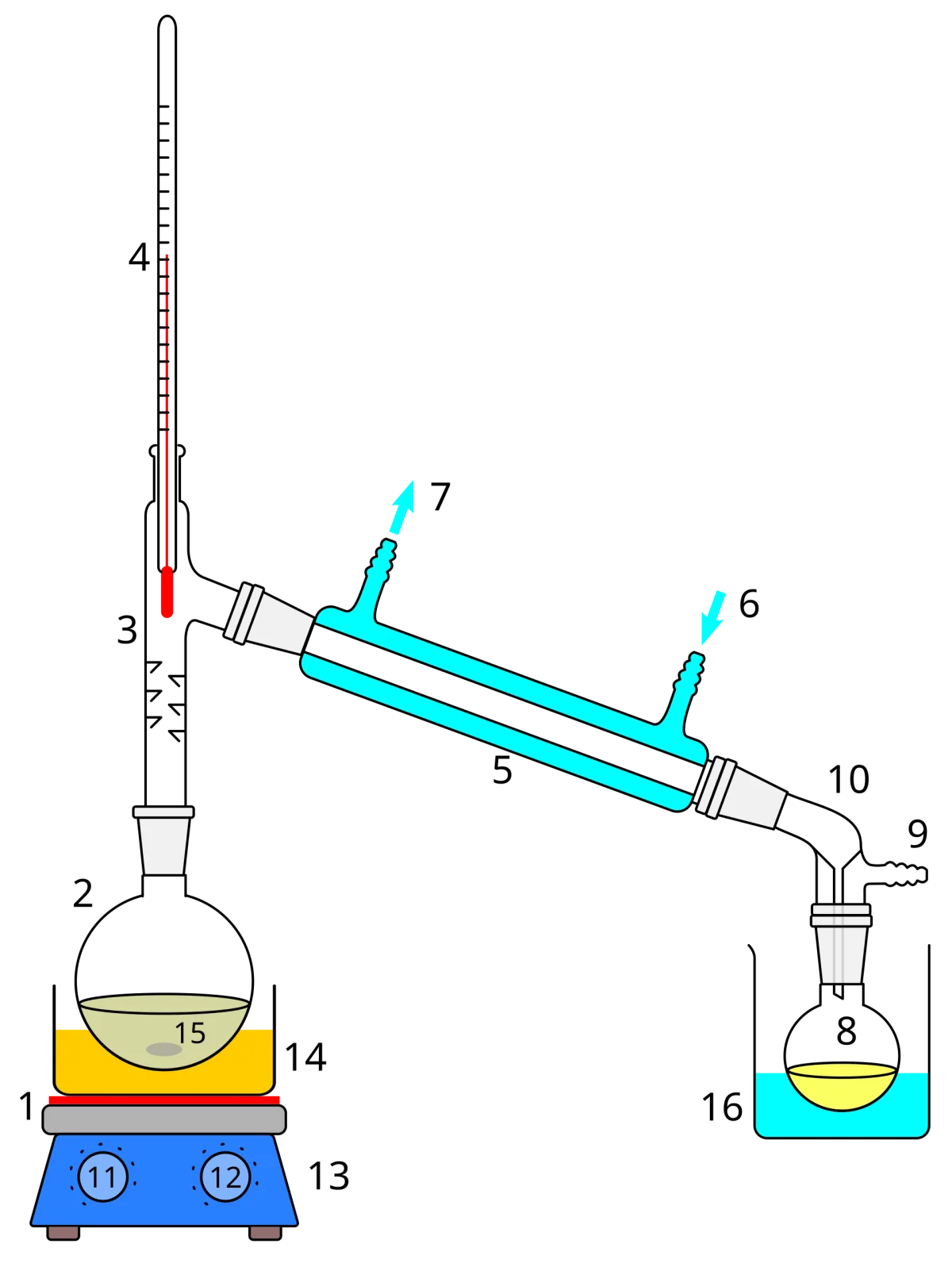
Simple Distillation
Simple distillation works when components differ in boiling point by at least 25°C. The apparatus consists of:
- Distillation flask (where the mixture is heated).
- Thermometer (measures vapor temperature at the junction).
- Condenser (water-cooled tube where vapor condenses).
- Receiving flask (collects the distillate).
Collect fractions based on temperature:
- Initial fraction: impurities with lower bp than the target.
- Main fraction: the desired component, distilled at its boiling point.
- Final fraction: higher-bp impurities and residue.
Only the main fraction is kept for further use.
Fractional Distillation
When boiling points differ by less than 25°C, simple distillation gives a mixture, not a pure component. Fractional distillation adds a fractionating column (vertical packed tube) between the flask and the condenser. The column provides multiple “theoretical plates” - each plate is equivalent to a mini-distillation.
As vapor rises through the column, it repeatedly condenses and re-evaporates on the packing material. Each cycle enriches the vapor in the lower-boiling component. By the time vapor reaches the top, it is nearly pure (for enough plates).
Fractional distillation can separate components differing by as little as 1-2°C if the column is tall enough. Industrial distillation (petroleum refining, chemical manufacturing) uses columns tens of meters tall with hundreds of theoretical plates.
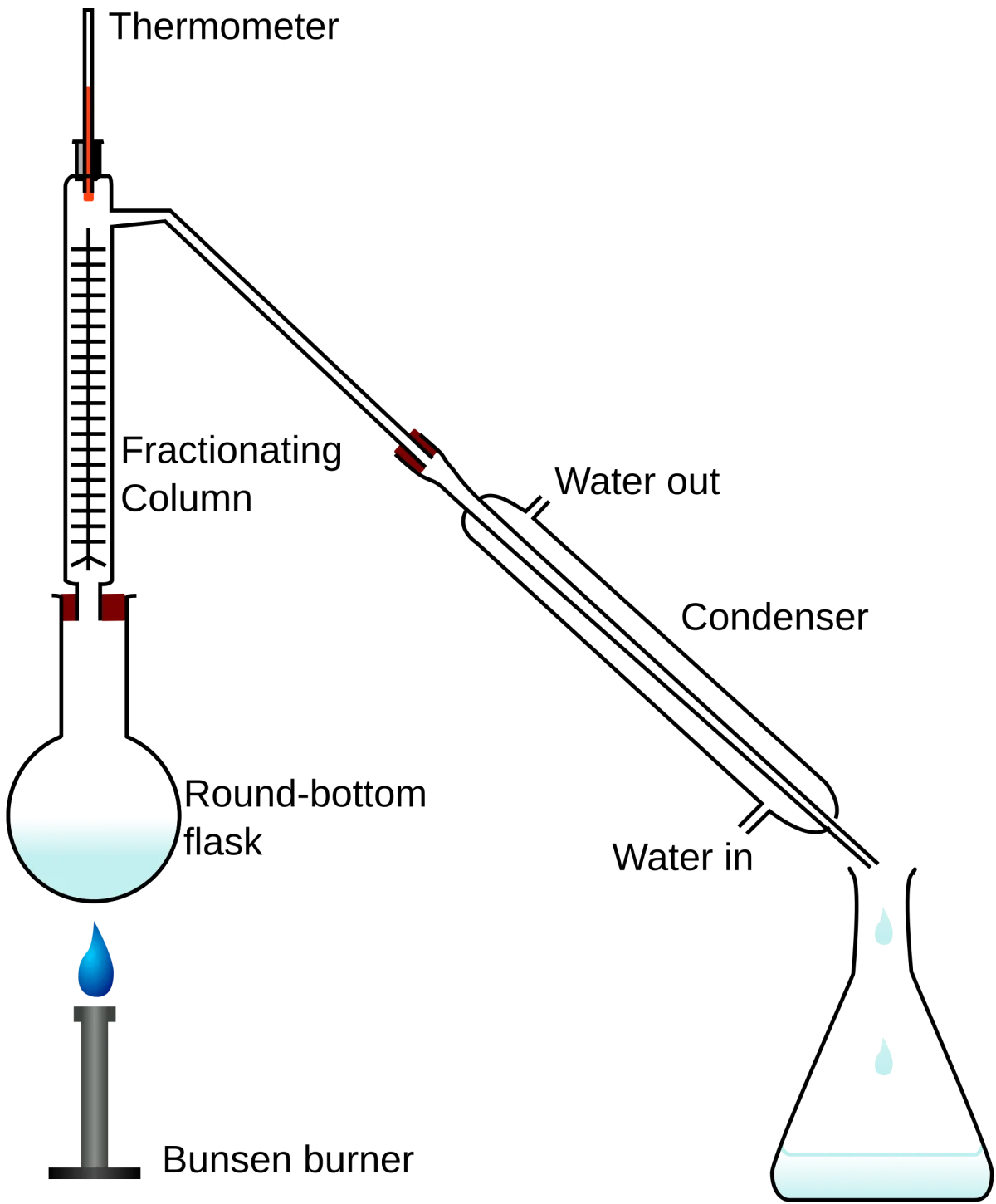
What Goes In, What Comes Out
When distilling a mixture of two miscible liquids:
- Initially, vapor has roughly the composition predicted by Raoult’s law: enriched in the lower-bp component.
- The temperature at the thermometer stays relatively constant while the lower-bp component distills (its bp is the “plateau”).
- Once the lower-bp component is exhausted, temperature jumps to the higher-bp component’s boiling point, and it begins distilling.
- Stop when only residue remains.
Azeotropes
Some mixtures form azeotropes - constant-boiling mixtures that cannot be fully separated by distillation. Examples:
- Ethanol-water forms a 95.6% ethanol / 4.4% water azeotrope at 78.2°C. Pure ethanol cannot be obtained by distillation alone; a desiccant or special techniques (like drying over molecular sieves) are needed for 100% ethanol.
- HCl-water forms an azeotrope at 108.5°C with 20.2% HCl.
- Many binary systems have azeotropes - a major complication in industrial distillation.
Collecting a Distillation Fraction
During a distillation, the main fraction is collected when:
- Temperature stabilizes at (or near) the boiling point of the desired component.
- The steady-state temperature is maintained while this component distills.
Monitor the thermometer closely. Fluctuations or gradual rises signal a transition or multi-component distillate - time to switch receivers.
Practical Issues
- Bumping (sudden boiling of superheated liquid) can be prevented by boiling chips or magnetic stirring.
- Foaming can slow distillation; use antifoam or lower heat.
- Distillation under air is risky for oxygen-sensitive compounds; use inert atmosphere (N₂, Ar).
- Decomposition at high temperature may be avoided by vacuum distillation (Section 12.5).