Temperature feels intuitive — you know when something is hot or cold. But the number you assign to that feeling depends entirely on the scale you’re using. The same room can be “20°,” “68°,” or “293°” — and all three are correct, in different scales.
For the MCAT, you need to move fluently between three temperature scales and know exactly when to use each one. There’s only one conversion you really have to memorize, and one rule about which scale to use when. Get those two things right and you’ll never lose a thermodynamics point to a temperature mistake.
Celsius - The Chemistry Default
The Celsius scale is built around water. Zero degrees Celsius (0 °C) is the freezing point of water at 1 atm, and 100 °C is its boiling point. Each degree represents 1001 of that range.
Most everyday science uses Celsius. When a passage describes a reaction “at 37 °C” (body temperature), it is using this scale.
Fahrenheit - The One You Can Ignore
Fahrenheit sets water’s freezing point at 32 °F and boiling at 212 °F. The conversion is:
°F = (59)°C + 32
The MCAT almost never tests Fahrenheit conversions, but you should know the formula exists. The important takeaway: Fahrenheit degrees are smaller than Celsius degrees (180 Fahrenheit degrees span the same range as 100 Celsius degrees).
Kelvin - The Physics Standard
The Kelvin scale is the absolute temperature scale. It starts at absolute zero - the lowest temperature theoretically possible, where molecular motion effectively stops.
Key Kelvin benchmarks:
0 K = -273 °C (absolute zero)
273 K = 0 °C (water freezes)
310 K = 37 °C (body temperature)
373 K = 100 °C (water boils)
Why Kelvin Matters for the MCAT
Every gas law and thermodynamic equation that includes temperature requires Kelvin. Using Celsius in PV = nRT or the Carnot efficiency formula will give you a wrong answer. The reason is simple: these equations involve ratios and products of temperature, and negative temperatures would produce nonsensical results.
Absolute Zero
At 0 K, particles have the minimum possible energy. You cannot go below this. Classical physics says all molecular motion stops; quantum mechanics says a tiny “zero-point energy” remains, but for the MCAT, the key idea is: no temperature below 0 K exists.
Quick Conversion Summary
Scale
Water Freezes
Water Boils
Absolute Zero
Celsius
0 °C
100 °C
-273 °C
Kelvin
273 K
373 K
0 K
Fahrenheit
32 °F
212 °F
-460 °F
Convert 37 °C (body temperature) to Kelvin.
Click to reveal answer
310 K. K = °C + 273 = 37 + 273 = 310 K. This is one of the most commonly used conversions on the MCAT.
A gas is heated from 200 K to 600 K. By what factor does its absolute temperature increase?
Click to reveal answer
Factor of 3. 600 K / 200 K = 3. This type of ratio calculation is exactly why you need Kelvin - a ratio using Celsius (e.g., -73 °C to 327 °C) would not give the same clean factor.
Before we can talk about heat flowing or engines running, we need to answer a more basic question: what does it even mean to say two objects have the “same temperature”? Why does sticking a thermometer against an object actually tell you anything about the object?
That’s what the zeroth law addresses. It’s the foundation that makes every thermometer in every doctor’s office, every kitchen, and every lab actually meaningful.
Thermal Equilibrium
When you place a hot cup of soup on a cool table, energy flows from the soup to the table. Over time, the soup cools and the table surface warms slightly. Eventually, they reach the same temperature and energy stops flowing. This state is thermal equilibrium - no net heat transfer between the objects.
The Zeroth Law - Stated Simply
The zeroth law says:
If object A is in thermal equilibrium with object C, and object B is in thermal equilibrium with object C, then A and B are in thermal equilibrium with each other.
This might sound obvious, but it is the logical foundation for every thermometer ever built. Object C is your thermometer. If the thermometer reads the same value when placed against A and against B, then A and B must be at the same temperature - even if they never touch each other.
Why “Zeroth”?
The first and second laws of thermodynamics were established before anyone realized this more fundamental principle was missing. Because it is logically prior to the others - you need it to even define temperature - it was numbered “zero” rather than being called the fourth law.
How Thermometers Work
A thermometer reaches thermal equilibrium with whatever it contacts. The mercury (or alcohol, or digital sensor) changes in a measurable way - expanding, changing resistance, etc. - and you read the result. The zeroth law guarantees that the thermometer’s temperature equals the object’s temperature once equilibrium is reached.
This is also why you wait before reading a thermometer. If you pull it out too soon, the thermometer has not yet equilibrated and the reading is inaccurate.
Connecting to the Big Picture
The zeroth law establishes temperature as a well-defined, measurable quantity. The first law (Section 3.7) will tell you how heat and work change a system’s energy. The second law (Section 3.10) will tell you which direction processes spontaneously go. But none of that works without the zeroth law quietly holding everything together.
State the zeroth law of thermodynamics in one sentence.
Click to reveal answer
If A is in thermal equilibrium with C, and B is in thermal equilibrium with C, then A is in thermal equilibrium with B. This transitivity of thermal equilibrium is what makes temperature a meaningful, measurable quantity.
Why is the zeroth law necessary for thermometers to work?
Click to reveal answer
Because the thermometer (C) acts as an intermediary. The zeroth law guarantees that if the thermometer equilibrates with object A and reads 37 °C, then any other object also at 37 °C is in thermal equilibrium with A - even without direct contact. Without this law, a thermometer reading would have no transferable meaning.
Heat always flows from hot to cold. That part is simple. The interesting question is how it gets there.
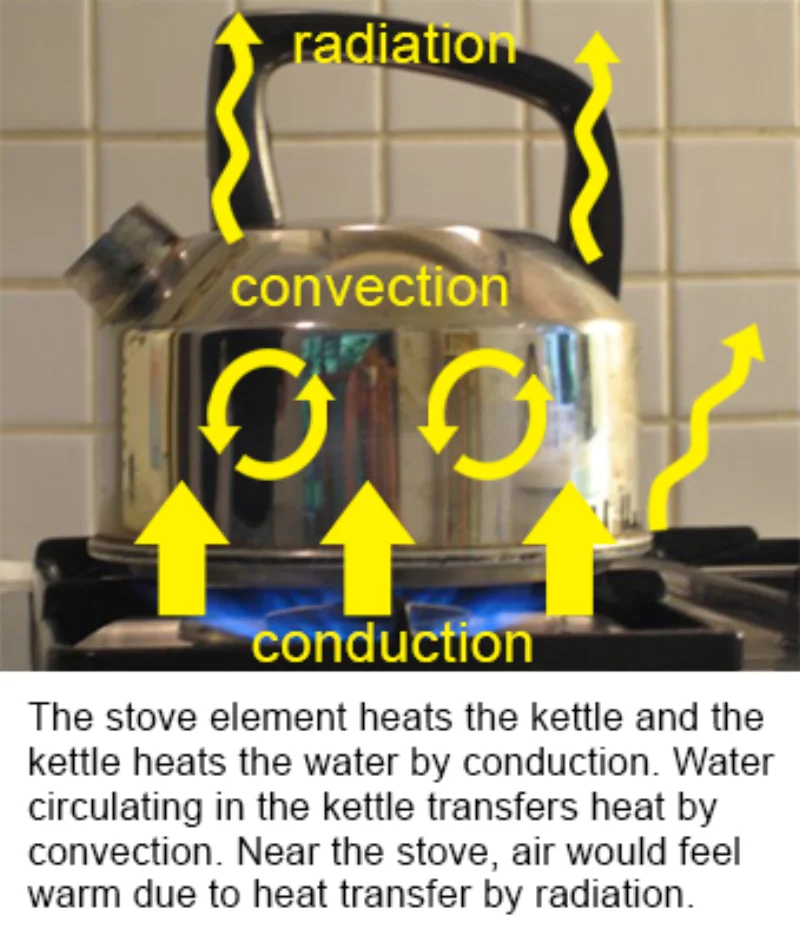
Nature uses three different delivery methods — conduction, convection, and radiation — and each one dominates in different situations. A coffee cup loses heat through all three at the same time: the mug warms your hands (conduction), steam rises and circulates the warm air around it (convection), and the surface emits invisible infrared waves (radiation). The MCAT expects you to identify which mechanism is at work in a given scenario and predict how changing conditions affects the rate.
Conduction - Direct Contact
Conduction is heat transfer through direct molecular collisions. Fast-moving (hot) molecules bump into slower-moving (cold) neighbors, transferring kinetic energy without any bulk movement of material.
Metals are excellent conductors because their free electrons carry energy rapidly through the lattice. That is why a metal spoon in hot soup gets burning hot while a wooden spoon stays cool - the metal conducts heat to your hand much faster.
Convection transfers heat through the bulk movement of a fluid (liquid or gas). When you heat water in a pot, the water at the bottom warms first, becomes less dense, and rises. Cooler, denser water sinks to replace it. This creates a circulation loop called a convection current.
There are two types:
Natural (free) convection - driven by density differences from temperature gradients (boiling water, wind patterns)
Forced convection - driven by an external source like a fan or pump (a convection oven, blood circulation with the heart as the pump)
Convection requires a medium - it cannot happen in a vacuum.
Radiation - Electromagnetic Waves
Radiation transfers heat through electromagnetic waves. Unlike conduction and convection, radiation needs no medium - it works through empty space. This is how the sun heats the Earth across 150 million kilometers of vacuum.
All objects above absolute zero emit thermal radiation. The hotter the object, the more radiation it emits and the shorter the peak wavelength. A glowing ember emits visible light; your body emits infrared (which is how night-vision cameras detect you).
Comparing the Three Mechanisms
Feature
Conduction
Convection
Radiation
Mechanism
Molecular collisions
Bulk fluid movement
EM waves
Medium required?
Yes (solid best)
Yes (fluid only)
No
Works in vacuum?
No
No
Yes
Example
Metal spoon in soup
Boiling water
Sunlight warming Earth
Multiple Mechanisms at Work
Most real situations involve more than one mechanism. A cup of hot coffee loses heat by conduction (through the mug to your hands), convection (hot air rising from the surface), and radiation (infrared emission). The MCAT may describe a scenario and ask you to identify which mechanism is primarily responsible for a specific observation.
The three mechanisms of heat transfer. Conduction requires direct contact between particles. Convection requires a fluid medium with density-driven circulation. Radiation travels as electromagnetic waves and needs no medium at all. Credit: Wikimedia Commons, CC BY-SA
Which heat transfer mechanism is responsible for warming the Earth from the sun?
Click to reveal answer
Radiation. Sunlight travels 150 million km through the vacuum of space as electromagnetic waves. Neither conduction nor convection can work without a medium, so radiation is the only mechanism that operates across a vacuum.
A metal spoon and a wooden spoon sit in the same pot of boiling water. Why does the metal spoon feel hotter when you grab it?
Click to reveal answer
Metal has a much higher thermal conductivity (k) than wood. Both spoons absorb heat from the water, but metal conducts that heat to the handle (and then to your hand) far more rapidly. The temperature of the spoon handle may actually be higher, and the rate of heat transfer to your skin is greater.
Drop a red-hot penny into a cup of water. The penny cools dramatically; the water barely warms. Now drop the same penny into a thimble of water. The water gets noticeably warm.
Same amount of heat released by the penny — but the result depends on (a) how much water is absorbing it, and (b) a property of water called specific heat. This single concept explains why water makes oceans moderate climate, why your body uses water for thermoregulation, and how every calorimetry calculation in chemistry actually works.
Specific Heat Capacity
Specific heat capacity (c) tells you how much energy it takes to raise the temperature of 1 gram of a substance by 1 °C. A high specific heat means the substance is “stubborn” - it resists temperature change. A low specific heat means it heats up and cools down quickly.
The Special Case of Water
Water has an unusually high specific heat: c = 4.18 J/g°C (about 1 cal/g°C). This is much higher than most substances - metals, for example, have specific heats around 0.1 to 0.5 J/g°C.
This matters biologically: water’s high specific heat helps stabilize body temperature. Your cells are bathed in water that resists rapid temperature swings. It also explains why coastal cities have milder climates than inland cities - the ocean absorbs and releases enormous amounts of heat without changing temperature much.
Calorimetry - Measuring Heat
A calorimeter is simply an insulated container that traps heat. In a simple “coffee cup” calorimeter (used for solution chemistry), you mix two substances and measure the temperature change. In a bomb calorimeter (used for combustion), the reaction happens at constant volume inside a sealed vessel.
The core principle of calorimetry is conservation of energy:
qlost + qgained = 0
This means: qhot = -qcold. The heat lost by the hot object equals the heat gained by the cold object (assuming no heat escapes to the surroundings).
Worked Example
A 50 g piece of iron (c = 0.45 J/g°C) at 200 °C is dropped into 200 g of water (c = 4.18 J/g°C) at 20 °C. What is the final temperature?
Set qiron + qwater = 0:
miron x ciron x (Tf - 200) + mwater x cwater x (Tf - 20) = 0
50(0.45)(Tf - 200) + 200(4.18)(Tf - 20) = 0
22.5(Tf - 200) + 836(Tf - 20) = 0
22.5 Tf - 4500 + 836 Tf - 16720 = 0
858.5 Tf = 21220
Tf ≈ 24.7 °C
Notice the final temperature is very close to the water’s starting temperature. That makes sense - water has both a much larger mass and a much higher specific heat than the iron, so it dominates the equilibrium.
Heat Capacity vs. Specific Heat
Specific heat (c) is per gram: J/g°C. Heat capacity (C) is for the whole object: J/°C. They are related by C = mc. If a problem gives you the heat capacity of a calorimeter (say, 850 J/°C), you use q = CΔT directly - no need for mass.
What is the specific heat of water, and why does it matter biologically?
Click to reveal answer
c = 4.18 J/g°C (or about 1 cal/g°C). Water's high specific heat means it resists rapid temperature changes. This stabilizes body temperature and creates milder climates near large bodies of water. Biologically, it protects cells from thermal shock.
You mix 100 g of water at 80 °C with 100 g of water at 20 °C in an insulated container. What is the final temperature?
Click to reveal answer
50 °C. Equal masses of the same substance (same c) will reach the average of their initial temperatures. qhot + qcold = 0 gives mc(Tf - 80) + mc(Tf - 20) = 0, so 2T_f = 100, Tf = 50 °C.
What is the difference between specific heat (c) and heat capacity (C)?
Click to reveal answer
Specific heat (c) is per gram (J/g°C); heat capacity (C) is for the entire object (J/°C). They are related by C = mc. Use q = mcΔT when given specific heat and mass; use q = CΔT when given total heat capacity.
Railroad tracks buckle in the summer. Bridge decks have those strange metal teeth at each end. Sidewalk slabs are separated by gaps filled with tar. The lid on a stuck jar comes loose when you run it under hot water.
These are all solutions to (or examples of) the same problem: most materials expand when heated and contract when cooled. Engineers spend a lot of time and money managing this fact, and the MCAT expects you to know the formulas, recognize the real-world examples, and understand why it happens.
Why Materials Expand
At higher temperatures, atoms vibrate with greater amplitude around their equilibrium positions. Because the potential energy curve between atoms is asymmetric (steeper on the compression side), the average separation between atoms grows slightly. Multiply that tiny increase by billions of atoms, and you get a measurable change in size.
Linear Expansion
For a solid object with a single dominant dimension (a rod, a rail, a wire), we use the linear expansion formula:
The coefficient α is material-specific. Metals generally have larger α values than ceramics or glass. Some MCAT-relevant values:
Material
α (x 10−6 /°C)
Aluminum
24
Steel
12
Glass
9
Concrete
12
Volumetric Expansion
For three-dimensional expansion (a liquid in a container, a solid block), use:
The approximation β ≈ 3α makes sense if you think about it: a cube expanding equally in all three dimensions. Each dimension grows by a factor of (1 + αΔT), so the volume grows by (1+αΔT)3 ≈ 1 + 3αΔT for small expansions.
Special Case: Water
Water is anomalous. Most liquids contract steadily as they cool, but water reaches its maximum density at 4 °C. Below 4 °C, water actually expands as it cools further and eventually freezes into ice, which is less dense than liquid water.
This is why ice floats and why lakes freeze from the top down. The densest water (4 °C) sinks to the bottom, insulating aquatic life below the ice layer.
The Hole-in-a-Plate Problem
A classic MCAT question: a metal plate with a hole is heated. Does the hole get bigger or smaller?
The hole gets bigger. Imagine the hole is filled with the same metal - if heated, that plug would expand. The surrounding material must expand the same way, so the hole expands as if it were made of the same material. Every linear dimension grows, including the diameter of the hole.
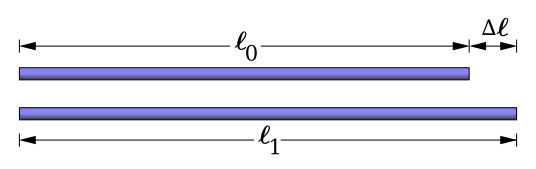
Thermal expansion: a rod expands by ΔL = α times L times ΔT when heated. Every linear dimension increases, including holes in materials. Credit: Wikimedia Commons, CC BY-SA
A steel rod is 2.00 m long at 20 °C. How much does it expand when heated to 120 °C? (α_steel = 12 x 10−6 /°C)
Click to reveal answer
ΔL = 0.0024 m = 2.4 mm. ΔL = αL0ΔT = (12 x 10−6)(2.00)(100) = 2.4 x 10⁻³ m. The expansion is small but measurable - and over a long bridge or railroad, these millimeters add up to centimeters.
A metal ring is too small to fit over a metal sphere. Should you heat the ring or cool it to make it fit?
Click to reveal answer
Heat the ring. When heated, the ring expands - including its inner diameter. This is the same principle as the hole-in-a-plate problem: heating a ring makes the opening larger, not smaller.
Put a pot of water on the stove and watch the thermometer. The temperature climbs steadily from room temperature toward 100°C. Then something odd happens: the water starts boiling — but the temperature stops rising. Crank the burner to maximum and the water still stays at 100°C until every last drop has boiled away.
Where is all that extra heat going? It’s not vanishing. It’s being used to break the intermolecular bonds that hold water molecules together as a liquid — converting them to gas. No temperature change happens during a phase transition, even though heat is pouring in. That single insight unlocks every heating-curve and latent-heat problem on the MCAT.
Heating Curves
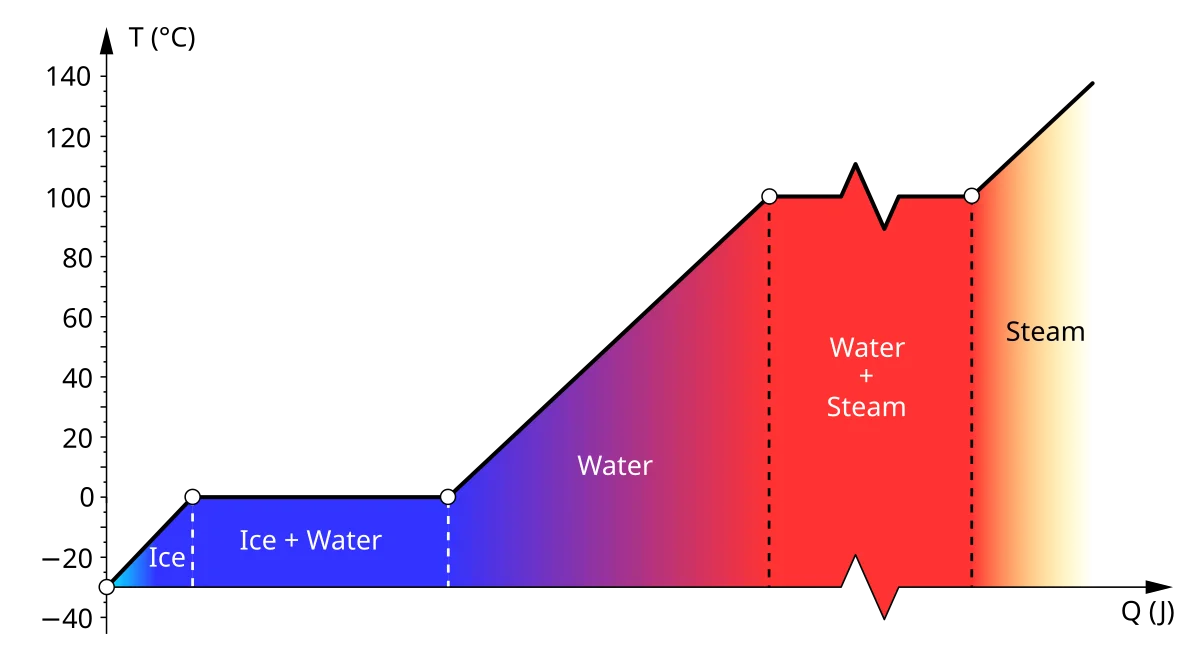
A heating curve plots temperature (y-axis) versus heat added (x-axis) for a substance being steadily heated. It has a characteristic staircase shape:
Solid phase - temperature rises (slope depends on specific heat of the solid)
Melting plateau - temperature stays constant at the melting point while solid converts to liquid
Liquid phase - temperature rises again (slope depends on specific heat of the liquid)
Boiling plateau - temperature stays constant at the boiling point while liquid converts to gas
Gas phase - temperature rises once more
Heating curve for water. The flat plateaus at 0 °C and 100 °C represent phase changes where all added energy goes into breaking intermolecular bonds rather than increasing temperature. Credit: Wikimedia Commons, CC BY-SA
Latent Heat
The energy needed to change the phase of a substance without changing its temperature is called latent heat. There are two values to know:
Heat of fusion (Lf) - energy to melt a solid (or released when a liquid freezes)
Heat of vaporization (Lv) - energy to vaporize a liquid (or released when a gas condenses)
For water:
Lf = 334 J/g (melting/freezing)
Lv = 2260 J/g (boiling/condensing)
Notice that Lv is roughly seven times larger than Lf. Boiling water takes far more energy than melting ice, because vaporization completely separates molecules from each other, while melting only loosens the rigid lattice.
Calculating Total Heat for a Multi-Step Process
If you need to heat ice at -20 °C all the way to steam at 120 °C, calculate each segment separately:
Heat ice from -20 °C to 0 °C: q1 = mc_ice ΔT
Melt ice at 0 °C: q2 = mL_f
Heat water from 0 °C to 100 °C: q3 = mc_water ΔT
Boil water at 100 °C: q4 = mL_v
Heat steam from 100 °C to 120 °C: q5 = mc_steam ΔT
Total heat = q1 + q2 + q3 + q4 + q5
The vaporization step (q4) usually dominates the total. This is a common calculation on the MCAT.
Phase Change Terminology
Transition
Name
Energy
Solid → Liquid
Melting (fusion)
Absorbs heat (endothermic)
Liquid → Solid
Freezing
Releases heat (exothermic)
Liquid → Gas
Vaporization (boiling)
Absorbs heat (endothermic)
Gas → Liquid
Condensation
Releases heat (exothermic)
Solid → Gas
Sublimation
Absorbs heat (endothermic)
Gas → Solid
Deposition
Releases heat (exothermic)
Why does temperature remain constant during a phase change?
Click to reveal answer
All added energy goes into breaking intermolecular bonds, not into raising kinetic energy. Temperature is a measure of average kinetic energy. During a phase change, the energy input overcomes intermolecular forces (changes potential energy) rather than speeding up molecules. Once the phase change is complete, temperature rises again.
How much heat is required to melt 50 g of ice at 0 °C? (Lf = 334 J/g)
Click to reveal answer
q = 16,700 J (16.7 kJ). q = mL_f = (50 g)(334 J/g) = 16,700 J. This energy changes the phase from solid to liquid but doesn't change the temperature - the resulting water is still at 0 °C.
The first law of thermodynamics is conservation of energy wearing a lab coat. Energy cannot be created or destroyed — it can only be transferred as heat or used to do work. The first law tells you exactly how to keep the energy books balanced for any thermodynamic process.
If you’ve internalized the conservation-of-energy idea from work-and-energy in §2.6, you’re already 80% of the way there. The first law just adds a little bookkeeping: which kinds of energy flow count as heat, which count as work, and what happens when both are happening at once.
The Bank Account Analogy
Think of a gas as a bank account. The “balance” is the internal energy (U) of the gas. There are two ways to change the balance:
Deposits - heat flowing into the system (Q > 0) or work done on the system
Withdrawals - heat flowing out (Q < 0) or work done by the system
The Equation
Sign Conventions
This is where most students get tripped up. Using the convention ΔU = Q - W:
Quantity
Positive means
Negative means
Q
Heat flows INTO system
Heat flows OUT of system
W
Work done BY system (expansion)
Work done ON system (compression)
ΔU
Internal energy increases
Internal energy decreases
Internal Energy
Internal energy (U) is the total kinetic and potential energy of all the molecules in the system. For an ideal gas, it depends only on temperature:
Monatomic ideal gas: U = (23)nRT
Diatomic ideal gas: U = (25)nRT
The key insight: for an ideal gas, if ΔT = 0, then ΔU = 0 no matter what else happens. This is enormously useful for isothermal processes (Section 3.8).
State Functions vs. Path Functions
This distinction is tested repeatedly on the MCAT.
State functions depend only on the current state of the system (like your bank balance - it doesn’t matter how you earned the money). Internal energy (U), temperature (T), pressure (P), and volume (V) are all state functions.
Path functions depend on how you got from one state to another. Heat (Q) and work (W) are path functions. The same starting and ending states can involve very different amounts of heat and work depending on the process taken.
Applying the First Law
Example 1: A gas absorbs 500 J of heat and does 200 J of work expanding against a piston.
ΔU = Q - W = 500 - 200 = 300 J. The internal energy (and temperature) increases.
Example 2: A gas is compressed (300 J of work done on it) while 100 J of heat escapes.
Q = -100 J (heat out), W = -300 J (work done on the system, not by it)
ΔU = Q - W = (-100) - (-300) = -100 + 300 = 200 J. Internal energy increases despite the heat loss, because the compression added even more energy.
Connection to Gen Chem
The first law is the physics version of energy conservation. In General Chemistry - Thermochemistry, you will see the same ideas expressed through enthalpy (H = U + PV), Hess’s law, and standard enthalpies of formation. The physics side focuses on PV work and gas behavior; the chemistry side focuses on reaction energetics. The MCAT tests both perspectives.
A system absorbs 400 J of heat and does 400 J of work. What is ΔU?
Click to reveal answer
ΔU = 0. ΔU = Q - W = 400 - 400 = 0. All the heat that entered was immediately used to do work. The internal energy (and temperature, for an ideal gas) didn't change. This describes an isothermal process.
Is heat (Q) a state function or a path function? Why?
Click to reveal answer
Path function. The amount of heat transferred between two states depends on how the process is carried out. You can go from state A to state B via an isothermal path (large Q) or an adiabatic path (Q = 0). The endpoint is the same, but Q is different. In contrast, ΔU between those states is the same no matter the path.
A PV diagram is the single most important graph in MCAT thermodynamics. Pressure on the y-axis, volume on the x-axis. Every thermodynamic process traces some path across this diagram, and the shape of that path tells you everything: what’s constant, what’s changing, how much work was done, and how much heat flowed.
Master the four standard processes (each with a distinctive shape) and you can answer almost any first-law or work question the exam throws at you, often without doing arithmetic — just by reading the graph.
The Four Key Processes
Every MCAT-relevant thermodynamic process holds one variable constant (or, in the case of adiabatic, holds heat transfer at zero). Here is the complete set:
Isothermal - Constant Temperature
“Iso” = same, “thermal” = temperature. The temperature doesn’t change, so for an ideal gas, ΔU = 0. By the first law, Q = W - all heat absorbed becomes work (or vice versa).
On a PV diagram, an isothermal process follows a hyperbola (since PV = nRT = constant). The curve bows away from the origin.
Isobaric - Constant Pressure
Pressure stays the same throughout the process. On a PV diagram, this is a horizontal line. Heating a gas in a cylinder with a freely moving, weightless piston is approximately isobaric.
Work is easy to calculate: W = PΔV (the rectangle under the horizontal line).
Isovolumetric (Isochoric) - Constant Volume
Volume doesn’t change, so the process appears as a vertical line on the PV diagram. Since the gas neither expands nor compresses, W = 0. By the first law, ΔU = Q - all heat goes directly into changing the internal energy.
Heating gas in a rigid, sealed container is isovolumetric.
Adiabatic - No Heat Transfer
“Adiabatic” means Q = 0. The system is perfectly insulated. By the first law, ΔU = -W. Any work done by the gas comes at the expense of its internal energy (temperature drops), and any work done on the gas raises its internal energy (temperature rises).
On a PV diagram, an adiabatic curve looks like an isothermal curve but is steeper. It crosses isotherms because the temperature is changing.
Summary Table
| Process | Constant | PV Shape | Work | ΔU | Special |
|---------|----------|----------|------|-----|---------|
| Isothermal | T | Hyperbola | Q = W | 0 | ΔU = 0 (ideal gas) |
| Isobaric | P | Horizontal | PΔV | Q - PΔV | Most common in lab |
| Isovolumetric | V | Vertical | 0 | Q | All heat → ΔU |
| Adiabatic | Q = 0 | Steep curve | -ΔU | -W | Steeper than isothermal |
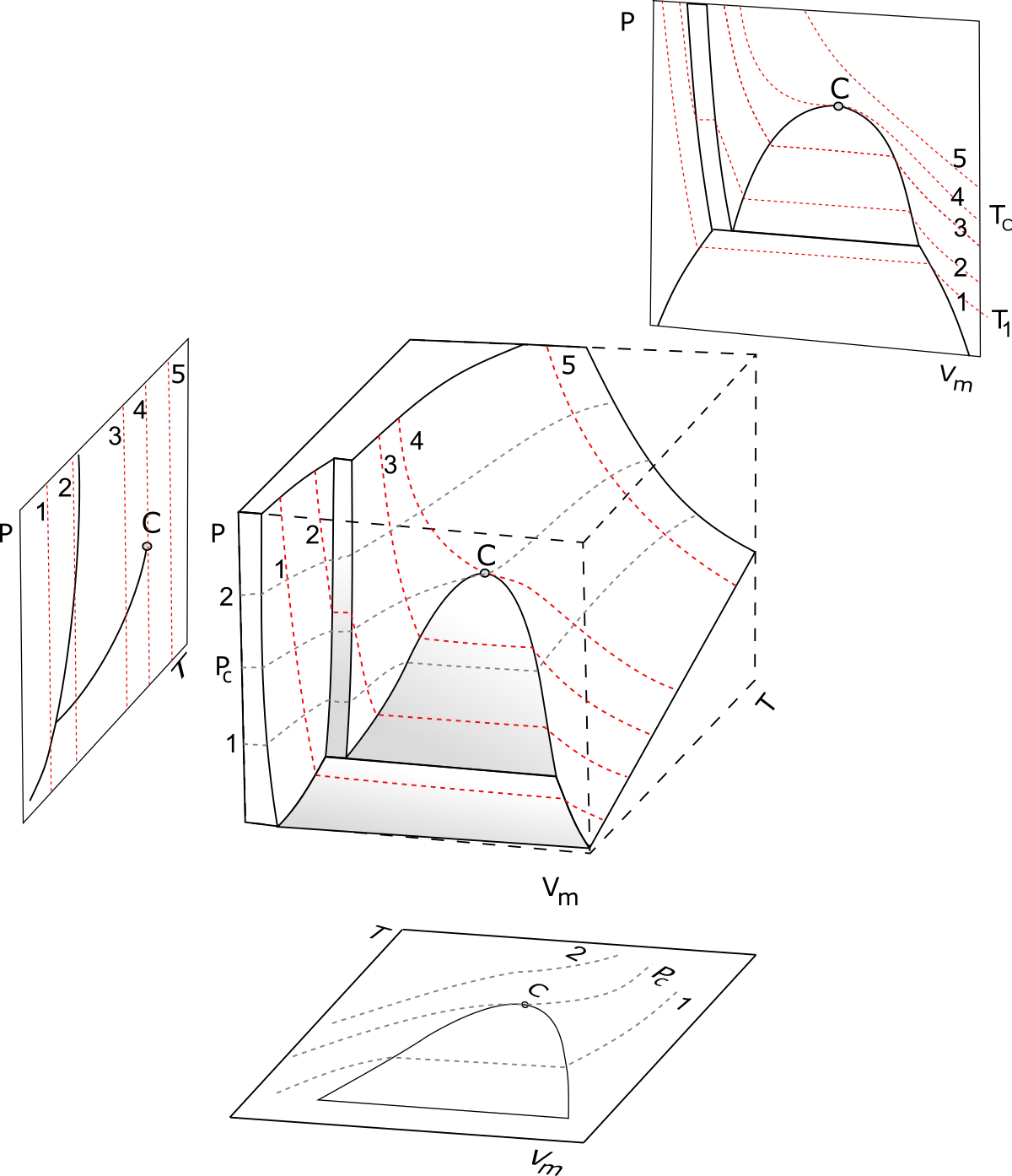
The pressure-volume-temperature surface for a pure substance, with the liquid-vapor dome and its critical point C. Each flat panel is one projection of that surface: pressure against volume (the red isotherms, numbered 1 to 5 from coolest to hottest), pressure against temperature (the familiar phase-boundary curve, which stops at the critical point), and temperature against volume. The isothermal process in the table above is one of those red curves; the pressure-volume panel is the plane every process in this lesson is drawn on. Credit: Wikimedia Commons, CC BY-SA
🎯 Predict First
A gas expands from 2 L to 5 L twice: once at constant pressure, once isothermally, starting from the same state each time. Which expansion does more work on the surroundings?
Now check your prediction directly. Pick a process and a direction, press Run, and watch the state point sweep along its curve while the area under the path fills in. That shaded area is the work, and the readouts track W, ΔU, and Q live as the piston moves.
W by gas: 0 JΔU: 0 JQ: 0 JT: 300 K
Reading a PV Diagram
To extract information from a PV diagram:
Identify the process type from the shape (horizontal, vertical, curve, steep curve)
Check the direction - rightward expansion means positive work by the gas; leftward compression means negative work (work done on the gas)
Compare areas to compare work done in different processes
Check if it is a cycle - if the path returns to the starting point, ΔU = 0 for the whole cycle
Distinguishing Isothermal from Adiabatic
Both look like downward-curving paths on a PV diagram during expansion. The key differences:
Isothermal stays on one isotherm (constant T). It is gentler because heat flows in to compensate for the work done.
Adiabatic crosses isotherms toward lower temperatures. It is steeper because no heat enters - the gas uses its own internal energy to do work, so it cools.
For a given expansion from V1 to V2, the isothermal process always does more work (more area under the curve) than the adiabatic process.
On a PV diagram, what does a vertical line represent? What is the work done?
Click to reveal answer
An isovolumetric (constant volume) process. Work = 0. Since the volume doesn’t change, there is no area under the curve and the gas does no work. By the first law, ΔU = Q, so all heat directly changes the internal energy and temperature.
Which process does more work during expansion from V1 to V2: isothermal or adiabatic? Why?
Click to reveal answer
Isothermal does more work. The isothermal curve stays at higher pressure throughout the expansion (because heat flows in to maintain temperature), so the area under the curve is larger. The adiabatic curve drops to lower pressures as the gas cools, resulting in less area and less work.
In the previous section, you learned to read PV diagrams. Now we put them to work — literally. The area under a process curve on a PV diagram tells you the work done. And the direction of a cycle tells you whether you’re looking at an engine (which makes useful work) or a refrigerator (which uses work to move heat).
This is one of the most underrated MCAT shortcuts: many work questions can be answered just by eyeballing the area on a PV diagram — no calculation required.
Work as Area Under the Curve
The fundamental relationship: work done by a gas equals the area under the process path on a PV diagram. For an isobaric (constant pressure) process, this simplifies beautifully:
For non-isobaric processes, the area under the curve still equals the work, but you may need to estimate the area geometrically (the MCAT usually gives you enough information to do this, or just asks you to compare areas).
Sign Conventions for Work
The sign of the work tells you the direction of energy flow:
Scenario
Volume change
W (by gas)
Energy flow
Gas expands
ΔV > 0
Positive
Energy leaves the gas
Gas is compressed
ΔV < 0
Negative
Energy enters the gas
No volume change
ΔV = 0
Zero
No PV work
Thermodynamic Cycles
A cycle is a process that returns to its starting state. On a PV diagram, it appears as a closed loop. Since the system returns to its original state, ΔU = 0 for the complete cycle. By the first law:
ΔU = Q - W = 0, so Qnet = Wnet for any complete cycle.
The direction of the cycle matters enormously:
Clockwise Cycle = Heat Engine
A clockwise loop on a PV diagram means the expansion (rightward) happens at higher pressure than the compression (leftward). The expansion does more work than the compression takes, so the net work is positive - the system outputs useful work.
This is a heat engine: it takes in heat from a hot source, converts some to work, and dumps the rest into a cold sink.
Counterclockwise Cycle = Refrigerator/Heat Pump
A counterclockwise loop means the compression happens at higher pressure than the expansion. More work goes into the system than comes out, so the net work is negative - work is done on the system.
This is a refrigerator: it uses work input to move heat from cold to hot (the opposite of the natural direction).
Calculating Work for Each Process Type
Process
Work formula
Area
Isobaric
W = PΔV
Rectangle
Isovolumetric
W = 0
No area (vertical line)
Isothermal
W = nRT ln(V2/V1)
Area under hyperbola
Adiabatic
W = -ΔU
Area under steep curve
Worked Example
A gas undergoes an isobaric expansion at P = 2 x 10⁵ Pa from V1 = 0.01 m³ to V2 = 0.03 m³.
W = PΔV = (2 x 10⁵)(0.03 - 0.01) = (2 x 10⁵)(0.02) = 4000 J
The gas does 4000 J of work on the surroundings by expanding.
A gas completes a clockwise cycle on a PV diagram. Is ΔU positive, negative, or zero? Is net work positive or negative?
Click to reveal answer
ΔU = 0; net work is positive. Any complete cycle returns to the starting state, so ΔU = 0 (state function). A clockwise cycle has positive net work because the expansion at higher pressure does more work than the compression at lower pressure takes back. The system acts as a heat engine.
A gas expands isobarically at 1 x 10⁵ Pa from 2 L to 5 L. How much work does the gas do?
Click to reveal answer
W = 300 J. W = PΔV = (1 x 10⁵ Pa)(5 x 10⁻³ - 2 x 10⁻³ m³) = (1 x 10⁵)(3 x 10⁻³) = 300 J. Remember to convert liters to m³: 1 L = 10−3 m³.
Drop an ice cube into a glass of warm water. The ice melts; the water cools slightly; everything settles into one uniform lukewarm temperature.
Now wait. And keep waiting. The water never spontaneously re-freezes part of itself while heating the rest back up — even though doing so would not violate conservation of energy. The total energy is the same either way. But it just doesn’t happen.
Why? The second law of thermodynamics says some processes go in one direction only — even when energy conservation alone would allow either direction. The “rule” that picks which direction is entropy, and once you grasp it, you’ll understand why ice melts but never un-melts, why heat flows from hot to cold but never the other way, and why no engine can ever be 100% efficient.
The Second Law - Multiple Statements
The second law of thermodynamics has been stated many ways, but they all say the same thing:
Entropy statement: The total entropy of the universe always increases in a spontaneous process. For a reversible process, it stays the same. It never decreases.
Heat flow statement: Heat flows spontaneously from hot to cold, never from cold to hot (without work input).
Engine statement: No heat engine can convert heat entirely into work with 100% efficiency.
These are not three separate laws - they are three different perspectives on the same fundamental principle.
What Is Entropy?
Entropy (S) is a measure of the number of microscopic arrangements (microstates) available to a system. More possible arrangements = higher entropy = more “disorder.”
Key trends for entropy:
Gas > Liquid > Solid. Gases have the most molecular freedom and the highest entropy.
Higher temperature = higher entropy. Molecules have more energy and more available microstates.
More particles = higher entropy. Reactions that produce more moles of gas raise entropy.
Dissolved > undissolved. A solute dissolved in solution has more entropy than the pure solid.
Spontaneous vs. Non-Spontaneous
A spontaneous process happens without external intervention - it is thermodynamically favorable. In chemistry, spontaneity is determined by Gibbs free energy (ΔG = ΔH - TΔS) - the physics entropy concepts here are the foundation for that equation. The second law says:
ΔSuniverse = ΔSsystem + ΔSsurroundings > 0 for any spontaneous process.
A process can decrease the entropy of a system as long as the surroundings’ entropy increases by a larger amount. The total (universe) always goes up.
Reversible vs. Irreversible
A reversible process is an idealization - it proceeds infinitely slowly through a series of equilibrium states, and ΔSuniverse = 0. All real processes are irreversible and produce a net increase in entropy.
Examples of irreversible processes: heat flowing from hot to cold, gas expanding freely into a vacuum, mixing of two solutions, friction turning kinetic energy into heat.
Ice Melting - A Detailed Look
When ice melts at 0 °C:
ΔSsystem > 0 - liquid water has more entropy than solid ice
ΔSsurroundings < 0 - the surroundings lose heat to melt the ice
ΔSuniverse > 0 - the system’s gain outweighs the surroundings’ loss
This is why ice spontaneously melts at room temperature. The second law says it must.
Rank the following in order of increasing entropy: liquid water, ice, steam.
Click to reveal answer
Ice < Liquid water < Steam. Entropy increases as molecular freedom increases. In ice, molecules are locked in a rigid lattice. In liquid water, they flow freely but remain close. In steam, they are widely separated with maximum disorder. Gas always has the highest entropy.
Can the entropy of a system decrease in a spontaneous process?
Click to reveal answer
Yes - but only if the entropy of the surroundings increases by a greater amount. The second law requires ΔSuniverse > 0, not ΔSsystem > 0. A freezer decreases the entropy of water (turning it to ice), but the compressor generates enough heat to increase the surroundings' entropy even more.
The previous section introduced entropy as “disorder increases.” That’s a good starting point, but the MCAT sometimes pushes deeper. How do you actually calculate an entropy change? What connects entropy to Gibbs free energy (the spontaneity equation in chemistry)? And — most puzzling — how can highly ordered structures like proteins fold spontaneously if entropy always increases?
This section answers all three. The protein-folding question is especially MCAT-relevant because it bridges thermodynamics, biochemistry, and biology — and the resolution is one of the most elegant ideas in physical chemistry.
Calculating Entropy Change
For a reversible process at constant temperature, the entropy change is:
This formula explains why the same amount of heat has a bigger effect on entropy at low temperatures. Adding 100 J to a system at 200 K raises entropy by 0.5 J/K, but adding 100 J at 1000 K raises entropy by only 0.1 J/K.
The Universe Always Wins
For any spontaneous process:
ΔSuniverse = ΔSsystem + ΔSsurroundings > 0
The system’s entropy can decrease - but only if the surroundings’ entropy increases by more. Look at specific examples:
Freezing water at -10 °C: ΔSsystem < 0 (liquid to solid = less disorder). But the heat released by freezing warms the surroundings, and because the surroundings are at a lower temperature, the entropy gain of the surroundings is large. Net result: ΔSuniverse > 0. The process is spontaneous.
Protein folding: A protein collapses from a random coil into a specific 3D shape - clearly lowering the protein’s own entropy. But the folding process releases water molecules that were ordered around hydrophobic residues, sharply raising the entropy of the surrounding water. The water’s entropy gain more than makes up for the protein’s entropy loss.
Connection to Gibbs Free Energy
Entropy is one half of the spontaneity equation. The full picture comes from Gibbs free energy, covered in General Chemistry - Thermochemistry:
ΔG = ΔH - TΔS
A process is spontaneous when ΔG < 0. Notice that high temperature amplifies the entropy term (TΔS), making entropy-driven processes more favorable at high temperatures.
ΔH
ΔS
ΔG
Spontaneity
-
+
Always -
Spontaneous at all T
+
-
Always +
Never spontaneous
-
-
Depends on T
Spontaneous at low T
+
+
Depends on T
Spontaneous at high T
Entropy and the Arrow of Time
Entropy gives time its direction. The laws of physics (Newton’s laws, Maxwell’s equations) work the same forward and backward in time. But the second law doesn’t - entropy increases toward the future, never toward the past. A video of an egg unscrambling itself looks wrong because it violates the second law, even though it would satisfy Newton’s laws perfectly.
The Third Law of Thermodynamics
At absolute zero (0 K), a perfect crystal has exactly one microstate - every atom is in its lowest energy position. Therefore, its entropy is exactly zero:
S = 0 at T = 0 K (for a perfect crystal)
This gives entropy an absolute reference point, unlike energy, which is always measured relative to some arbitrary zero. The MCAT may mention this but rarely tests it quantitatively.
If 500 J of heat is added reversibly to a system at 250 K, what is ΔS?
Click to reveal answer
ΔS = 2.0 J/K. ΔS = Qrev / T = 500 J / 250 K = 2.0 J/K. The same heat added at a higher temperature would give a smaller entropy change.
How can a protein fold into a more ordered structure if entropy must increase?
Click to reveal answer
Local entropy decreases are allowed as long as the surroundings' entropy increases more. Protein folding buries hydrophobic residues, releasing ordered water molecules into the bulk solvent. The entropy gained by the freed water exceeds the entropy lost by the protein, so ΔSuniverse > 0 and the process is spontaneous.
Your car engine burns fuel, and some of that energy becomes motion — but a lot of it goes straight out the exhaust pipe and radiator as waste heat. A typical gasoline engine is only ~25% efficient. The other 75% literally goes up in heat.
It turns out this isn’t just a matter of engineering imperfection. No matter how clever the engineering, no engine can ever convert all of the input heat into useful work. The second law of thermodynamics forbids it. And the Carnot cycle tells you exactly how close to perfect you could ever theoretically get — given the temperatures of the hot and cold reservoirs you’re working with.
How a Heat Engine Works
A heat engine runs between two thermal reservoirs:
Hot reservoir (TH) - the energy source (burning fuel, boiling water, the sun)
Cold reservoir (TC) - the energy sink (exhaust, cooling water, the atmosphere)
Each cycle, the engine:
Absorbs heat QH from the hot reservoir
Turns part of it into useful work W
Dumps the remaining heat QC into the cold reservoir
By conservation of energy: QH = W + QC
Efficiency
Efficiency measures how much of the input heat becomes useful work:
The Carnot Cycle - Maximum Possible Efficiency
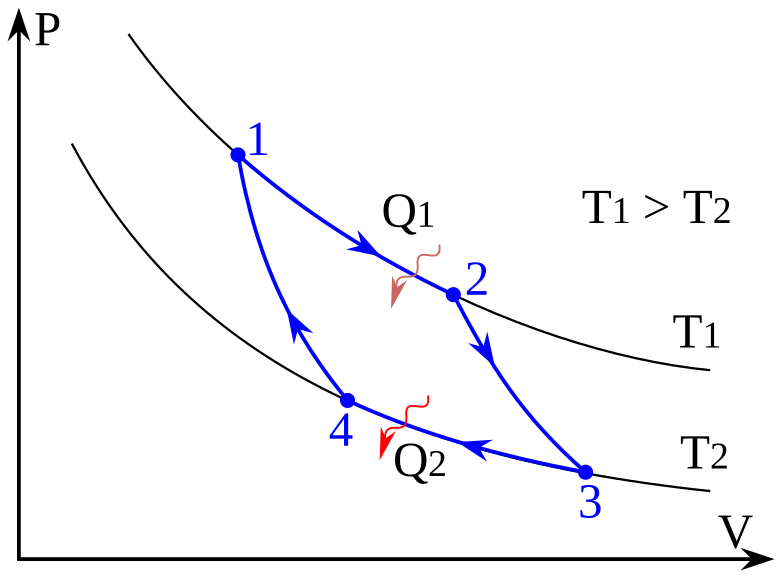
The Carnot cycle is a theoretical ideal - a perfectly reversible cycle made of two isothermal and two adiabatic processes. No real engine can match it, but it sets the absolute ceiling on efficiency:
Worked Example
A power plant operates between a steam temperature of 500 °C and a cooling water temperature of 27 °C. What is the maximum possible efficiency?
Convert to Kelvin: TH = 500 + 273 = 773 K, TC = 27 + 273 = 300 K
Even under ideal Carnot conditions, nearly 40% of the input heat must be wasted. The actual efficiency of a real power plant would be much lower.
The Carnot Cycle on a PV Diagram
The Carnot cycle consists of four steps:
Isothermal expansion at TH - gas absorbs QH from the hot reservoir and expands
Adiabatic expansion - gas continues expanding, cooling from TH to TC with no heat transfer
Isothermal compression at TC - gas dumps QC to the cold reservoir as it is compressed
Adiabatic compression - gas is compressed back to the starting state, warming from TC to TH
The Carnot cycle on a PV diagram. Two isotherms (constant temperature curves) are connected by two adiabatic paths (no heat transfer). The enclosed area represents the net work output per cycle. Credit: Wikimedia Commons, CC BY-SA
Why No Real Engine Reaches Carnot Efficiency
Real engines fall short because of:
Friction between moving parts (wastes energy as heat)
Irreversible heat transfer (heat flows across finite temperature differences)
Turbulence in gas flow
Non-ideal gas behavior
Typical real-world efficiencies: car engines around 20-30%, power plants around 30-40%, diesel engines around 35-45%.
These engine numbers are brake thermal efficiencies: the fraction of the fuel’s chemical energy that reaches the crankshaft as useful work. Whole-vehicle figures, sometimes quoted as “tank-to-wheels” efficiency, are lower, because they also subtract drivetrain, idling, and accessory losses. The two are measured against different denominators, so they are not the same quantity.
Refrigerators and Heat Pumps
A refrigerator is a heat engine running backward - it uses work input to move heat from cold to hot. The “coefficient of performance” (COP) replaces efficiency:
COP_refrigerator = QC / W
The MCAT rarely tests COP calculations but may describe a refrigerator conceptually.
What is the Carnot efficiency of an engine operating between 600 K and 300 K?
Click to reveal answer
50%.eCarnot = 1 - TC/TH = 1 - 600300 = 1 - 0.5 = 0.5 = 50%. This means even a perfect engine operating between these temperatures would waste half the input heat.
A heat engine absorbs 1000 J from the hot reservoir and exhausts 600 J to the cold reservoir. What is the efficiency and how much work is done?
Click to reveal answer
W = 400 J, e = 40%. W = QH - QC = 1000 - 600 = 400 J. Efficiency = W/QH = 1000400 = 0.40 = 40%. The remaining 60% of the input energy is dumped as waste heat.
Why must you use Kelvin (not Celsius) in the Carnot efficiency formula?
Click to reveal answer
Because the formula involves a ratio of temperatures. The Carnot formula e = 1 - TC/TH requires an absolute scale. Using Celsius could give negative temperatures and nonsensical ratios. For example, TC = -20 °C and TH = 80 °C gives e = 1 - (-8020) = 1.25, which implies over 100% efficiency - physically impossible.
A heating curve (§3.6) shows what happens when you add heat at constant pressure. A phase diagram is more powerful — it maps out which phase a substance occupies at every combination of temperature and pressure. One glance tells you whether a substance is solid, liquid, or gas under any given conditions.
Phase diagrams also explain pressure cookers, why water boils at a lower temperature in Denver than in Miami, why freeze-drying works, and why ice melts when you press hard on a skate blade. The MCAT loves them because a single picture covers a lot of conceptual ground.
Anatomy of a Phase Diagram
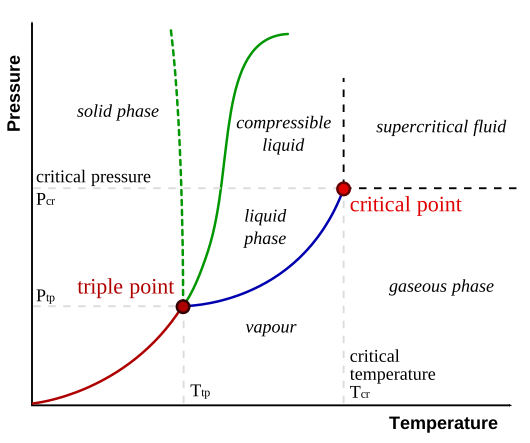
A standard phase diagram has temperature on the x-axis and pressure on the y-axis. Three regions represent the three phases (solid, liquid, gas), separated by boundary lines where phase transitions happen.
A phase diagram. The three regions represent solid, liquid, and gas. Boundary lines show the conditions at which two phases coexist. The triple point is where all three phases coexist simultaneously. Credit: Wikimedia Commons, CC BY-SA
The Boundary Lines
Each boundary line represents conditions where two phases coexist in equilibrium:
Solid-liquid line (fusion curve) - melting/freezing happens along this line
Liquid-gas line (vaporization curve) - boiling/condensation happens along this line
Solid-gas line (sublimation curve) - sublimation/deposition happens along this line
Moving across a boundary means a phase transition is happening. Standing on a boundary means both phases exist at the same time.
The Triple Point
The triple point is the single temperature-pressure combination where all three phases coexist at once. It is a unique, fixed point for every substance.
For water: triple point is at 0.01 °C and 611 Pa (about 0.006 atm). At pressures below the triple point, liquid water cannot exist - ice can only sublime directly to vapor.
The Critical Point
The critical point is the endpoint of the liquid-gas boundary line. Above the critical temperature and pressure, the difference between liquid and gas disappears. The substance becomes a supercritical fluid - it has properties of both a liquid (density, dissolving ability) and a gas (fills its container, low viscosity).
Beyond the critical point, you can go from “liquid-like” to “gas-like” without ever crossing a phase boundary - there is no sudden boiling transition.
Reading a Phase Diagram
To answer MCAT questions about phase diagrams:
Locate the point on the diagram using the given T and P
Identify the region - that tells you the phase
Trace a path to predict what happens when you change T or P
Check for phase transitions - does your path cross a boundary line?
Example: Start with water at 1 atm and 50 °C (liquid region). Heat at constant pressure (move right along a horizontal line). You cross the liquid-gas boundary at 100 °C and enter the gas region. The water boils.
Example: Start with water at 1 atm and 50 °C. Lower the pressure at constant temperature (move down along a vertical line). If you drop below the liquid-gas boundary, the water boils - at 50 °C! This is the principle behind vacuum distillation.
Water’s Anomalous Phase Diagram
Most substances have a solid-liquid boundary that slopes to the right (positive slope) - higher pressure favors the solid because it is denser. Water is different. Its solid-liquid line slopes slightly to the left (negative slope) because ice is less dense than liquid water.
This means raising pressure on ice at its melting point will melt it - pressure favors the denser phase (liquid water). This unusual behavior is often tested on the MCAT.
Effect of Pressure on Boiling Point
The liquid-gas boundary line shows that boiling point increases with pressure. This is why:
Water boils below 100 °C at high altitudes (lower atmospheric pressure)
Water boils above 100 °C in a pressure cooker (higher pressure)
At the triple point pressure, boiling and freezing happen at nearly the same temperature
What is the triple point, and what is special about it?
Click to reveal answer
The triple point is the unique temperature and pressure where solid, liquid, and gas coexist simultaneously. Below the triple point pressure, liquid cannot exist and the substance sublimes directly. It is a fixed, defining property of each substance.
Why does water's solid-liquid boundary line slope to the left, unlike most substances?
Click to reveal answer
Because ice is less dense than liquid water. For most substances, the solid is denser than the liquid, so higher pressure favors the solid and the line slopes right. For water, the liquid is denser, so higher pressure favors the liquid (melting) and the line slopes left. This is the same reason ice floats.
Why does water boil at a lower temperature on top of a mountain?
Click to reveal answer
Lower atmospheric pressure at high altitude. On the phase diagram, moving down (lower P) along the liquid-gas boundary shifts the boiling point to a lower temperature. At the top of Mount Everest, water boils at about 70 °C because the atmospheric pressure is only about 0.34 atm.