
Phase Changes
Put a pot of water on the stove and watch the thermometer. The temperature climbs steadily from room temperature toward 100°C. Then something odd happens: the water starts boiling — but the temperature stops rising. Crank the burner to maximum and the water still stays at 100°C until every last drop has boiled away.
Where is all that extra heat going? It’s not vanishing. It’s being used to break the intermolecular bonds that hold water molecules together as a liquid — converting them to gas. No temperature change happens during a phase transition, even though heat is pouring in. That single insight unlocks every heating-curve and latent-heat problem on the MCAT.
Heating Curves
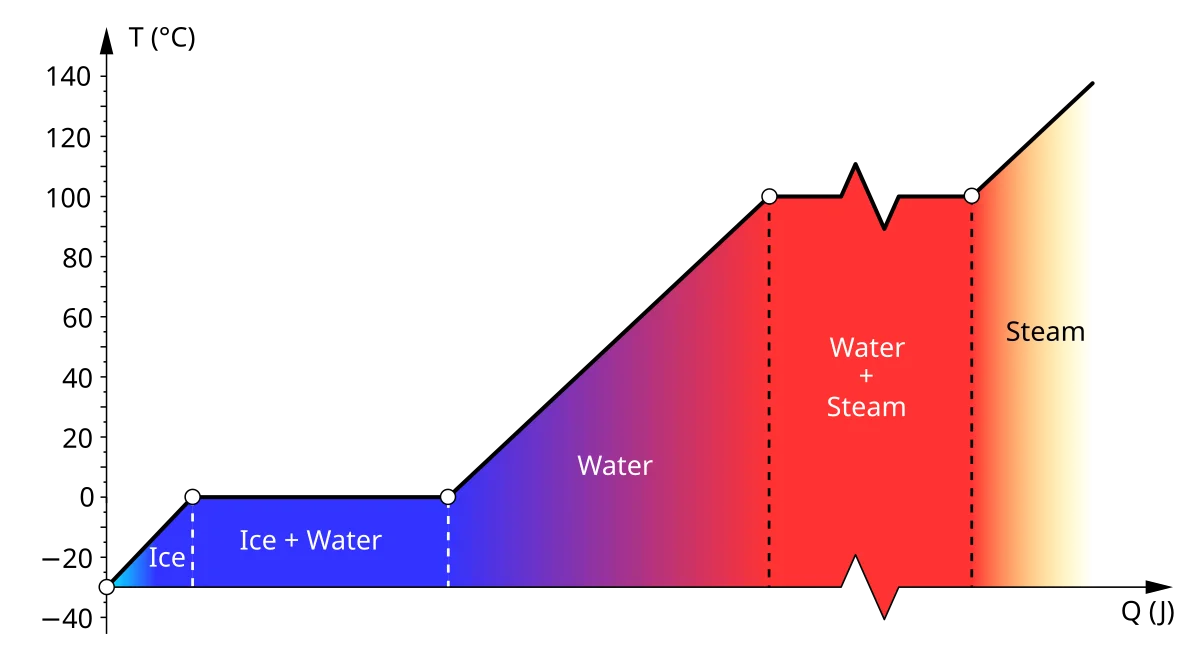
A heating curve plots temperature (y-axis) versus heat added (x-axis) for a substance being steadily heated. It has a characteristic staircase shape:
- Solid phase - temperature rises (slope depends on specific heat of the solid)
- Melting plateau - temperature stays constant at the melting point while solid converts to liquid
- Liquid phase - temperature rises again (slope depends on specific heat of the liquid)
- Boiling plateau - temperature stays constant at the boiling point while liquid converts to gas
- Gas phase - temperature rises once more
Latent Heat
The energy needed to change the phase of a substance without changing its temperature is called latent heat. There are two values to know:
- Heat of fusion () - energy to melt a solid (or released when a liquid freezes)
- Heat of vaporization () - energy to vaporize a liquid (or released when a gas condenses)
For water:
- = 334 J/g (melting/freezing)
- = 2260 J/g (boiling/condensing)
Notice that is roughly seven times larger than . Boiling water takes far more energy than melting ice, because vaporization completely separates molecules from each other, while melting only loosens the rigid lattice.
Calculating Total Heat for a Multi-Step Process
If you need to heat ice at -20 °C all the way to steam at 120 °C, calculate each segment separately:
- Heat ice from -20 °C to 0 °C: = mc_ice ΔT
- Melt ice at 0 °C: = mL_f
- Heat water from 0 °C to 100 °C: = mc_water ΔT
- Boil water at 100 °C: = mL_v
- Heat steam from 100 °C to 120 °C: = mc_steam ΔT
Total heat = + + + +
The vaporization step () usually dominates the total. This is a common calculation on the MCAT.
Phase Change Terminology
| Transition | Name | Energy |
|---|---|---|
| Solid → Liquid | Melting (fusion) | Absorbs heat (endothermic) |
| Liquid → Solid | Freezing | Releases heat (exothermic) |
| Liquid → Gas | Vaporization (boiling) | Absorbs heat (endothermic) |
| Gas → Liquid | Condensation | Releases heat (exothermic) |
| Solid → Gas | Sublimation | Absorbs heat (endothermic) |
| Gas → Solid | Deposition | Releases heat (exothermic) |