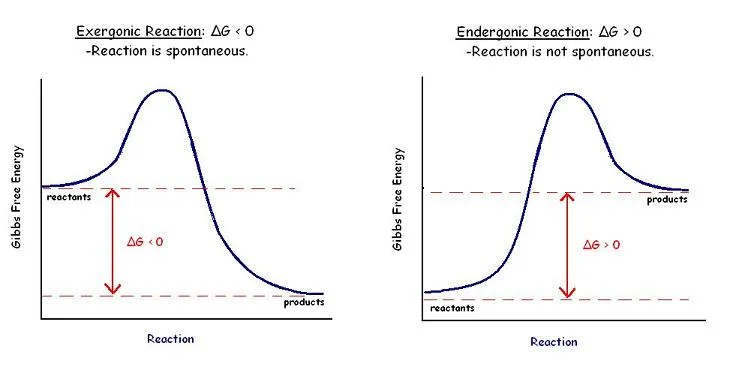
You now know two pieces of the puzzle: enthalpy (does the reaction release heat?) and entropy (does the reaction increase disorder?). The entropy concepts from physics thermodynamics apply directly here. But neither alone tells you whether a reaction will happen spontaneously. An exothermic reaction with a large entropy decrease might not be spontaneous. An endothermic reaction with a large entropy increase might be. You need one equation that combines both factors to give you the final answer.
The Master Equation
The Gibbs free energy relationship. A reaction is spontaneous when ΔG < 0, which can occur when enthalpy decreases (ΔH < 0), entropy increases (ΔS > 0), or the temperature is high enough that the TΔS term dominates. Credit: Wikimedia Commons, Public Domain
Unit Warning
Watch units carefully. ΔH is usually given in kJ/mol, but ΔS is usually given in J/(mol·K). Before plugging into ΔG = ΔH - TΔS, convert them to the same units. Either divide ΔS by 1,000 to get kJ/(mol·K), or multiply ΔH by 1,000 to get J/mol.
The Four Scenarios
This is one of the most tested concepts in MCAT thermochemistry. Depending on the signs of ΔH and ΔS, there are four possible combinations:
ΔH
ΔS
ΔG
Spontaneity
Example
-
+
Always negative
Spontaneous at ALL temperatures
Combustion, rust
+
-
Always positive
NEVER spontaneous
Reverse of combustion
-
-
Depends on T
Spontaneous at LOW T (enthalpy wins)
Freezing water below 0 C
+
+
Depends on T
Spontaneous at HIGH T (entropy wins)
Melting ice above 0 C
The Crossover Temperature
For the two “depends on T” cases, you can find the exact temperature where spontaneity switches by setting ΔG=0:
0=ΔH−TΔS→T=ΔSΔH
Below this temperature, one factor dominates; above it, the other does. This crossover temperature is the phase transition temperature for phase changes (0 C for water freezing/melting at 1 atm, 100 C for boiling/condensing).
Exergonic vs. Endergonic
Term
ΔG Sign
Meaning
Exergonic
ΔG < 0
Releases free energy; spontaneous
Endergonic
ΔG > 0
Requires free energy input; nonspontaneous
Do not confuse these with exothermic/endothermic. Exothermic/endothermic refer to ΔH (heat). Exergonic/endergonic refer to ΔG (free energy). A reaction can be exothermic but endergonic (if entropy decreases enough), or endothermic but exergonic (if entropy increases enough).
Spontaneity Does Not Mean Fast
A critical concept: ΔG tells you WHETHER a reaction is thermodynamically favorable, not HOW FAST it occurs. Diamond converting to graphite has ΔG < 0 (spontaneous), but it takes billions of years. The rate of a reaction depends on kinetics (activation energy, catalysts), not thermodynamics. ΔG says “will it?”; kinetics says “how fast?”
A reaction has ΔH = +50 kJ/mol and ΔS = +200 J/(mol·K). Above what temperature is this reaction spontaneous?
Click to reveal answer
Above 250 K (-23 C). Set ΔG = 0: T = ΔH/ΔS = 50,000 J / 200 J/K = 250 K. Above 250 K, the TΔS term overcomes the positive ΔH, making ΔG negative. Note the unit conversion: 50 kJ = 50,000 J.
A reaction is exothermic (ΔH < 0) and decreases entropy (ΔS < 0). At what temperatures is this reaction spontaneous?
Click to reveal answer
At low temperatures. ΔG = ΔH - TΔS. With ΔH < 0 and ΔS < 0, the -TΔS term is positive (subtracting a negative). At low T, TΔS is small, so ΔH dominates and ΔG is negative (spontaneous). At high T, TΔS becomes large and positive, overwhelming the negative ΔH, making ΔG positive (nonspontaneous). Example: freezing water is spontaneous below 0 C but not above.