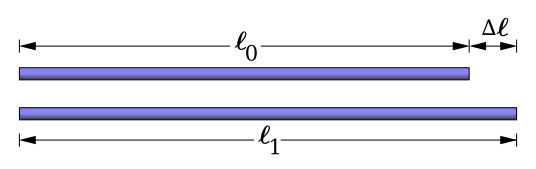
Thermal Expansion
Railroad tracks buckle in the summer. Bridge decks have those strange metal teeth at each end. Sidewalk slabs are separated by gaps filled with tar. The lid on a stuck jar comes loose when you run it under hot water.
These are all solutions to (or examples of) the same problem: most materials expand when heated and contract when cooled. Engineers spend a lot of time and money managing this fact, and the MCAT expects you to know the formulas, recognize the real-world examples, and understand why it happens.
Why Materials Expand
At higher temperatures, atoms vibrate with greater amplitude around their equilibrium positions. Because the potential energy curve between atoms is asymmetric (steeper on the compression side), the average separation between atoms grows slightly. Multiply that tiny increase by billions of atoms, and you get a measurable change in size.
Linear Expansion
For a solid object with a single dominant dimension (a rod, a rail, a wire), we use the linear expansion formula:
The coefficient α is material-specific. Metals generally have larger α values than ceramics or glass. Some MCAT-relevant values:
| Material | α (x /°C) |
|---|---|
| Aluminum | 24 |
| Steel | 12 |
| Glass | 9 |
| Concrete | 12 |
Volumetric Expansion
For three-dimensional expansion (a liquid in a container, a solid block), use:
The approximation β ≈ 3α makes sense if you think about it: a cube expanding equally in all three dimensions. Each dimension grows by a factor of (1 + αΔT), so the volume grows by ≈ 1 + 3αΔT for small expansions.
Special Case: Water
Water is anomalous. Most liquids contract steadily as they cool, but water reaches its maximum density at 4 °C. Below 4 °C, water actually expands as it cools further and eventually freezes into ice, which is less dense than liquid water.
This is why ice floats and why lakes freeze from the top down. The densest water (4 °C) sinks to the bottom, insulating aquatic life below the ice layer.
The Hole-in-a-Plate Problem
A classic MCAT question: a metal plate with a hole is heated. Does the hole get bigger or smaller?
The hole gets bigger. Imagine the hole is filled with the same metal - if heated, that plug would expand. The surrounding material must expand the same way, so the hole expands as if it were made of the same material. Every linear dimension grows, including the diameter of the hole.