
Heat Engines & Carnot
Your car engine burns fuel, and some of that energy becomes motion — but a lot of it goes straight out the exhaust pipe and radiator as waste heat. A typical gasoline engine is only ~25% efficient. The other 75% literally goes up in heat.
It turns out this isn’t just a matter of engineering imperfection. No matter how clever the engineering, no engine can ever convert all of the input heat into useful work. The second law of thermodynamics forbids it. And the Carnot cycle tells you exactly how close to perfect you could ever theoretically get — given the temperatures of the hot and cold reservoirs you’re working with.
How a Heat Engine Works
A heat engine runs between two thermal reservoirs:
- Hot reservoir () - the energy source (burning fuel, boiling water, the sun)
- Cold reservoir () - the energy sink (exhaust, cooling water, the atmosphere)
Each cycle, the engine:
- Absorbs heat from the hot reservoir
- Turns part of it into useful work W
- Dumps the remaining heat into the cold reservoir
By conservation of energy: = W +
Efficiency
Efficiency measures how much of the input heat becomes useful work:
The Carnot Cycle - Maximum Possible Efficiency
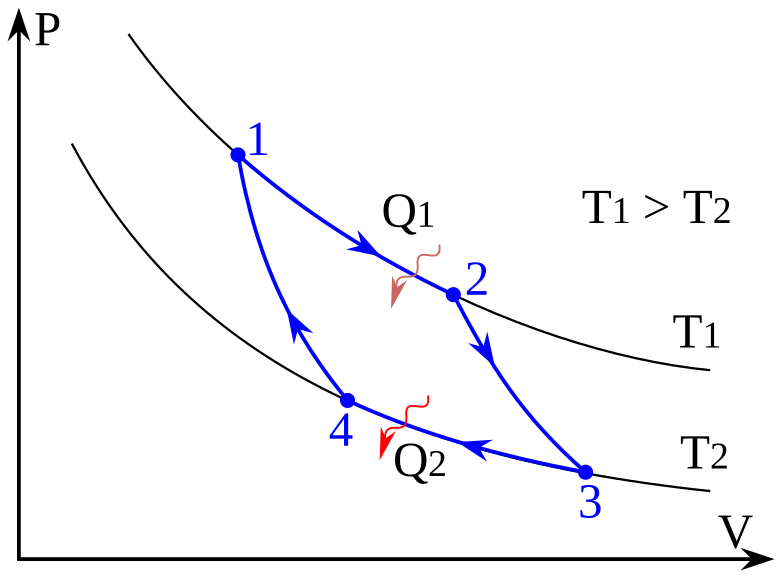
The Carnot cycle is a theoretical ideal - a perfectly reversible cycle made of two isothermal and two adiabatic processes. No real engine can match it, but it sets the absolute ceiling on efficiency:
Worked Example
A power plant operates between a steam temperature of 500 °C and a cooling water temperature of 27 °C. What is the maximum possible efficiency?
Convert to Kelvin: = 500 + 273 = 773 K, = 27 + 273 = 300 K
= 1 - / = 1 - = 1 - 0.388 = 0.612 = 61.2%
Even under ideal Carnot conditions, nearly 40% of the input heat must be wasted. The actual efficiency of a real power plant would be much lower.
The Carnot Cycle on a PV Diagram
The Carnot cycle consists of four steps:
- Isothermal expansion at - gas absorbs from the hot reservoir and expands
- Adiabatic expansion - gas continues expanding, cooling from to with no heat transfer
- Isothermal compression at - gas dumps to the cold reservoir as it is compressed
- Adiabatic compression - gas is compressed back to the starting state, warming from to
Why No Real Engine Reaches Carnot Efficiency
Real engines fall short because of:
- Friction between moving parts (wastes energy as heat)
- Irreversible heat transfer (heat flows across finite temperature differences)
- Turbulence in gas flow
- Non-ideal gas behavior
Typical real-world efficiencies: car engines around 20-30%, power plants around 30-40%, diesel engines around 35-45%.
These engine numbers are brake thermal efficiencies: the fraction of the fuel’s chemical energy that reaches the crankshaft as useful work. Whole-vehicle figures, sometimes quoted as “tank-to-wheels” efficiency, are lower, because they also subtract drivetrain, idling, and accessory losses. The two are measured against different denominators, so they are not the same quantity.
Refrigerators and Heat Pumps
A refrigerator is a heat engine running backward - it uses work input to move heat from cold to hot. The “coefficient of performance” (COP) replaces efficiency:
COP_refrigerator = / W
The MCAT rarely tests COP calculations but may describe a refrigerator conceptually.