Heat Transfer
Heat always flows from hot to cold. That part is simple. The interesting question is how it gets there.
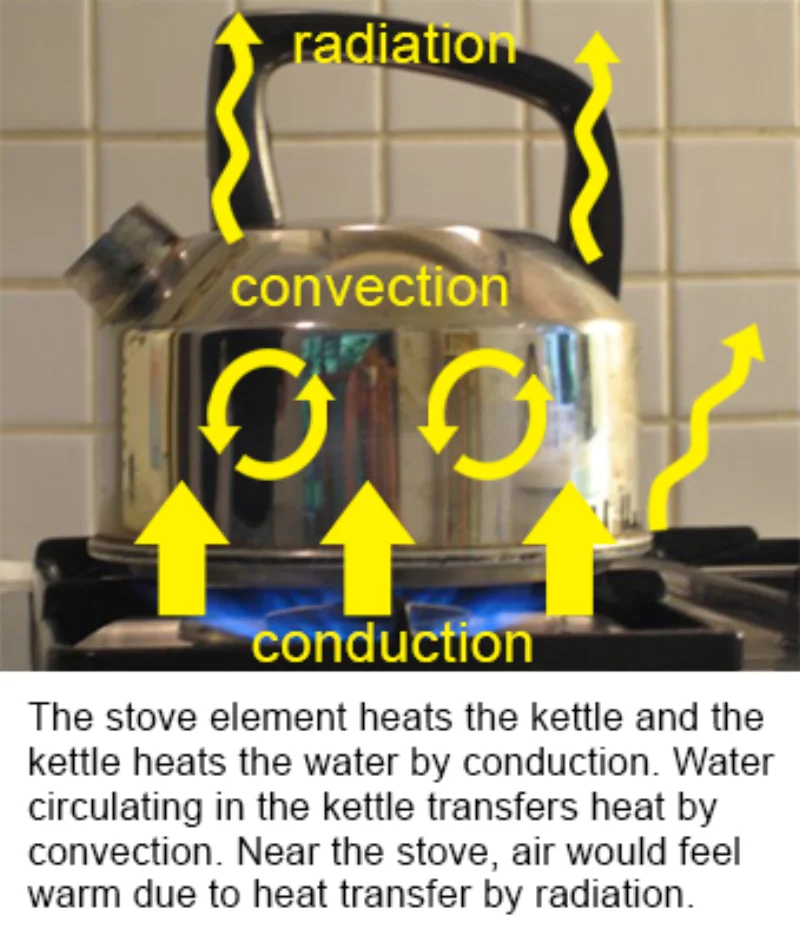
Nature uses three different delivery methods — conduction, convection, and radiation — and each one dominates in different situations. A coffee cup loses heat through all three at the same time: the mug warms your hands (conduction), steam rises and circulates the warm air around it (convection), and the surface emits invisible infrared waves (radiation). The MCAT expects you to identify which mechanism is at work in a given scenario and predict how changing conditions affects the rate.
Conduction - Direct Contact
Conduction is heat transfer through direct molecular collisions. Fast-moving (hot) molecules bump into slower-moving (cold) neighbors, transferring kinetic energy without any bulk movement of material.
Metals are excellent conductors because their free electrons carry energy rapidly through the lattice. That is why a metal spoon in hot soup gets burning hot while a wooden spoon stays cool - the metal conducts heat to your hand much faster.
The rate of conduction depends on:
- Temperature difference (bigger ΔT = faster flow)
- Cross-sectional area (more area = more flow)
- Thickness of the material (thicker = slower flow)
- Thermal conductivity (metals high, insulators low)
Convection - Fluid Circulation
Convection transfers heat through the bulk movement of a fluid (liquid or gas). When you heat water in a pot, the water at the bottom warms first, becomes less dense, and rises. Cooler, denser water sinks to replace it. This creates a circulation loop called a convection current.
There are two types:
- Natural (free) convection - driven by density differences from temperature gradients (boiling water, wind patterns)
- Forced convection - driven by an external source like a fan or pump (a convection oven, blood circulation with the heart as the pump)
Convection requires a medium - it cannot happen in a vacuum.
Radiation - Electromagnetic Waves
Radiation transfers heat through electromagnetic waves. Unlike conduction and convection, radiation needs no medium - it works through empty space. This is how the sun heats the Earth across 150 million kilometers of vacuum.
All objects above absolute zero emit thermal radiation. The hotter the object, the more radiation it emits and the shorter the peak wavelength. A glowing ember emits visible light; your body emits infrared (which is how night-vision cameras detect you).
Comparing the Three Mechanisms
| Feature | Conduction | Convection | Radiation |
|---|---|---|---|
| Mechanism | Molecular collisions | Bulk fluid movement | EM waves |
| Medium required? | Yes (solid best) | Yes (fluid only) | No |
| Works in vacuum? | No | No | Yes |
| Example | Metal spoon in soup | Boiling water | Sunlight warming Earth |
Multiple Mechanisms at Work
Most real situations involve more than one mechanism. A cup of hot coffee loses heat by conduction (through the mug to your hands), convection (hot air rising from the surface), and radiation (infrared emission). The MCAT may describe a scenario and ask you to identify which mechanism is primarily responsible for a specific observation.