Six theories of personality. Each tells a different story about where personality comes from. The MCAT expects you to recognize the signatures of each.
1. Psychoanalytic Theory (Freud)
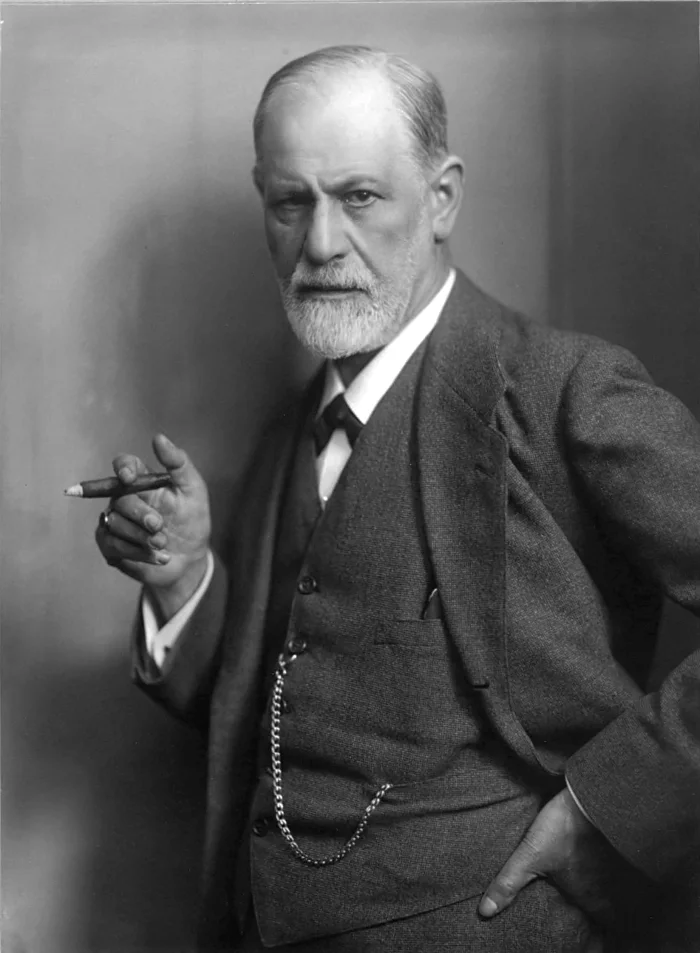
Sigmund Freud (1856–1939), founder of psychoanalysis. He proposed that personality emerges from unconscious conflicts among the id, ego, and superego — vocabulary the MCAT still tests despite the theory's contested empirical status. Credit: Max Halberstadt via Wikimedia Commons (Public Domain).
Personality is shaped by unconscious conflicts from early childhood. Three interacting mental agencies:
Id - innate, unconscious. Operates on the pleasure principle: seeks immediate gratification of drives. Present from birth.
Ego - the “reality principle.” Mediates between id, superego, and the external world. Delays gratification.
Superego - internalized moral standards (“conscience”). Strives for perfection, inhibits sexual and aggressive impulses.
A healthy personality has a strong ego balancing id and superego. Imbalances produce neurosis, anxiety, or impulsivity. Psychoanalytic therapy tries to bring unconscious conflicts into consciousness.
Freud is historically important but scientifically contested. The MCAT tests the vocabulary (id/ego/superego, defense mechanisms, psychosexual stages) because it shows up in older research and clinical language.
2. Humanistic Theory (Rogers, Maslow)
Personality develops through self-actualization - the drive to realize one’s full potential. Focuses on conscious experience and personal choice, rejecting the deterministic tone of psychoanalysis and behaviorism.
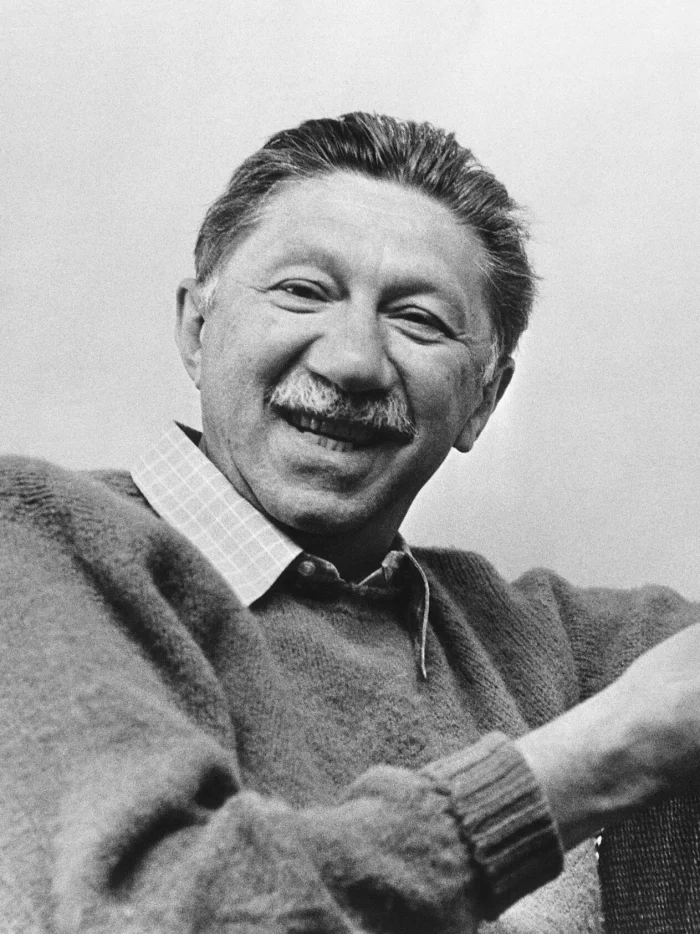
Abraham Maslow (1908–1970), a founder of humanistic psychology. He argued that human motivation is organized into a hierarchy crowned by self-actualization. Credit: William Carter via Wikimedia Commons (Public Domain).
Carl Rogers
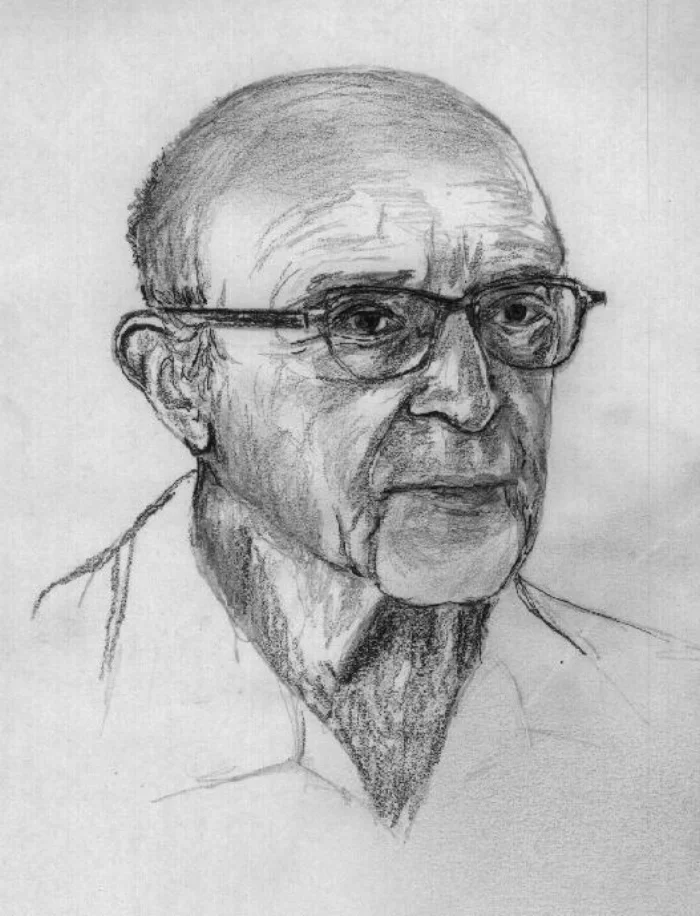
Carl Rogers (1902–1987), founder of person-centered (client-centered) therapy. He made unconditional positive regard and the real-self / ideal-self distinction central to humanistic personality theory. Credit: Didius via Wikimedia Commons (CC BY 2.5).
Self-concept - the image you hold of yourself.
Real self vs. ideal self - the bigger the gap, the more psychological distress.
Unconditional positive regard - acceptance regardless of behavior. Rogers argued children raised with it develop healthier self-concepts.
Abraham Maslow
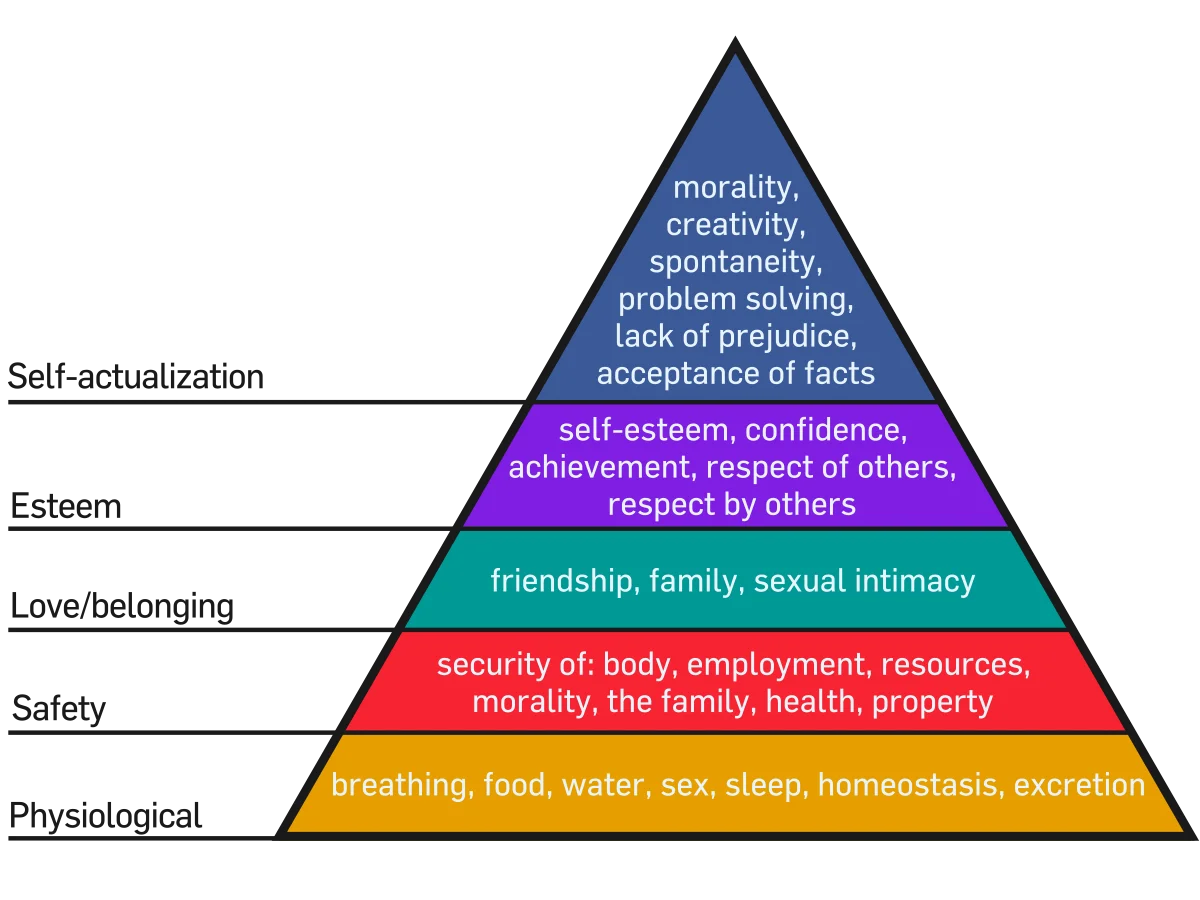
Hierarchy of needs (covered in Chapter 5). Self-actualization sits at the top - only achievable once lower needs are met. Self-actualizers are autonomous, creative, morally grounded, and focused on problems larger than themselves.
Maslow's hierarchy of needs. Lower-level deficiency needs (physiological, safety, belonging, esteem) must be met before a person can pursue self-actualization at the top. The MCAT routinely tests stage names and order. Credit: Factoryjoe via Wikimedia Commons (CC BY-SA 3.0).
3. Biological (Evolutionary) Theory
Personality is significantly inherited and shaped by brain biology.
David Buss - evolutionary psychology theorizes that men and women evolved different mating strategies because of different reproductive costs.
Hans Eysenck - proposed extroverts have naturally LOWER cortical arousal than introverts, so they seek more stimulation. Introverts are already over-aroused and avoid stimulation. Same principle applies to extraversion-introversion at the physiological level.
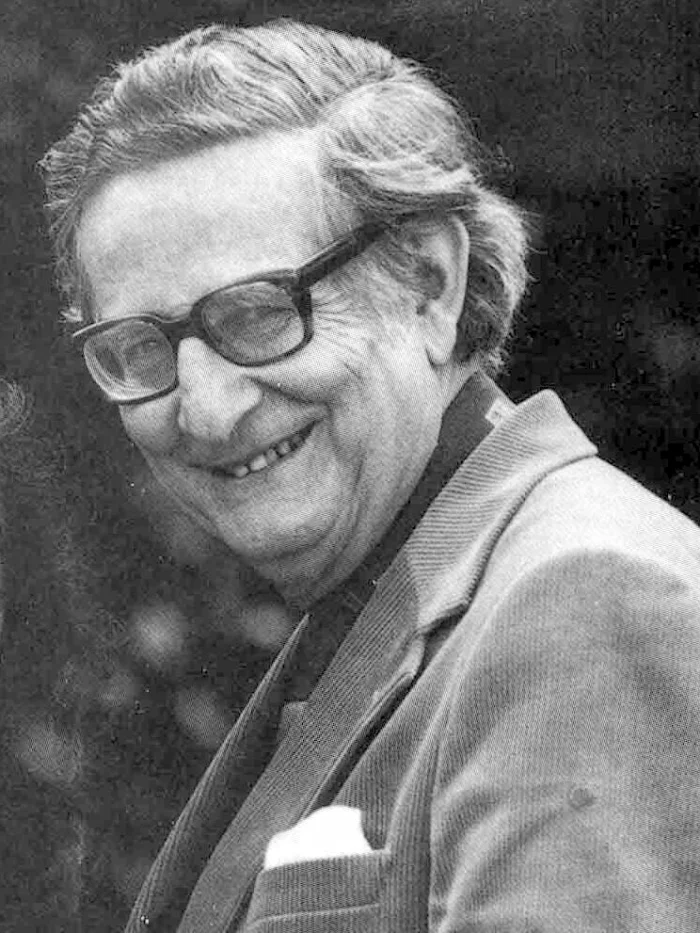
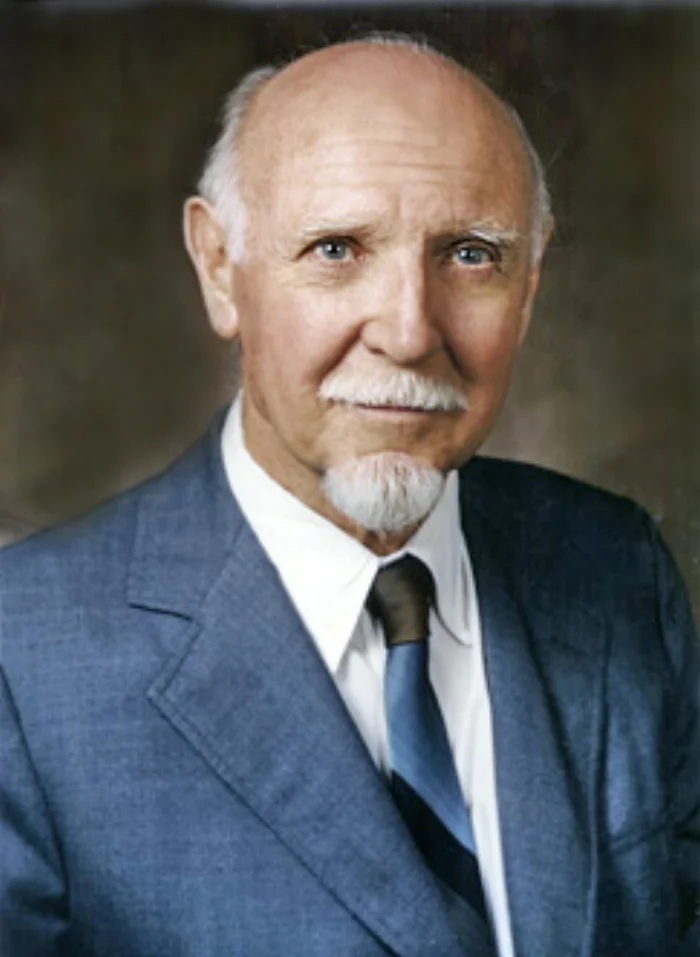
Hans Eysenck (1916–1997) anchored personality in biology. His PEN model (Psychoticism–Extraversion–Neuroticism) proposed that introverts have higher baseline cortical arousal and therefore avoid stimulation, while extroverts seek it. Credit: Sirswindon via Wikimedia Commons (CC BY 3.0).
- **Jeffrey Gray** - personality is governed by two biological systems: behavioral **inhibition** (punishment/avoidance) and behavioral **activation** (reward/approach).
- **C. Robert Cloninger** - linked personality traits to specific brain systems (e.g., low dopamine → impulsivity).
Twin studies consistently show substantial heritability of personality traits (~40-50%). Specific genes (e.g., long DRD4 receptor gene → thrill-seeking) have been correlated with specific traits.
4. Behaviorist Theory (Skinner, Pavlov)
Personality is the result of learned behaviors shaped by the environment through classical and operant conditioning. Deterministic: the environment completely determines behavior. Doesn’t accept unobservable mental entities.
Skinner - operant conditioning. Reinforcement and punishment shape personality patterns across life.
Pavlov - classical conditioning. Emotional responses learned through pairing with unconditioned stimuli.
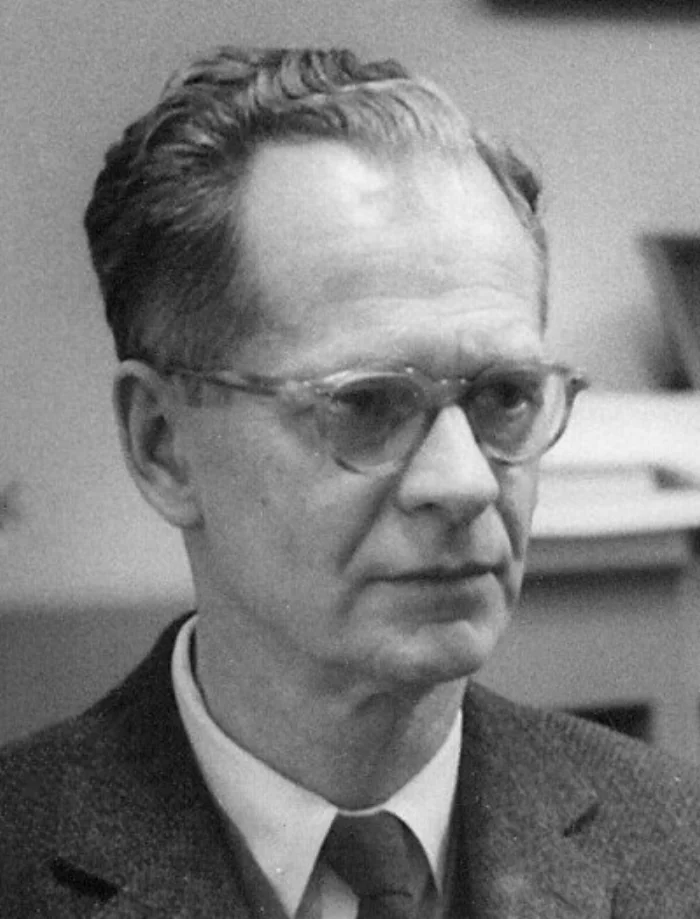
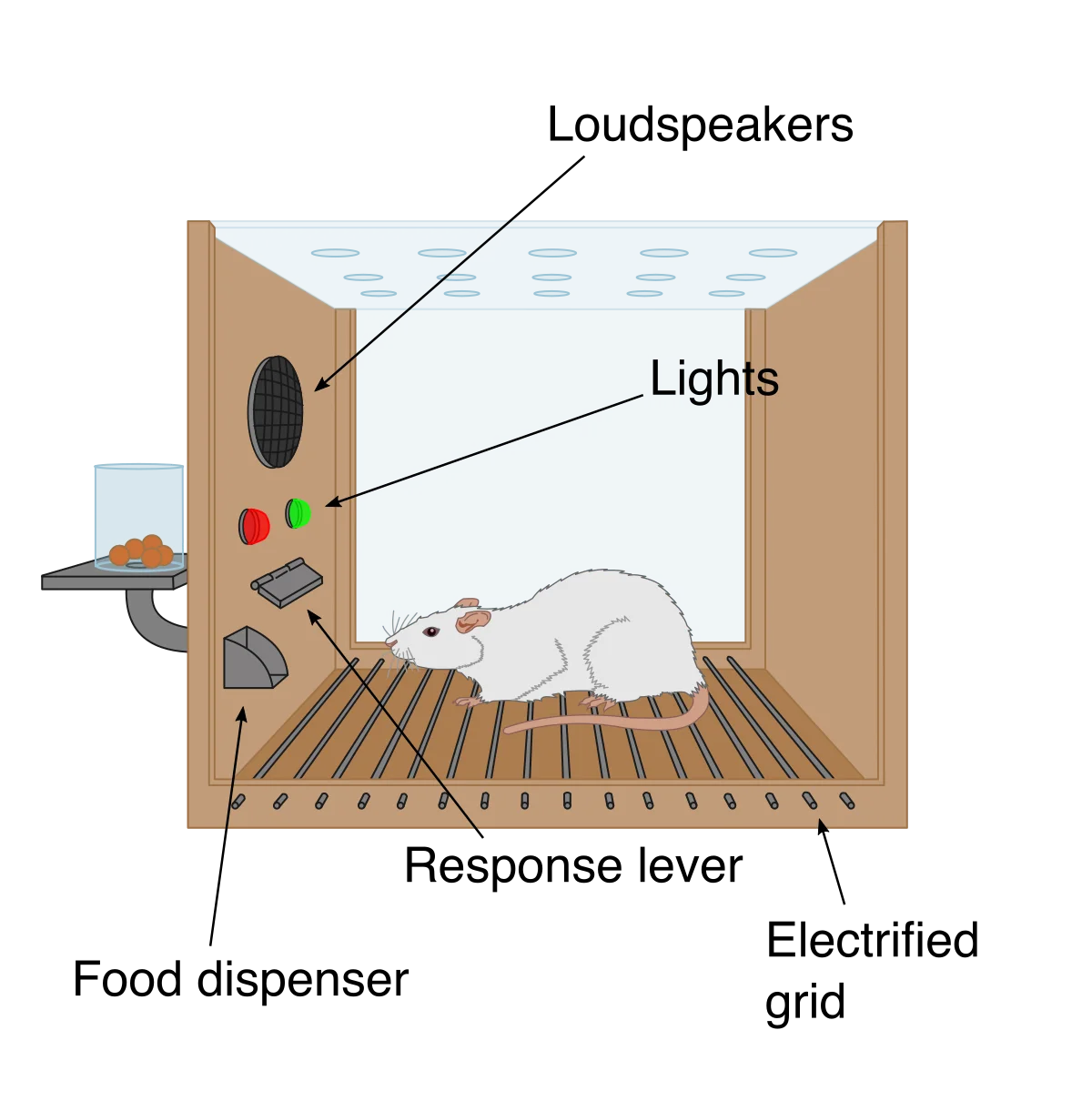
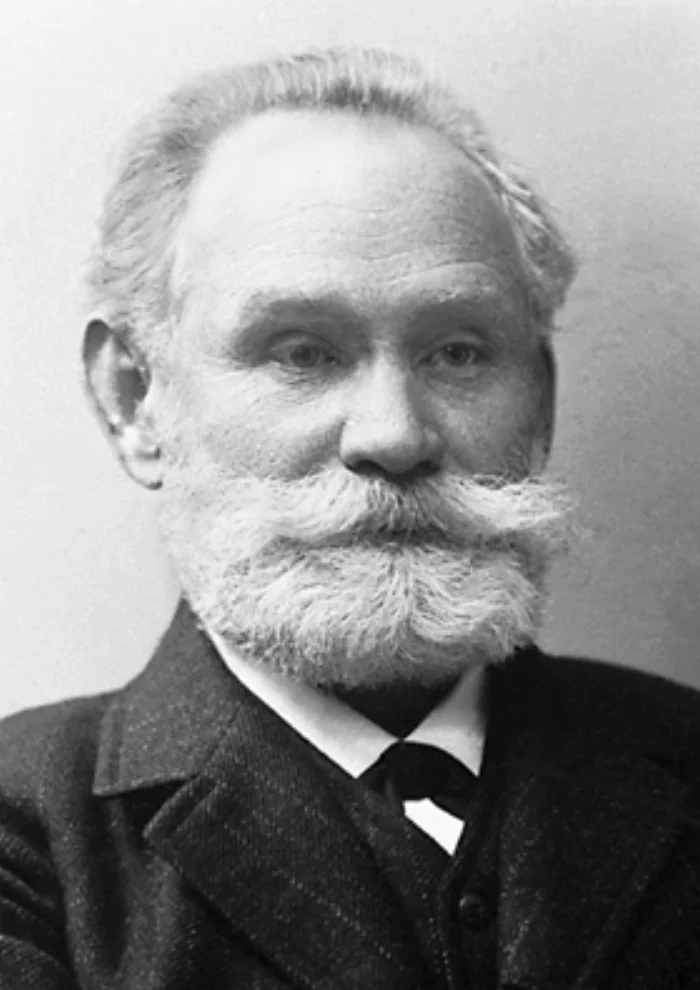
B.F. Skinner (1904–1990), the most influential behaviorist of the 20th century. His operant conditioning chamber (the "Skinner box") let him quantify how reinforcement schedules shape behavior — the empirical core of behaviorist personality theory. Credit: Silly rabbit via Wikimedia Commons (CC BY 3.0).The operant chamber (Skinner box). Animals press a lever for food (positive reinforcement) or to avoid shock (negative reinforcement); precisely scheduled consequences shape behavior over time. The chamber is the canonical demonstration of operant conditioning's role in personality. Credit: AndreasJS / Pixelsquid via Wikimedia Commons (CC BY-SA 3.0).Ivan Pavlov (1849–1936), Russian physiologist whose work on salivary conditioning in dogs founded classical conditioning. Behaviorist personality theory treats emotional responses as conditioned associations of this kind. Credit: Unknown author via Wikimedia Commons (Public Domain).
Behaviorism explains how behavior patterns form but struggles with the stability of personality across wildly different situations. The cognitive theory (next) emerged as a bridge.
5. Social Cognitive Theory (Bandura)
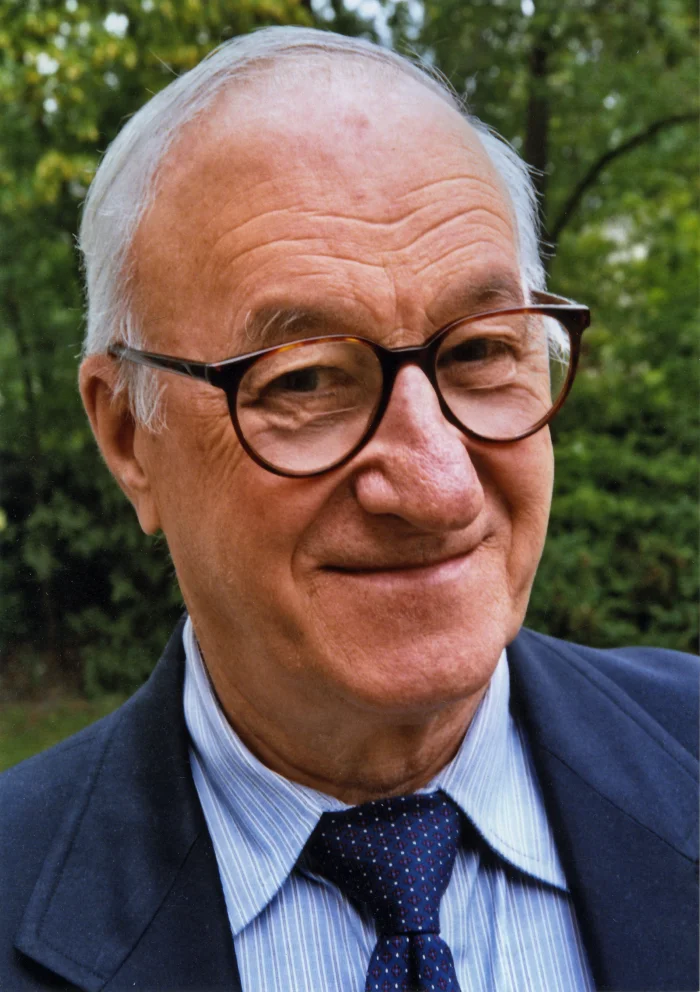
Albert Bandura (1925–2021), the founder of social cognitive theory. He bridged behaviorism and cognitive psychology with concepts like self-efficacy, observational learning, and reciprocal determinism. Credit: bandura@stanford.edu via Wikimedia Commons (CC BY-SA 4.0).
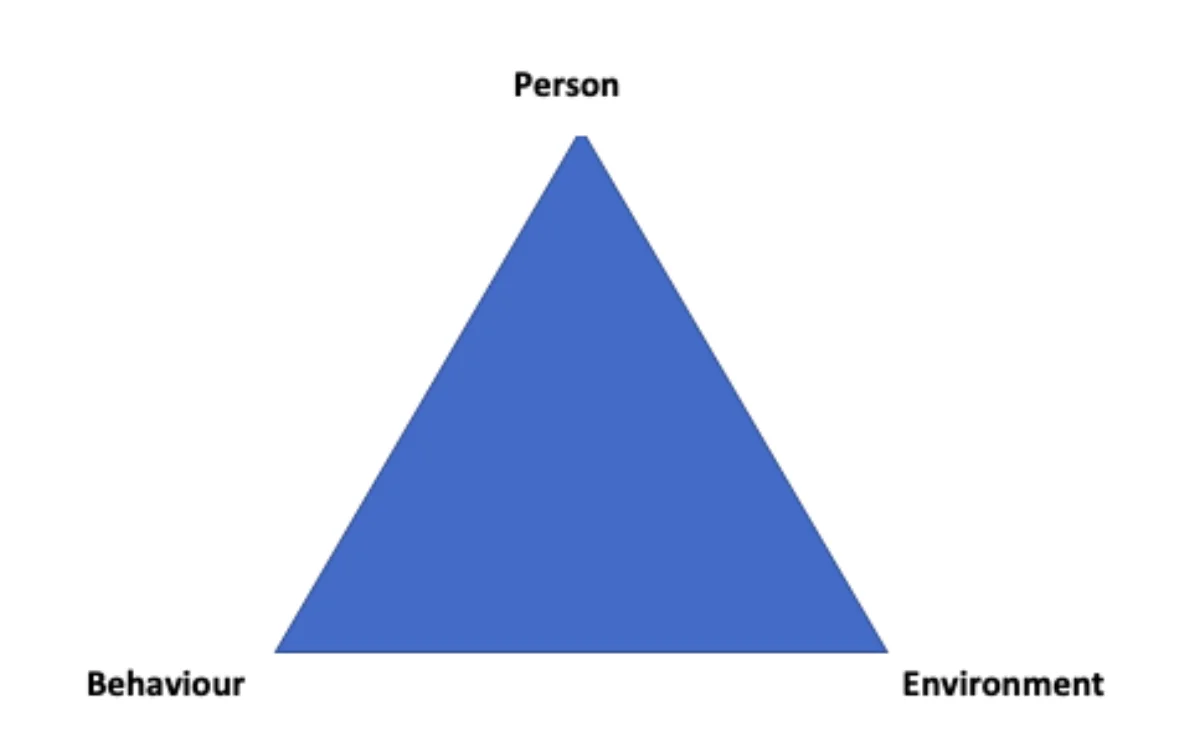
A synthesis. Personality is shaped by the interaction of behavior, cognition, and environment. Bandura’s reciprocal determinism - the three factors continuously influence each other.
Central role for self-efficacy - one’s belief in one’s ability to accomplish a task.
Observational learning (Chapter 3) is a key mechanism.
Unlike pure behaviorism, social cognitive theory takes thought and expectation seriously.
Bandura's reciprocal determinism. Person (cognition), behavior, and environment continually influence one another — none of the three is the sole driver of personality. The MCAT often tests this triadic structure directly. Credit: U3190210 via Wikimedia Commons (CC BY-SA 4.0).
6. Trait Theory
Personality is a stable pattern of traits - enduring dispositions toward particular behaviors. Describes rather than explains.
Gordon Allport
Three categories of traits:
Cardinal traits - a single dominant trait that shapes most of a person’s behavior (rare; think Mother Teresa’s compassion).
Central traits - 5-10 major characteristics that describe most people (honesty, sociability).
Mnemonic: “A Cardinal Allport Can Sing (Central, Cardinal, Secondary).”
Raymond Cattell
Raymond Cattell (1905–1998) used factor analysis to derive 16 source traits, distilled into the 16PF questionnaire. He pushed personality theory toward statistical rigor. Credit: Cattell family via Wikimedia Commons (CC BY-SA 3.0).
Identified 16 personality factors using factor analysis. The 16 PF (Personality Factor) questionnaire is still used.
Hans Eysenck (PEN Model)
Three super-dimensions:
Psychoticism - degree to which reality is distorted.
Extraversion - sociability.
Neuroticism - emotional stability.
Mnemonic: “Eysenck’s PEN.”
The Big Five (Five-Factor Model)
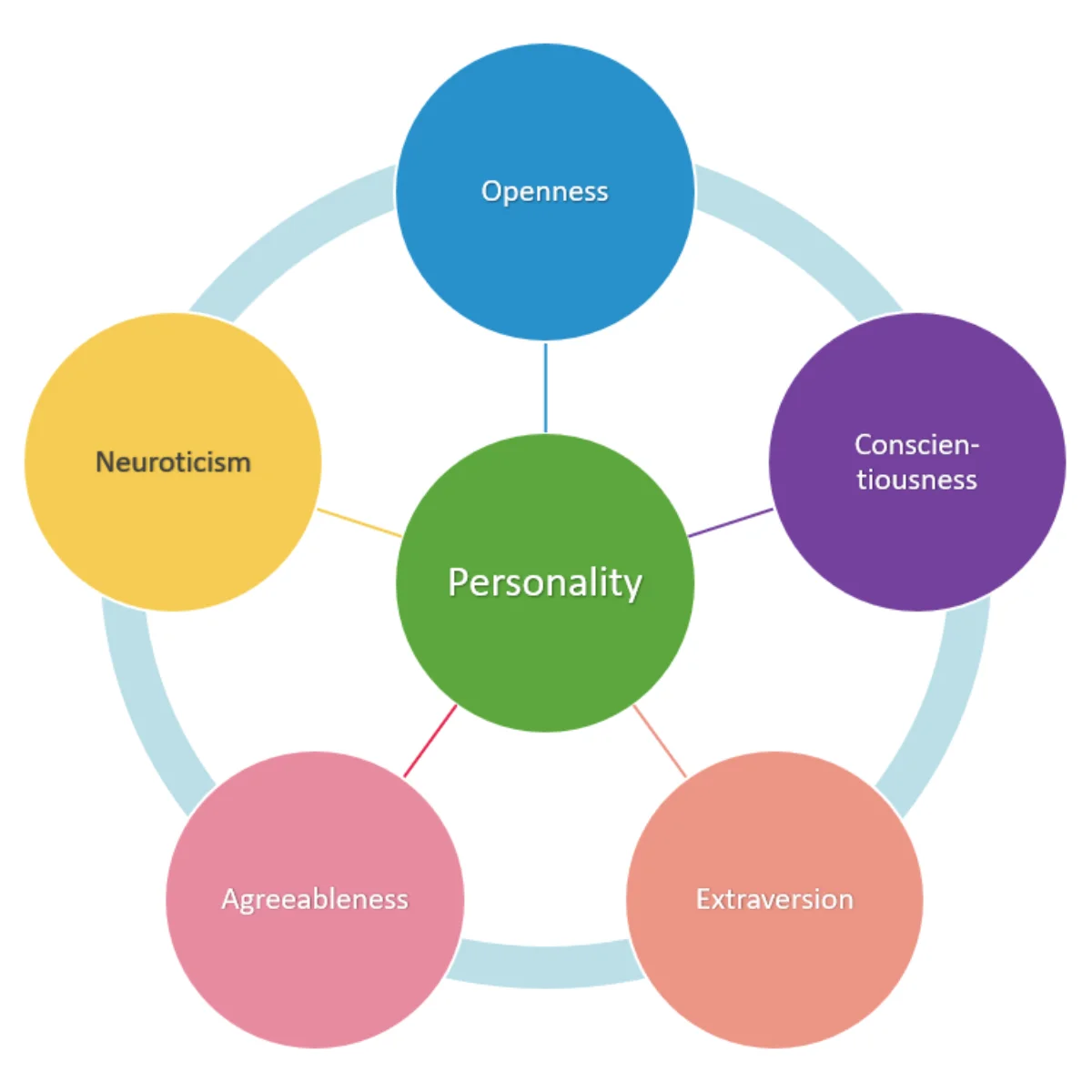
The current consensus model. Five broad dimensions found across cultures and ages.
Mnemonic: OCEAN.
Openness - imagination vs. practicality, intellectual curiosity.
Conscientiousness - careful vs. careless, disciplined vs. impulsive, organized.
Extraversion - sociable vs. reserved, talkative vs. quiet.
Agreeableness - kind vs. cold, cooperative vs. antagonistic.
Neuroticism - anxious vs. calm, tense vs. stable.
The Big Five (OCEAN) personality dimensions. Each trait is statistically independent of the others and appears across cultures and ages — the strongest empirical support of any modern personality model. Credit: MissLunaRose12 via Wikimedia Commons (CC BY-SA 4.0).
The Big Five has robust empirical support - the dimensions are statistically independent and appear in diverse populations.
Myers-Briggs Type Indicator (MBTI)
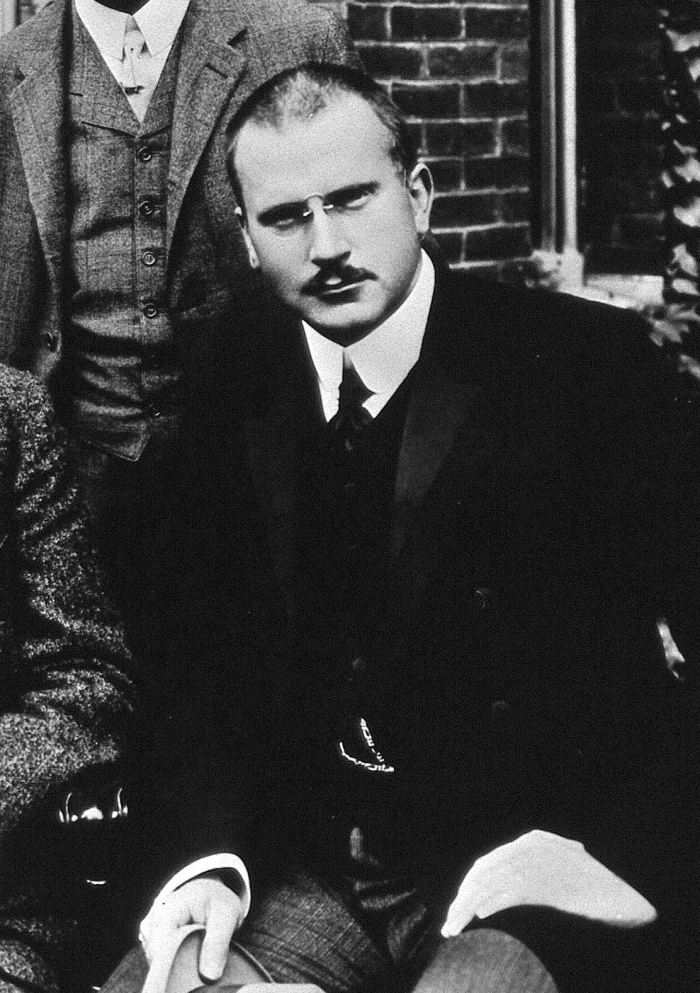
Carl Jung (1875–1961), Swiss psychiatrist whose theory of psychological types (introvert/extravert plus four functions) inspired — but is much richer than — the modern Myers-Briggs Type Indicator. Credit: Unknown author via Wikimedia Commons (Public Domain).
Popular but psychometrically weak. Four dichotomies (E/I, S/N, T/F, J/P) producing 16 types. Derived loosely from Carl Jung. Used heavily in business and career counseling despite limited scientific validity - the MCAT may reference it but the Big Five is the scientifically preferred system.
What are the five traits in the Big Five personality model?
Click to reveal answer
Openness, Conscientiousness, Extraversion, Agreeableness, Neuroticism. Mnemonic: OCEAN. The Big Five shows strong empirical support across cultures and ages.
What does Rogers mean by 'unconditional positive regard'?
Click to reveal answer
Accepting and valuing another person regardless of their behavior. Rogers argued children raised with unconditional positive regard develop healthy self-concepts, while those given only conditional approval develop conflict between real and ideal self.
How does Eysenck's biological theory explain why introverts avoid crowded parties?
Click to reveal answer
Introverts have higher baseline cortical arousal than extroverts. They are already over-stimulated, so they avoid additional stimulation (loud crowds). Extroverts need more input to reach their optimal arousal level.
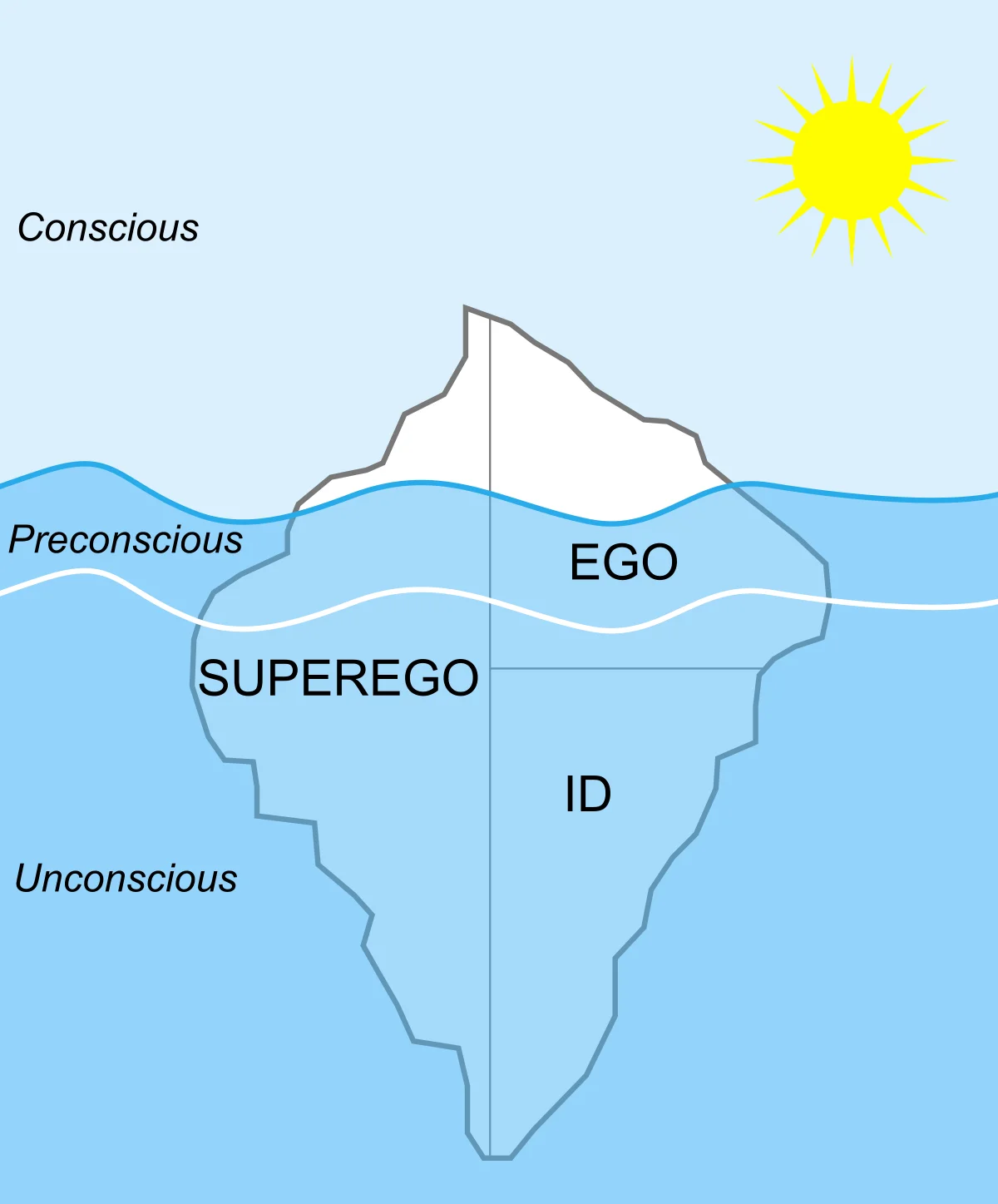
Freud’s structural model of the mind - id, ego, superego - frames personality as a constant balancing act. When the balance wobbles, anxiety arises, and the ego deploys defense mechanisms to keep unwanted impulses and memories out of awareness. Each mechanism is unconscious. None are chosen deliberately. All are testable on the MCAT.
Review: Id, Ego, Superego
Freud's iceberg model. The conscious mind (above the water) is only the tip — most of the ego, all of the id, and much of the superego operate unconsciously. Defense mechanisms run below the waterline, which is why we don't notice them. Credit: historicair via Wikimedia Commons (Public Domain).
Id. Pleasure principle. Wants immediate satisfaction. Unconscious. Present from birth.
Ego. Reality principle. Balances id, superego, and external reality. Develops in early childhood. Mostly conscious.
Superego. Morality principle. Internalized parental and cultural standards. Develops around age 3-5. Mostly unconscious.
The ego’s job is to navigate between the id’s demands, the superego’s ideals, and reality’s constraints. When these collide hard enough to generate anxiety, defense mechanisms kick in.
The Classic Defense Mechanisms
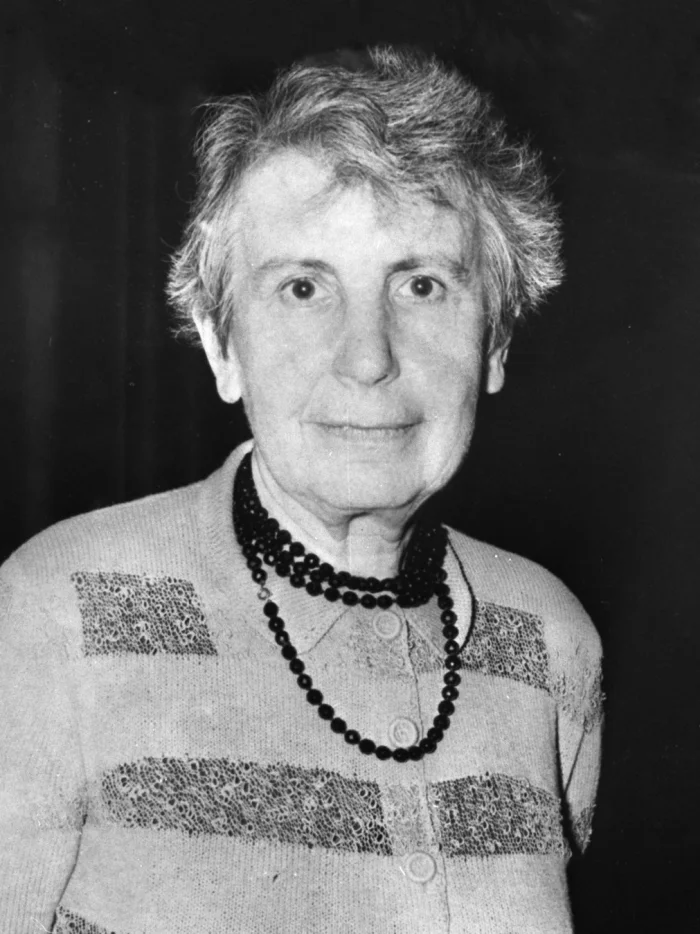
Anna Freud (1895–1982), Sigmund Freud's daughter and a major theorist in her own right. Her 1936 book The Ego and the Mechanisms of Defense systematized the catalogue of defenses (repression, projection, sublimation, etc.) that the MCAT still tests today. Credit: Dutch National Archives via Wikimedia Commons (CC0).
Repression
Unconsciously pushing anxiety-provoking thoughts out of awareness. The most basic defense. A combat veteran unable to remember specific details of a traumatic battle. A child abused by a trusted adult who has no conscious memory of the abuse.
Repression is different from suppression, which is the conscious effort to avoid thinking about something (“I’ll think about the exam later”).
Denial
Refusing to acknowledge an unpleasant reality. An alcoholic insists they don’t have a drinking problem. A terminally ill patient refuses to believe the diagnosis.
Projection
Attributing your own unacceptable feelings to someone else. “I don’t hate my sister - she hates me.” A person struggling with homosexual feelings vocally accuses others of being gay.
Displacement
Redirecting emotions from a threatening target to a safer one. You’re angry at your boss, so you yell at your spouse when you get home. A frustrated child kicks the dog.
Rationalization
Creating logical-sounding explanations for behaviors driven by unconscious impulses. Didn’t get the job? “I didn’t really want it anyway.” Ate a whole pizza? “I deserve it, I had a tough day.”
Reaction Formation
Expressing the OPPOSITE of your true feelings. A woman who secretly hates her sister gushes about how much she loves her. A person with unacceptable sexual impulses becomes a militant moralist campaigning against those same impulses.
Sublimation
Redirecting unacceptable impulses into socially acceptable activities. Channeling aggression into contact sports. Channeling sexual desire into artistic creation.
Considered the most mature defense mechanism - the only one that is generally adaptive.
Regression
Reverting to an earlier, less mature stage of development under stress. An adult throws a tantrum during a disagreement. A hospitalized 6-year-old starts bedwetting again.
Intellectualization
Focusing on abstract, analytical aspects to avoid emotional engagement. A doctor who has just received a cancer diagnosis launches into a detailed discussion of treatment options and statistics, avoiding any emotional response.
Suppression (Semi-Conscious)
Consciously pushing aside thoughts without denying they exist. Unlike repression, the person knows the thought is there but chooses not to engage with it. Less testable but worth distinguishing.
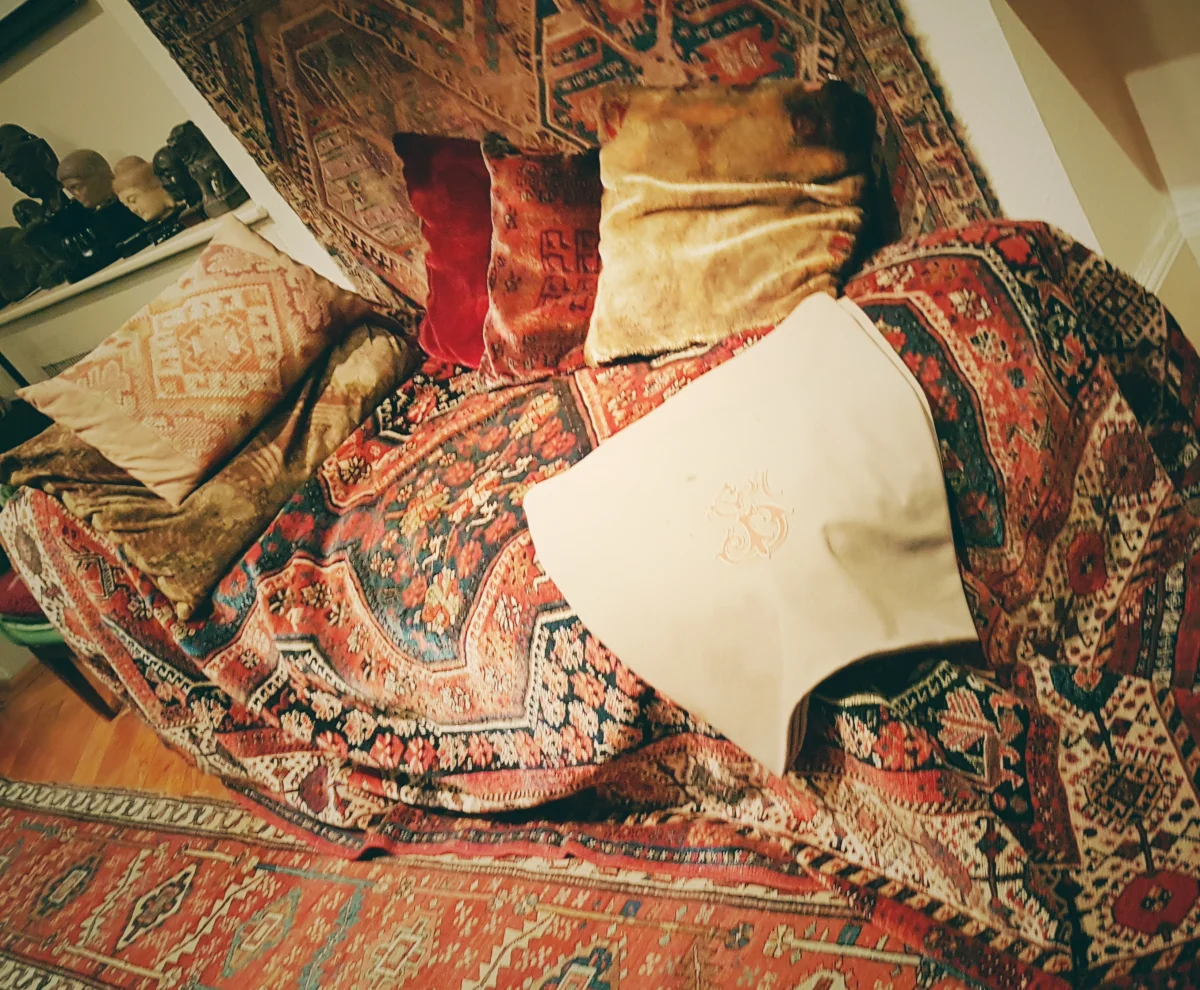
Freud's actual couch (now at the Freud Museum, London). Patients reclined here while free-associating; Freud believed the resulting flow of speech could surface the unconscious conflicts and defense mechanisms that produced their symptoms. Credit: JRennocks via Wikimedia Commons (CC BY 4.0).
Relative Adaptiveness
Modern psychology roughly ranks defense mechanisms by maturity:
Mature (adaptive). Sublimation, humor, anticipation, altruism. Help the ego manage conflict without distorting reality.
Neurotic. Repression, displacement, reaction formation, intellectualization. Common in normal people, can reduce anxiety short-term but may cause problems long-term.
Immature. Projection, regression, passive aggression. Common in childhood and adolescent development; dysfunctional in adults.
Psychotic. Denial of external reality, extreme distortion. Seen in severe mental illness.
Distinguish REPRESSION from SUPPRESSION.
Click to reveal answer
Repression is UNCONSCIOUS - the memory or feeling is blocked from awareness without the person choosing. Suppression is CONSCIOUS - the person deliberately decides not to think about the topic for now.
A man who is unhappy in his marriage suddenly devotes excessive attention and affection to his wife. Which defense mechanism?
Click to reveal answer
Reaction formation: expressing the OPPOSITE of true feelings. Often a giveaway in MCAT scenarios where behavior is described as excessive or exaggerated in a direction opposite to what circumstances would predict.
A frustrated employee comes home and yells at their kids instead of confronting their boss. Which defense mechanism?
Click to reveal answer
Displacement: redirecting emotion from a threatening target (boss) to a safer one (kids). If the person instead channels the frustration into a vigorous workout, that would be sublimation (more mature).
Which defense mechanism is generally considered the MOST adaptive?
Click to reveal answer
Sublimation - channeling unacceptable impulses into socially productive activities (e.g., aggression into sports, sexual energy into art). The only defense mechanism routinely considered mature.
Your sense of self is layered. At the foundation is self-concept (how you describe yourself). Above it sits self-esteem (how you feel about that description) and self-efficacy (whether you believe you can do things). Running through all of it is your locus of control - who or what you think is actually steering the ship.
Self-Concept, Self-Identity, Social Identity
Self-concept. The whole mental image you have of yourself - physical traits, personality, abilities, values. The most inclusive term.
Self-identity. Your sense of who you are as an individual, distinguishing you from others.
Social identity. Who you are in relation to groups (your nationality, religion, profession, team fandoms). Social identity changes with context - you might foreground your student identity at school, your family identity at home.
Your self-concept is not fixed; it develops through experience, feedback, and comparison to others. A child who is praised for being a “good reader” integrates that label into their self-concept.
Self-Esteem
Self-esteem is how much you like, value, or accept yourself. High self-esteem is associated with positive mood, resilience, and persistence. Low self-esteem is linked to depression, anxiety, and relationship problems.
But self-esteem has a dark side too: unstable or inflated self-esteem (narcissism) can fuel aggression when threatened. Research now emphasizes self-compassion as healthier than unconditional high self-esteem - accepting flaws without requiring constant superiority.
Self-Efficacy (Bandura)
Self-efficacy is your belief in your ability to perform a specific behavior successfully. Distinct from self-esteem: you can have high self-esteem generally but low self-efficacy for a specific task (confident person, bad at dancing).
Sources of self-efficacy (Bandura):
Past successes and failures (biggest source).
Observation of others (if they can do it, maybe I can).
High self-efficacy predicts persistence through setbacks, better academic performance, and better health behavior adherence. Therapy often aims to increase self-efficacy by structuring small successes.
Locus of Control
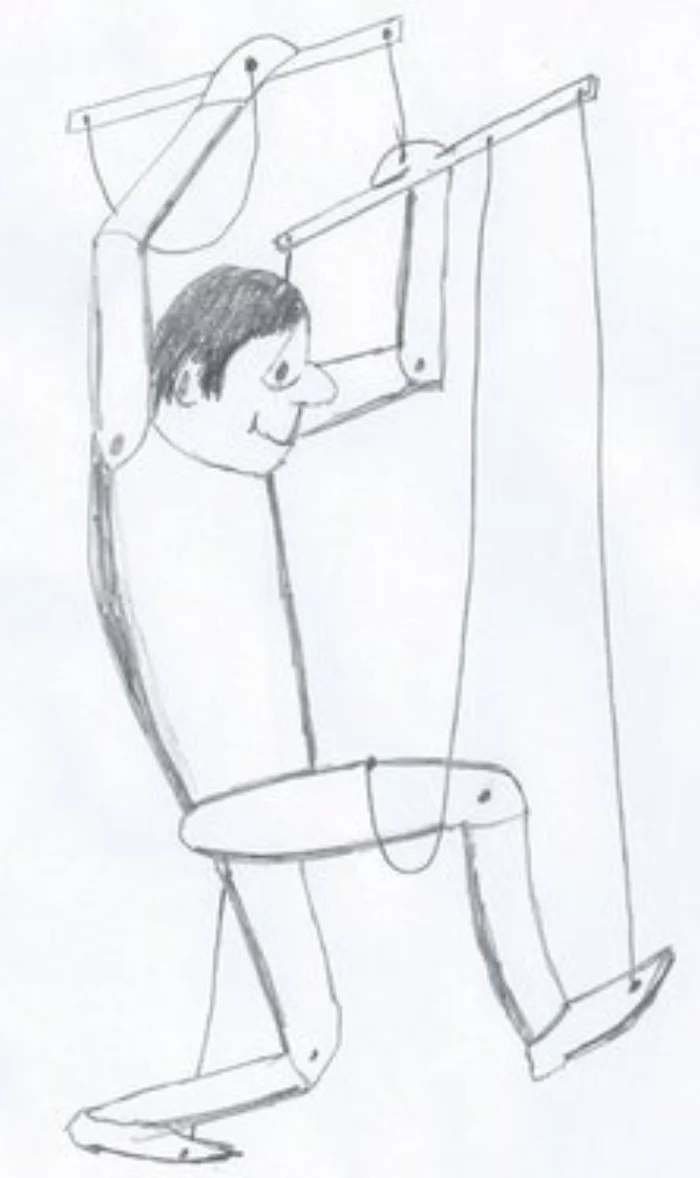
A marionette is the visual shorthand for an external locus of control: someone who feels their outcomes are pulled by outside forces. People with an internal locus believe they are working their own strings — and tend to show better academic, occupational, and health outcomes. Credit: CFD75 via Wikimedia Commons (CC BY-SA 4.0).
Locus of control is the degree to which you feel you control your own life.
Internal locus of control. “My actions determine my outcomes.” “I should have studied harder.” Associated with higher achievement, lower stress, better health behaviors.
External locus of control. “Outside forces determine my outcomes.” “That test was unfair.” “Luck is against me.” Associated with higher anxiety, depression, and worse health outcomes.
A mix is usually healthiest. Over-internal can mean blaming yourself for things outside your control. Over-external can mean learned helplessness.
Learned Helplessness
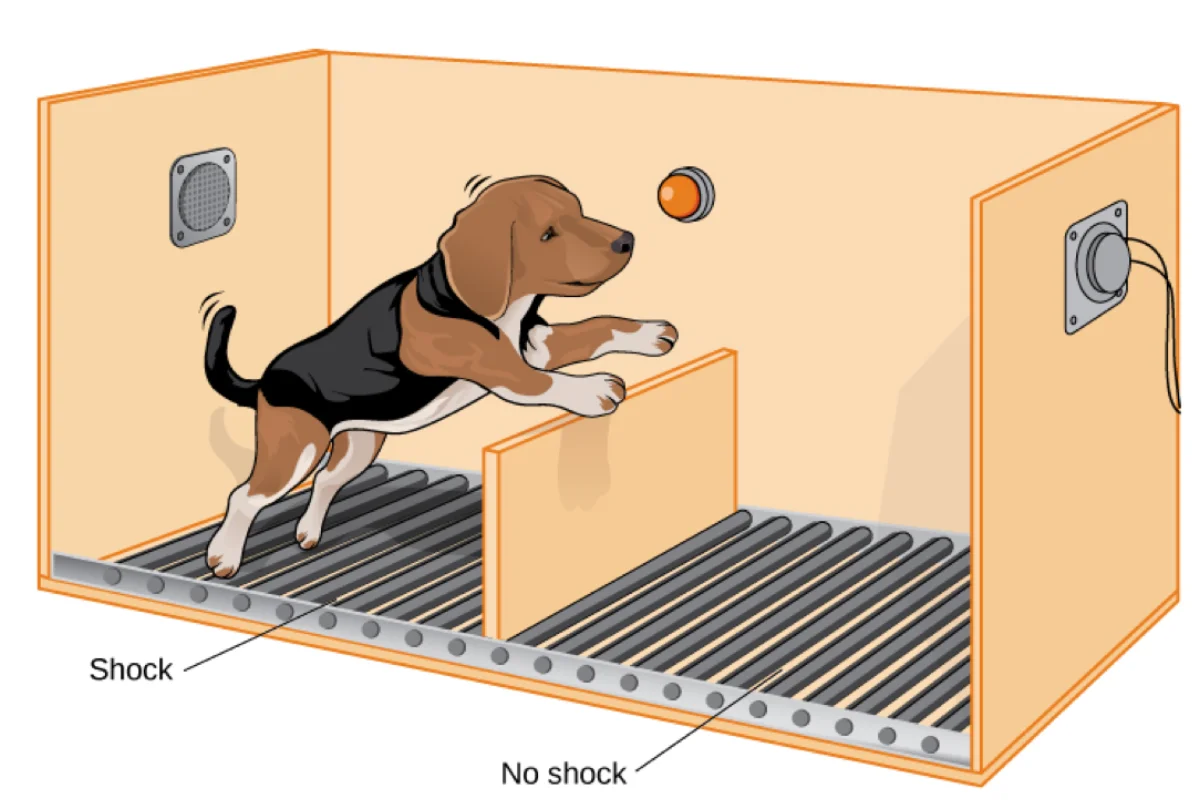
Seligman's shuttle-box paradigm. Dogs first exposed to inescapable shock later fail to escape even when escape is possible — they have learned that nothing they do matters. The result generalizes to depression, low self-efficacy, and external locus of control in humans. Credit: Rose M. Spielman, PhD (OpenStax) via Wikimedia Commons (CC BY 4.0).
Learned helplessness (Seligman - we saw this in Chapter 5) - after repeated uncontrollable negative events, people stop trying to escape even when escape becomes possible. Generalizes to a perception that “nothing I do matters.” Closely linked to clinical depression. Key contributor to the external locus of control in chronically stressed populations.
Self-Control and the Tyranny of Choice
Self-control (or self-regulation) is the capacity to override immediate impulses to pursue long-term goals. Finite resource - “ego depletion” research (now contested) suggested that exercising self-control in one domain could reduce it in others. Modern evidence suggests the effect is subtler and situation-dependent.
The tyranny of choice (Barry Schwartz): having too many options can paralyze decision-making, reduce satisfaction with the final choice, and increase regret. Paradoxically, abundance can harm well-being. Countered by establishing rules of thumb, accepting “good enough” choices (satisficing), or deliberately narrowing options.
Distinguish self-concept from self-esteem from self-efficacy.
Click to reveal answer
Self-concept: how you describe yourself (the full mental self-image). Self-esteem: how much you LIKE or VALUE that self. Self-efficacy: belief in your ability to perform a specific task. All three are distinct.
A student who receives a bad grade says 'the professor is unfair.' What is the student's locus of control?
Click to reveal answer
External - the student attributes the outcome to outside forces (the professor) rather than to their own behavior. Internal locus of control would say 'I should have studied more' or 'I didn't understand the material well enough.'
Learned helplessness tends to produce which locus of control?
Click to reveal answer
External. Repeated exposure to uncontrollable stress teaches the person that nothing they do matters, producing a generalized perception that outcomes are beyond their control. This contributes to depression.
Four developmental theorists, four competing lenses. All produce stages - neat packages that the MCAT loves to test. Match the theorist to the vocabulary and you win most of these questions.
Freud’s Psychosexual Stages
Freud proposed that libido (psychic energy) focuses on different erogenous zones at different ages. Failure to resolve conflicts at a stage leads to fixation - persistent personality issues related to that stage.
Phallic (3-6). Genitals. Oedipus complex (boys) or Electra complex (girls). Child unconsciously desires opposite-sex parent, fears same-sex parent’s retaliation. Resolved by identification with same-sex parent.
Latency (6-12). Sexual feelings dormant. Child focuses on peer friendships, school, hobbies.
Genital (12+). Puberty onward. Mature sexual interests.
Most modern psychology has rejected this framework, but the vocabulary remains testable.
Erikson’s Psychosocial Stages
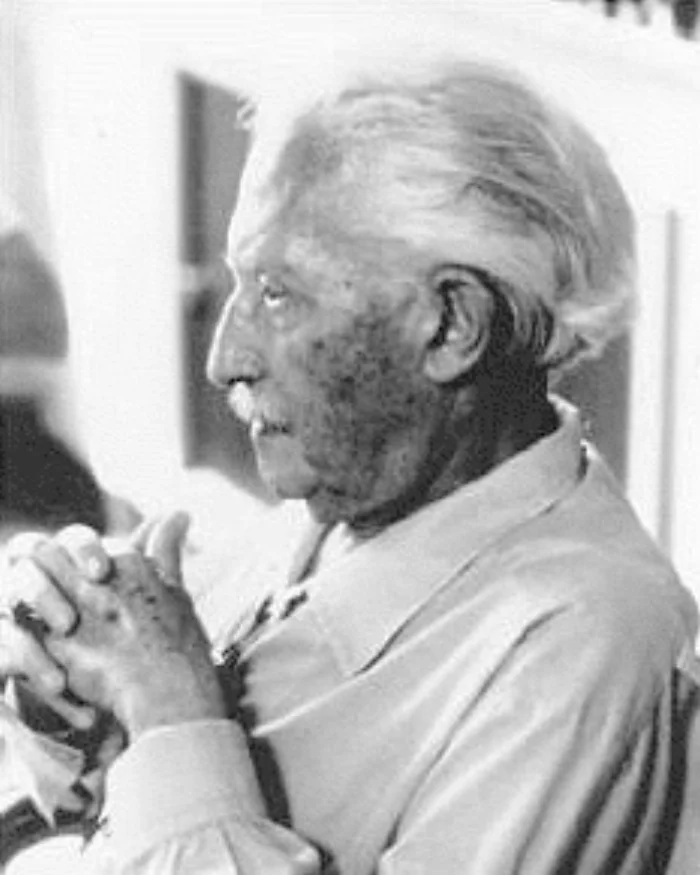
Erik Erikson (1902–1994) extended Freud's developmental scheme across the whole lifespan. His eight psychosocial stages are a perennial MCAT favorite — match the stage to the age and the central crisis. Credit: Unknown author via Wikimedia Commons (Public Domain).
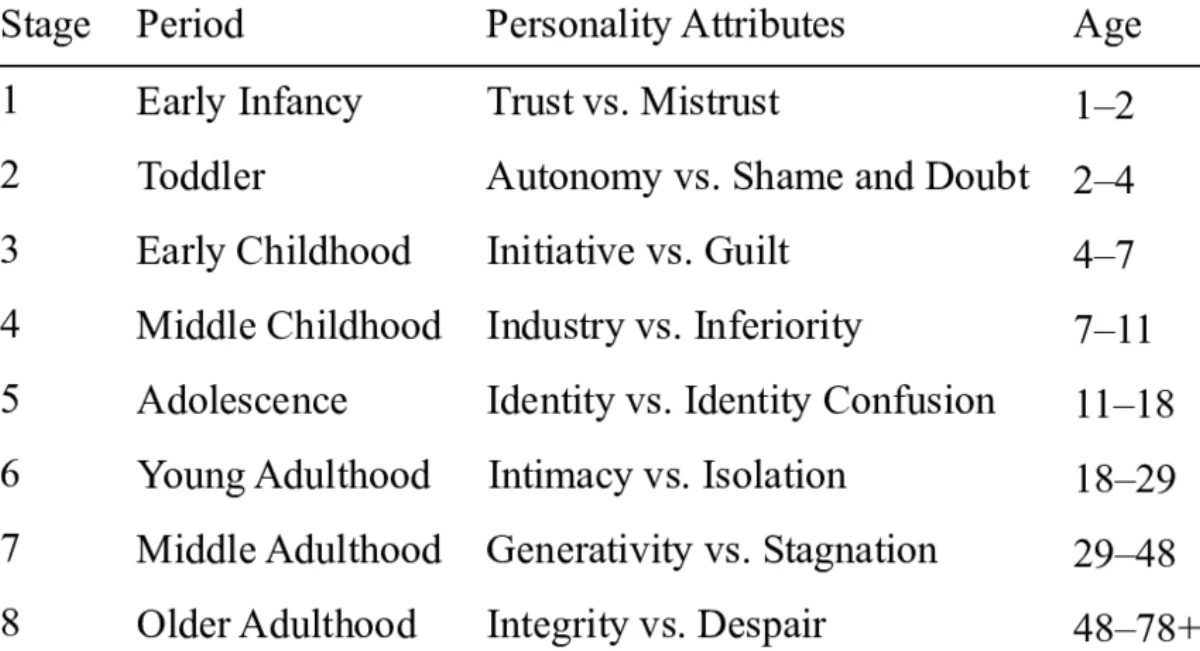
Erik Erikson modified Freud into eight psychosocial stages spanning the entire life. Each stage is a crisis between two poles. Successful resolution produces a virtue; failure produces difficulty.
Trust vs. Mistrust (0-1). Infant learns to trust caregivers (or doesn’t). Virtue: hope.
Autonomy vs. Shame and Doubt (1-3). Toddler explores independence. Virtue: will.
Initiative vs. Guilt (3-6). Preschooler asserts power and control. Virtue: purpose.
Industry vs. Inferiority (6-12). School-age child develops competence. Virtue: competence.
Identity vs. Role Confusion (12-18). Adolescent develops a coherent identity. Virtue: fidelity.
Intimacy vs. Isolation (young adult). Forming close relationships. Virtue: love.
Generativity vs. Stagnation (middle age). Contributing to the next generation. Virtue: care.
Integrity vs. Despair (old age). Reflecting on a life well-lived. Virtue: wisdom.
Erikson's eight stages at a glance: each life period pairs with a defining crisis between two poles. Successfully resolving the crisis produces a virtue; failure leaves a developmental deficit that resurfaces later. Credit: Robert.G Sacco via Wikimedia Commons (CC BY-SA 4.0).
Mnemonic for Erikson: “Trust Autonomy Initiative Industry Identity Intimacy Generativity Integrity.”
Vygotsky’s Sociocultural Theory
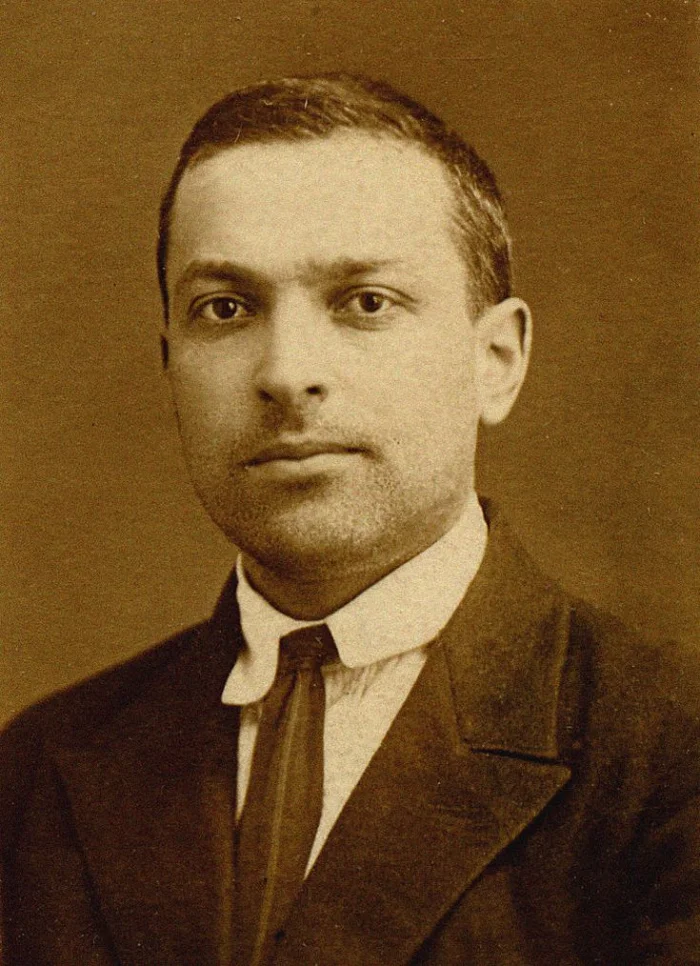
Lev Vygotsky (1896–1934), Russian developmental psychologist. He argued that cognitive development is fundamentally social — children acquire higher mental functions by internalizing the cultural tools (especially language) supplied by more competent others. Credit: Unknown author via Wikimedia Commons (Public Domain).
Lev Vygotsky argued that cognitive development is fundamentally social and cultural. Children learn through interactions with more knowledgeable others (parents, teachers, older children), internalizing the social tools (language, mathematical notation, cultural practices) that their society provides.
Zone of Proximal Development (ZPD)
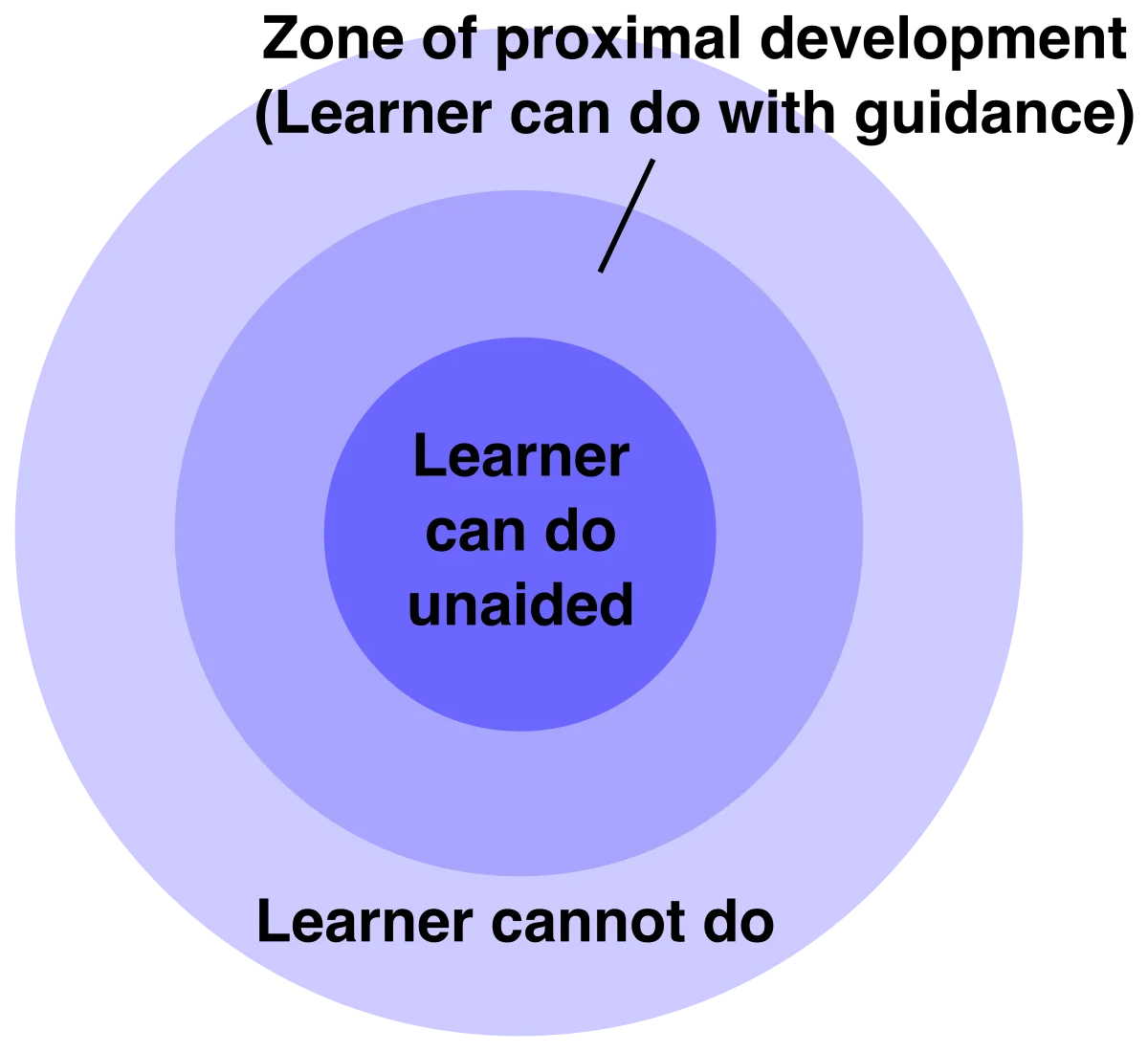
The gap between what a child can do alone and what they can do with help. Learning happens in this zone - tasks just beyond current ability but within reach with guidance.
The Zone of Proximal Development sits between what a learner can do alone and what is still out of reach. Effective scaffolding pulls the learner across this zone — and the scaffolding fades as competence grows. Credit: Dcoetzee via Wikimedia Commons (CC0).
Scaffolding
The support a more knowledgeable other provides to help a learner complete a task just beyond their current ability. The scaffolding is withdrawn as the learner’s competence grows - like training wheels.
Private Speech
Children’s tendency to talk to themselves (out loud) while working through problems. Vygotsky saw this as cognitive development happening in real time - the child is internalizing language as a tool for thought. Eventually private speech becomes silent “inner speech” - the verbal thinking of adults.
Vygotsky’s theory contrasts with Piaget’s: Piaget saw development as largely self-driven discovery; Vygotsky insisted it was fundamentally social.
Kohlberg’s Moral Development
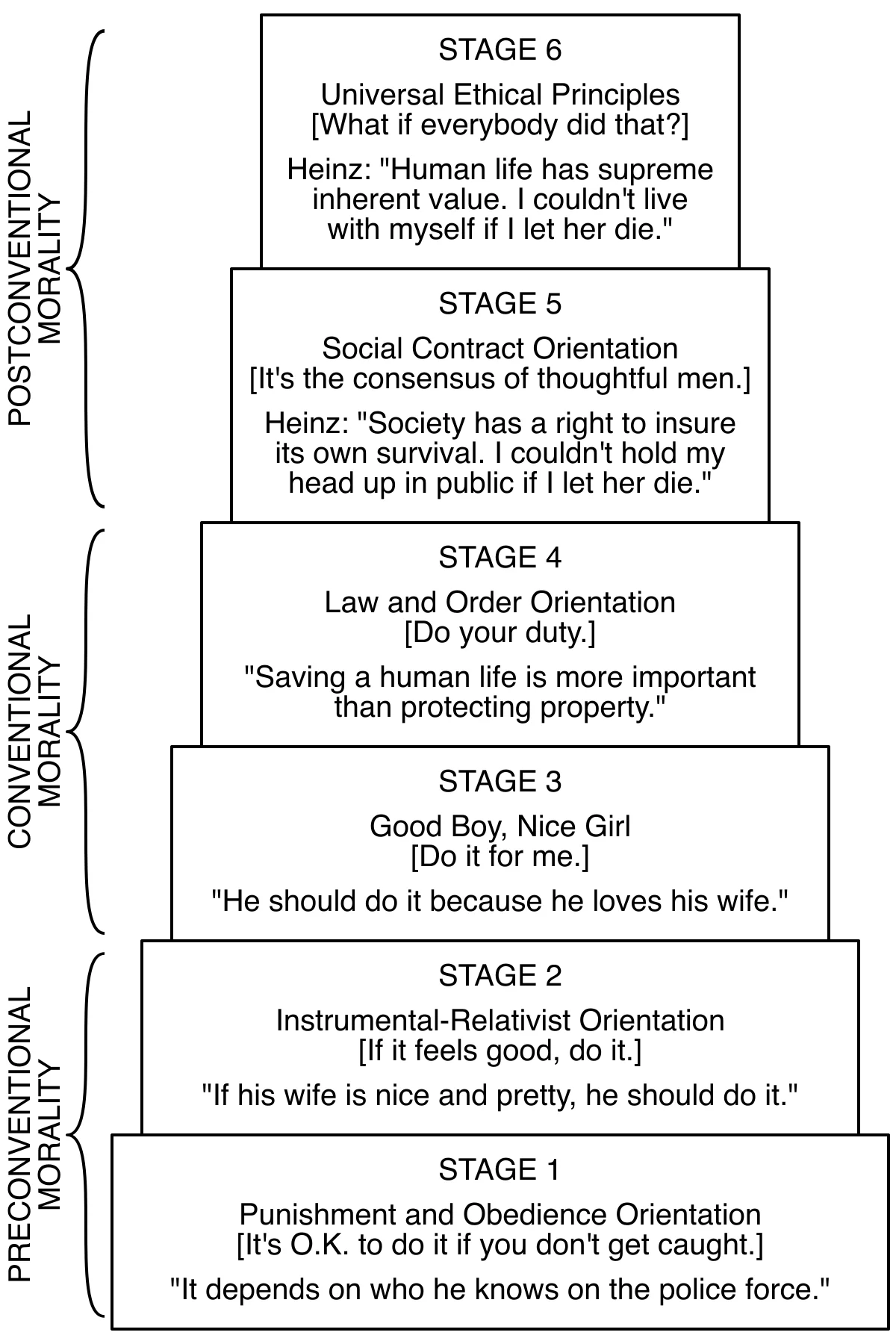
Lawrence Kohlberg used moral dilemmas (classic: the Heinz dilemma - should a man steal a drug to save his dying wife?) to map moral reasoning. Three levels, each with two stages.
Level 1: Preconventional Morality (children)
Decisions based on personal consequences.
Stage 1: Obedience and punishment. “Don’t steal because you’ll get in trouble.”
Stage 2: Self-interest / instrumental. “Steal if it benefits you, don’t if it doesn’t.”
Level 2: Conventional Morality (adolescents and most adults)
Decisions based on social approval and maintaining order.
Stage 3: Good boy / good girl. “Don’t steal because people will think you’re a bad person.”
Stage 4: Law and order. “Don’t steal because stealing breaks the law, and laws must be followed.”
Level 3: Postconventional Morality (some adults)
Decisions based on abstract ethical principles that can override social convention.
Stage 5: Social contract. “Laws are agreements that should be changed if they don’t serve the public good.”
Stage 6: Universal ethical principles. “Don’t steal because stealing violates a deeper ethical principle - but if the principle at stake is saving a life, stealing may be morally required.” Martin Luther King Jr.’s civil disobedience argument.
Kohlberg's six stages of moral development scaffolded onto the Heinz dilemma. Notice how the same scenario yields very different reasoning at each level. The MCAT routinely shows you a quote and asks for the matching stage. Credit: Lawrence Kohlberg / Em Griffin / cmglee via Wikimedia Commons (CC BY-SA 4.0).
Not everyone reaches Level 3. Carol Gilligan critiqued Kohlberg for male-biased reasoning, arguing that women’s moral reasoning often emphasizes an ethic of care rather than abstract justice. Modern research acknowledges both voices.
Carol Gilligan, who critiqued Kohlberg's stage theory as gender-biased. She argued women more often reason from an ethic of care (relationships, responsibility) than from the abstract ethic of justice Kohlberg's scheme privileges. Credit: Deror avi via Wikimedia Commons (CC BY-SA 3.0).
A teenager struggles to form a coherent sense of who they are and what they stand for. According to Erikson, what stage are they in?
Click to reveal answer
Stage 5: Identity vs. Role Confusion (ages 12-18). Adolescents develop a coherent sense of self. Failure produces confusion about future roles, values, and relationships. Virtue: fidelity.
What is Vygotsky's zone of proximal development?
Click to reveal answer
The gap between what a learner can do alone and what they can do with help. Learning happens best in this zone - tasks just beyond current ability but within reach with guidance. Supported by 'scaffolding' from a more knowledgeable other.
A child says 'I shouldn't steal because I might get caught and get in trouble.' Which Kohlberg level and stage?
Click to reveal answer
Preconventional level, Stage 1: obedience and punishment. Morality is determined by avoiding punishment, not by internalized principles or social norms.
Which Kohlberg stage is exemplified by civil disobedience in the pursuit of a higher moral principle?
Click to reveal answer
Postconventional Stage 6: universal ethical principles. Laws can be broken when they violate higher ethical principles. Classic example: Martin Luther King Jr.'s Letter from Birmingham Jail.
How do we make sense of other people’s behavior - and our own? Attribution theory tells us we’re constantly building explanations for actions, and those explanations are systematically biased. This section also covers two sociological theorists who built foundational models of how the self forms through social interaction: George Herbert Mead and Charles Cooley.
Attribution Theory
Attribution theory (Heider, Kelley) explains how we infer the causes of behavior. Two broad categories of causes:
Dispositional (internal) attribution. The behavior reflects the person’s stable traits, personality, or choices. “He yelled because he’s an angry person.”
Situational (external) attribution. The behavior reflects the circumstances. “He yelled because his flight just got cancelled.”
We use cues to decide which applies. Kelley’s covariation model suggests we check three kinds of information:
Consistency - does the person usually act this way in this situation?
Distinctiveness - does the person act differently in other situations?
Consensus - do others act this way in the same situation?
High consistency, low distinctiveness, and low consensus point to dispositional attribution. High consistency, high distinctiveness, and high consensus point to situational attribution.
Systematic Attribution Biases
Fundamental Attribution Error
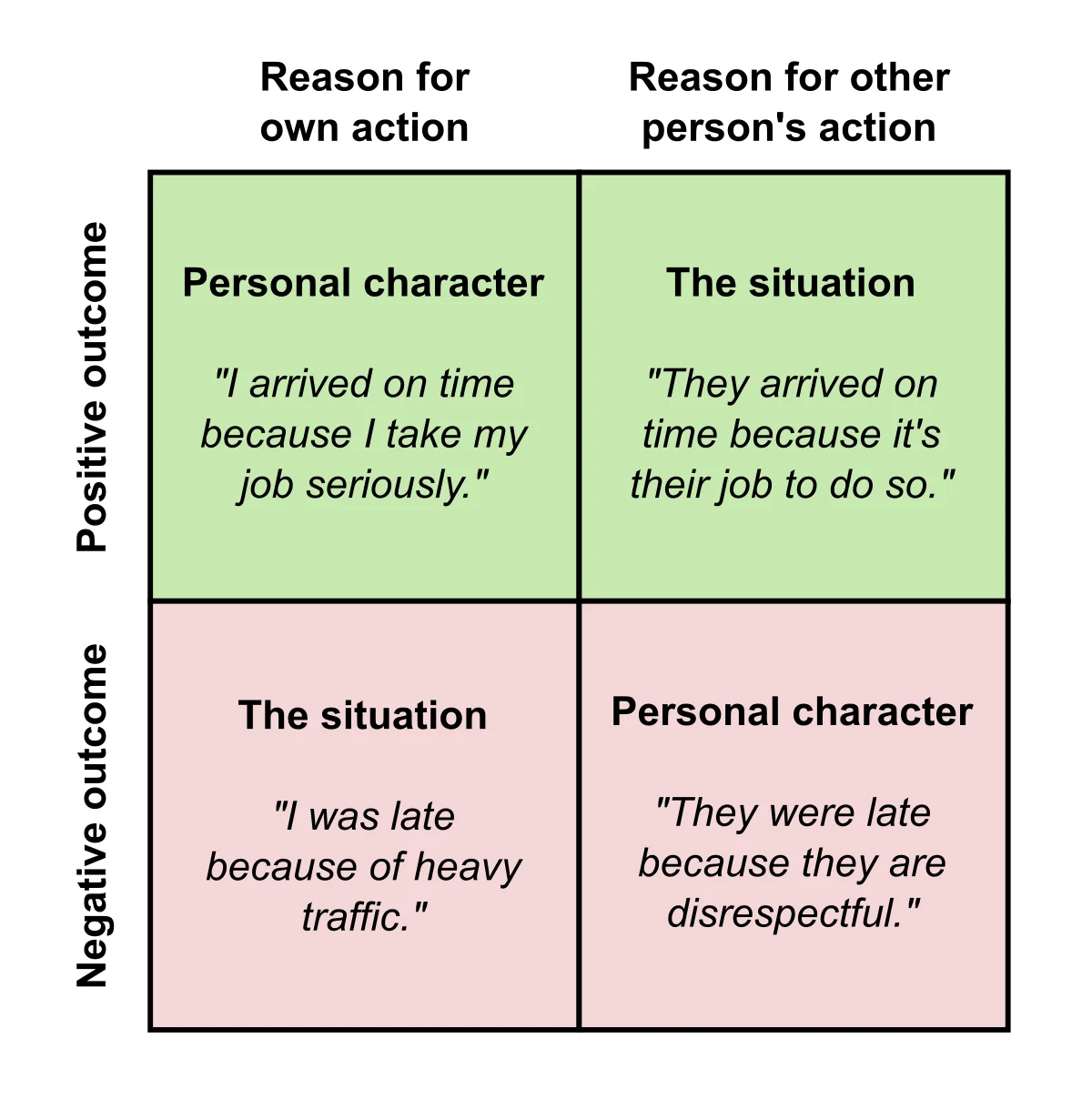
Overweighting dispositional factors and underweighting situational factors when explaining OTHERS’ behavior. A driver cuts you off; you decide they’re a jerk (dispositional) rather than stressed or late (situational).
The fundamental attribution error and self-serving bias in one grid. We credit our successes to character and excuse our failures with circumstance — and do the opposite for others. The MCAT loves this exact 2×2 framing. Credit: Belbury via Wikimedia Commons (CC BY-SA 4.0).
This is an especially Western tendency - cross-cultural research shows it’s weaker in collectivist cultures (which pay more attention to context).
Actor-Observer Bias
You attribute OTHERS’ behavior to disposition but YOUR OWN behavior to situation. Same cut-off in traffic: “I was only speeding because I’m late” (situational) but “that other driver is a reckless idiot” (dispositional).
Self-Serving Bias
Attribute your successes to dispositional causes (“I got the job because I’m talented”) and your failures to situational causes (“I didn’t get the job because the market is tough”). Protects self-esteem.
Just-World Hypothesis
The belief that the world is fundamentally fair - good things happen to good people, bad things to bad people. Leads to blaming victims (“if they got robbed, they must have done something to deserve it”). Explains some social attitudes toward poverty, crime, and illness.
Social Perception Biases
Halo Effect
A positive impression of one trait spreads to unrelated traits. Attractive people are also judged as kinder, smarter, and more trustworthy. Classic job-interview confound - more attractive candidates get rated higher on qualifications they haven’t even displayed.
Primacy and Recency Effects
Early information (primacy) dominates first impressions. Later information (recency) can override primacy when we have time to process.
Stereotypes and Stereotype Threat
A stereotype is a generalized belief about a group. Stereotypes influence perception and memory even when we consciously reject them.
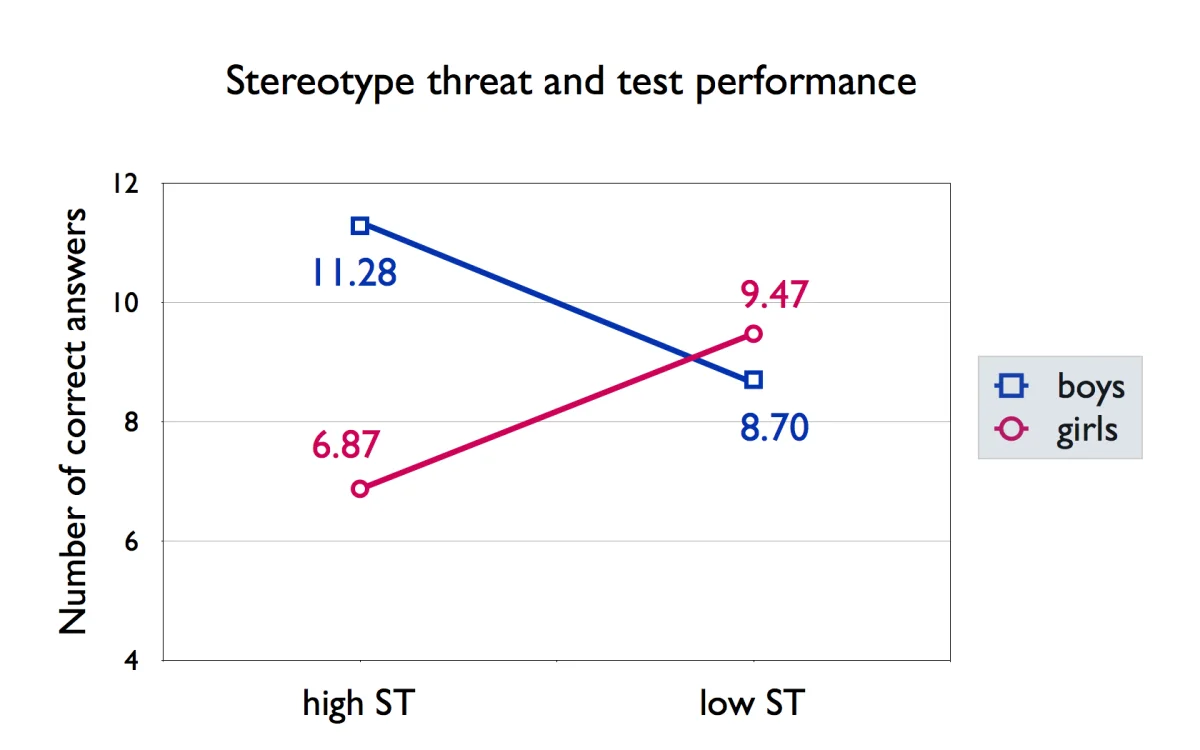
Stereotype threat (Steele and Aronson). When members of a stigmatized group are reminded of a negative stereotype before performing a task, their performance drops. African American students primed to think about race perform worse on standardized tests; women primed to think about gender perform worse on math tests. The stereotype itself generates anxiety that undermines performance.
A classic stereotype-threat result on a math task. When the gender stereotype is made salient (high ST), girls underperform boys; when the threat is removed (low ST), the gap disappears and even reverses. Performance was being suppressed by anxiety about confirming the stereotype, not by ability. Credit: Sonicyouth86 via Wikimedia Commons (CC BY-SA 3.0).
Self-Fulfilling Prophecy
Expectations about a person or group can cause them to behave in ways that confirm the expectation. Rosenthal’s classic study: teachers told certain (randomly chosen) students were “late bloomers” actually treated them differently, and those students improved more by year-end.
Mead’s “I” and “Me”
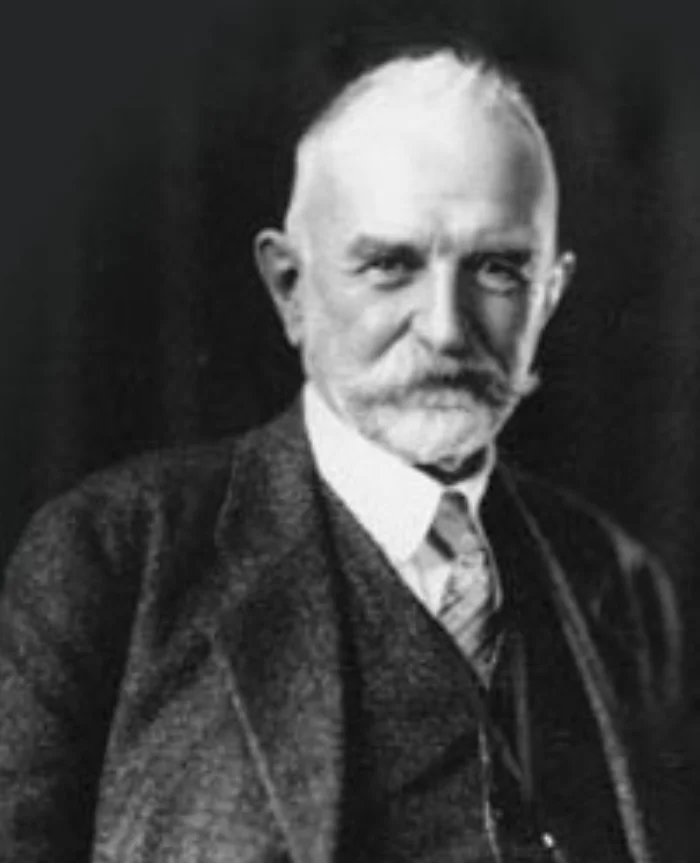
George Herbert Mead (1863–1931), founder of symbolic interactionism. His "I / Me" distinction and three stages of role-taking (preparatory, play, game) are MCAT staples. Credit: Unknown author via Wikimedia Commons (Public Domain).
George Herbert Mead (founder of symbolic interactionism) described the self as having two components:
“I” - the spontaneous, subjective, creative self. The part that initiates action.
“Me” - the objective self as seen by others. The internalized social self.
The “I” acts; the “me” reflects on how others will perceive that action. Healthy social functioning involves balancing both.
Mead also described three stages of development:
Preparatory stage - imitation. Children mimic others without understanding meaning.
Play stage - children play roles (doctor, parent) and take on others’ perspectives one at a time.
Game stage - children can take on multiple perspectives at once, understanding their role in a larger system (the generalized other - the society’s viewpoint).
Cooley’s Looking-Glass Self
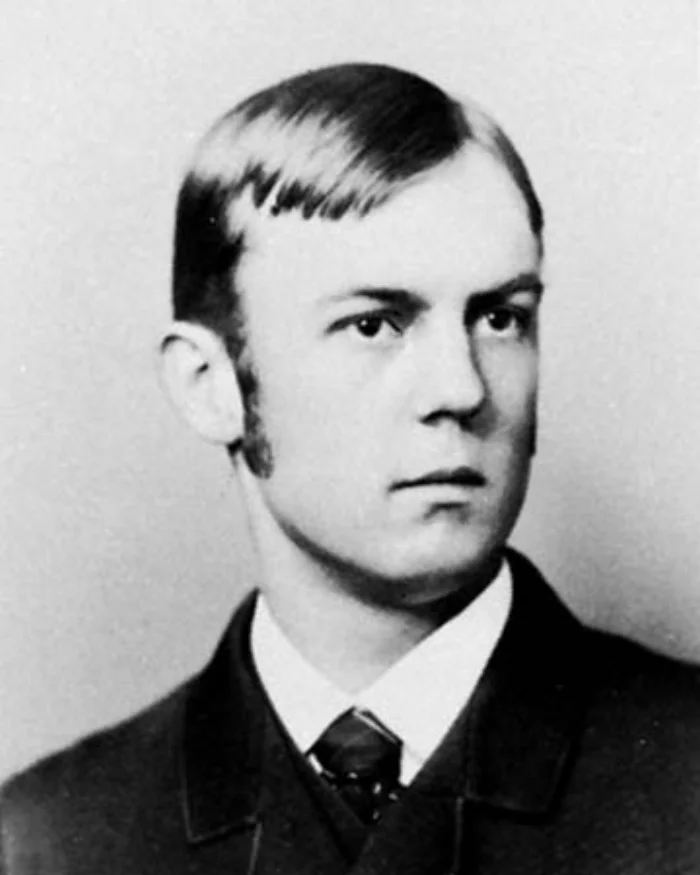
Charles Horton Cooley (1864–1929), American sociologist who coined the looking-glass self. He argued that the self emerges through the imagined judgments of others — a precursor to modern social psychology of self-esteem. Credit: Unknown author via Wikimedia Commons (Public Domain).
Charles Horton Cooley argued that we develop our self-concept through the perceived judgments of others. Three steps:
We imagine how we appear to others.
We imagine how others judge our appearance.
We develop our self-concept based on those imagined judgments.
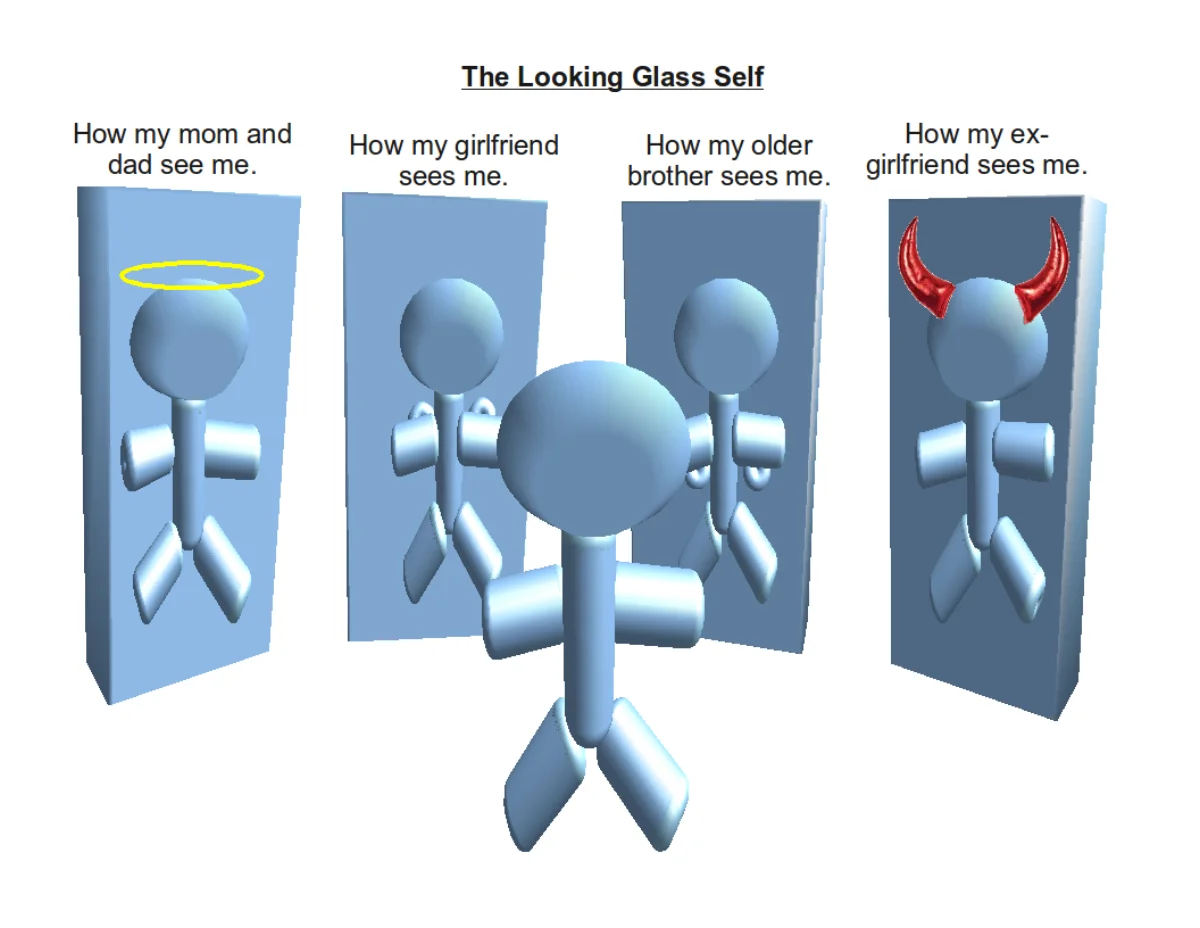
The self is literally reflected back to us from the social mirror. This explains why social feedback (parents, peers) shapes self-esteem so powerfully, especially in childhood.
The looking-glass self in cartoon form. We assemble our self-concept out of the (imagined) reflections we see in the people around us — and different audiences hand back different reflections. Credit: Rcragun via Wikimedia Commons (CC BY 3.0).
A coworker arrives late to a meeting and you decide they're unreliable. In fact, their train broke down. What attribution error have you committed?
Click to reveal answer
Fundamental attribution error - overweighting disposition (unreliable) and underweighting situation (broken train) when explaining someone else's behavior.
What is stereotype threat, and what is a classic demonstration?
Click to reveal answer
When a stigmatized group is reminded of a negative stereotype, performance on stereotype-relevant tasks drops. Classic demo: Steele and Aronson showed that simply having African American students report their race before a test lowered their scores. Women primed to think about gender also underperform on math.
In Mead's theory, what is the difference between the 'I' and the 'Me'?
Click to reveal answer
'I' is the spontaneous, subjective, creative self that initiates action. 'Me' is the internalized social self - the self as seen by others. Healthy functioning balances both.
Describe Cooley's 'looking-glass self.'
Click to reveal answer
Self-concept is built from the perceived judgments of others. We imagine how we appear, imagine others judging us, and develop our self-image based on those imagined judgments. The self is reflected back to us from the social 'mirror.'