Six Theories of Personality

Six Theories of Personality

7 min read Updated Apr 19, 2026

Six theories of personality. Each tells a different story about where personality comes from. The MCAT expects you to recognize the signatures of each.

1. Psychoanalytic Theory (Freud)
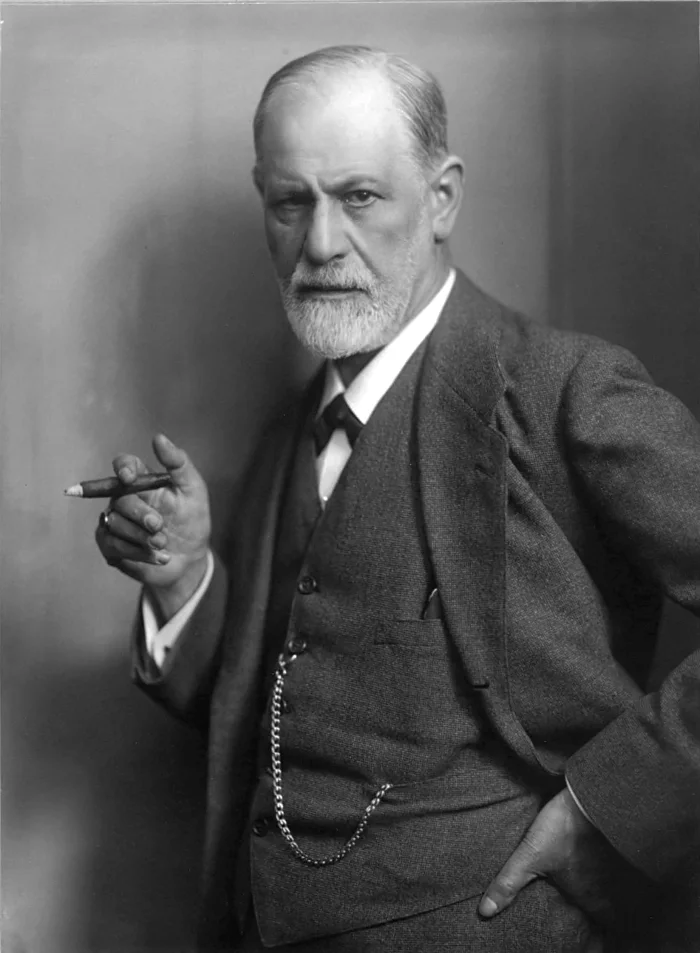
Black-and-white studio portrait of Sigmund Freud in a three-piece suit, holding a cigar in his right hand, looking sternly at the camera
Sigmund Freud (1856–1939), founder of psychoanalysis. He proposed that personality emerges from unconscious conflicts among the id, ego, and superego — vocabulary the MCAT still tests despite the theory's contested empirical status. Credit: Max Halberstadt via Wikimedia Commons (Public Domain).

Personality is shaped by unconscious conflicts from early childhood. Three interacting mental agencies:

  • Id - innate, unconscious. Operates on the pleasure principle: seeks immediate gratification of drives. Present from birth.
  • Ego - the “reality principle.” Mediates between id, superego, and the external world. Delays gratification.
  • Superego - internalized moral standards (“conscience”). Strives for perfection, inhibits sexual and aggressive impulses.

A healthy personality has a strong ego balancing id and superego. Imbalances produce neurosis, anxiety, or impulsivity. Psychoanalytic therapy tries to bring unconscious conflicts into consciousness.

Freud is historically important but scientifically contested. The MCAT tests the vocabulary (id/ego/superego, defense mechanisms, psychosexual stages) because it shows up in older research and clinical language.

2. Humanistic Theory (Rogers, Maslow)

Personality develops through self-actualization - the drive to realize one’s full potential. Focuses on conscious experience and personal choice, rejecting the deterministic tone of psychoanalysis and behaviorism.
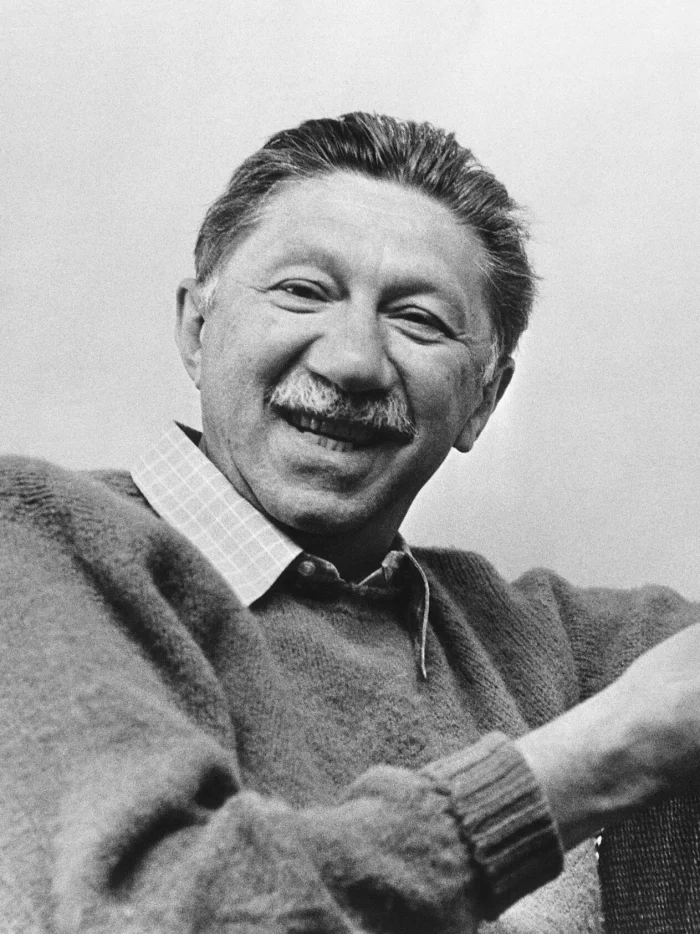
Black-and-white photograph of Abraham Maslow smiling broadly at the camera, wearing a sweater over a checkered shirt
Abraham Maslow (1908–1970), a founder of humanistic psychology. He argued that human motivation is organized into a hierarchy crowned by self-actualization. Credit: William Carter via Wikimedia Commons (Public Domain).

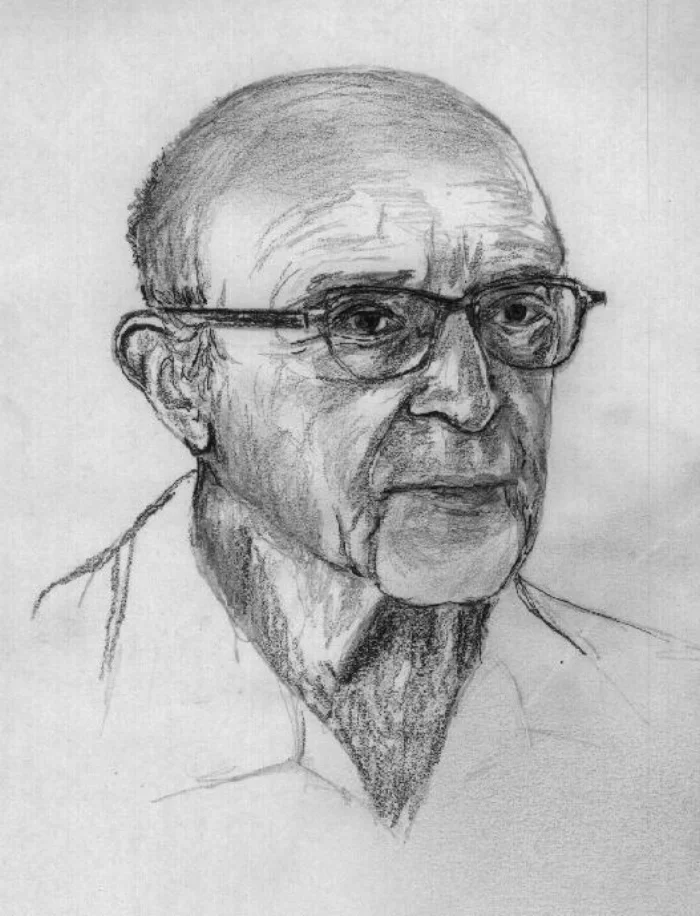
Carl Rogers

Pencil sketch portrait of Carl Rogers, an older man with glasses, looking thoughtfully off to the side
Carl Rogers (1902–1987), founder of person-centered (client-centered) therapy. He made unconditional positive regard and the real-self / ideal-self distinction central to humanistic personality theory. Credit: Didius via Wikimedia Commons (CC BY 2.5).
  • Self-concept - the image you hold of yourself.
  • Real self vs. ideal self - the bigger the gap, the more psychological distress.
  • Unconditional positive regard - acceptance regardless of behavior. Rogers argued children raised with it develop healthier self-concepts.

Abraham Maslow

Hierarchy of needs (covered in Chapter 5). Self-actualization sits at the top - only achievable once lower needs are met. Self-actualizers are autonomous, creative, morally grounded, and focused on problems larger than themselves.
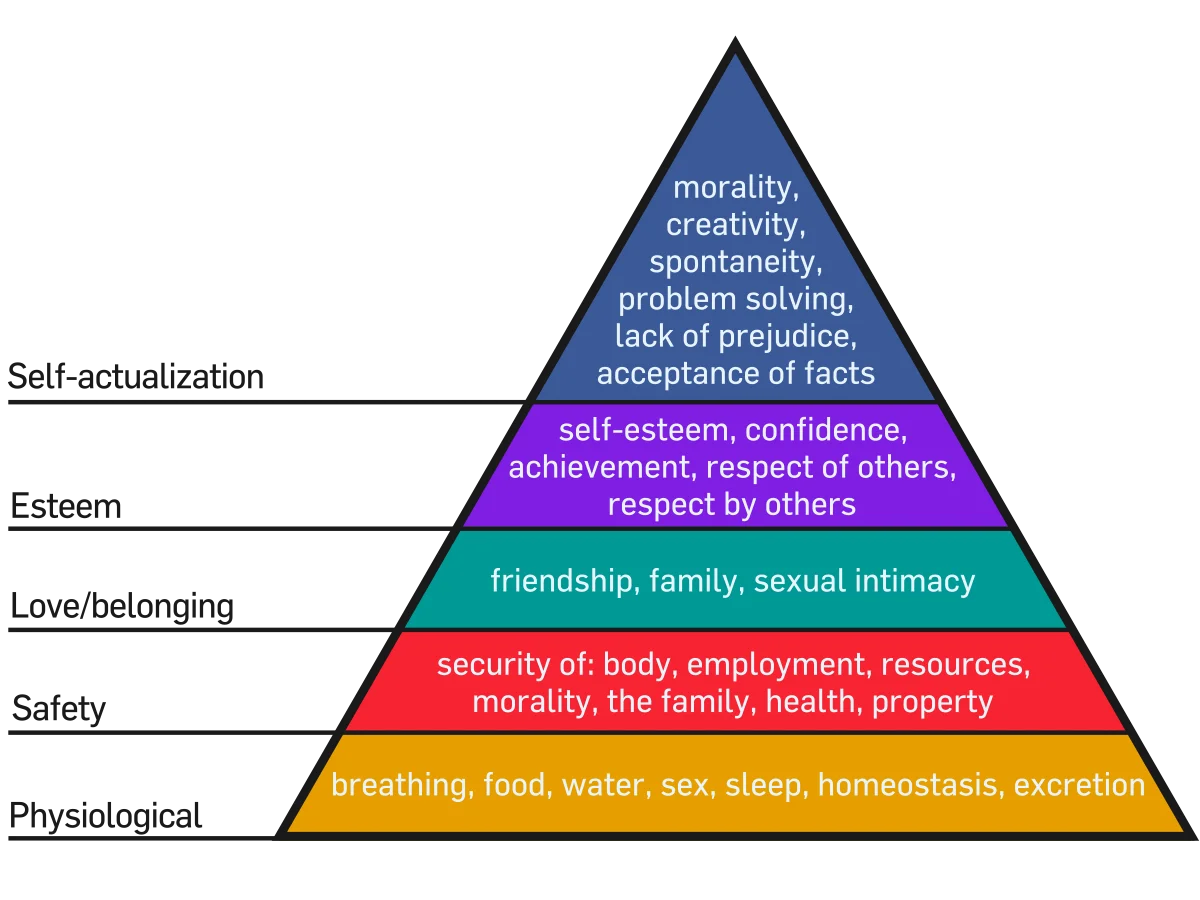
Color pyramid diagram of Maslow's hierarchy of needs with five tiers from bottom to top: Physiological (breathing, food, water, sex, sleep), Safety (security of body, employment, resources), Love/belonging (friendship, family, sexual intimacy), Esteem (self-esteem, confidence, achievement, respect), and Self-actualization (morality, creativity, spontaneity, problem solving)
Maslow's hierarchy of needs. Lower-level deficiency needs (physiological, safety, belonging, esteem) must be met before a person can pursue self-actualization at the top. The MCAT routinely tests stage names and order. Credit: Factoryjoe via Wikimedia Commons (CC BY-SA 3.0).

3. Biological (Evolutionary) Theory

Personality is significantly inherited and shaped by brain biology.

  • David Buss - evolutionary psychology theorizes that men and women evolved different mating strategies because of different reproductive costs.
  • Hans Eysenck - proposed extroverts have naturally LOWER cortical arousal than introverts, so they seek more stimulation. Introverts are already over-aroused and avoid stimulation. Same principle applies to extraversion-introversion at the physiological level.
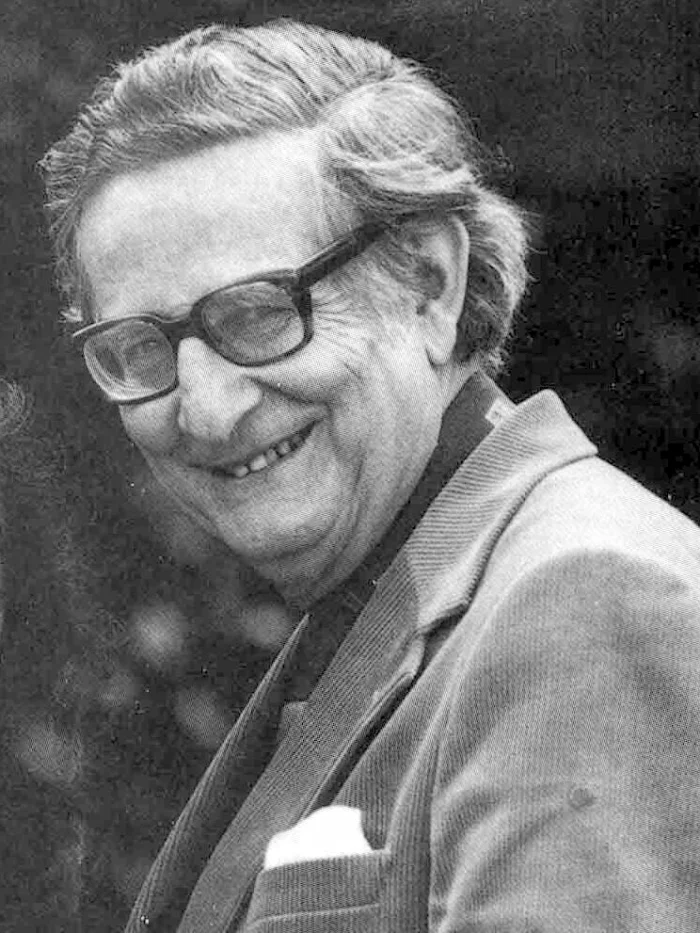
Black-and-white photograph of Hans Eysenck, an older man with glasses, smiling toward the camera in a tweed jacket
Hans Eysenck (1916–1997) anchored personality in biology. His PEN model (Psychoticism–Extraversion–Neuroticism) proposed that introverts have higher baseline cortical arousal and therefore avoid stimulation, while extroverts seek it. Credit: Sirswindon via Wikimedia Commons (CC BY 3.0).
- **Jeffrey Gray** - personality is governed by two biological systems: behavioral **inhibition** (punishment/avoidance) and behavioral **activation** (reward/approach). - **C. Robert Cloninger** - linked personality traits to specific brain systems (e.g., low dopamine → impulsivity).

Twin studies consistently show substantial heritability of personality traits (~40-50%). Specific genes (e.g., long DRD4 receptor gene → thrill-seeking) have been correlated with specific traits.

4. Behaviorist Theory (Skinner, Pavlov)

Personality is the result of learned behaviors shaped by the environment through classical and operant conditioning. Deterministic: the environment completely determines behavior. Doesn’t accept unobservable mental entities.

  • Skinner - operant conditioning. Reinforcement and punishment shape personality patterns across life.
  • Pavlov - classical conditioning. Emotional responses learned through pairing with unconditioned stimuli.
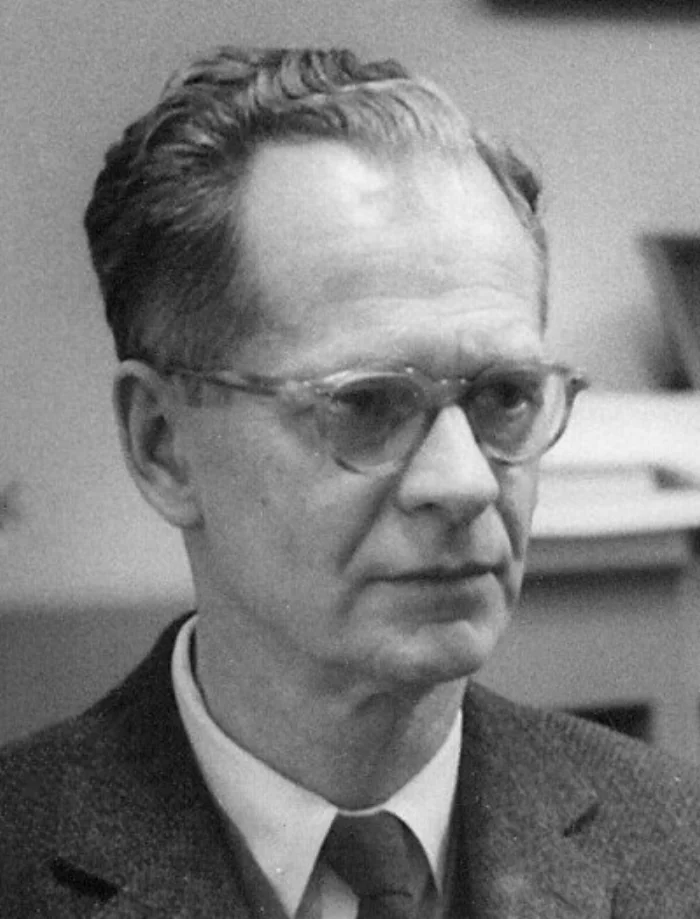
Black-and-white photograph of B.F. Skinner at Harvard around 1950, an older man with glasses looking down to the right
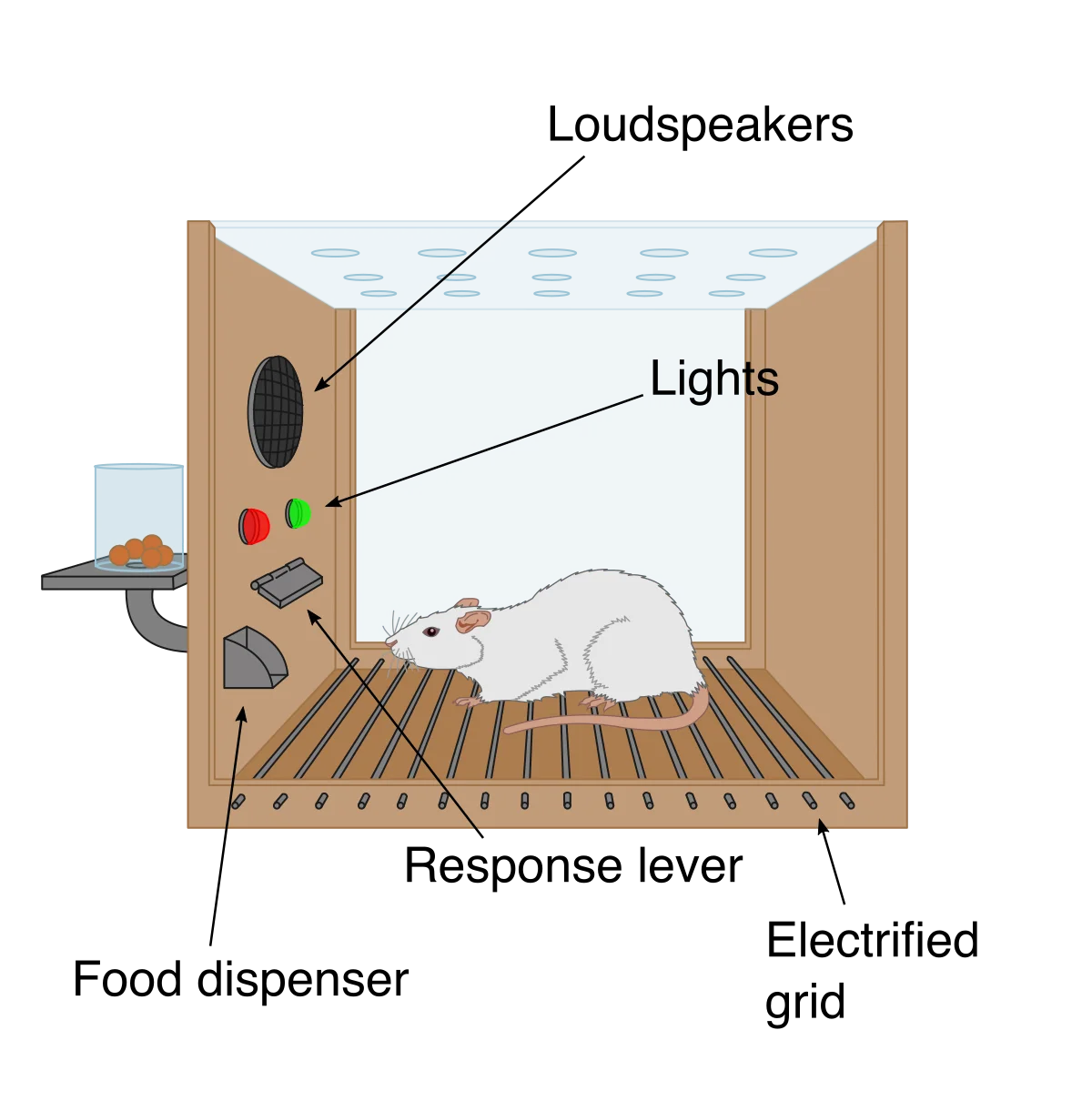
B.F. Skinner (1904–1990), the most influential behaviorist of the 20th century. His operant conditioning chamber (the "Skinner box") let him quantify how reinforcement schedules shape behavior — the empirical core of behaviorist personality theory. Credit: Silly rabbit via Wikimedia Commons (CC BY 3.0).
Color cutaway diagram of a Skinner operant conditioning chamber containing a white rat. Labels point to a response lever, food dispenser, loudspeakers, lights, and an electrified grid floor
The operant chamber (Skinner box). Animals press a lever for food (positive reinforcement) or to avoid shock (negative reinforcement); precisely scheduled consequences shape behavior over time. The chamber is the canonical demonstration of operant conditioning's role in personality. Credit: AndreasJS / Pixelsquid via Wikimedia Commons (CC BY-SA 3.0).
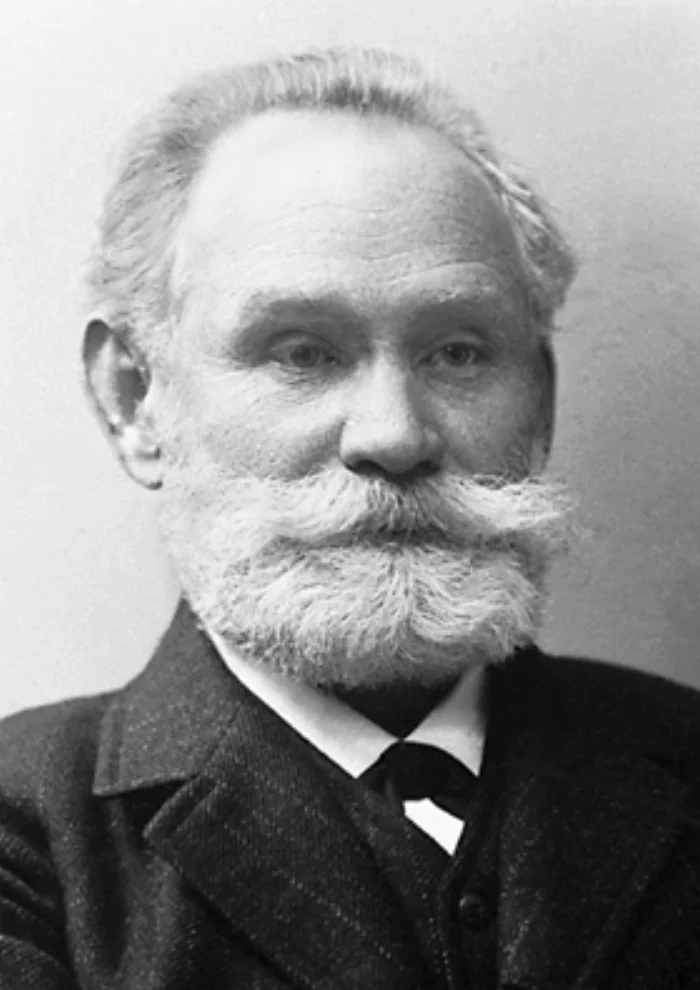
Black-and-white portrait of Ivan Pavlov, an older man with a full white beard and mustache, in a dark suit
Ivan Pavlov (1849–1936), Russian physiologist whose work on salivary conditioning in dogs founded classical conditioning. Behaviorist personality theory treats emotional responses as conditioned associations of this kind. Credit: Unknown author via Wikimedia Commons (Public Domain).

Behaviorism explains how behavior patterns form but struggles with the stability of personality across wildly different situations. The cognitive theory (next) emerged as a bridge.

5. Social Cognitive Theory (Bandura)
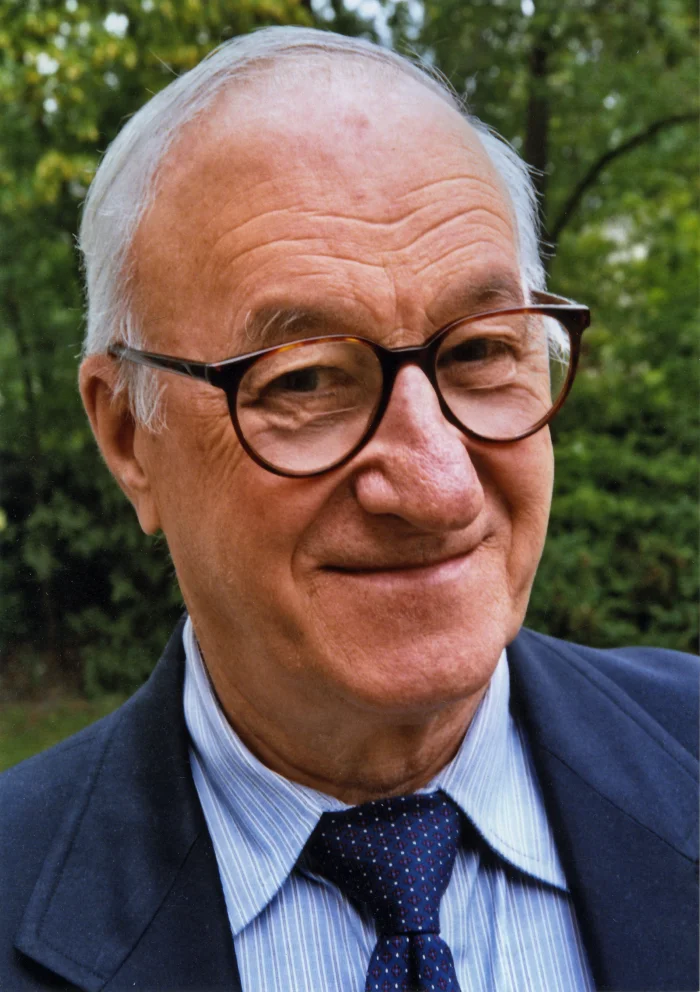
Color portrait photograph of Albert Bandura, an older man with white hair and large glasses, smiling and wearing a dark blue suit and patterned tie
Albert Bandura (1925–2021), the founder of social cognitive theory. He bridged behaviorism and cognitive psychology with concepts like self-efficacy, observational learning, and reciprocal determinism. Credit: bandura@stanford.edu via Wikimedia Commons (CC BY-SA 4.0).

A synthesis. Personality is shaped by the interaction of behavior, cognition, and environment. Bandura’s reciprocal determinism - the three factors continuously influence each other.

  • Behavior affects environment affects cognition affects behavior…
  • Central role for self-efficacy - one’s belief in one’s ability to accomplish a task.
  • Observational learning (Chapter 3) is a key mechanism.

Unlike pure behaviorism, social cognitive theory takes thought and expectation seriously.
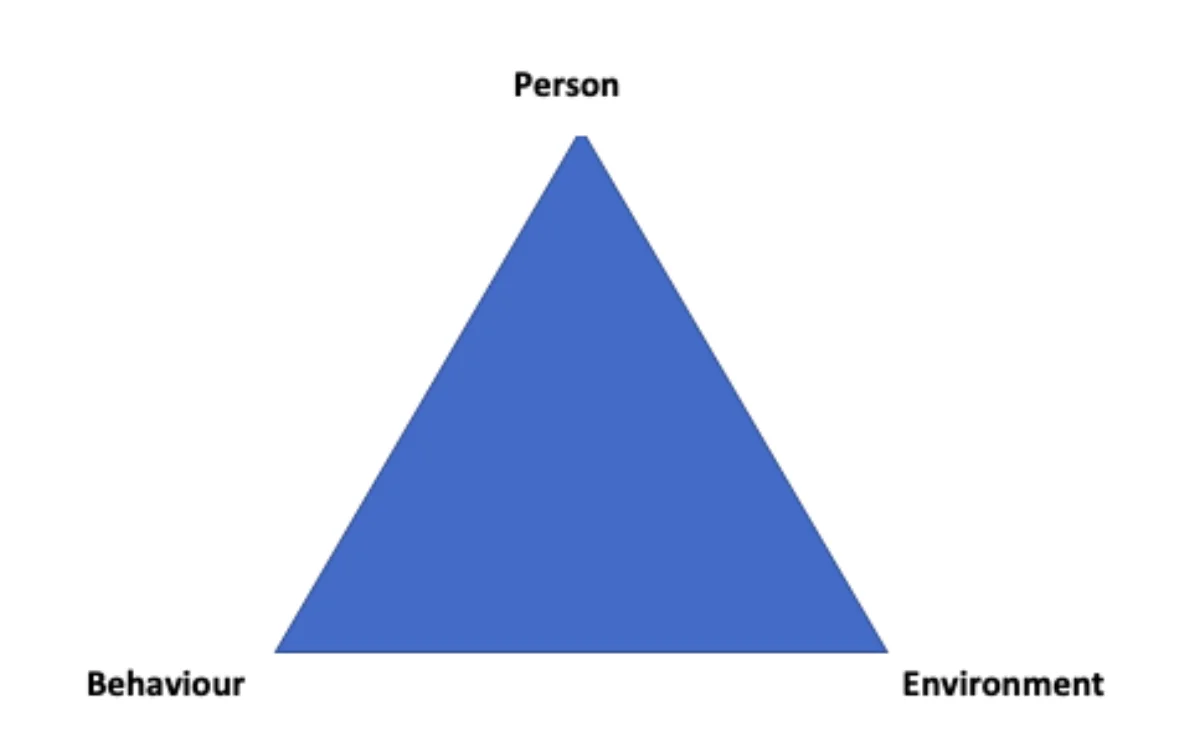
Triangle diagram with three labeled vertices: Person at the top, Behaviour at the bottom-left, and Environment at the bottom-right, illustrating mutual influence between the three
Bandura's reciprocal determinism. Person (cognition), behavior, and environment continually influence one another — none of the three is the sole driver of personality. The MCAT often tests this triadic structure directly. Credit: U3190210 via Wikimedia Commons (CC BY-SA 4.0).

6. Trait Theory

Personality is a stable pattern of traits - enduring dispositions toward particular behaviors. Describes rather than explains.

Gordon Allport

  • Three categories of traits:
    • Cardinal traits - a single dominant trait that shapes most of a person’s behavior (rare; think Mother Teresa’s compassion).
    • Central traits - 5-10 major characteristics that describe most people (honesty, sociability).
    • Secondary traits - preferences, attitudes, situational reactions.

Mnemonic: “A Cardinal Allport Can Sing (Central, Cardinal, Secondary).”

Raymond Cattell
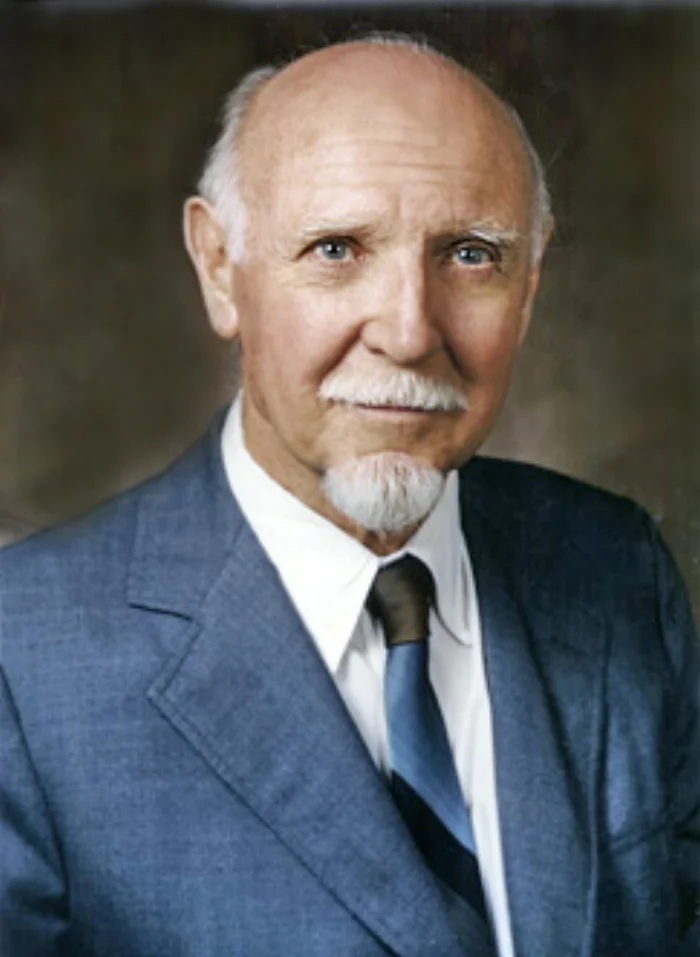
Color portrait of Raymond Cattell, an older man with a white goatee, wearing a blue suit and tie
Raymond Cattell (1905–1998) used factor analysis to derive 16 source traits, distilled into the 16PF questionnaire. He pushed personality theory toward statistical rigor. Credit: Cattell family via Wikimedia Commons (CC BY-SA 3.0).

Identified 16 personality factors using factor analysis. The 16 PF (Personality Factor) questionnaire is still used.

Hans Eysenck (PEN Model)

Three super-dimensions:

  • Psychoticism - degree to which reality is distorted.
  • Extraversion - sociability.
  • Neuroticism - emotional stability.

Mnemonic: “Eysenck’s PEN.”

The Big Five (Five-Factor Model)

The current consensus model. Five broad dimensions found across cultures and ages.

Mnemonic: OCEAN.

  • Openness - imagination vs. practicality, intellectual curiosity.
  • Conscientiousness - careful vs. careless, disciplined vs. impulsive, organized.
  • Extraversion - sociable vs. reserved, talkative vs. quiet.
  • Agreeableness - kind vs. cold, cooperative vs. antagonistic.
  • Neuroticism - anxious vs. calm, tense vs. stable.
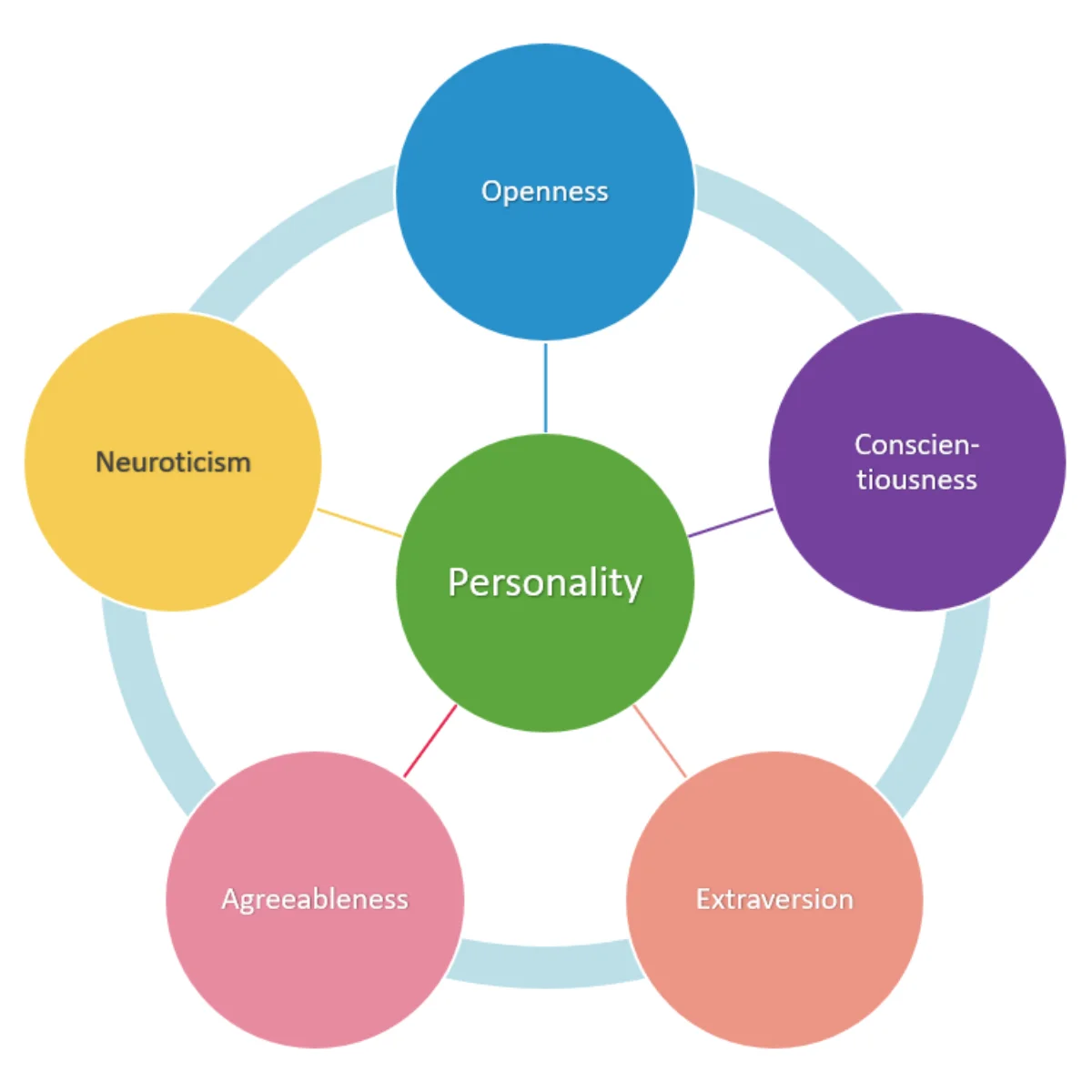
Diagram showing five colored circles arranged around a central green Personality circle, each labeled with one of the Big Five traits: Openness, Conscientiousness, Extraversion, Agreeableness, and Neuroticism
The Big Five (OCEAN) personality dimensions. Each trait is statistically independent of the others and appears across cultures and ages — the strongest empirical support of any modern personality model. Credit: MissLunaRose12 via Wikimedia Commons (CC BY-SA 4.0).

The Big Five has robust empirical support - the dimensions are statistically independent and appear in diverse populations.

Myers-Briggs Type Indicator (MBTI)
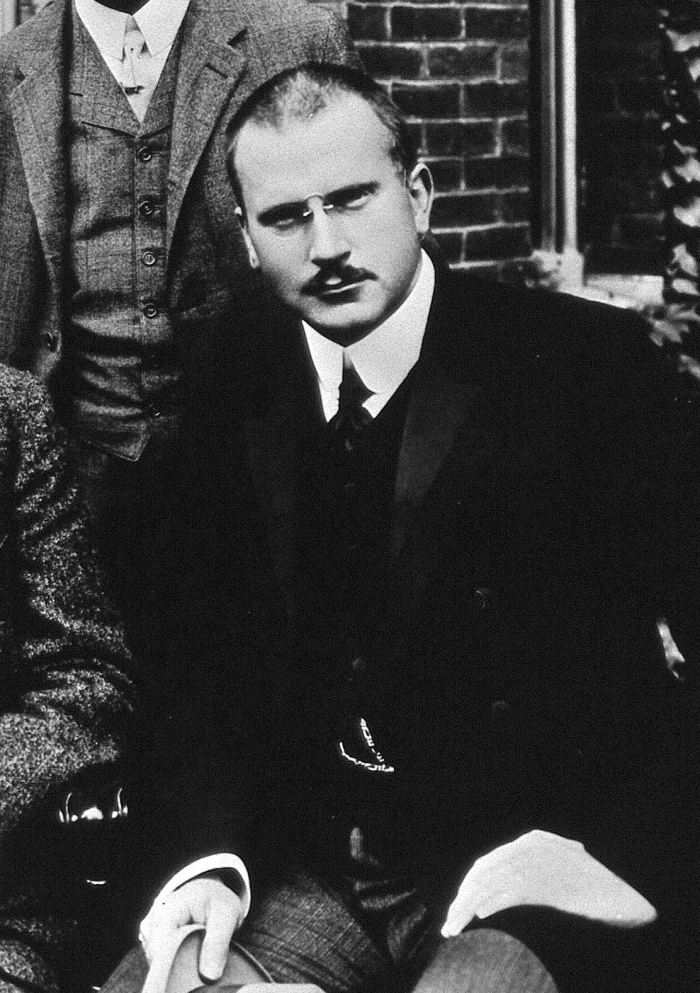
Black-and-white photograph of a young Carl Jung in a dark suit and tie, looking off-camera
Carl Jung (1875–1961), Swiss psychiatrist whose theory of psychological types (introvert/extravert plus four functions) inspired — but is much richer than — the modern Myers-Briggs Type Indicator. Credit: Unknown author via Wikimedia Commons (Public Domain).

Popular but psychometrically weak. Four dichotomies (E/I, S/N, T/F, J/P) producing 16 types. Derived loosely from Carl Jung. Used heavily in business and career counseling despite limited scientific validity - the MCAT may reference it but the Big Five is the scientifically preferred system.

What are the five traits in the Big Five personality model?
Click to reveal answer
Openness, Conscientiousness, Extraversion, Agreeableness, Neuroticism. Mnemonic: OCEAN. The Big Five shows strong empirical support across cultures and ages.
What does Rogers mean by 'unconditional positive regard'?
Click to reveal answer
Accepting and valuing another person regardless of their behavior. Rogers argued children raised with unconditional positive regard develop healthy self-concepts, while those given only conditional approval develop conflict between real and ideal self.
How does Eysenck's biological theory explain why introverts avoid crowded parties?
Click to reveal answer
Introverts have higher baseline cortical arousal than extroverts. They are already over-stimulated, so they avoid additional stimulation (loud crowds). Extroverts need more input to reach their optimal arousal level.