
Adolescence and Genetics
The last stretch of this chapter covers two big transitions: the physical and neural remodeling of adolescence, and the genetic and environmental factors that shape behavior across the lifespan. Each is a favorite MCAT topic.
Adolescence
Adolescence begins at sexual maturity (puberty) and ends at adult independence. The exact age markers are cultural, but the biology is universal.
Puberty
- About 2 years of sexual maturation. Typically starts around age 11 in girls, 13 in boys (with wide individual variation).
- Primary sex characteristics - the reproductive organs themselves (testes, ovaries, genitalia).
- Secondary sex characteristics - related to sexual development but not required for reproduction.
- Boys: voice deepens, body hair, growth spurt.
- Girls: breasts, widening hips.
- Both: pubic and underarm hair.
Social Timing Effects
- Boys. Early puberty has mixed effects - stronger and taller (advantages in sports, popularity), but also increased risk of delinquency and alcohol use.
- Girls. Early puberty is largely negative - increased risk of teasing, harassment, and being out of sync with peers.
Brain Changes
Adolescence is a period of dramatic neural remodeling:
- Prefrontal cortex (planning, judgment, impulse control) is the LAST region to mature, continuing into the mid-20s. This lag explains characteristic teenage risk-taking and poor judgment: the emotional (limbic) system is mature, but the prefrontal brake is still developing.
- Limbic system (amygdala) is fully developed, driving emotional intensity.
- Corpus callosum thickens, improving inter-hemispheric communication (related to language skill development).
- Myelination continues, speeding neural communication.
- Synaptic pruning - unused synapses are eliminated while heavily used ones are strengthened. “Use it or lose it.” What teenagers spend their time doing shapes their adult brains. Total brain volume actually decreases slightly in adolescence due to pruning.
Temperament, Heredity, and Genes
Temperament - innate emotional reactivity and disposition (shy, easy, difficult), relatively stable across life. Observable from infancy, before environmental effects have accumulated.
Heredity - transmission of traits from parents to offspring via genes. Humans have about 20,000-25,000 genes.
Traits cluster into:
- Simple (Mendelian) traits. Controlled by one or few genes. Eye color, hair color.
- Complex traits. Controlled by many genes interacting with each other and the environment. Intelligence, personality, disease susceptibility. Most behavioral traits are complex.
Twin Studies
Designed to tease apart nature vs nurture.
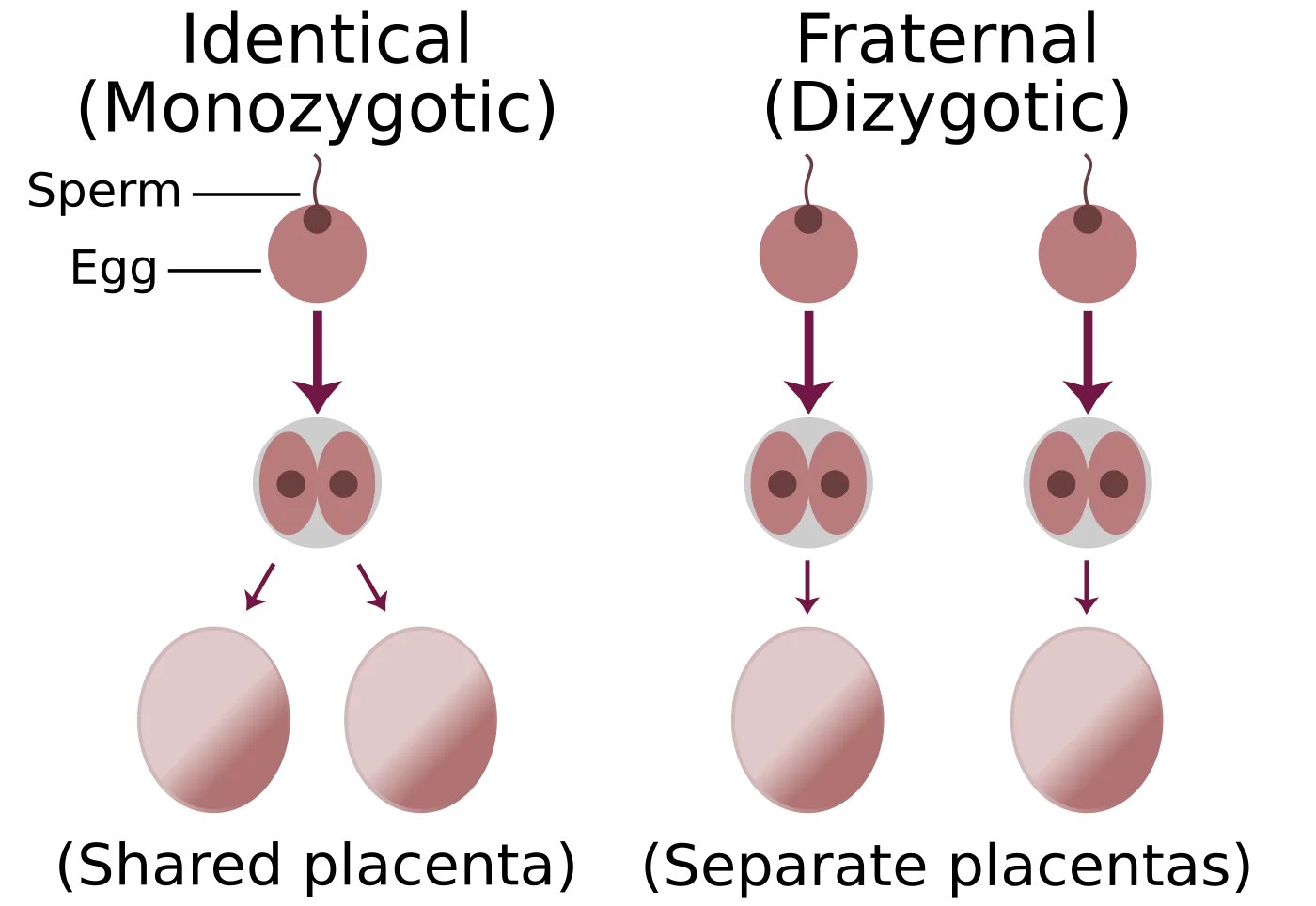
- Monozygotic (identical) twins. One fertilized egg splits in two. Share 100% of DNA.
- Dizygotic (fraternal) twins. Two separately fertilized eggs. Share 50% of DNA on average - like ordinary siblings, just same womb and age.
Both share the prenatal environment and household. If a trait shows up more similarly in monozygotic twins than dizygotic twins, it suggests a genetic contribution. If both twin types show the same similarity, the trait looks environmentally driven.
Identical twins reared apart are the gold standard: same genes, different environments. The Minnesota Twin Study famously found that identical twins raised apart still converge on many traits (personality, intelligence, religiosity), supporting strong genetic influence.
Adoption Studies
Adopted children share genes with biological parents but environment with adoptive parents. If a trait resembles biological parents more, it’s genetic; if it resembles adoptive parents, it’s environmental.
Problems with twin and adoption studies:
- Identical twins often treated more similarly than fraternal twins (confound).
- Adoptive families are not randomly distributed (tend to be similar to biological families in SES).
- Information about biological parents is often incomplete.
Heritability
Heritability (h²) - the proportion of variance in a trait within a population that is attributable to genetic variance.
Critical nuances the MCAT loves to test:
- Heritability is a population statistic, not an individual one. You cannot say “John’s intelligence is 70% genetic.”
- Heritability depends on the environment being studied. If everyone lives in identical environments, heritability rises (no environmental variation left to explain differences). In wildly different environments, heritability often falls.
- High heritability does NOT mean unchangeable. PKU is highly heritable but managed entirely through diet.
Typical heritability estimates: IQ ~50-70% in adults, personality ~40-50%, schizophrenia ~80% liability.
Regulatory Genes and Epigenetics
Only ~5% of the genome codes for proteins. The other ~95% regulates when and where genes are expressed. Regulatory genes control gene expression in development and behavior.
Epigenetics - heritable changes in gene expression that do NOT change the DNA sequence itself. Main mechanism: methylation - attaching methyl groups to DNA, silencing genes. Methylation patterns can be influenced by environment (diet, stress, drugs) and are sometimes passed to offspring.

Epigenetics explains how identical twins can diverge physiologically over time and how maternal experience (nutrition, stress) can affect offspring gene expression without changing the DNA.
Gene-Environment Interaction
Behavior emerges from a constant interplay of genes and environments, not either alone.
Classic Examples
- PKU (phenylketonuria). A heritable single-gene disorder: the enzyme phenylalanine hydroxylase is defective, so phenylalanine builds up and causes brain damage. Treatment: a phenylalanine-free diet. A classic case of a “genetic disease” whose effects are entirely determined by environment. If caught on newborn screening, kids with PKU develop normally.
- Depression vulnerability. Some genetic variants (e.g., 5-HTT short allele) increase depression risk ONLY in individuals who also experience severe stress. Genes set a vulnerability; environment determines whether it’s expressed.
Older nature-vs-nurture debates have been replaced by the more accurate framing: nature through nurture. Genes and environments are coupled, not competing.
Adaptive Value of Behavioral Traits
Behaviors are shaped by evolution to maintain homeostasis and promote survival and reproduction.
Innate Behaviors
Genetically programmed, present at birth, require no learning.
- Reflexes. Simple stimulus-response loops (knee-jerk).
- Fixed-action patterns. Complex innate behaviors triggered by a specific cue (a praying mantis’s strike sequence).
- Orientation behaviors.
- Kinesis - undirected change in movement speed in response to a stimulus.
- Taxis - directed movement toward (positive) or away from (negative) a stimulus. Moths to light = positive phototaxis.
Learned Behaviors
Acquired through experience - covered extensively in Chapter 3 (learning).
Most behaviors are complex, reflecting a mix of innate predisposition and learned refinement. Insects flying is partly innate, partly refined through trial and error.