Three famous experiments shape every MCAT question on social influence. Learn the setup, the findings, and the key variables of each.
Conformity: Adjusting to the Group
Conformity is adjusting your behavior or thinking to match a group standard. Two main drivers:
Normative social influence. Going along to be accepted or to avoid rejection. You know the group is wrong but don’t want to stand out.
Informational social influence. Going along because you think the group has better information. You’re actually unsure, and the group’s answer seems likely correct.
Both produce the same outward behavior but differ in motivation.
Asch’s Line Studies (1951)
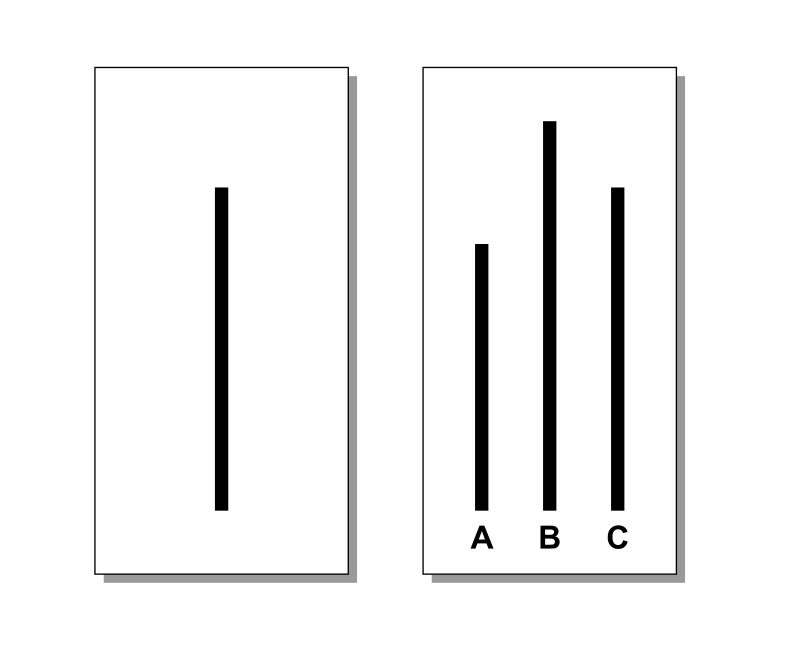
Participants were shown a “standard” line and asked to pick which of three comparison lines matched its length. The answer was obvious. But confederates (actors posing as other participants) gave deliberately wrong answers first. The real participant was asked last.
The Asch line stimuli. The correct match for the standard (left) is obvious - line C on the right - yet participants gave the wrong answer about a third of the time when confederates around them deliberately picked A or B. Credit: Fred the Oyster via Wikimedia Commons (CC BY-SA 4.0).
About one-third of responses conformed to the incorrect group answer. About 75% of participants conformed at least once across multiple trials. Only 25% never caved.
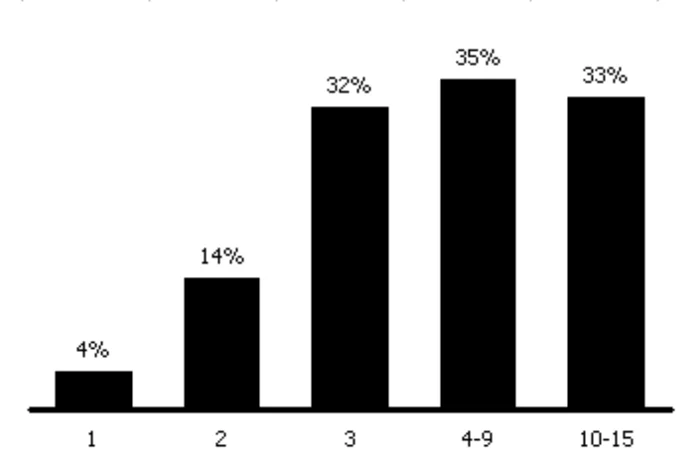
Conformity climbs sharply from 1 to 3 confederates and then plateaus. Adding bodies past about 3-4 doesn't increase pressure - a key MCAT detail about group size. Credit: Wikimedia Commons (CC BY-SA 3.0).
Why? Mostly normative influence - participants privately knew the right answer but didn’t want to stand alone. When debriefed, most reported feeling the pressure acutely.
Factors That Increase Conformity
Group size up to ~3-4 people. Beyond that, added conformity pressure levels off.
Unanimity. One dissenting voice in the group dramatically reduces conformity.
Cohesion. The tighter the group, the stronger the pull.
Status. Higher-status models produce more conformity.
Public responses (vs. private written answers).
Cultures that emphasize collectivism show higher conformity rates than individualist cultures.
Milgram’s Obedience Studies (1961-1963)
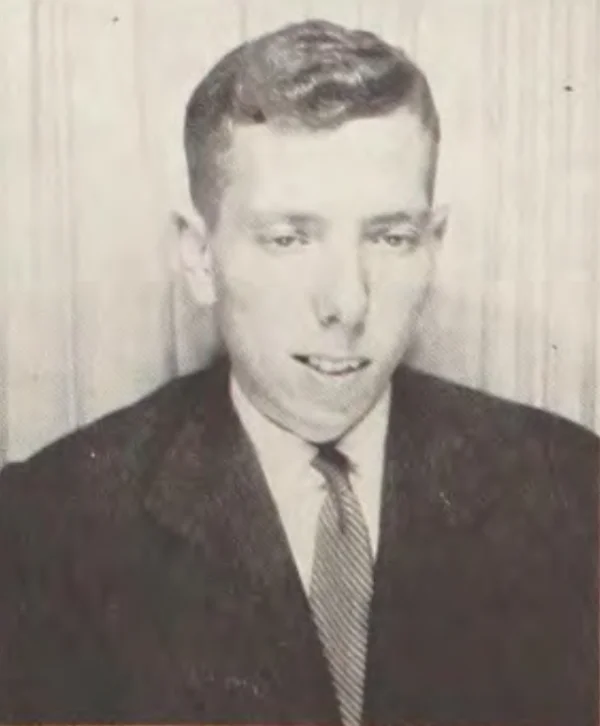
Stanley Milgram (1933–1984), the Yale social psychologist whose obedience studies remain the most cited - and ethically debated - experiments in social psychology. Credit: Dayton Daily News (1974) via Wikimedia Commons (Public Domain).
Stanley Milgram tested how far ordinary people would go to obey an authority figure. The setup:
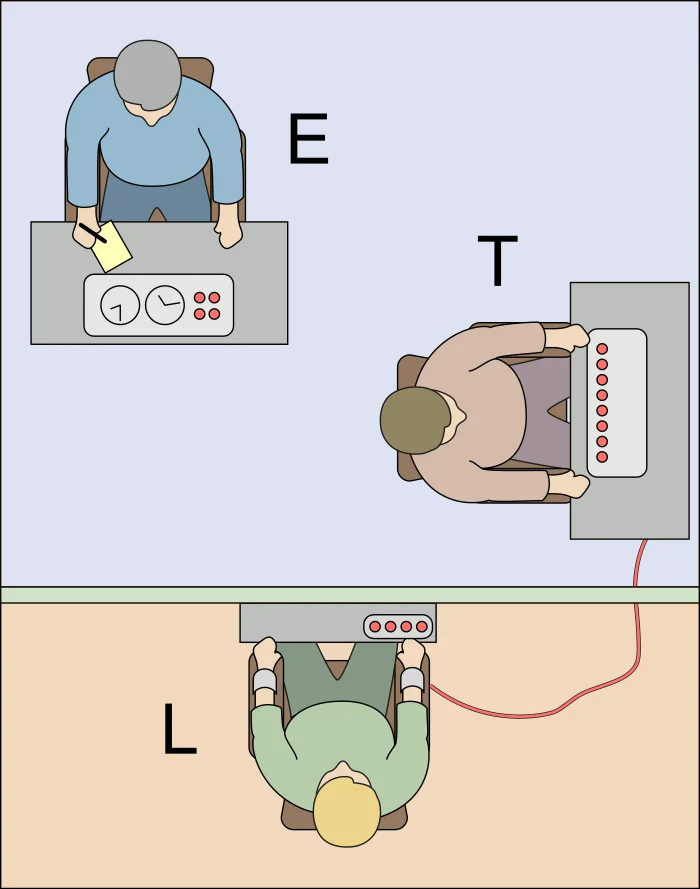
Participant arrives at Yale lab, meets “researcher” (authority) and “learner” (actually a confederate).
Participant is the “teacher.” Learner is in another room, strapped to an electroshock apparatus.
Each time the learner gets a word-pair answer wrong, the teacher is instructed to deliver an electric shock of increasing voltage - from 15 volts (slight) to 450 volts (marked “XXX - Danger: Severe Shock”).
The learner (who isn’t actually shocked) cries out, bangs on the wall at 300 V, and eventually falls silent.
When the teacher hesitates, the researcher calmly issues verbal prods: “Please continue.” “The experiment requires you to continue.” “You have no other choice; you must go on.”
The classic Milgram setup. The experimenter (E) instructs the teacher (T) to administer escalating shocks to the learner (L) in another room. The physical separation made the victim more abstract - one of the situational factors that boosts obedience. Credit: Fred the Oyster via Wikimedia Commons (CC BY-SA 4.0).
Milgram expected virtually no one would deliver the maximum shock. Instead, 65% of participants administered the maximum 450 volts. Many showed extreme distress but kept going.
Factors That Increase Obedience
Authority figure present (researcher physically in the room).
Authority figure is legitimate (wearing lab coat, Yale affiliation).
Institutional setting (prestigious university).
Victim depersonalized or distant (in another room, not visible).
Gradual escalation (small steps easier to continue than a sudden large ask).
Diffusion of responsibility (“I’m just following orders”).
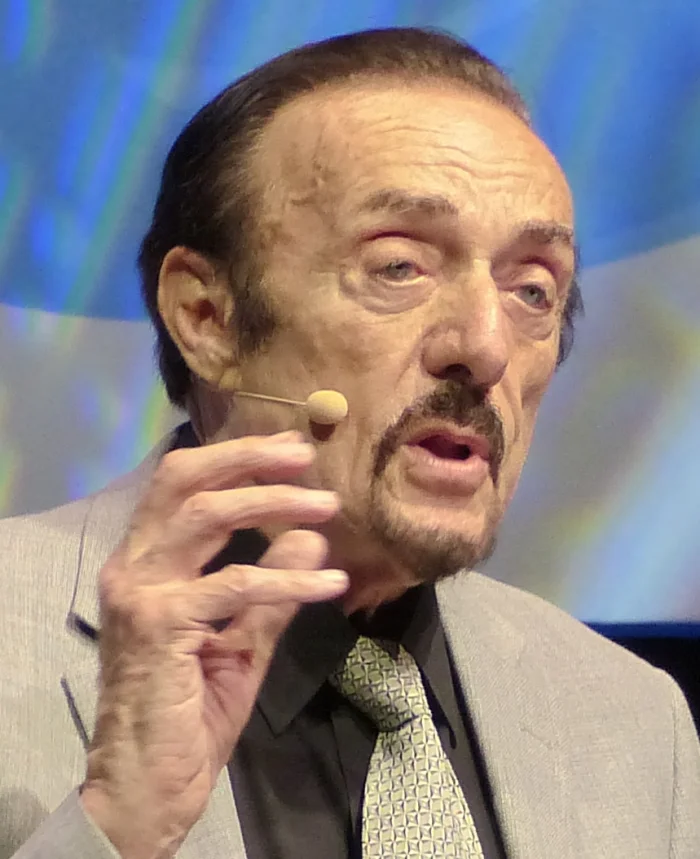
Philip Zimbardo (1933–2024), who designed and ran the Stanford Prison Experiment - and later acknowledged how much his own role as "prison superintendent" shaped the outcome. Credit: Elekes Andor via Wikimedia Commons (CC BY-SA 4.0).
Philip Zimbardo randomly assigned 24 mentally healthy college students to be “guards” or “prisoners” in a mock prison built in the Stanford basement. The experiment was scheduled to run 2 weeks.
Within 6 days it was shut down. Guards became abusive and dehumanizing. Prisoners broke down psychologically. One prisoner developed a rash and had to be released; others became deeply depressed.
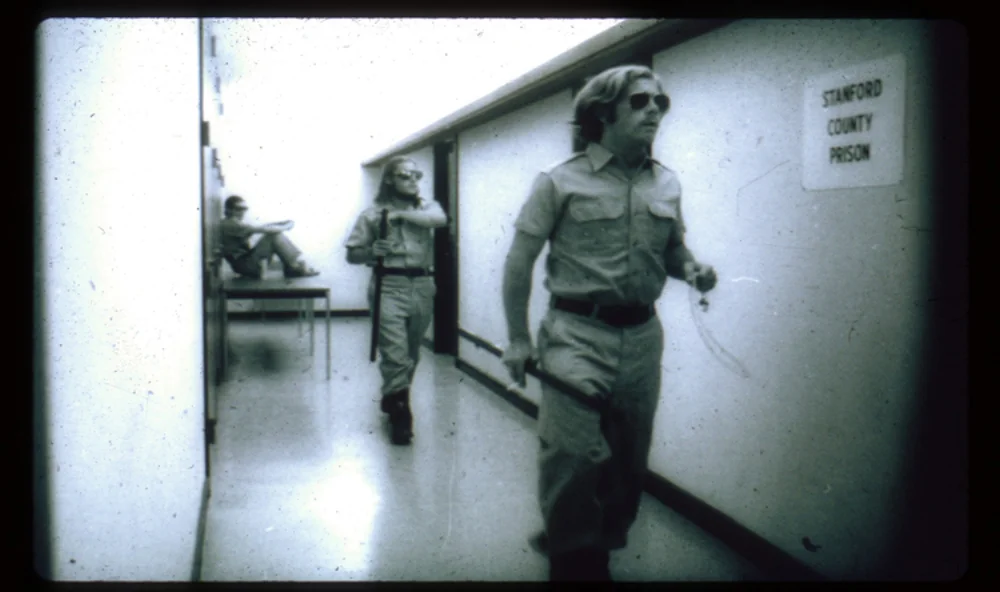
Student "guards" patrol the simulated Stanford County Prison in 1971. The reflective sunglasses and uniforms were intentional - tools of deindividuation that helped ordinary undergraduates dissolve into a punitive role within days. Credit: Philip Zimbardo / prisonexp.org via Wikimedia Commons (CC BY-SA 4.0).
Zimbardo’s interpretation: situations powerfully shape behavior. Ordinary people placed in powerful roles with institutional backing and no accountability drift toward those roles’ extremes.
Modern critiques: the experiment was methodologically flawed (Zimbardo himself acted as “prison superintendent” and encouraged harsh behavior; some guards were coached). Re-analyses suggest the results were less automatic than Zimbardo claimed. But the core lesson - that situations shape behavior more than most people realize - is supported by other research.
The Power of the Situation
Across Asch, Milgram, and Zimbardo, the big finding is the same: ordinary people do extraordinary things - good and bad - under situational pressure. This is the situationist perspective in social psychology. It doesn’t deny that personality matters; it just shows that situational forces are often underestimated.
This finding interacts with the fundamental attribution error (Chapter 7): we tend to explain others’ behavior dispositionally (“he must be cruel”) and underestimate situational pressures that would lead any of us to do the same.
Distinguish normative from informational social influence.
Click to reveal answer
Normative: going along to be accepted or avoid rejection (you know you're wrong but don't want to stand out). Informational: going along because you think the group has better information (you're genuinely unsure). Both produce conformity but differ in motivation.
What percentage of Asch's participants conformed to the incorrect group answer at least once?
Click to reveal answer
About 75%. About one-third of responses overall conformed to the incorrect group. Adding even one dissenting confederate dropped conformity dramatically.
What percentage of Milgram's participants delivered the maximum 450-volt shock?
Click to reveal answer
Around 65%. Most showed extreme distress but continued when prompted by the authority figure. Obedience dropped when the victim was more visible, the authority was less proximal, or peers disobeyed.
What was the key finding of the Stanford Prison Experiment, and why is it controversial today?
Click to reveal answer
Finding: ordinary people assigned to 'guard' roles became abusive, while 'prisoners' became depressed - situations shape behavior powerfully. Controversial because Zimbardo acted as superintendent and encouraged harsh behavior; some guards were coached. The core insight about situational power holds, but the results were less automatic than originally claimed.
Groups change people. Put a person into a group and their performance, judgment, and willingness to take action all shift - sometimes for better, usually for worse. This section covers the most-tested group phenomena.
Social Facilitation
Social facilitation is the tendency for the presence of others to enhance performance on easy/well-learned tasks and impair performance on difficult/novel tasks.
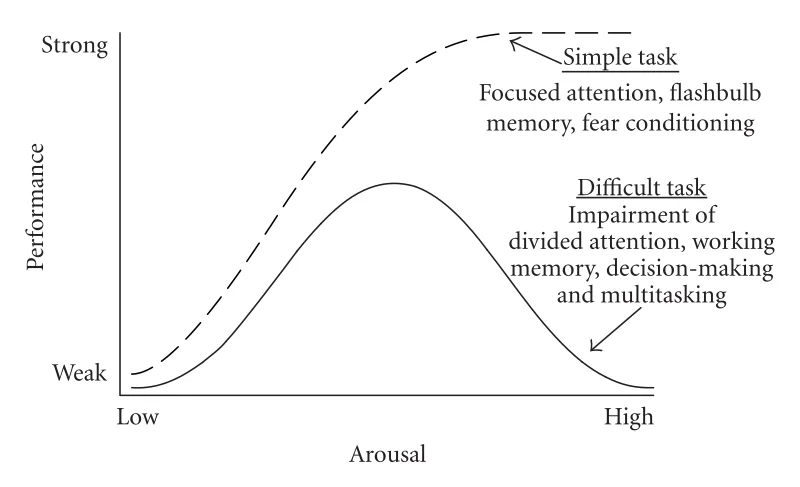
Why? Others’ presence increases arousal (Yerkes-Dodson law from Chapter 5). For simple tasks, higher arousal helps. For complex tasks, higher arousal hurts.
The Yerkes-Dodson law that underlies social facilitation. Higher arousal helps performance on simple/well-learned tasks (dashed) but creates an inverted-U for difficult tasks (solid) - too much arousal hurts. The presence of an audience supplies that extra arousal. Credit: Diamond et al. via Wikimedia Commons (CC0).
A skilled runner performs better with a crowd cheering.
A novice pianist falls apart in front of an audience.
The classic demo (Triplett, 1898): cyclists pedal faster when racing against others than when riding alone.
Social Loafing
Social loafing is the tendency to exert less effort when part of a group than when working alone, especially on tasks where individual contributions aren’t identifiable.
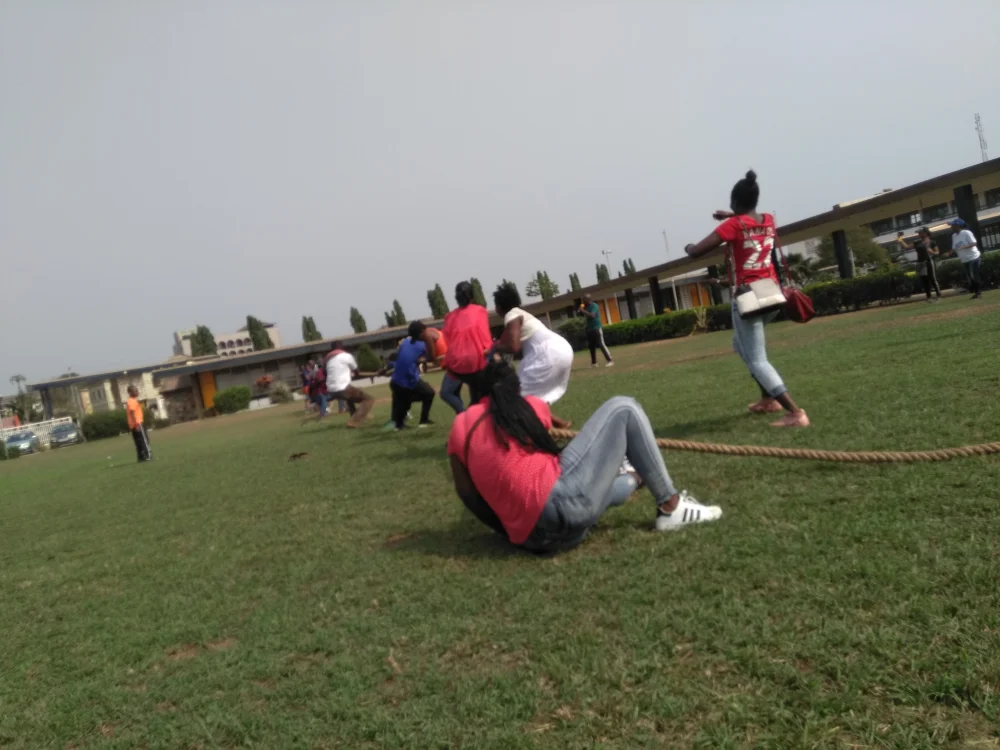
The original demo of social loafing was a tug-of-war: each individual pulled less hard as more teammates were added. Because nobody can tell whose grip is slacking, the moral weight of effort dissolves into the group. Credit: Joy Agyepong via Wikimedia Commons (CC BY-SA 4.0).
Group projects where grading is collective; rowing teams; brainstorming sessions. Everyone does slightly less work than they would alone, and the group’s total output is less than the sum of individual efforts.
Loafing is reduced when:
Individual contributions are identified.
Tasks are challenging and meaningful.
Group cohesion is high.
Members feel their contribution matters.
Deindividuation
Deindividuation is the loss of self-awareness and individual accountability when in a group, particularly under conditions of anonymity. Produces behavior that would be inhibited if the person were identifiable - cheering at a sports riot, flaming in online comments, mob violence.
Classic factors:
Anonymity (masks, darkness, online identities).
Arousal.
Diffuse responsibility.
Large groups.
The Stanford Prison Experiment involved deindividuation (uniforms, shared identity, loss of individuality). Costumes and uniforms produce measurable increases in aggression in experimental settings.
Group Polarization
Groups tend to make more extreme decisions than individuals. Discussion amplifies the group’s initial leaning.
A mildly conservative group becomes strongly conservative after discussion.
A mildly risk-tolerant group becomes highly risk-tolerant after discussion.
Why? Hearing arguments that support the initial view strengthens it; social comparison pushes members to demonstrate commitment to the group’s position. Partisan media and echo chambers are prime drivers of group polarization in modern politics.
Groupthink
Groupthink (Janis) is a pattern of dysfunctional group decision-making in which the desire for harmony overrides realistic evaluation of alternatives. Common in cohesive, high-pressure, high-stakes groups with strong leadership.
Features:
Illusion of invulnerability.
Belief in the group’s moral superiority.
Collective rationalization of warnings.
Pressure on dissenters to conform.
Self-censorship - members suppress their doubts.
Illusion of unanimity.
Self-appointed “mindguards” who filter dissenting information away from the group.
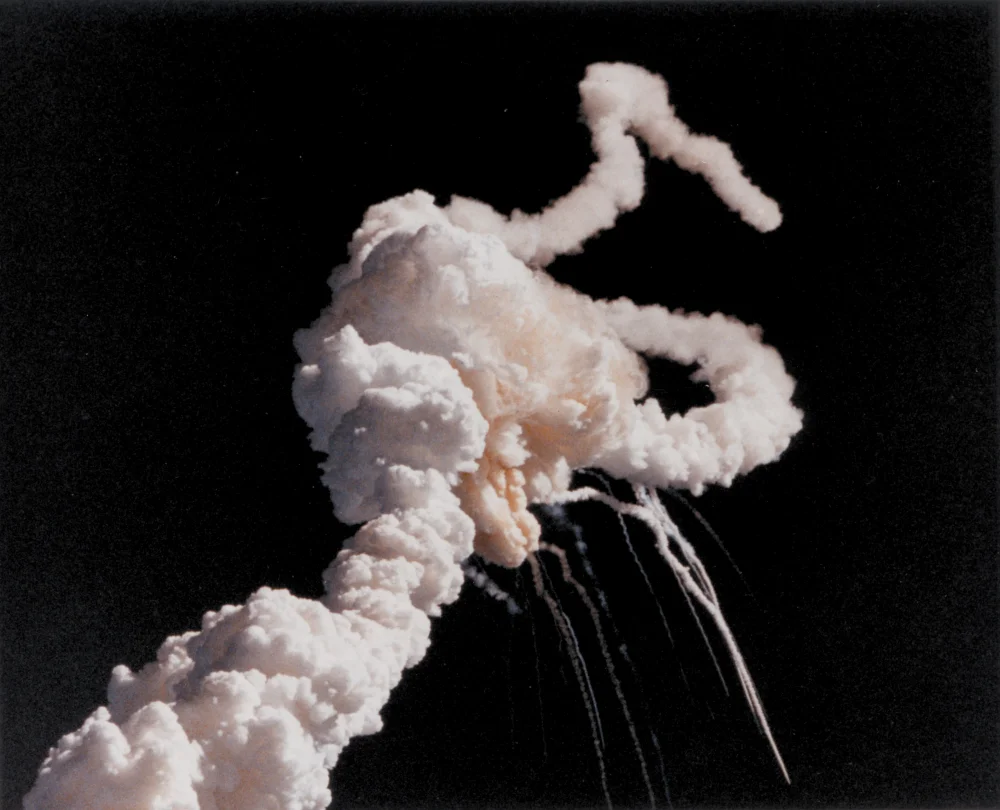
Classic examples: Bay of Pigs invasion, Challenger shuttle disaster, Iraq WMD assessments. Prevention: appointing a devil’s advocate, inviting outside experts, encouraging dissent.
The Space Shuttle Challenger broke apart 73 seconds after launch. The post-mortem became a textbook case of groupthink: NASA managers minimized engineers' warnings about O-ring failure in cold weather to preserve schedule consensus. Credit: Kennedy Space Center / NASA via Wikimedia Commons (Public Domain).
The Bystander Effect
The bystander effect: the more people present during an emergency, the LESS likely any individual is to help. Seems counterintuitive. The MCAT loves it.
The effect is explained by:
Diffusion of responsibility. “Surely someone else will help.” The moral weight of acting is split across bystanders.
Pluralistic ignorance. If no one else is reacting, maybe there’s no actual emergency. Everyone looks at everyone else for cues.
Evaluation apprehension. Fear of looking foolish by misreading the situation.
The Kitty Genovese case (1964) prompted the initial research, though the original reporting (38 witnesses did nothing) was later shown to be exaggerated. The phenomenon itself has been replicated thousands of times.
Kitty Genovese, whose 1964 murder in Queens galvanized Darley and Latané's foundational bystander research. The viral "38 silent witnesses" framing was later debunked - but the bystander effect itself has held up across thousands of replications. Credit: New York Police Department via Wikimedia Commons (Public Domain).
Darley and Latané’s Decision Tree
To help in an emergency, a person must:
Notice the event.
Interpret it as an emergency.
Assume responsibility to help.
Know how to help.
Decide to help.
Failure at any step blocks helping behavior. Groups increase failure particularly at steps 2 and 3.
Factors That Increase Helping
Smaller crowds or being the only bystander.
Clear emergencies (hard to misinterpret).
Similar-looking victim.
Rural or small-community settings (higher sense of connection).
Good mood.
Exposure to models who help.
Peer Pressure
Related to conformity but more directly about influence from peers (people of similar age/status). Especially powerful in adolescence, when identity formation and belonging needs peak simultaneously. Teen risk-taking is notably elevated in the presence of peers - fMRI studies show peer presence amplifies activity in reward-related brain regions while reducing prefrontal inhibition.
Define social facilitation and its main effect on performance.
Click to reveal answer
Social facilitation: the presence of others enhances performance on easy/well-learned tasks (arousal helps simple tasks) and impairs performance on difficult/novel tasks (arousal hurts complex tasks). Follows Yerkes-Dodson.
How does the bystander effect work, and what are the two main mechanisms?
Click to reveal answer
More bystanders → lower probability that any individual will help. Driven by diffusion of responsibility ('someone else will do it') and pluralistic ignorance ('if no one else is reacting, maybe it isn't an emergency'). Smaller crowds produce more helping.
What is groupthink, and which classic historical events exemplify it?
Click to reveal answer
Groupthink: dysfunctional group decision-making where desire for harmony overrides realistic evaluation. Features include illusion of invulnerability, self-censorship, and pressure on dissenters. Examples: Bay of Pigs, Challenger disaster, Iraq WMD assessments.
Deindividuation tends to increase when which conditions are present?
Click to reveal answer
Anonymity (masks, uniforms, online screen names), arousal, diffuse responsibility, and large group size. Leads to loss of self-awareness and inhibition, enabling behavior the person would avoid if identifiable.
Every society runs on unwritten rules. Norms are shared expectations about behavior. When people break them, the reaction depends on which kind of norm was violated. This section covers the types of norms, how we learn them (socialization), and the sociological theories of what happens when someone consistently breaks them (deviance).
Types of Norms
Ranked roughly by severity of violation:
Folkways. Everyday informal customs. Not morally serious. Breaking them gets you mild social sanction. Wearing pajamas to a wedding; eating with your hands; showing up late.
Mores. Morally serious norms. Violation generates stronger reactions. Adultery, public drunkenness, dress codes at religious services.
Taboos. The most severe moral prohibitions. Violation triggers deep revulsion and strong punishment. Incest, cannibalism. Many taboos are culturally universal.
Laws. Formal norms backed by institutional enforcement. Some laws codify mores (murder, theft); some codify folkways (parking rules).
Violation of folkways generates “odd” reactions. Violation of mores generates “wrong” reactions. Violation of taboos generates “disgust.” Laws get police.
Socialization
Socialization is the process by which individuals internalize the norms and values of their society.
Primary socialization. Happens in childhood, mainly through family. Basic norms, language, emotion regulation.
Secondary socialization. Happens through schools, peers, workplaces, media. Specialized norms for specific social roles.
Anticipatory socialization. Learning the norms of a group you expect to join (medical students learning to be doctors; interns learning corporate culture).
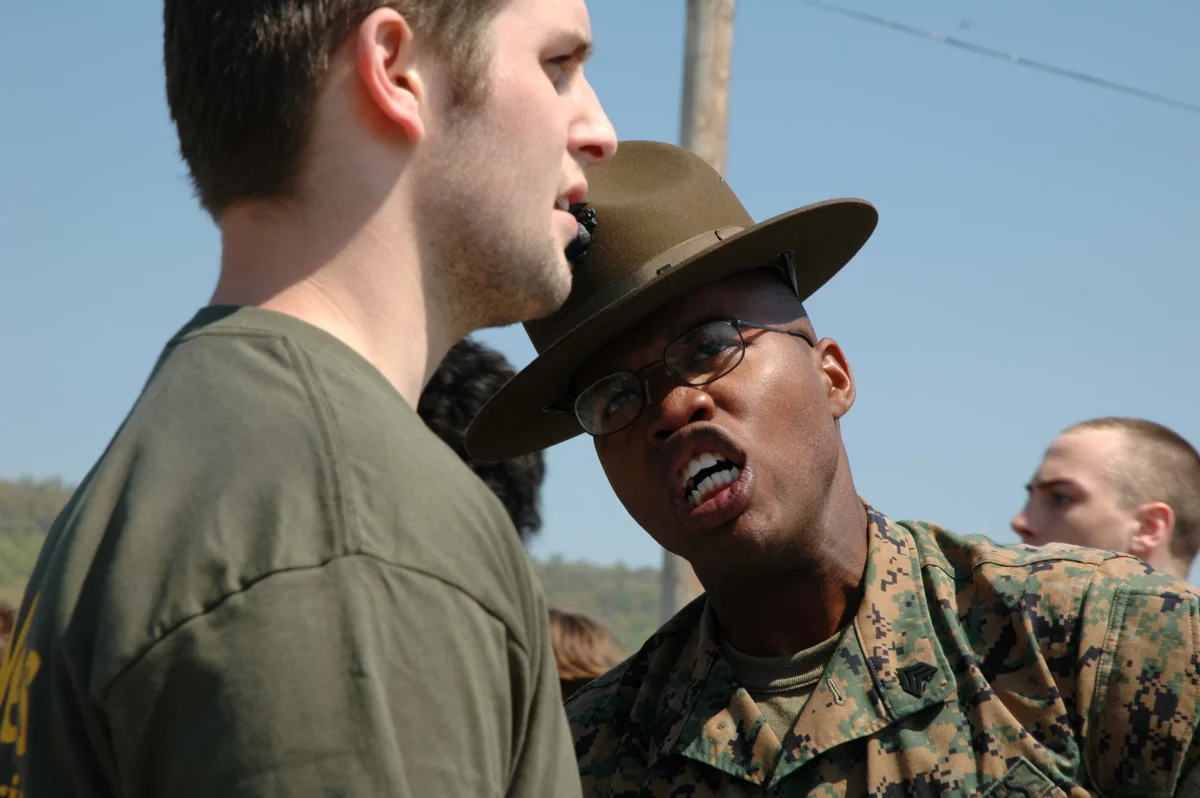
Resocialization. Replacing old norms with new ones, often in total institutions (prisons, military boot camp, religious orders, cults). Strips the person of their prior identity and installs a new one.
A Marine Corps drill instructor running an enlistee through pre-boot-camp conditioning. Boot camp is the textbook total institution: it strips the recruit's civilian identity and resocializes them into a new role with new norms, hierarchy, and language. Credit: Sgt. Reece Lodder / USMC via Wikimedia Commons (Public Domain).
Agents of Socialization
Family - primary source, especially in early childhood.
School - formal socialization in rules, achievement, and civic norms.
Peers - especially influential in adolescence.
Media - shapes values, aspirations, and stereotypes.
Religion - moral framework and identity.
Workplace - professional norms, hierarchies.
Socialization continues throughout life as people enter new roles (parent, retiree, patient).
Deviance
Deviance is any behavior that violates social norms. Definitions are culturally relative - what’s deviant in one society may be celebrated in another (tattooing, polygamy).
Primary vs. Secondary Deviance
Primary deviance. Initial norm violation that doesn’t significantly affect self-image or social standing. A teenager shoplifts once and isn’t caught; life goes on.
Secondary deviance. The person’s response to being labeled a deviant. The label itself amplifies the behavior. The teen is caught, labeled a thief by parents and school, and internalizes the label - now they actually identify as a criminal.
Sociological Theories of Deviance
Differential Association (Sutherland)
Deviance is learned through association with others who engage in it. You become a criminal by being exposed to definitions favorable to breaking the law - through peers, family, or community. Applies to shoplifting, drug use, and white-collar crime alike.
Key claim: deviance isn’t a personality defect; it’s a learned behavior pattern like any other.
Labeling Theory
Deviance is not in the act itself but in how society reacts to the act. Once labeled a deviant, the person faces stigmatization, reduced opportunities, and pressure to live up to the label. Strongly predicts secondary deviance.
Applications: juvenile justice critiques arguing that labeling young offenders as “delinquents” drives them further into crime.
Strain Theory (Merton)
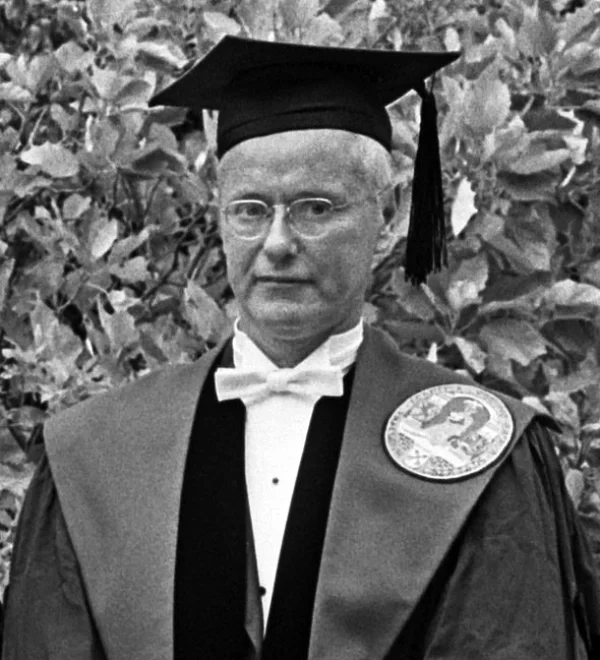
Robert K. Merton (1910–2003), the sociologist whose strain theory and deviance typology are the most-tested sociological framework on the MCAT behavioral section. Credit: Eric Koch for Anefo / Nationaal Archief via Wikimedia Commons (CC0).
Deviance arises when culturally approved goals (wealth, success) are unreachable through culturally approved means (education, hard work). The strain between goal and access pushes people toward deviance.
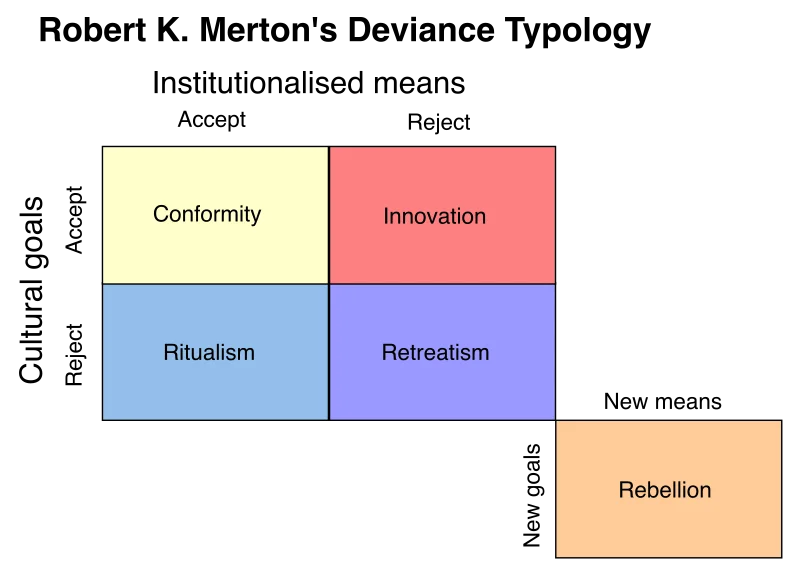
Merton’s five responses to strain:
Conformity - accept goals, accept means. Most people.
Innovation - accept goals, reject means. Leads to criminal acquisition of wealth (stealing, fraud).
Ritualism - reject goals, accept means. Going through the motions without ambition.
Retreatism - reject both. Homelessness, drug addiction, dropping out.
Rebellion - reject both, replace with new goals and means. Revolutionary movements.
Merton's deviance typology. The MCAT will give you a vignette and ask which cell it lives in - innovation (accept the goal of wealth, reject legitimate means → fraud) is the highest-yield example. Credit: User:Wykis via Wikimedia Commons (Public Domain).
Anomie is a related concept (Durkheim) - a breakdown of norms leaving individuals without clear rules. Modern, rapidly changing societies are prone to anomie; it contributes to suicide and deviance.
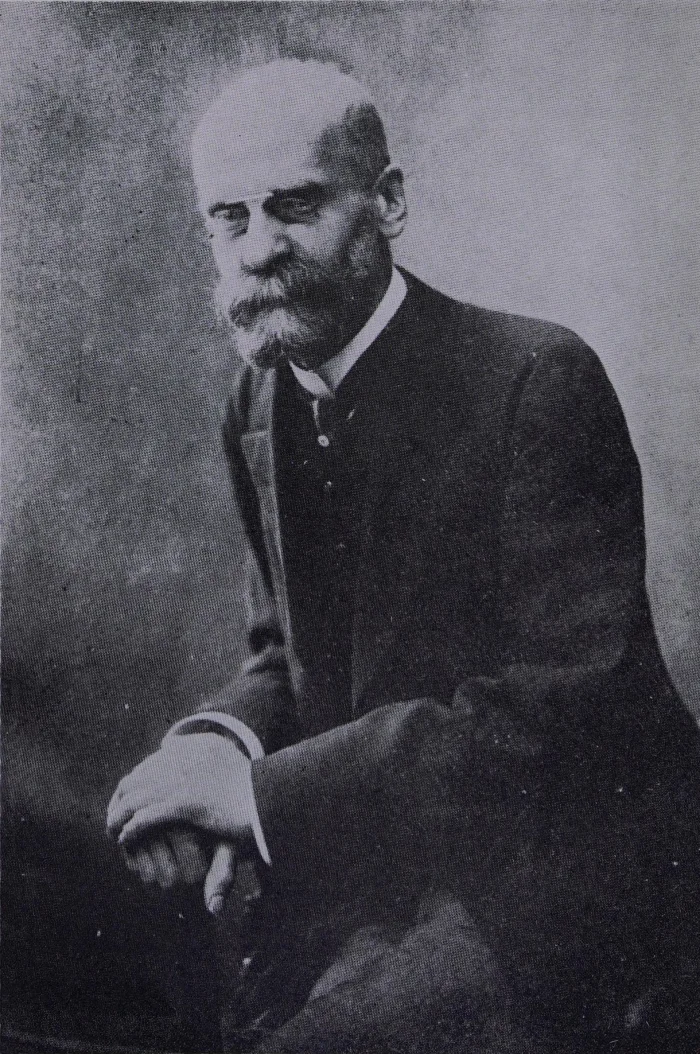
Émile Durkheim (1858–1917), founder of modern sociology. His concept of anomie - the breakdown of shared norms in rapidly changing societies - sits behind both Merton's strain theory and the sociological theory of suicide. Credit: Wikimedia Commons (Public Domain).
Rank folkways, mores, taboos, and laws from mildest to most severe violation.
Click to reveal answer
Folkways (minor customs - 'odd') → Mores (moral norms - 'wrong') → Taboos (deep moral prohibitions - 'disgusting'). Laws are formal norms enforced institutionally, codifying mores and (sometimes) folkways.
Distinguish primary deviance from secondary deviance.
Click to reveal answer
Primary deviance: initial norm violation that doesn't alter self-image. Secondary deviance: amplified deviance as a response to being LABELED a deviant - the label becomes self-fulfilling and shapes identity.
According to strain theory, why does deviance arise?
Click to reveal answer
When culturally approved goals (wealth, success) are blocked by lack of access to culturally approved means (education, jobs). The strain pushes people toward alternative (deviant) means of achieving the goals - e.g., turning to crime to acquire wealth.
What is resocialization, and where does it typically occur?
Click to reveal answer
The process of replacing old norms with new ones, often in total institutions like prisons, military boot camps, religious orders, or cults. Strips prior identity and installs a new one through controlled social environments.
Three related concepts, often confused even in casual conversation. The MCAT wants them distinguished precisely.
Prejudice, Stereotypes, Discrimination
Stereotype. A generalized belief (cognitive) about members of a group. Can be positive, negative, or neutral. “Asian students are good at math.” “Athletes are popular.”
Prejudice. An attitude (emotional/evaluative) toward a group, usually negative. “I dislike doctors.” “I distrust politicians.” Prejudice is the feeling associated with a stereotype.
Discrimination. Unequal treatment (behavior) of people based on group membership. Refusing to hire someone based on race, gender, or religion is discrimination, regardless of whether you hold overt prejudice.
Stereotypes are thoughts. Prejudice is feelings. Discrimination is behavior.
You can have one without the others. Someone may hold a prejudicial attitude without acting on it (no discrimination). Someone may discriminate without explicit prejudice (e.g., following a discriminatory company policy). And systems can produce discrimination through structural factors without any single individual holding prejudice.
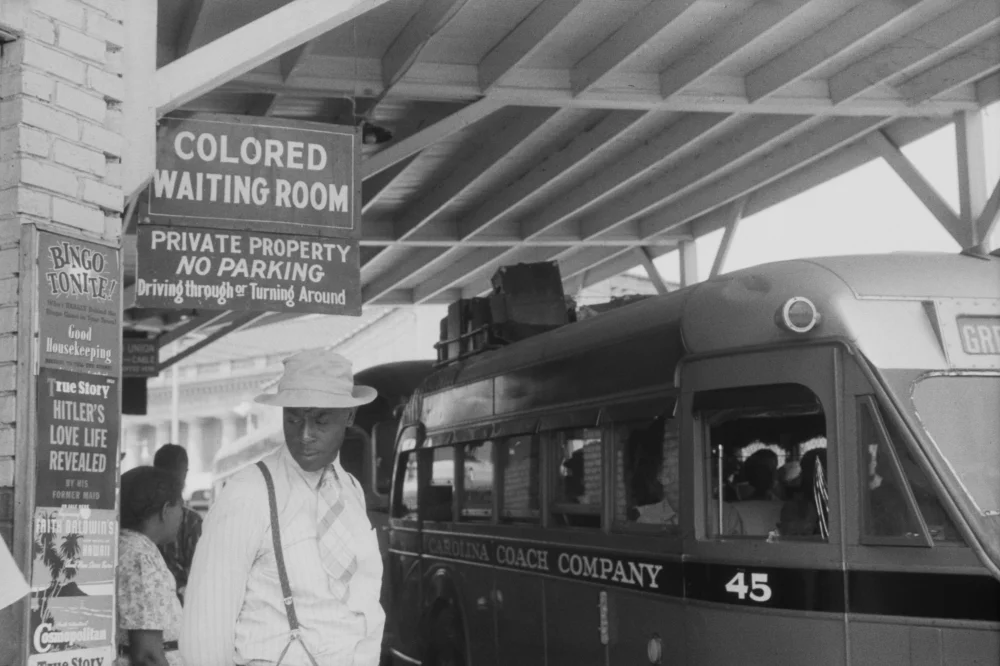
A Jim Crow-era bus station in Durham, NC (1940). Segregated waiting rooms are pure institutional discrimination: unequal treatment built into law and infrastructure regardless of any individual's prejudice. Credit: Jack Delano / Library of Congress via Wikimedia Commons (Public Domain).
In-Group and Out-Group
In-group. A group you identify with and feel belonging to.
Out-group. A group you don’t identify with.
Even arbitrary, temporary group assignments (split a room into “green dots” and “red dots”) produce:
In-group favoritism. Preferential treatment and positive evaluations of in-group members.
Out-group homogeneity. Seeing out-group members as all alike (“they all look the same”).
Out-group hostility. In extreme cases, treating out-group members as less than human (dehumanization).
Social identity theory (Tajfel) explains these effects: group membership is a core part of self-concept, so inflating the in-group’s status inflates one’s own.
Ethnocentrism and Cultural Relativism
Ethnocentrism. Judging other cultures by the standards of your own. Tends to produce negative evaluations of practices that differ from what’s familiar.
Cultural relativism. Evaluating cultural practices within the context of that culture’s values, rather than imposing outside standards. The opposite of ethnocentrism.
Both are end-points of a continuum; most people sit somewhere between.
Individual vs. Institutional Discrimination
Individual discrimination. One person treating another unequally based on group membership. A manager refuses to hire a woman because of her gender.
Institutional (or structural) discrimination. Policies, practices, or systems that produce unequal outcomes for groups, even without any individual holding prejudice. Example: a hiring algorithm trained on historical data that systematically underrates Black applicants; a testing regime that correlates with parental income.
Institutional discrimination is harder to see and harder to fix because no individual needs to hold prejudice for the pattern to persist.
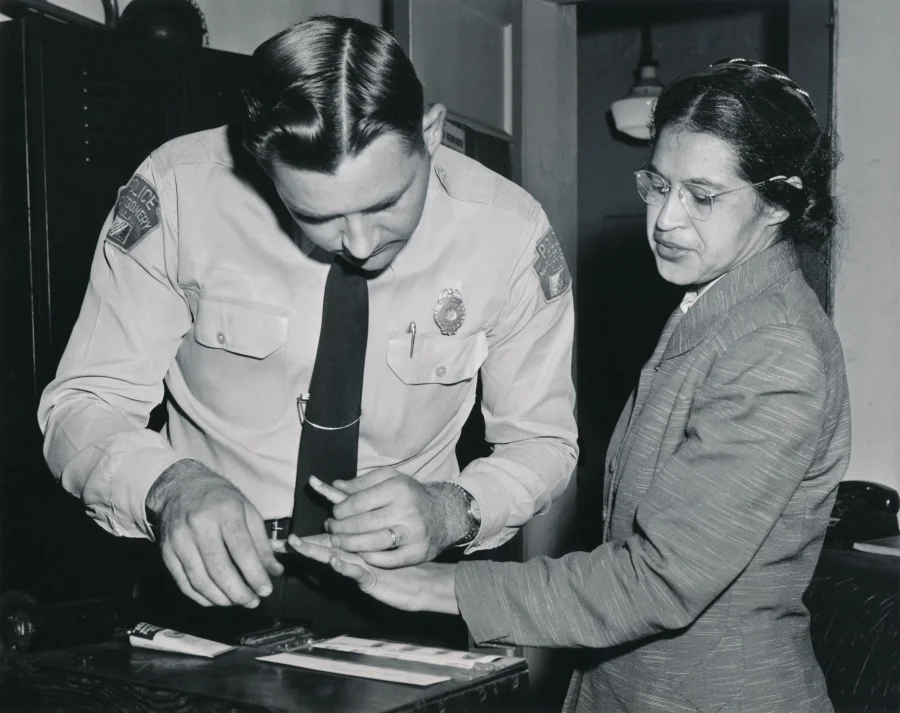
An apartheid-era beach sign in Durban, South Africa (1989). Apartheid is the canonical historical example of institutional discrimination - codified by national law, enforced by police, and producing systematic inequality independent of any one person's beliefs. Credit: Guinnog via Wikimedia Commons (CC BY-SA 3.0).Rosa Parks being fingerprinted in 1956 after her arrest during the Montgomery bus boycott. Her refusal to give up her seat became a flashpoint that turned diffuse prejudice into organized resistance against institutional discrimination. Credit: Gene Herrick / AP, restored by Adam Cuerden via Wikimedia Commons (Public Domain).
Stigma
Stigma is a negative social attribute that discredits or devalues a person. Three types:
Physical stigma. Visible body differences (scars, obesity, disability).
Character stigma. Perceived character flaws (addiction, mental illness, criminal record).
Tribal stigma. Group membership that is stigmatized (race, ethnicity, religion).
Self-stigma - internalizing the stigma, seeing oneself through its lens. Reduces help-seeking and worsens mental health outcomes.
Courtesy stigma - stigma extended to people associated with the stigmatized (family members of people with mental illness or addiction).
Erving Goffman theorized stigma as a “spoiled identity” - the stigmatized person has to actively manage information about the discrediting attribute.
Erving Goffman (1922–1982), the sociologist whose work on stigma as a "spoiled identity" and on the dramaturgical performance of self underlies how the MCAT frames stigma, courtesy stigma, and impression management. Credit: Wikimedia Commons (Public Domain).
Self-Fulfilling Prophecy in Prejudice
Prejudiced expectations can cause the very behavior they anticipate. Rosenthal’s Pygmalion study showed this with teacher expectations; similar effects occur with racial and gender stereotypes in workplaces.
Teacher expects Student A to do well; treats them more warmly; Student A performs better.
Manager expects female employees to be less committed; gives them less important projects; they become less engaged.
The bias produces evidence that seems to confirm the bias.
Just-World Hypothesis (Revisited)
The just-world hypothesis (covered in Chapter 7) contributes to prejudice by justifying inequality. “If they’re poor, they must deserve it.” “If they were attacked, they must have done something to provoke it.” This reasoning blames victims and exonerates the system.
Power and Privilege
Privilege is unearned advantage conferred by group membership (being white in a predominantly white society, being male in a patriarchal system). Those with privilege may be unaware of it precisely because it’s the default - fish don’t notice water.
Power is the ability to influence others or control outcomes. Structural discrimination concentrates power in historically dominant groups; reducing it requires redistributing power, not just individual attitude change.
Distinguish stereotype, prejudice, and discrimination.
Click to reveal answer
Stereotype = generalized belief (cognition). Prejudice = attitude or feeling (evaluation, usually negative). Discrimination = unequal behavior based on group membership. Can occur independently.
What is out-group homogeneity?
Click to reveal answer
The tendency to see members of OTHER groups as more alike ('they all look the same') while viewing in-group members as diverse individuals. A cognitive bias that emerges even with arbitrary group assignments.
Define institutional discrimination and give an example.
Click to reveal answer
Discrimination produced by policies, practices, or systems rather than individual attitudes. Example: a hiring algorithm trained on biased historical data systematically underrates Black applicants, even if no individual holds prejudice. Harder to see and address than individual discrimination.
What is courtesy stigma?
Click to reveal answer
Stigma extended to people associated with a stigmatized individual - family members, caregivers, close friends. Commonly experienced by relatives of people with mental illness, addiction, or incarcerated individuals.
When thousands of people suddenly do the same thing at once - adopt a fashion, panic-shop for toilet paper, riot after a sports game - it often violates the norms they hold individually. Sociologists call this collective behavior. It’s distinct from group behavior in several ways the MCAT tests.
Collective Behavior vs. Group Behavior
Group behavior. Ongoing, structured, with strongly-held norms and stable membership. A family, a sports team, a workplace.
Collective behavior. Short-lived, loose structure, emergent or vague norms, open membership. A crowd, a fad-following public, a mob.
The key differences:
Duration. Collective behavior is typically brief; group behavior persists.
Membership. Collective is open and fluid; groups are relatively fixed.
Norms. Collective norms are loose or emerging; group norms are well-defined.
Structure. Collective has little internal organization; groups have roles and hierarchies.
Fads
A fad is a behavior, style, or interest that rapidly becomes popular and rapidly disappears. Fads spread quickly through media and peer networks. Examples: pet rocks, fidget spinners, the “cinnamon challenge,” planking.
The fidget spinner: a near-perfect MCAT-style example of a fad. Explosive global popularity in 2017, near-zero presence within a year. Fast adoption, no real cultural anchor, fast collapse. Credit: Árni Dagur via Wikimedia Commons (CC0).
Fads are typically harmless, but some can be dangerous (dangerous “challenges” on social media) or socially harmful (diet fads, investment fads).
Distinct from fashions, which also spread rapidly but persist longer and involve broader shifts in aesthetic norms. And from trends, which are broader and longer-lasting than fads.
Mass Hysteria and Mass Psychogenic Illness
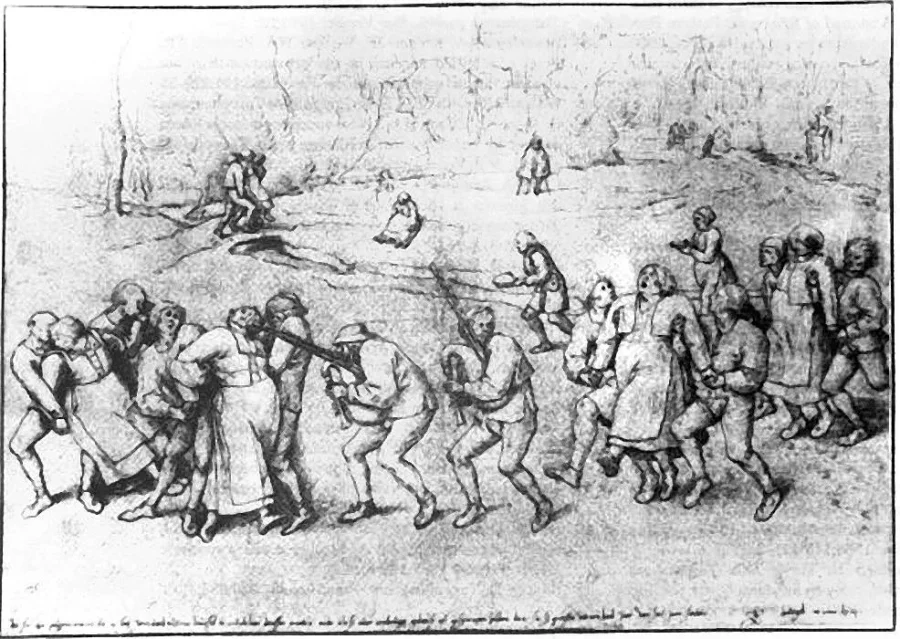
Mass hysteria refers to large numbers of people experiencing irrational anxiety, delusions, or physical symptoms in response to a perceived (often exaggerated or fictional) threat. Spreads through rumor and media.
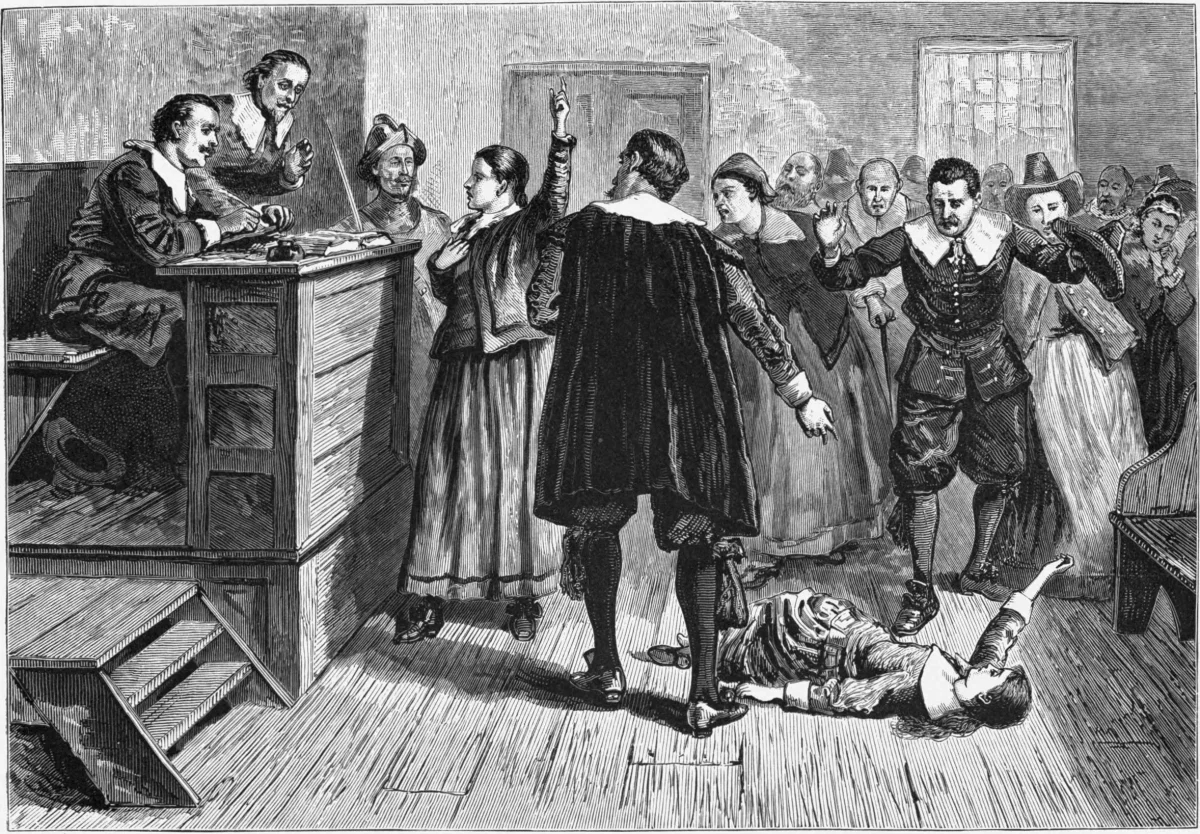
The Salem witch trials (1692-1693) - one of the most-cited historical examples of mass hysteria. Communal panic, social contagion of physical symptoms, and rumor cascaded into 19 executions. Credit: William A. Crafts (1876) via Wikimedia Commons (Public Domain).Bruegel's 1564 depiction of the European "dancing plague," in which whole villages compulsively danced for days, sometimes to the point of collapse - a classic premodern example of mass psychogenic illness spreading through social contagion. Credit: Pieter Bruegel the Elder via Wikimedia Commons (Public Domain).
Features:
Emotional contagion.
Panic and irrational behavior (rushing to stockpile goods, fleeing an imagined threat).
Often involves perceived contamination, illness, or external danger.
Mass psychogenic illness (or epidemic hysteria) is a subtype where people develop physical symptoms they believe are caused by a disease or toxin that isn’t actually present. Example: after anthrax letters were mailed in 2001, thousands of Americans reported symptoms they attributed to anthrax exposure - most were psychogenic, not infectious.
2020 pandemic-era panic buying of toilet paper. There was no real supply shortage at the start - the perceived threat alone, amplified by social media, produced cascading hoarding behavior characteristic of mass hysteria. Credit: Mwinog2777 via Wikimedia Commons (CC BY-SA 4.0).
The spiral of silence and escalation of concern fuel these events - as more people show symptoms, others interpret their own minor sensations as confirmation.
Riots and Mobs
Riot. A large group of people engaging in disorderly, destructive behavior - vandalism, violence, theft. Typically triggered by a perceived injustice or provocation. Crowds become self-sustaining through group dynamics.
Mob. A group of emotional, aggressive people focused on specific targets (individuals, property, or groups). More targeted than a riot.
Both involve deindividuation - loss of self-awareness and accountability in a crowd, particularly when anonymity and arousal are high (masks, darkness, alcohol, collective chants).
Triggers for riots:
Perceived social injustice (police brutality, government oppression).
Sports outcomes (often used as an excuse rather than a cause).
Economic grievances.
Racial or religious tensions.
Classic examples: LA riots after Rodney King verdict; urban uprisings following high-profile police shootings; European soccer hooliganism; various 2020 protests that sometimes escalated to property damage.
Aftermath of the 1992 Los Angeles riots that followed the Rodney King verdict. The riots are a textbook MCAT case: a perceived injustice ignited a crowd, deindividuation took over, and self-sustaining destructive behavior far exceeded what any one rioter would have done alone. Credit: Mick Taylor via Wikimedia Commons (CC BY-SA 2.0).
Social Movements
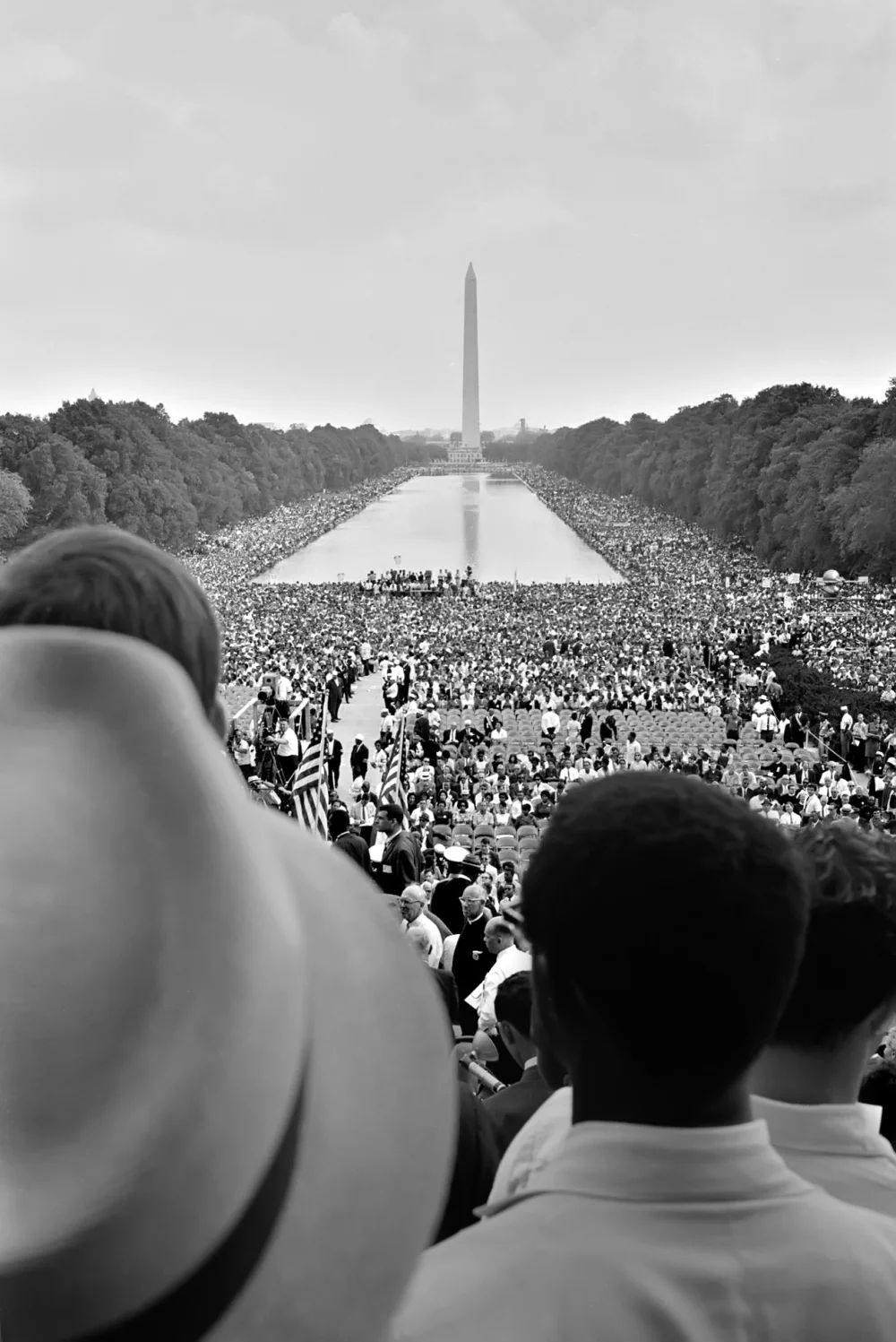
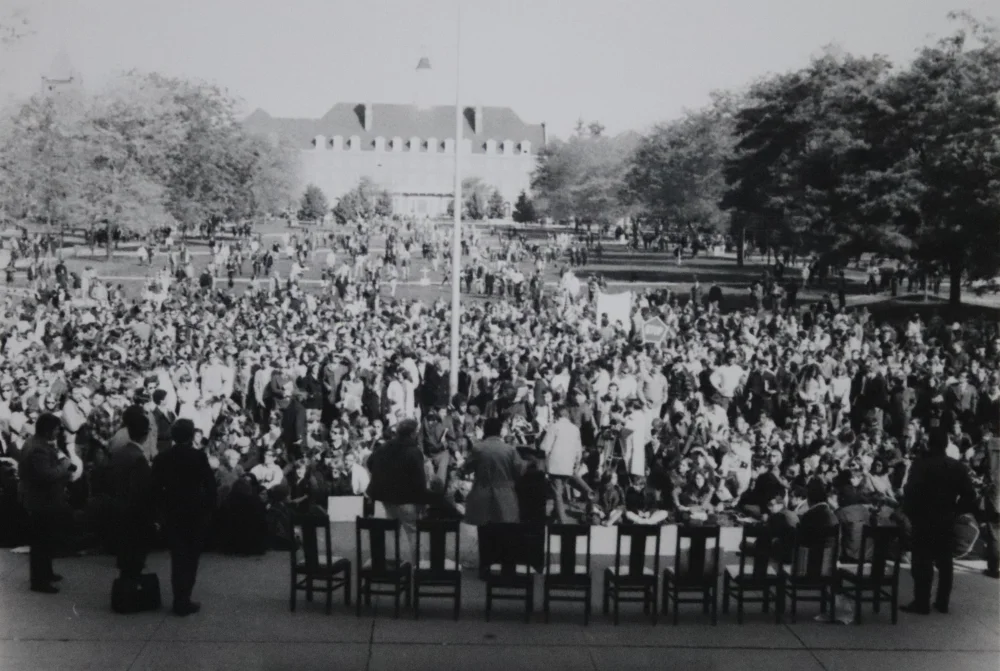
Social movements are organized, sustained collective efforts to promote or resist social change. Distinct from fleeting collective behavior in their persistence and organization - but they often begin as loose collective behavior and evolve into structured movements.
Examples: civil rights movement, women’s suffrage, environmental movement, #MeToo.
The 1963 March on Washington for Jobs and Freedom drew roughly 250,000 people - a textbook social movement hitting all four of Tilly's WUNC criteria (worthiness, unity, numbers, commitment) and producing durable institutional change. Credit: Warren K. Leffler / Library of Congress via Wikimedia Commons (Public Domain).An anti-Vietnam War teach-in at the University of Illinois - one of thousands of campus mobilizations that grew from loose collective behavior into a sustained, organized social movement during the 1960s and early 70s. Credit: Gary Todd via Wikimedia Commons (Public Domain).
Components (Charles Tilly’s WUNC):
Worthiness - respectable participants.
Unity - coordinated participation.
Numbers - large gatherings.
Commitment - sustained effort.
We revisit social movements in the sociology chapters. For now, know that they sit on the boundary between collective behavior and organized institutional change.
What are the main differences between collective behavior and group behavior?
Click to reveal answer
Collective behavior is short-lived, has loose norms, and open membership. Group behavior is ongoing, has well-defined norms, and relatively fixed membership with established roles and hierarchies.
What is mass psychogenic illness?
Click to reveal answer
A subtype of mass hysteria in which people develop physical symptoms they believe are caused by a disease or toxin that isn't actually present. Spreads through social contagion. Example: thousands reporting anthrax symptoms after the 2001 letters, most of which were psychogenic rather than infectious.
Which psychological phenomenon is a major driver of riot behavior?
Click to reveal answer
Deindividuation - loss of self-awareness and accountability in a crowd. Amplified by anonymity (masks, crowds, darkness), arousal, and collective identity. Enables behavior participants would avoid if identifiable.