Norms, Deviance, and Socialization
Every society runs on unwritten rules. Norms are shared expectations about behavior. When people break them, the reaction depends on which kind of norm was violated. This section covers the types of norms, how we learn them (socialization), and the sociological theories of what happens when someone consistently breaks them (deviance).
Types of Norms
Ranked roughly by severity of violation:
- Folkways. Everyday informal customs. Not morally serious. Breaking them gets you mild social sanction. Wearing pajamas to a wedding; eating with your hands; showing up late.
- Mores. Morally serious norms. Violation generates stronger reactions. Adultery, public drunkenness, dress codes at religious services.
- Taboos. The most severe moral prohibitions. Violation triggers deep revulsion and strong punishment. Incest, cannibalism. Many taboos are culturally universal.
- Laws. Formal norms backed by institutional enforcement. Some laws codify mores (murder, theft); some codify folkways (parking rules).
Violation of folkways generates “odd” reactions. Violation of mores generates “wrong” reactions. Violation of taboos generates “disgust.” Laws get police.
Socialization
Socialization is the process by which individuals internalize the norms and values of their society.
- Primary socialization. Happens in childhood, mainly through family. Basic norms, language, emotion regulation.
- Secondary socialization. Happens through schools, peers, workplaces, media. Specialized norms for specific social roles.
- Anticipatory socialization. Learning the norms of a group you expect to join (medical students learning to be doctors; interns learning corporate culture).
- Resocialization. Replacing old norms with new ones, often in total institutions (prisons, military boot camp, religious orders, cults). Strips the person of their prior identity and installs a new one.

Agents of Socialization
- Family - primary source, especially in early childhood.
- School - formal socialization in rules, achievement, and civic norms.
- Peers - especially influential in adolescence.
- Media - shapes values, aspirations, and stereotypes.
- Religion - moral framework and identity.
- Workplace - professional norms, hierarchies.
Socialization continues throughout life as people enter new roles (parent, retiree, patient).
Deviance
Deviance is any behavior that violates social norms. Definitions are culturally relative - what’s deviant in one society may be celebrated in another (tattooing, polygamy).
Primary vs. Secondary Deviance
- Primary deviance. Initial norm violation that doesn’t significantly affect self-image or social standing. A teenager shoplifts once and isn’t caught; life goes on.
- Secondary deviance. The person’s response to being labeled a deviant. The label itself amplifies the behavior. The teen is caught, labeled a thief by parents and school, and internalizes the label - now they actually identify as a criminal.
Sociological Theories of Deviance
Differential Association (Sutherland)
Deviance is learned through association with others who engage in it. You become a criminal by being exposed to definitions favorable to breaking the law - through peers, family, or community. Applies to shoplifting, drug use, and white-collar crime alike.
Key claim: deviance isn’t a personality defect; it’s a learned behavior pattern like any other.
Labeling Theory
Deviance is not in the act itself but in how society reacts to the act. Once labeled a deviant, the person faces stigmatization, reduced opportunities, and pressure to live up to the label. Strongly predicts secondary deviance.
Applications: juvenile justice critiques arguing that labeling young offenders as “delinquents” drives them further into crime.
Strain Theory (Merton)
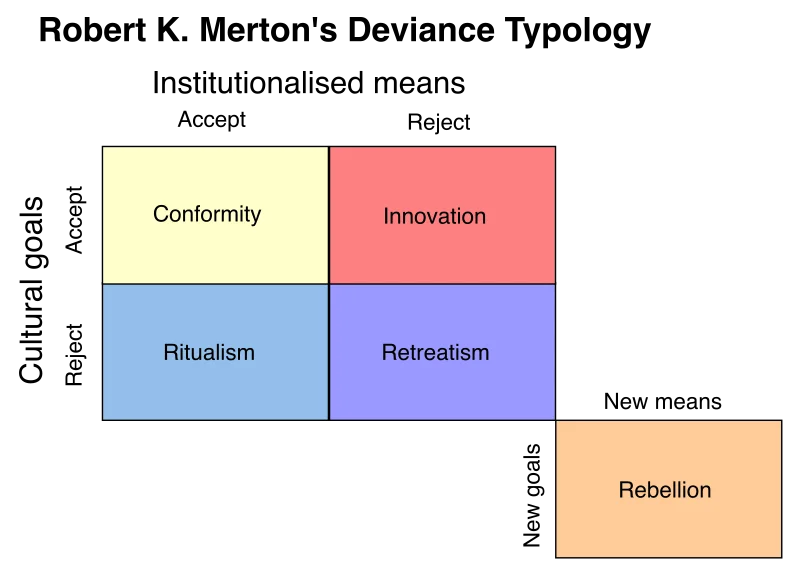
Deviance arises when culturally approved goals (wealth, success) are unreachable through culturally approved means (education, hard work). The strain between goal and access pushes people toward deviance.
Merton’s five responses to strain:
- Conformity - accept goals, accept means. Most people.
- Innovation - accept goals, reject means. Leads to criminal acquisition of wealth (stealing, fraud).
- Ritualism - reject goals, accept means. Going through the motions without ambition.
- Retreatism - reject both. Homelessness, drug addiction, dropping out.
- Rebellion - reject both, replace with new goals and means. Revolutionary movements.
Anomie is a related concept (Durkheim) - a breakdown of norms leaving individuals without clear rules. Modern, rapidly changing societies are prone to anomie; it contributes to suicide and deviance.