Collective Behavior

Collective Behavior

4 min read Updated Apr 19, 2026

When thousands of people suddenly do the same thing at once - adopt a fashion, panic-shop for toilet paper, riot after a sports game - it often violates the norms they hold individually. Sociologists call this collective behavior. It’s distinct from group behavior in several ways the MCAT tests.

Collective Behavior vs. Group Behavior

  • Group behavior. Ongoing, structured, with strongly-held norms and stable membership. A family, a sports team, a workplace.
  • Collective behavior. Short-lived, loose structure, emergent or vague norms, open membership. A crowd, a fad-following public, a mob.

The key differences:

  • Duration. Collective behavior is typically brief; group behavior persists.
  • Membership. Collective is open and fluid; groups are relatively fixed.
  • Norms. Collective norms are loose or emerging; group norms are well-defined.
  • Structure. Collective has little internal organization; groups have roles and hierarchies.

Fads

A fad is a behavior, style, or interest that rapidly becomes popular and rapidly disappears. Fads spread quickly through media and peer networks. Examples: pet rocks, fidget spinners, the “cinnamon challenge,” planking.

Top-down photograph of a bright red plastic three-arm fidget spinner with black ball-bearing rings at each tip and a central thumb-rest disc, on a white background
The fidget spinner: a near-perfect MCAT-style example of a fad. Explosive global popularity in 2017, near-zero presence within a year. Fast adoption, no real cultural anchor, fast collapse. Credit: Árni Dagur via Wikimedia Commons (CC0).

Fads are typically harmless, but some can be dangerous (dangerous “challenges” on social media) or socially harmful (diet fads, investment fads).

Distinct from fashions, which also spread rapidly but persist longer and involve broader shifts in aesthetic norms. And from trends, which are broader and longer-lasting than fads.

Mass Hysteria and Mass Psychogenic Illness

Mass hysteria refers to large numbers of people experiencing irrational anxiety, delusions, or physical symptoms in response to a perceived (often exaggerated or fictional) threat. Spreads through rumor and media.
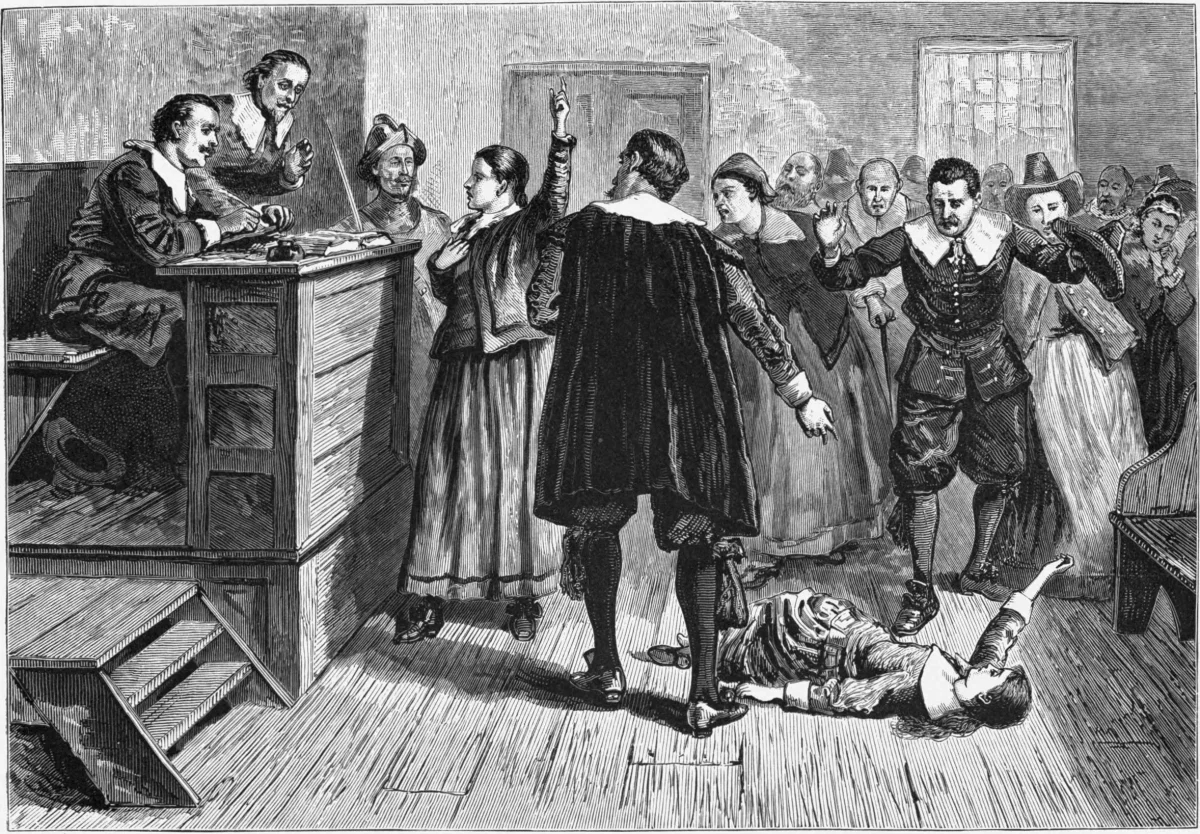
19th-century engraving of a Salem witch trial: a young woman lies sprawled on the courtroom floor as if convulsing, several women point and gesture wildly toward an accused figure, and judges in robes look on from the bench
The Salem witch trials (1692-1693) - one of the most-cited historical examples of mass hysteria. Communal panic, social contagion of physical symptoms, and rumor cascaded into 19 executions. Credit: William A. Crafts (1876) via Wikimedia Commons (Public Domain).
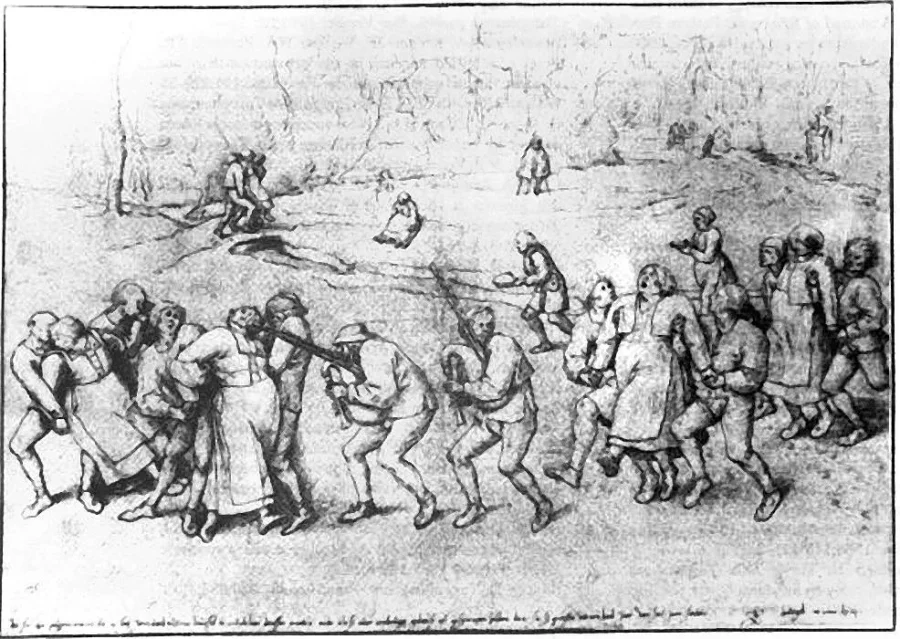
A 1564 pen-and-ink drawing by Pieter Bruegel the Elder showing a chain of medieval villagers - men and women in long tunics - holding each other and apparently dancing wildly across a country path while bystanders watch
Bruegel's 1564 depiction of the European "dancing plague," in which whole villages compulsively danced for days, sometimes to the point of collapse - a classic premodern example of mass psychogenic illness spreading through social contagion. Credit: Pieter Bruegel the Elder via Wikimedia Commons (Public Domain).

Features:

  • Emotional contagion.
  • Panic and irrational behavior (rushing to stockpile goods, fleeing an imagined threat).
  • Often involves perceived contamination, illness, or external danger.

Mass psychogenic illness (or epidemic hysteria) is a subtype where people develop physical symptoms they believe are caused by a disease or toxin that isn’t actually present. Example: after anthrax letters were mailed in 2001, thousands of Americans reported symptoms they attributed to anthrax exposure - most were psychogenic, not infectious.

Black-and-white photograph of an open kitchen cabinet completely overstuffed with dozens of rolls of toilet paper, packed across three shelves with no remaining space
2020 pandemic-era panic buying of toilet paper. There was no real supply shortage at the start - the perceived threat alone, amplified by social media, produced cascading hoarding behavior characteristic of mass hysteria. Credit: Mwinog2777 via Wikimedia Commons (CC BY-SA 4.0).

The spiral of silence and escalation of concern fuel these events - as more people show symptoms, others interpret their own minor sensations as confirmation.

Riots and Mobs

  • Riot. A large group of people engaging in disorderly, destructive behavior - vandalism, violence, theft. Typically triggered by a perceived injustice or provocation. Crowds become self-sustaining through group dynamics.
  • Mob. A group of emotional, aggressive people focused on specific targets (individuals, property, or groups). More targeted than a riot.

Both involve deindividuation - loss of self-awareness and accountability in a crowd, particularly when anonymity and arousal are high (masks, darkness, alcohol, collective chants).

Triggers for riots:

  • Perceived social injustice (police brutality, government oppression).
  • Sports outcomes (often used as an excuse rather than a cause).
  • Economic grievances.
  • Racial or religious tensions.

Classic examples: LA riots after Rodney King verdict; urban uprisings following high-profile police shootings; European soccer hooliganism; various 2020 protests that sometimes escalated to property damage.

Color photograph showing the burnt-out skeleton of a Los Angeles building after the 1992 riots: charred wooden beams jut at angles, twisted metal grates and rebar lie tangled in the foreground, and pale smoke still drifts through the wreckage
Aftermath of the 1992 Los Angeles riots that followed the Rodney King verdict. The riots are a textbook MCAT case: a perceived injustice ignited a crowd, deindividuation took over, and self-sustaining destructive behavior far exceeded what any one rioter would have done alone. Credit: Mick Taylor via Wikimedia Commons (CC BY-SA 2.0).

Social Movements

Social movements are organized, sustained collective efforts to promote or resist social change. Distinct from fleeting collective behavior in their persistence and organization - but they often begin as loose collective behavior and evolve into structured movements.

Examples: civil rights movement, women’s suffrage, environmental movement, #MeToo.
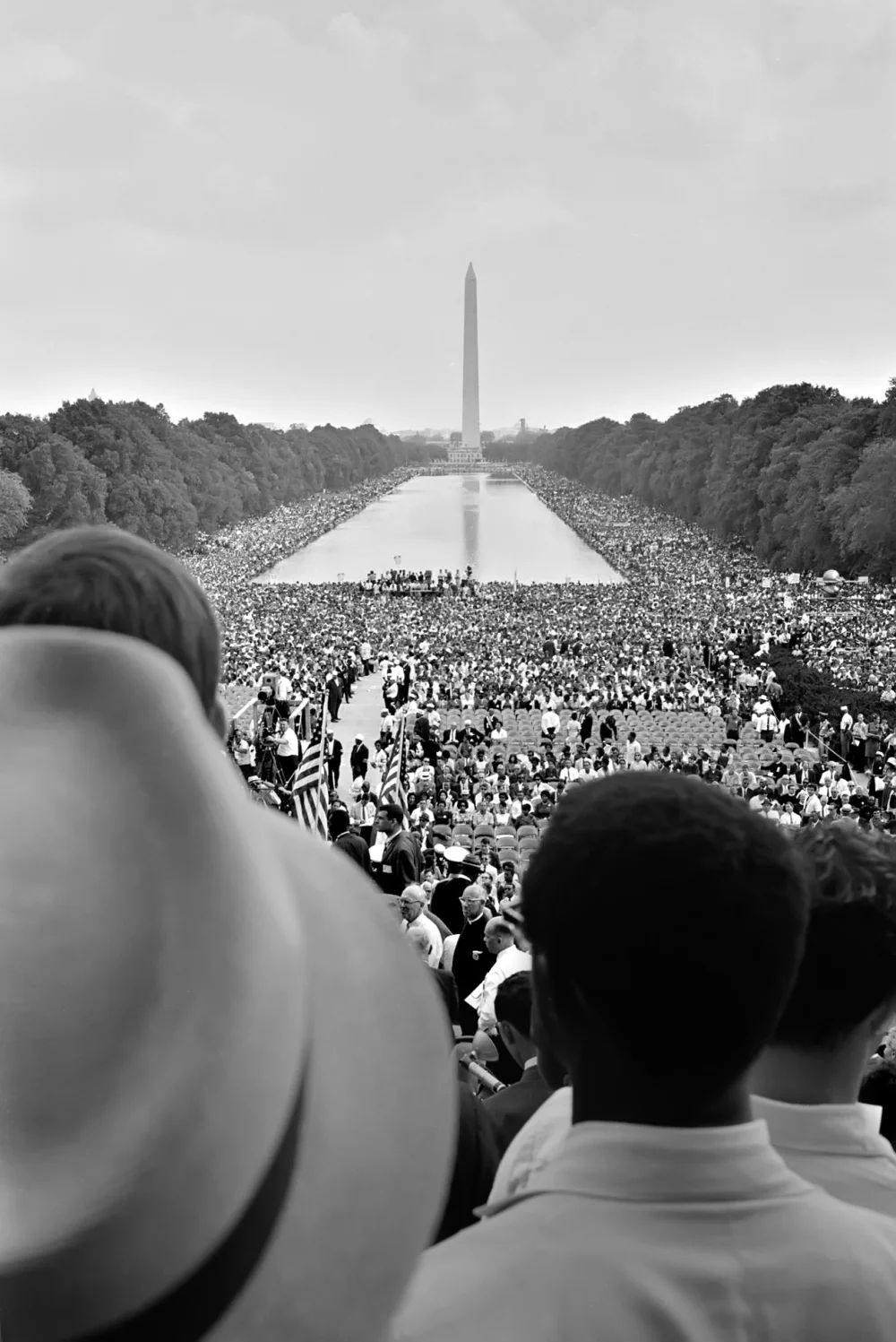
Black-and-white 1963 photograph taken from behind two men in foreground hats, looking out across an enormous crowd filling the National Mall on either side of the Lincoln Memorial Reflecting Pool, with the Washington Monument rising in the distance
The 1963 March on Washington for Jobs and Freedom drew roughly 250,000 people - a textbook social movement hitting all four of Tilly's WUNC criteria (worthiness, unity, numbers, commitment) and producing durable institutional change. Credit: Warren K. Leffler / Library of Congress via Wikimedia Commons (Public Domain).
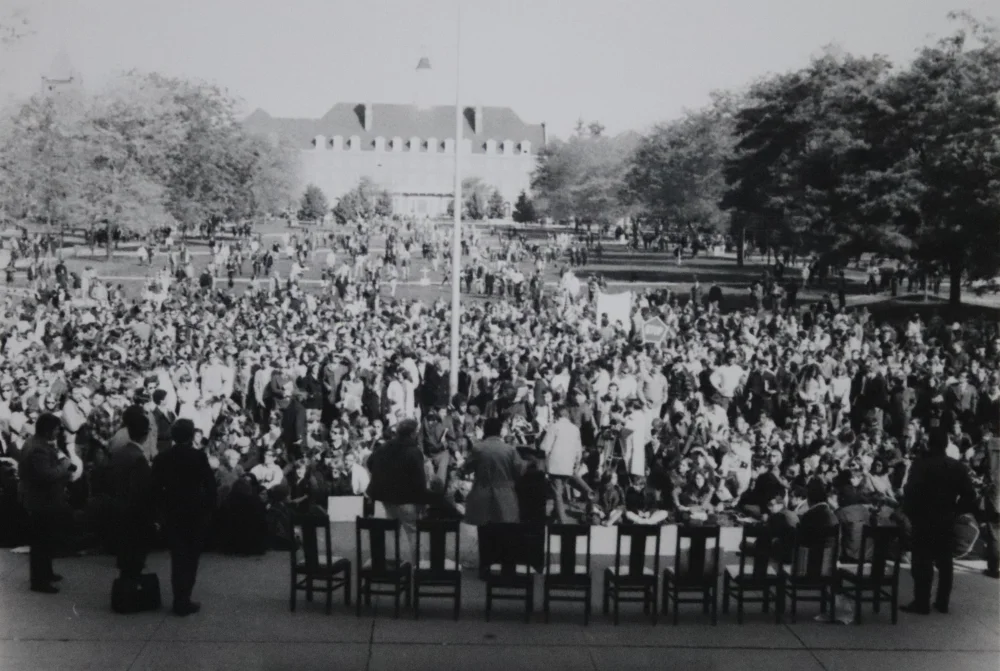
1960s black-and-white photograph of a massive student crowd seated and standing on a university quad facing a stage with empty chairs, with reporters and photographers in the foreground and a campus building in the background
An anti-Vietnam War teach-in at the University of Illinois - one of thousands of campus mobilizations that grew from loose collective behavior into a sustained, organized social movement during the 1960s and early 70s. Credit: Gary Todd via Wikimedia Commons (Public Domain).

Components (Charles Tilly’s WUNC):

  • Worthiness - respectable participants.
  • Unity - coordinated participation.
  • Numbers - large gatherings.
  • Commitment - sustained effort.

We revisit social movements in the sociology chapters. For now, know that they sit on the boundary between collective behavior and organized institutional change.

What are the main differences between collective behavior and group behavior?
Click to reveal answer
Collective behavior is short-lived, has loose norms, and open membership. Group behavior is ongoing, has well-defined norms, and relatively fixed membership with established roles and hierarchies.
What is mass psychogenic illness?
Click to reveal answer
A subtype of mass hysteria in which people develop physical symptoms they believe are caused by a disease or toxin that isn't actually present. Spreads through social contagion. Example: thousands reporting anthrax symptoms after the 2001 letters, most of which were psychogenic rather than infectious.
Which psychological phenomenon is a major driver of riot behavior?
Click to reveal answer
Deindividuation - loss of self-awareness and accountability in a crowd. Amplified by anonymity (masks, crowds, darkness), arousal, and collective identity. Enables behavior participants would avoid if identifiable.