
Conformity and Obedience
Three famous experiments shape every MCAT question on social influence. Learn the setup, the findings, and the key variables of each.
Conformity: Adjusting to the Group
Conformity is adjusting your behavior or thinking to match a group standard. Two main drivers:
- Normative social influence. Going along to be accepted or to avoid rejection. You know the group is wrong but don’t want to stand out.
- Informational social influence. Going along because you think the group has better information. You’re actually unsure, and the group’s answer seems likely correct.
Both produce the same outward behavior but differ in motivation.
Asch’s Line Studies (1951)
Participants were shown a “standard” line and asked to pick which of three comparison lines matched its length. The answer was obvious. But confederates (actors posing as other participants) gave deliberately wrong answers first. The real participant was asked last.
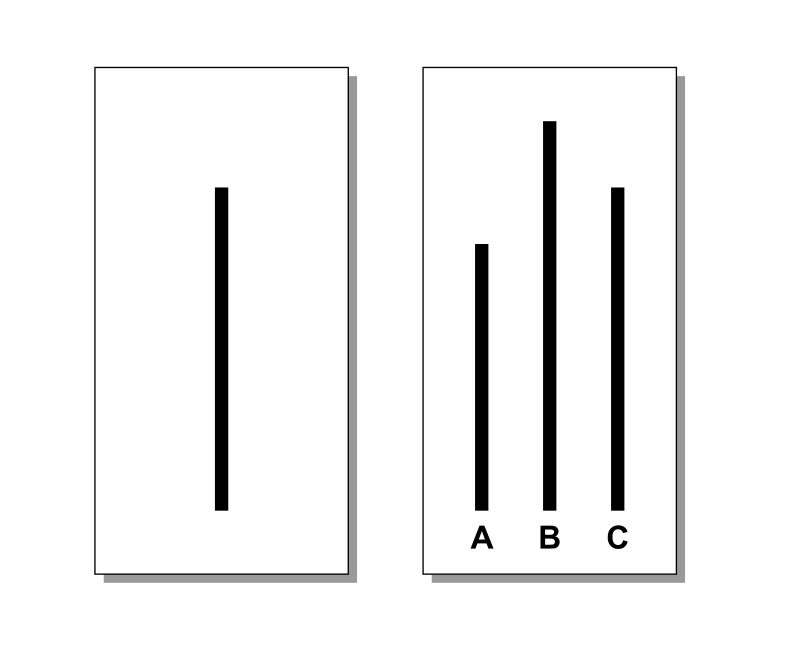
About one-third of responses conformed to the incorrect group answer. About 75% of participants conformed at least once across multiple trials. Only 25% never caved.
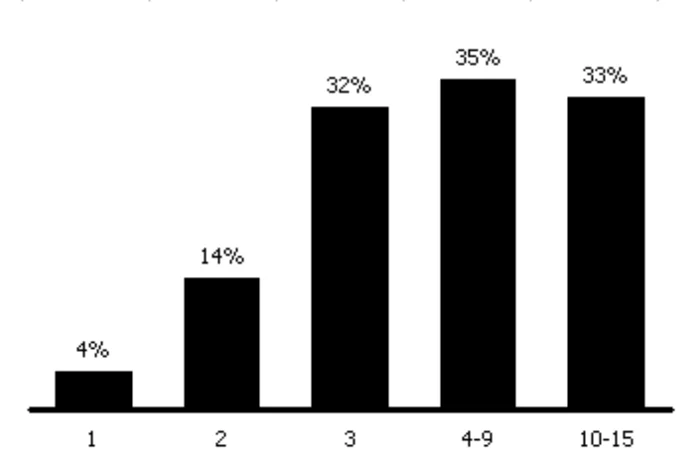
Why? Mostly normative influence - participants privately knew the right answer but didn’t want to stand alone. When debriefed, most reported feeling the pressure acutely.
Factors That Increase Conformity
- Group size up to ~3-4 people. Beyond that, added conformity pressure levels off.
- Unanimity. One dissenting voice in the group dramatically reduces conformity.
- Cohesion. The tighter the group, the stronger the pull.
- Status. Higher-status models produce more conformity.
- Public responses (vs. private written answers).
- Cultures that emphasize collectivism show higher conformity rates than individualist cultures.
Milgram’s Obedience Studies (1961-1963)

Stanley Milgram tested how far ordinary people would go to obey an authority figure. The setup:
- Participant arrives at Yale lab, meets “researcher” (authority) and “learner” (actually a confederate).
- Participant is the “teacher.” Learner is in another room, strapped to an electroshock apparatus.
- Each time the learner gets a word-pair answer wrong, the teacher is instructed to deliver an electric shock of increasing voltage - from 15 volts (slight) to 450 volts (marked “XXX - Danger: Severe Shock”).
- The learner (who isn’t actually shocked) cries out, bangs on the wall at 300 V, and eventually falls silent.
- When the teacher hesitates, the researcher calmly issues verbal prods: “Please continue.” “The experiment requires you to continue.” “You have no other choice; you must go on.”
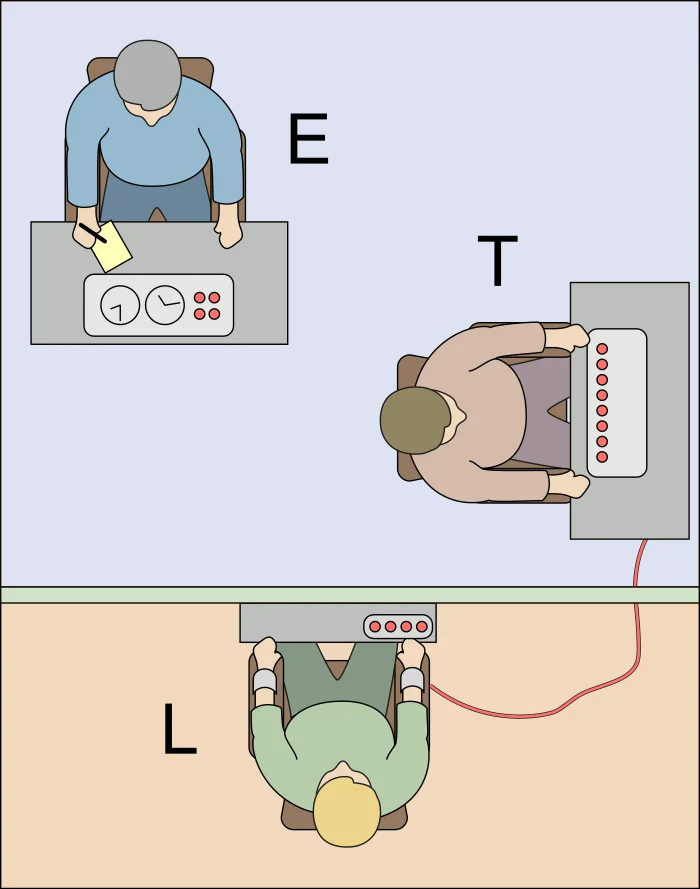
Milgram expected virtually no one would deliver the maximum shock. Instead, 65% of participants administered the maximum 450 volts. Many showed extreme distress but kept going.
Factors That Increase Obedience
- Authority figure present (researcher physically in the room).
- Authority figure is legitimate (wearing lab coat, Yale affiliation).
- Institutional setting (prestigious university).
- Victim depersonalized or distant (in another room, not visible).
- Gradual escalation (small steps easier to continue than a sudden large ask).
- Diffusion of responsibility (“I’m just following orders”).
Factors That Decrease Obedience
- Victim visible or present in same room.
- Authority figure absent or via phone.
- Conflicting authorities (two experimenters disagreeing).
- Peers disobeying.
- Personal accountability made salient.
Zimbardo’s Stanford Prison Experiment (1971)

Philip Zimbardo randomly assigned 24 mentally healthy college students to be “guards” or “prisoners” in a mock prison built in the Stanford basement. The experiment was scheduled to run 2 weeks.
Within 6 days it was shut down. Guards became abusive and dehumanizing. Prisoners broke down psychologically. One prisoner developed a rash and had to be released; others became deeply depressed.

Zimbardo’s interpretation: situations powerfully shape behavior. Ordinary people placed in powerful roles with institutional backing and no accountability drift toward those roles’ extremes.
Modern critiques: the experiment was methodologically flawed (Zimbardo himself acted as “prison superintendent” and encouraged harsh behavior; some guards were coached). Re-analyses suggest the results were less automatic than Zimbardo claimed. But the core lesson - that situations shape behavior more than most people realize - is supported by other research.
The Power of the Situation
Across Asch, Milgram, and Zimbardo, the big finding is the same: ordinary people do extraordinary things - good and bad - under situational pressure. This is the situationist perspective in social psychology. It doesn’t deny that personality matters; it just shows that situational forces are often underestimated.
This finding interacts with the fundamental attribution error (Chapter 7): we tend to explain others’ behavior dispositionally (“he must be cruel”) and underestimate situational pressures that would lead any of us to do the same.