
Lipoproteins
Fats are hydrophobic; blood is water. Shipping fat through blood requires a carrier particle: a lipoprotein. Each lipoprotein is a tiny ball with a hydrophobic core of triglycerides and cholesteryl esters, surrounded by a shell of phospholipids, free cholesterol, and proteins called apolipoproteins.
The five main classes differ by density, size, and cargo.
The Five Classes
| Class | Made by | Main cargo | Density | Role |
|---|---|---|---|---|
| Chylomicron | Intestine | Dietary triglycerides | Lowest (biggest) | Transports dietary fat from gut to tissues |
| VLDL | Liver | Endogenous triglycerides | Low | Liver → tissues (fat delivery) |
| IDL | Plasma (VLDL → IDL) | Intermediate | Intermediate | Short-lived; becomes LDL |
| LDL | Plasma (VLDL → IDL → LDL) | Cholesterol | Higher | Delivers cholesterol to tissues |
| HDL | Liver and intestine | Cholesterol | Highest (smallest) | Brings cholesterol BACK to liver (reverse transport) |
What Each Class Does
Chylomicrons
Made in the intestine from dietary fat. They carry triglycerides through lymph and blood to tissues. Lipoprotein lipase on capillary endothelium cleaves triglycerides in chylomicrons, releasing free fatty acids to adipose and muscle. The remaining “chylomicron remnant” is cleared by the liver.
VLDL
Made in the liver from endogenous triglycerides (assembled from fatty acids and carbohydrates). VLDL carries fat to tissues similarly to chylomicrons, via lipoprotein lipase. As triglycerides are removed, VLDL shrinks and gets denser, becoming IDL, then LDL.
LDL
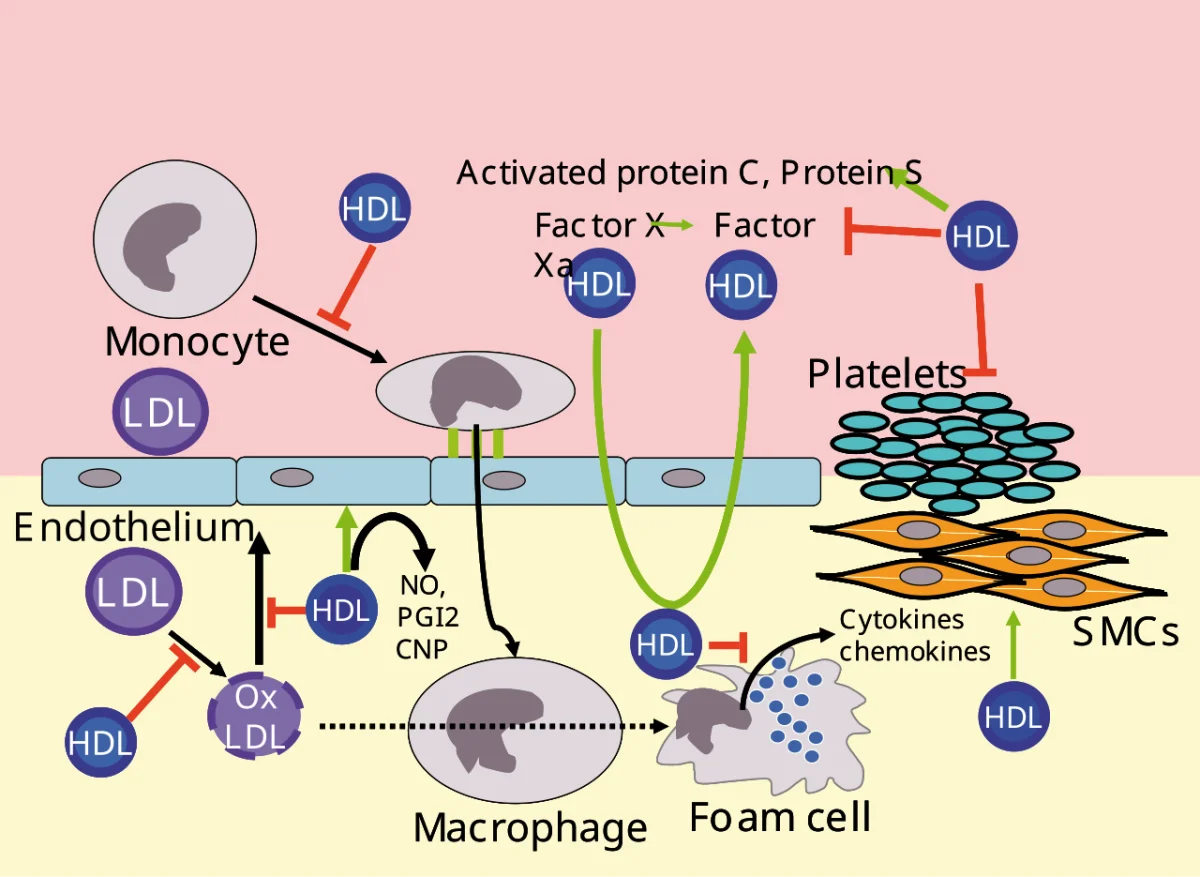
LDL is the cholesterol-delivery particle. Cells take up LDL via the LDL receptor (a classic example of receptor-mediated endocytosis). Dysfunctional LDL receptors (as in familial hypercholesterolemia) cause high blood LDL and early cardiovascular disease. Oxidized LDL is a major player in atherosclerotic plaque formation - it is taken up by macrophages that become foam cells in the artery wall.
HDL
HDL scavenges cholesterol from peripheral tissues (including atherosclerotic plaques) and returns it to the liver for disposal or reuse - reverse cholesterol transport. HDL is “good” because the more HDL, the more cholesterol can be cleared from tissues.
Apolipoproteins
The proteins on the surface identify the particle to receptors. A few you should recognize:
- apoB-48: on chylomicrons. Made by intestine.
- apoB-100: on VLDL/IDL/LDL. Made by liver. Binds the LDL receptor.
- apoA-I: on HDL. Activates LCAT, the enzyme that esterifies free cholesterol for transport.
- apoC-II: activates lipoprotein lipase (on chylomicrons and VLDL).
- apoE: mediates clearance of chylomicron remnants and IDL by the liver.