Two monosaccharides joined by a glycosidic bond form a disaccharide. Three disaccharides dominate the MCAT: maltose, lactose, and sucrose. Each has a specific pair of sugar monomers and a specific bond type.
The Big Three
Disaccharide
Composition
Bond type
Reducing?
Everyday source
Maltose
Glucose + glucose
α-1,4
Yes
Malt, beer, barley
Lactose
Galactose + glucose
β-1,4
Yes
Milk
Sucrose
Glucose + fructose
α-1,2 glycosidic (anomeric-to-anomeric)
No
Table sugar, sugar cane
Maltose
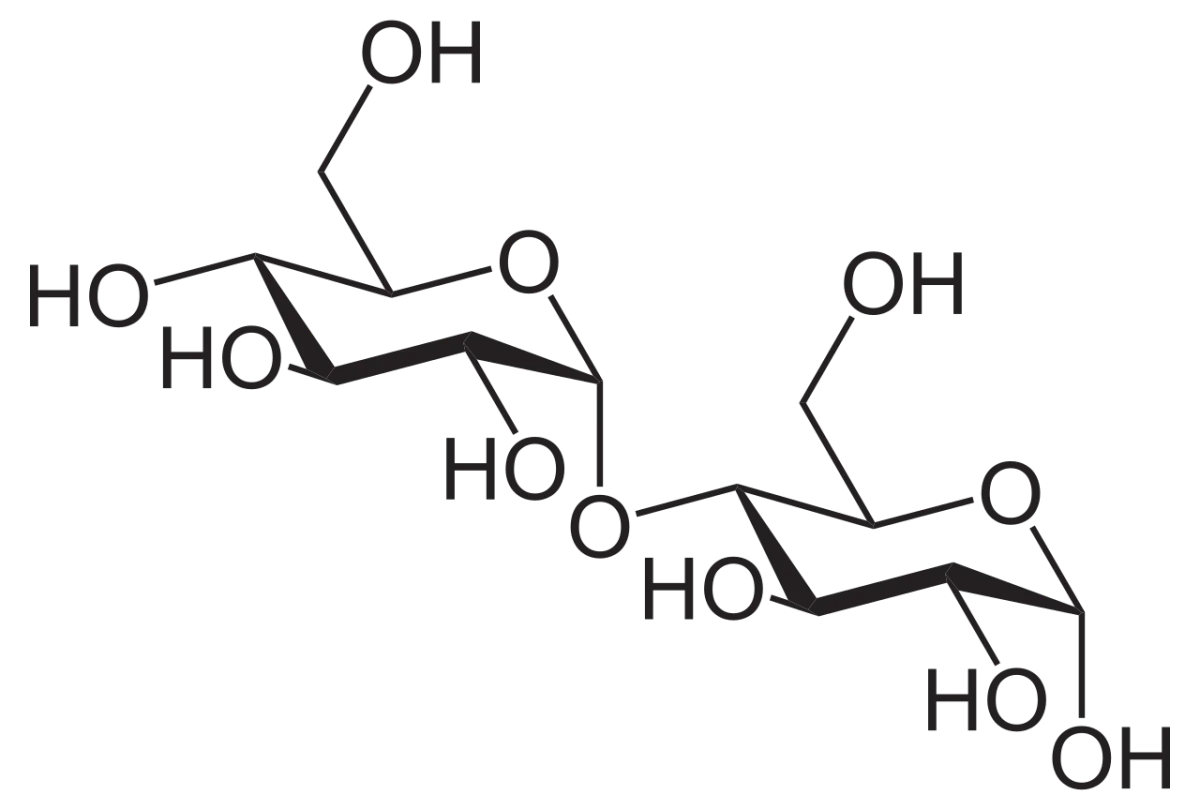
Maltose: two glucose units connected by an alpha-1,4 glycosidic bond. The right-side C1 is free (reducing). Credit: Wikimedia Commons, CC BY-SA
Maltose is a glucose-glucose disaccharide with an alpha-1,4 bond. It is a digestion product of starch - amylase breaks starch into maltose fragments, and maltase (in the intestinal brush border) splits maltose into two glucoses.
Malted barley has high maltose content, hence the name. Maltose is a reducing sugar because one anomeric carbon (on the right-hand glucose) is still free.
Lactose
Lactose is the sugar in milk. It is galactose (on the left) linked to glucose (on the right) via a beta-1,4 glycosidic bond. Both units are in their pyranose forms.
Lactose: galactose-beta-1,4-glucose. The beta linkage requires lactase (in humans, only infants and some adults express lactase fully into adulthood). Credit: Wikimedia Commons, CC BY-SA
Digestion requires lactase (a beta-galactosidase) in the brush border. Adults who stop expressing lactase develop lactose intolerance - undigested lactose reaches the colon, bacteria ferment it, and gas and diarrhea result.
Sucrose
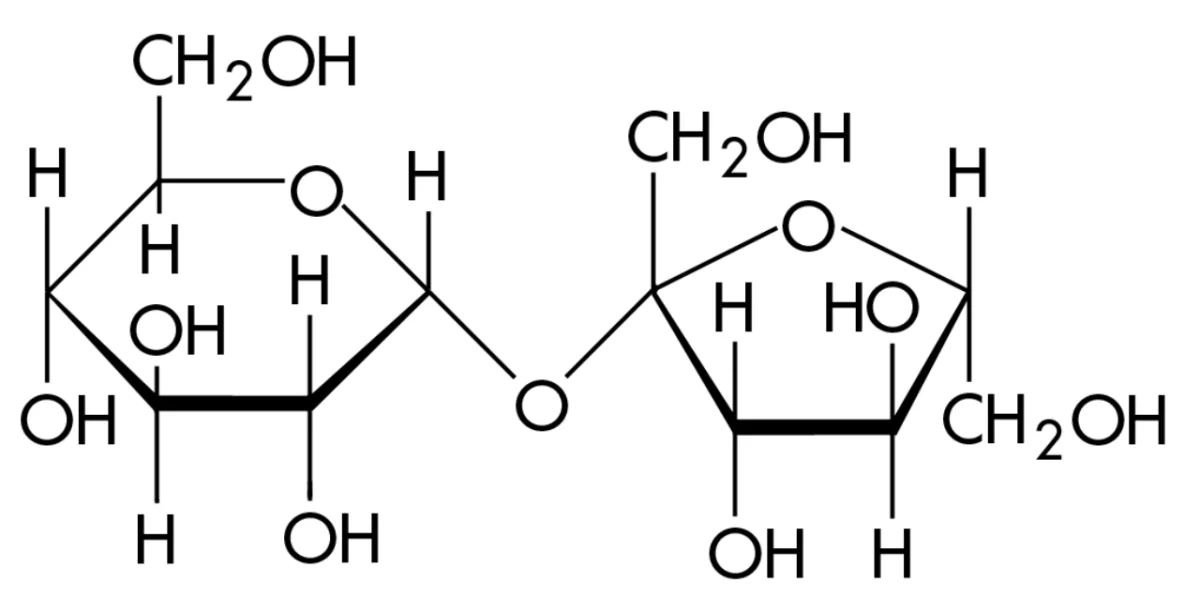
Sucrose is glucose + fructose. The bond is unusual: it is formed between the anomeric C1 of glucose and the anomeric C2 of fructose. Because BOTH anomeric carbons are locked in the glycosidic bond, sucrose has no free anomeric -OH. It is a non-reducing sugar.
Sucrose: glucose-α-1,2-β-fructose. Both anomeric carbons are in the bond, so there is no free -OH available for oxidation. Sucrose is non-reducing. Credit: Wikimedia Commons, CC BY-SA
Digestion requires sucrase in the brush border, which yields glucose + fructose.
Disaccharidases
All disaccharides are broken down by specific brush-border enzymes:
Maltase splits maltose into 2 glucose.
Lactase splits lactose into galactose + glucose.
Sucrase (part of sucrase-isomaltase) splits sucrose into glucose + fructose.
Isomaltase cleaves alpha-1,6 branch points from starch digestion products.
The monosaccharide products are absorbed by enterocytes via specific transporters (SGLT1 for glucose/galactose, GLUT5 for fructose).
What monosaccharides make up each of maltose, lactose, and sucrose, and what is each bond type?
Click to reveal answer
Maltose = glucose + glucose via α-1,4. Lactose = galactose + glucose via β-1,4. Sucrose = glucose + fructose via α-1,2 glycosidic (both anomeric carbons in the bond).
Why is sucrose a non-reducing sugar?
Click to reveal answer
Because both component anomeric carbons (C1 of glucose and C2 of fructose) are in the glycosidic bond. Neither monomer has a free anomeric -OH available to open and expose an aldehyde or alpha-hydroxy ketone. Without that, sucrose cannot be oxidized by Benedict's/Tollens'/Fehling's reagent.
What enzyme digests lactose, and why do many adults stop making it?
Click to reveal answer
Lactase, a brush-border beta-galactosidase, cleaves lactose into galactose + glucose. In many adults, lactase expression decreases after weaning (the ancestral human state). Undigested lactose reaches the colon where bacteria ferment it, producing gas, bloating, and diarrhea - lactose intolerance. Lactase persistence into adulthood is a relatively recent mutation enriched in historically dairy-dependent populations.