Sugars have lots of chiral centers and at least one ring. To avoid drawing 3D perspective every time, chemists use two conventional 2D shortcuts: Fischer projections (linear) and Haworth projections (cyclic).
Fischer Projections
Fischer projection rules:
Carbon chain is drawn vertically, with the most oxidized carbon (usually the aldehyde or ketone) at the top.
Horizontal bonds come OUT of the page toward you.
Vertical bonds go BEHIND the page.
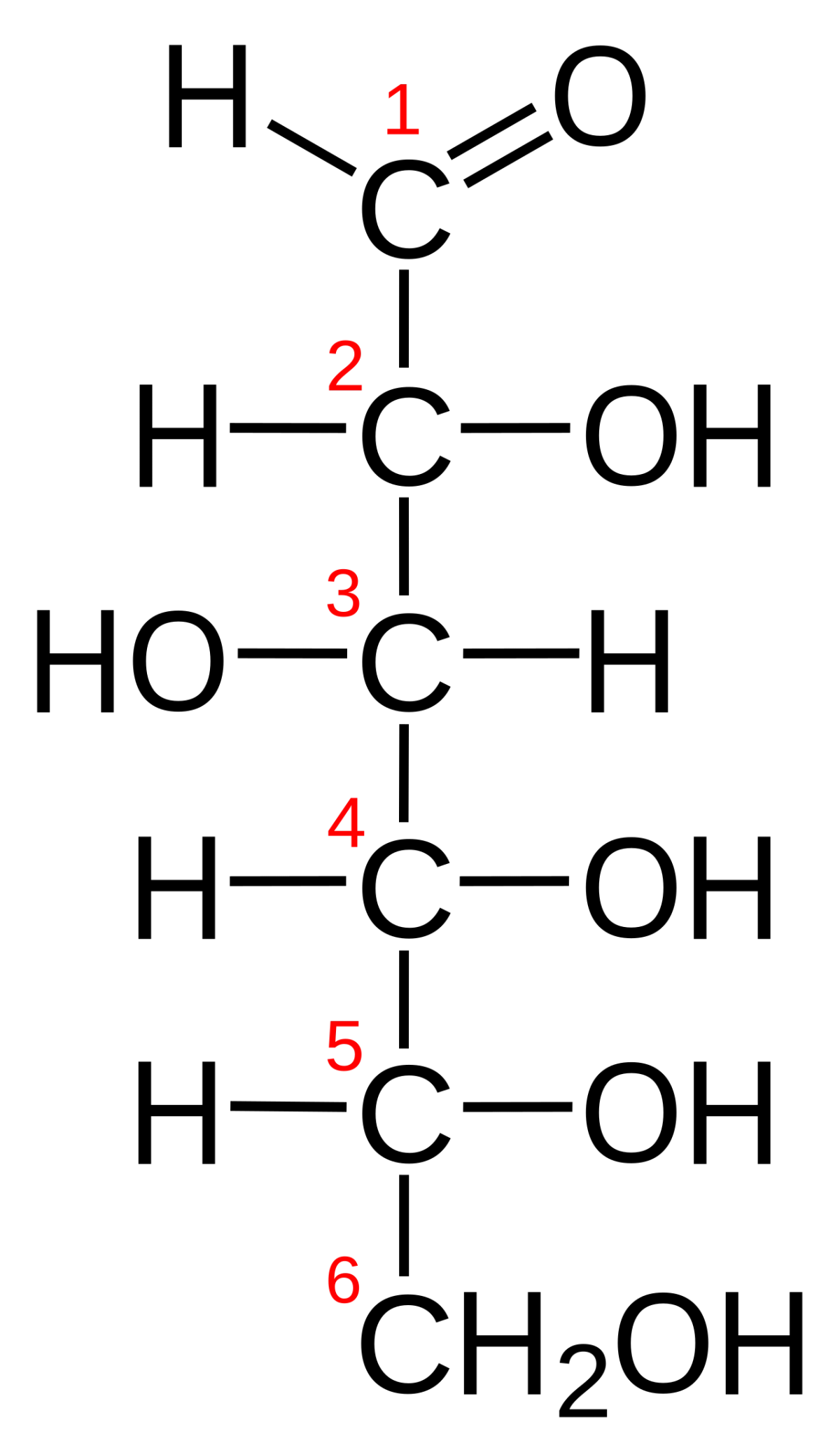
Fischer projection of D-glucose. The C1 aldehyde is at the top; the OH on the bottom-most chiral center (C5) points right, which defines D-sugars. Credit: Wikimedia Commons, CC BY-SA
The “D” or “L” label is set by the bottom chiral center. If its -OH is on the right, the sugar is D. If on the left, L. Almost all naturally occurring sugars are D.
Haworth Projections
Most sugars exist as rings in solution. A Haworth projection depicts the ring structure as a flat hexagon (six-membered ring = pyranose) or pentagon (five-membered ring = furanose) with substituents drawn up or down.
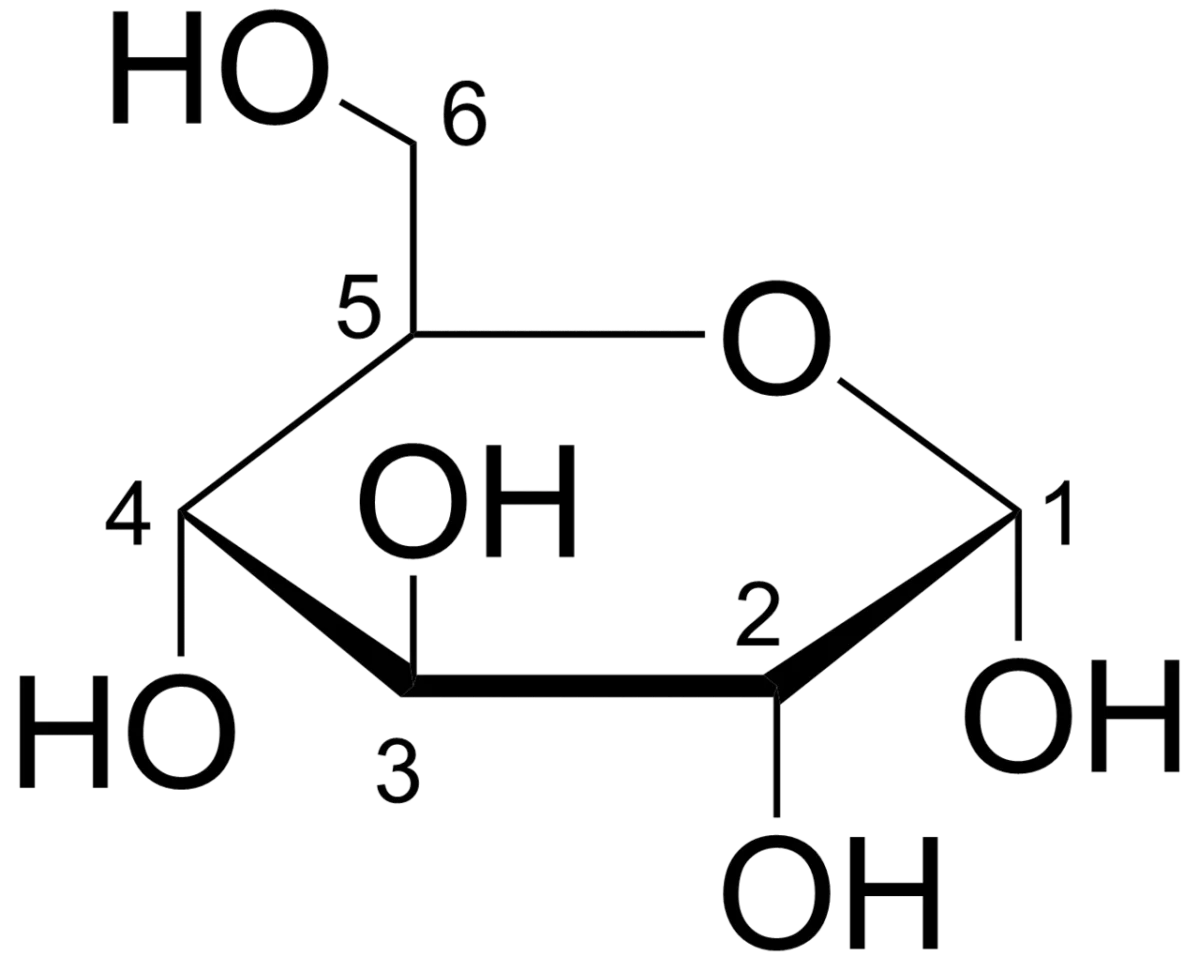
Haworth projection of glucose. The ring is a flat hexagon; OH groups project up or down. The oxygen in the ring is the bridge between C5 (or C4 for furanoses) and the carbonyl carbon. Credit: Wikimedia Commons, CC BY-SA
Fischer to Haworth Conversion Rule
To convert a Fischer projection to Haworth:
Groups on the right in Fischer go DOWN in Haworth.
Groups on the left in Fischer go UP in Haworth.
The terminal -CH2OH (C6 for hexoses) goes UP for D-sugars.
Pyranose vs. Furanose
Pyranose = 6-membered ring (5 carbons + 1 oxygen). Named after pyran. Most hexoses (glucose, galactose, mannose) prefer the pyranose form.
Furanose = 5-membered ring (4 carbons + 1 oxygen). Named after furan. Fructose (a hexose) and ribose (a pentose, in nucleic acids) exist as furanoses.
The Chair Conformation
For a more realistic 3D view, pyranose rings are sometimes drawn in chair conformation (the six-membered ring looks like a lawn chair). In the chair of β-D-glucopyranose, every large substituent sits equatorial (sticking out horizontally), which is maximally stable. This is part of why glucose is the most common monosaccharide: it is unusually stable in its ring form.
In a Fischer projection, how do you tell whether a sugar is D or L?
Click to reveal answer
Look at the bottom-most chiral center (for a hexose, C5). If the hydroxyl group points to the right, the sugar is D. If it points to the left, L. The designation only cares about that single chiral center, regardless of orientations at other positions.
A hydroxyl group is drawn on the right in a Fischer projection. Where does it appear in the Haworth projection?
Click to reveal answer
Below the ring (pointing DOWN). The rule is "right in Fischer becomes down in Haworth, left in Fischer becomes up in Haworth." For D-sugars, the terminal -CH2OH (C6 in a hexose) points UP.
Why does glucose form a pyranose while fructose forms a furanose?
Click to reveal answer
Glucose's aldehyde carbonyl is at C1. When C5's hydroxyl attacks C1, the resulting ring has 6 members (5C + 1 O): a pyranose. Fructose's ketone carbonyl is at C2. When C5's hydroxyl attacks C2, the resulting ring has 5 members (4C + 1 O): a furanose. The ring size follows directly from which carbon bears the carbonyl.