
Important Monosaccharides
A handful of monosaccharides do most of the physiologically important work. Memorize these by shape, by epimer relationship, and by food source.
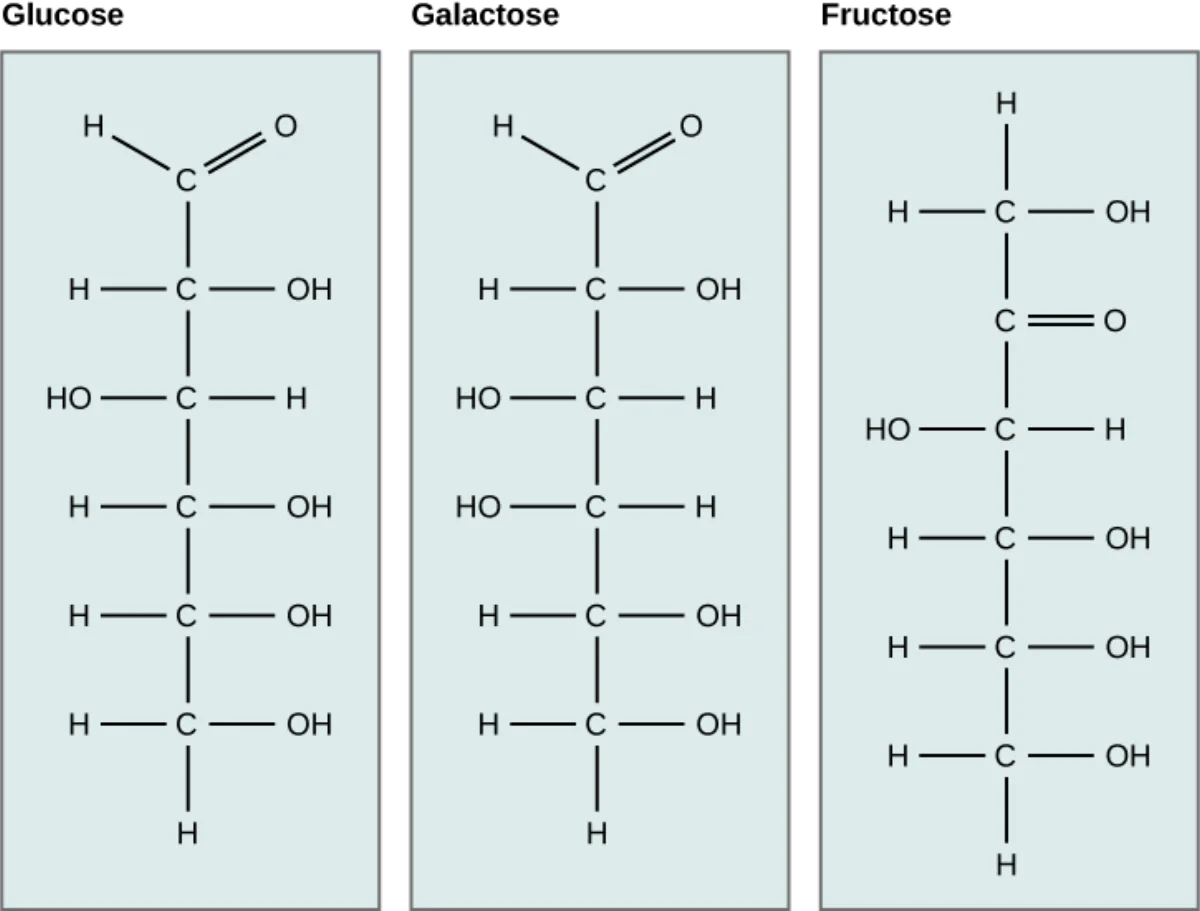
Glucose
The universal monosaccharide. Blood sugar. Every cell in your body can use glucose for energy. It is an aldohexose. In solution, it exists mostly as beta-D-glucopyranose (64%) and alpha-D-glucopyranose (36%). Blood-glucose levels are tightly regulated around 80-100 mg/dL in the fasting state (about 4-5 mM).
Glucose enters cells through GLUT transporters, then gets phosphorylated by hexokinase (or glucokinase in the liver). Once phosphorylated, it cannot diffuse back out.
Fructose
Fruit sugar. A ketohexose and a C2-C5 structural rearrangement of glucose. In solution, fructose favors the furanose (five-membered ring) form. Sweeter than sucrose.
Fructose bypasses the usual glucose regulatory steps. It enters hepatocytes independently of insulin and gets phosphorylated by fructokinase at C1 - skipping phosphofructokinase-1 regulation in glycolysis. This is why very high fructose intake (e.g., from high-fructose corn syrup) can overload the liver faster than an equivalent amount of glucose.
Galactose
Galactose is the C4 epimer of glucose. It is half of lactose (the sugar in milk). After digestion of lactose, galactose is converted back to glucose-6-phosphate by a series of enzymes (the Leloir pathway), the most important of which is galactose-1-phosphate uridyltransferase. Deficiency of this enzyme causes classic galactosemia - a serious neonatal disease.
Fructose and galactose: the side doors into glycolysis
Scroll sideways to see the whole map.
Why fructose is not just another sugarGalactose joins the trunk at glucose-6-phosphate, upstream of PFK-1, so it is subject to the same brake as glucose. Fructose in the liver joins as DHAP and glyceraldehyde-3-phosphate, downstream of PFK-1, so it pours in past the gate. That is why a large fructose load feeds straight into pyruvate, acetyl-CoA, and fatty acid synthesis without waiting for permission.
The enzyme deficienciesEssential fructosuria (fructokinase) is harmless: fructose simply appears in urine. Hereditary fructose intolerance (aldolase B) is not: fructose-1-phosphate piles up and traps the cell's phosphate, which stalls glycogenolysis and gluconeogenesis and causes hypoglycemia after fruit or sucrose. The same pattern holds for galactose: galactokinase deficiency gives cataracts from galactitol, while GALT deficiency is classic galactosemia, which is severe.
Where the cataracts come fromWhen galactose backs up, aldose reductase converts it to galactitol, which cannot leave the lens and pulls in water osmotically. The same enzyme makes sorbitol from glucose, which is the mechanism behind diabetic cataracts and neuropathy.
Mannose
The C2 epimer of glucose. Important as a component of glycoproteins, particularly on the surface of many microorganisms and on newly synthesized eukaryotic proteins in the ER. You do not need to memorize mannose metabolism, but recognize that it is a C2-glucose epimer.
Ribose and Deoxyribose
Both are pentoses (5 carbons).
- Ribose is the sugar in RNA and in many cofactors (ATP, NAD+, FAD, CoA). In ring form, it is a furanose.
- 2-Deoxyribose is the sugar in DNA - the only difference is that C2 has no -OH (just -H).
The missing -OH on deoxyribose makes DNA more chemically stable than RNA, which is why genetic information is stored in DNA rather than RNA.
Quick Identification Table
| Sugar | Type | Notable feature | Found in |
|-------|------|-----------------|----------|
| Glucose | Aldohexose | Blood sugar | Every cell |
| Fructose | Ketohexose | Sweeter; furanose ring | Fruits, honey, HFCS |
| Galactose | Aldohexose | C4 epimer of glucose | Milk (as lactose) |
| Mannose | Aldohexose | C2 epimer of glucose | Glycoprotein N-linkages |
| Ribose | Aldopentose | Furanose | RNA, ATP, NAD+ |
| 2-Deoxyribose | Aldopentose | Missing C2 -OH | DNA |