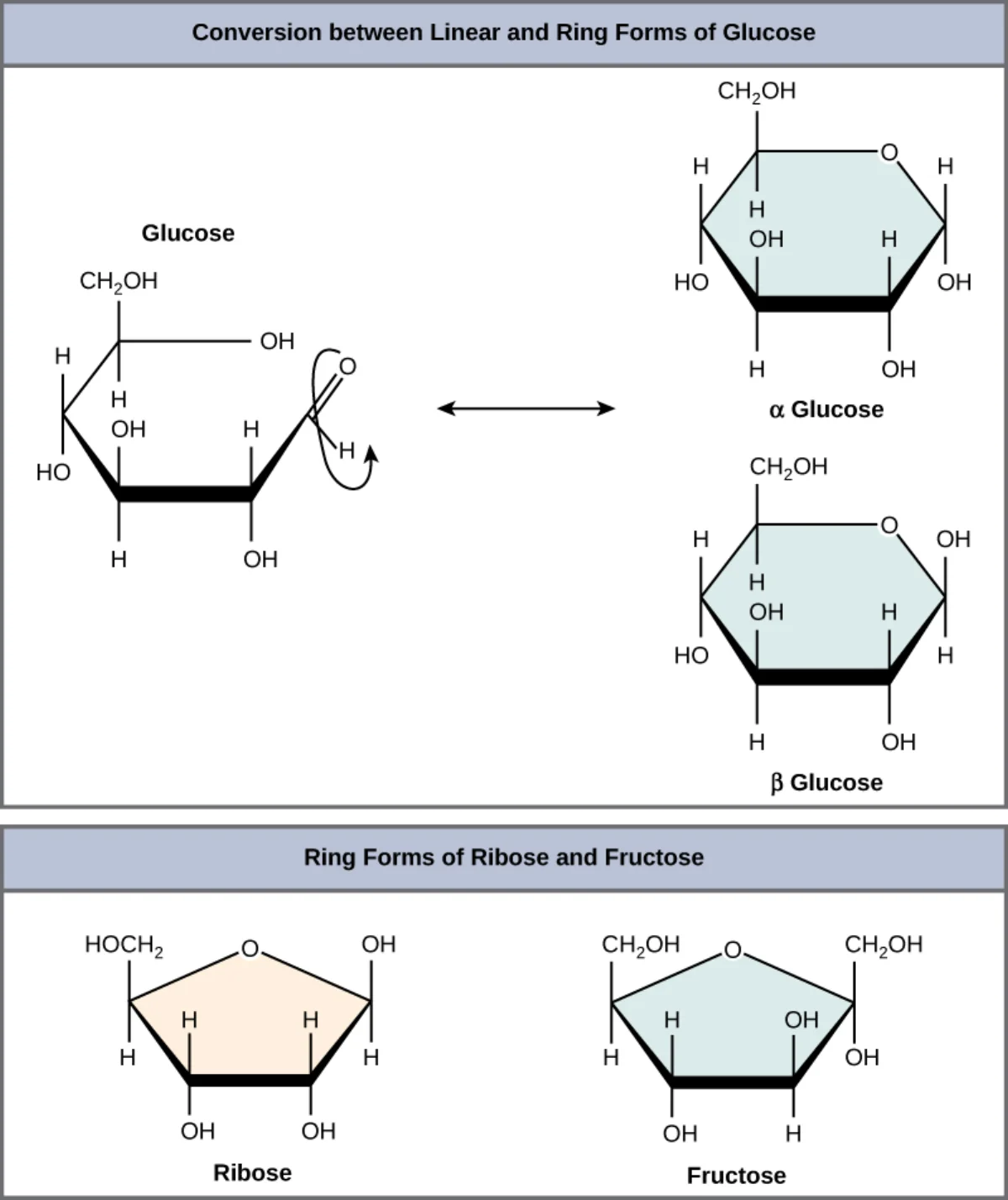
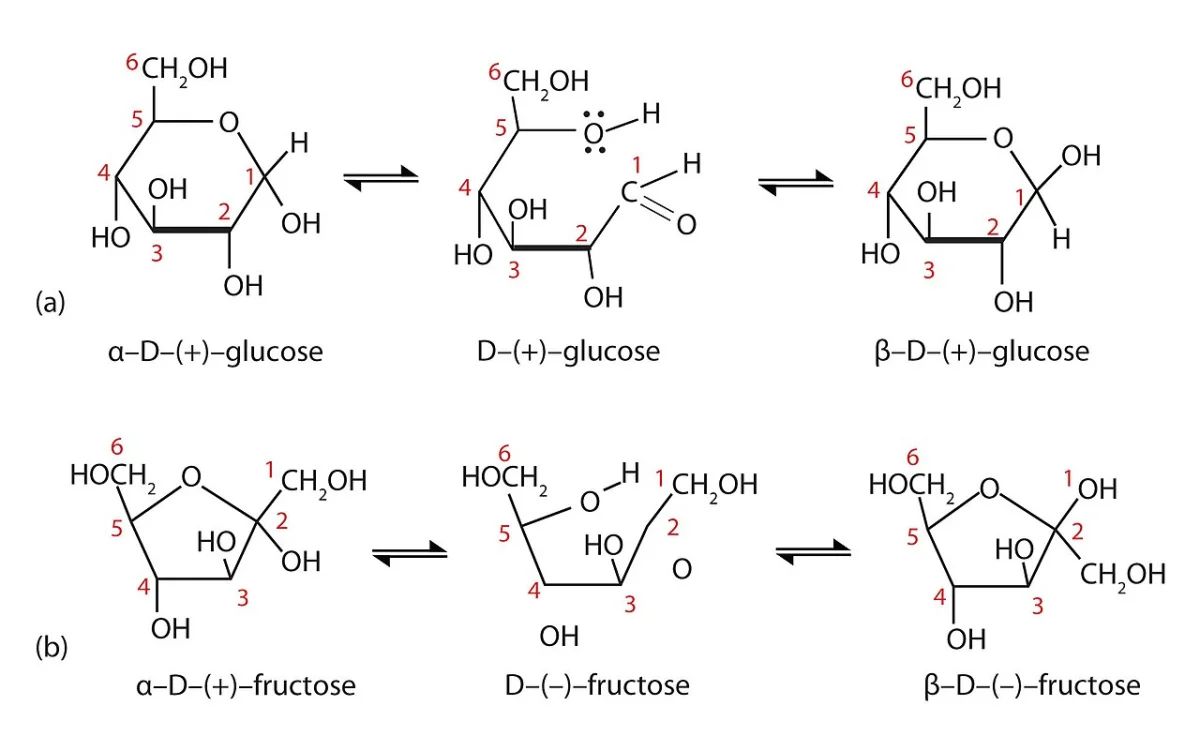
In solution, sugars exist mostly as rings. The ring forms by an intramolecular reaction between a hydroxyl group and the carbonyl group of the same molecule. Understanding this step is the key to understanding anomers and mutarotation.
Hemiacetals and Hemiketals
Hemiacetal: formed when an alcohol attacks an aldehyde. The resulting carbon has -OR and -OH on the same carbon.
Hemiketal: formed when an alcohol attacks a ketone. Same idea, but starting from a ketone.
For sugars, the attack is intramolecular - a hydroxyl from farther down the chain swings around and adds to the carbonyl.
Glucose ring formation. The aldehyde at C1 is attacked by the hydroxyl oxygen at C5, closing a six-membered pyranose ring. The new -OH at C1 defines the anomeric carbon. Credit: OpenStax Biology 2e, CC BY 4.0
The hydroxyl can only reach the carbonyl because of how the chain folds. The specific carbons involved determine ring size.
The Anomeric Carbon Is Special
In the linear form, C1 of glucose is an aldehyde - planar, sp2, no chirality. When it cyclizes to the hemiacetal, C1 becomes a chiral carbon. The new hydroxyl can be on either face (top or bottom), giving two possible stereochemistries. These are the alpha and beta anomers.
The anomeric carbon is always the only carbon with both -OR (ring oxygen) and -OH groups. You can always spot it in a ring structure.
Mutarotation
Pure alpha-D-glucose dissolved in water slowly equilibrates between the alpha and beta anomers. The linear (open-chain) form is the intermediate - the ring opens briefly, the C1 stereochemistry is lost, and re-closure can produce either anomer. After a few hours at room temperature, the solution reaches equilibrium at roughly 64 percent beta, 36 percent alpha, and less than 1 percent open chain.
This is mutarotation. It can be measured by optical rotation (specific rotation changes over time because the two anomers have different rotations).
Mutarotation. Pure alpha- or beta-glucose in solution slowly equilibrates via the linear open-chain aldehyde, reaching about 64% beta and 36% alpha at equilibrium. Credit: Wikimedia Commons, CC BY-SA
Reducing Sugars
Any sugar with a free (non-glycosidically-bonded) anomeric carbon can open into its linear form and expose the aldehyde (or alpha-hydroxy ketone), which can be oxidized. Such sugars are called reducing sugars and react positively with Benedict’s, Tollens’, or Fehling’s reagents.
Glucose, galactose, maltose, lactose: reducing (free anomeric carbon somewhere in the molecule).
Sucrose: non-reducing - both anomeric carbons are locked in the glycosidic bond.
What is a hemiacetal, and how does it form in glucose?
Click to reveal answer
A hemiacetal is a carbon bearing both an -OR group and an -OH group. In glucose, the C5 hydroxyl attacks the C1 aldehyde carbonyl, forming a six-membered ring with a new -OH at C1 (the anomeric hydroxyl) and an -O- bridge to C5. That C1 is a hemiacetal. The corresponding reaction in fructose gives a hemiketal because it starts from a ketone.
What is mutarotation and why does pure alpha-D-glucose show it in water?
Click to reveal answer
Mutarotation is the spontaneous equilibration of alpha and beta anomers in solution. The ring briefly opens into the linear (open-chain) form, losing the C1 stereochemistry, and then recloses to either anomer. Over time, a pure anomer reaches the equilibrium ratio (about 64% beta, 36% alpha for glucose). The changing mix is detectable as a change in optical rotation.
Why is sucrose not a reducing sugar even though it is made from glucose and fructose?
Click to reveal answer
Both anomeric carbons (C1 of glucose and C2 of fructose) are locked in the glycosidic bond. Neither has a free -OH that can equilibrate with an open-chain aldehyde or alpha-hydroxy ketone. Without that free anomeric hydroxyl, sucrose cannot be oxidized and gives a negative Benedict's/Fehling's test.