
Monosaccharide Classification
A monosaccharide is a single sugar unit. Two pieces of information fully classify it: what functional group it carries and how many carbons it has.
Aldoses vs. Ketoses
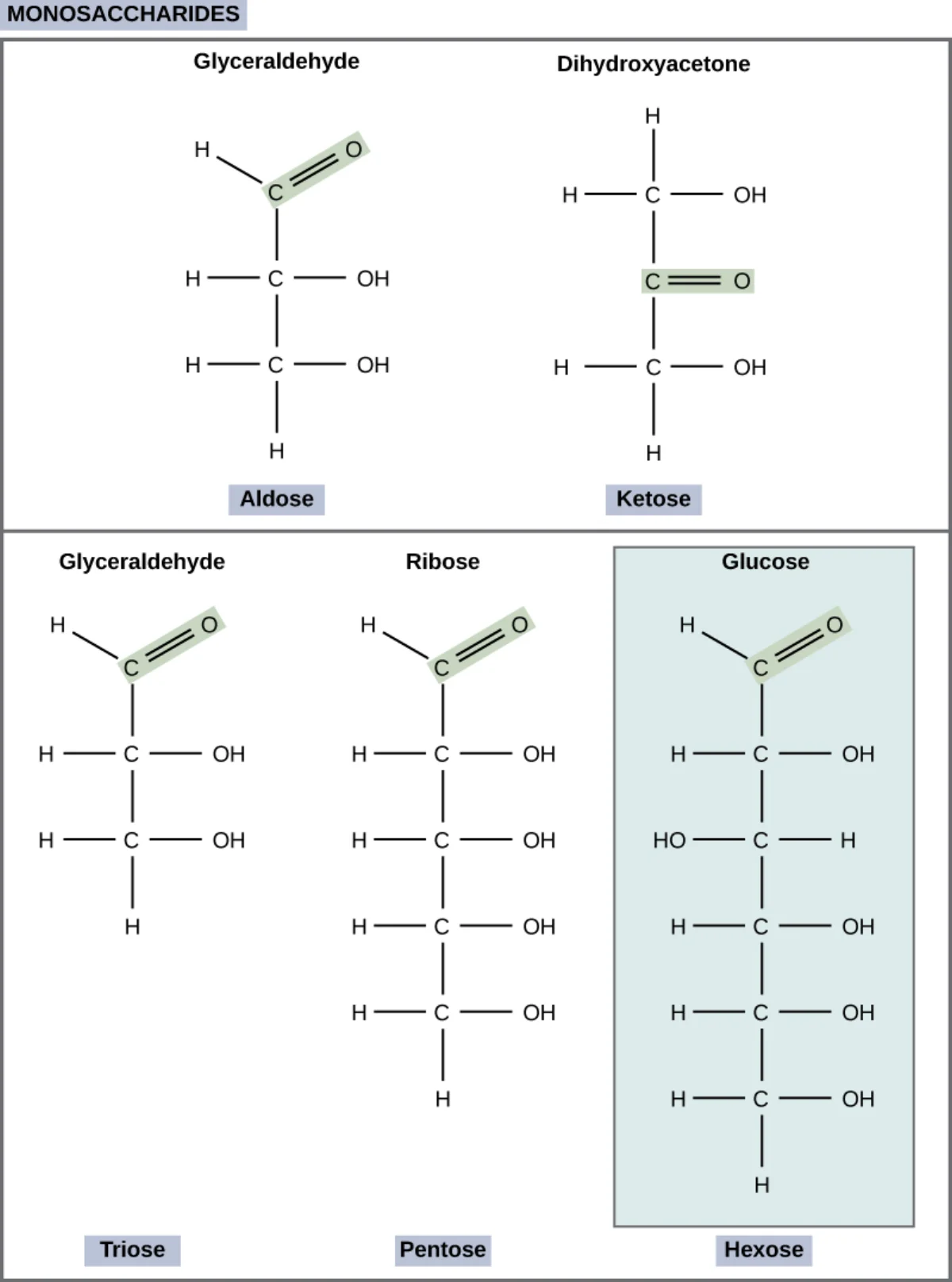
All monosaccharides have multiple hydroxyl groups and one carbonyl group (C=O). The position of the carbonyl splits them into two families.
- Aldose: carbonyl is an aldehyde at the END of the chain (C1). Example: glucose.
- Ketose: carbonyl is a ketone INSIDE the chain (usually C2). Example: fructose.
Classification by Carbon Count
| # Carbons | Name | Example aldose | Example ketose |
|---|---|---|---|
| 3 | Triose | Glyceraldehyde | Dihydroxyacetone (DHA) |
| 4 | Tetrose | Erythrose | Erythrulose |
| 5 | Pentose | Ribose | Ribulose |
| 6 | Hexose | Glucose, galactose | Fructose |
Combining the Two Classifications
You can put the two descriptors together. Glucose is an aldohexose (aldose + hexose = 6-carbon sugar with aldehyde). Fructose is a ketohexose (ketose + hexose = 6-carbon sugar with ketone). Ribose is an aldopentose.
What is the difference between an aldose and a ketose?
Click to reveal answer
An aldose has its carbonyl group as an aldehyde at the end of the carbon chain (C1). A ketose has its carbonyl as a ketone inside the chain (usually C2). All aldoses can be written as the complementary ketose through enolization, but in biology each sugar typically exists as one form.
Classify glucose, fructose, ribose, and glyceraldehyde.
Click to reveal answer
Glucose = aldohexose (6C, aldehyde). Fructose = ketohexose (6C, ketone). Ribose = aldopentose (5C, aldehyde). Glyceraldehyde = aldotriose (3C, aldehyde). Every monosaccharide can be named this way.
Why does dihydroxyacetone lack a chiral center despite being a ketose with hydroxyl groups?
Click to reveal answer
Its three-carbon structure is HOCH2-CO-CH2OH. The central carbon bears a C=O (no H attached), and the two flanking carbons each bear two identical -CH2OH groups on either side. No carbon has four different substituents, so no carbon is chiral. DHA is the only achiral triose.