
Aldol Condensation
The aldol reaction joins two aldehyde or ketone molecules into a single larger carbonyl compound. The mechanism has two phases: aldol addition (the alpha-C of one carbonyl attacks the carbonyl-C of another, giving a beta-hydroxy carbonyl) and, optionally, aldol condensation (dehydration of the beta-hydroxy product to give an alpha-beta unsaturated carbonyl, or enone).
Aldol chemistry is the foundational C-C bond-forming reaction of this chapter and a key tool in both laboratory synthesis and biochemistry (e.g., the aldolase step in glycolysis).
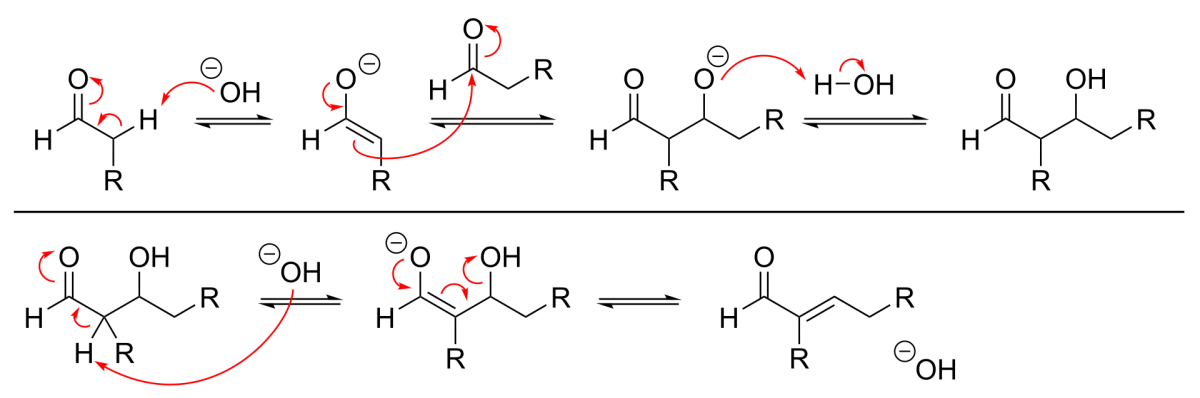
Base-Catalyzed Mechanism
Starting with acetaldehyde (CH₃CHO) as the simplest example:
Step 1: Enolate formation. Hydroxide (or alkoxide) removes an alpha-H to give the acetaldehyde enolate (CH₂=CHO⁻).
Step 2: Nucleophilic addition. The enolate’s C-end attacks the C=O carbon of a second acetaldehyde molecule. The pi bond of the target carbonyl breaks; electrons flow onto the oxygen.
Step 3: Alkoxide protonation. The resulting tetrahedral alkoxide is protonated by water to give the aldol - a beta-hydroxy aldehyde (3-hydroxybutanal).
Walk through the mechanism one step at a time below. Toggle between the self-aldol (acetone × acetone) and crossed aldol (acetone + benzaldehyde, which cannot enolize), and choose whether to stop at the addition product or continue through E1cb dehydration to the α,β-unsaturated enone.
Aldol step-through
NaOH removes the acidic α-hydrogen (pKa ~20). The resulting enolate is resonance-stabilized — negative charge delocalizes onto the carbonyl oxygen.
Net aldol addition: 2 CH₃CHO → CH₃CH(OH)-CH₂-CHO.
Step 4 (condensation, heat required): dehydration. Under heating or more concentrated base, the aldol loses water to form an alpha-beta unsaturated carbonyl (an enone or enal). For this example: CH₃CH(OH)-CH₂-CHO → CH₃-CH=CH-CHO (but-2-enal, crotonaldehyde).
The dehydration step (often via E1cb mechanism: deprotonate the alpha-H, then lose hydroxide) requires higher temperature because the simple alkoxide intermediate does not spontaneously lose water at room temperature.
Acid-Catalyzed Mechanism
Under acid catalysis (e.g., HCl):
- Carbonyl is protonated, activating it as an electrophile.
- Enol of one carbonyl (from acid-catalyzed tautomerization) attacks the protonated carbonyl.
- Deprotonation and further proton transfers give the beta-hydroxy carbonyl.
- Dehydration (loss of water) gives the enone.
Acid catalysis is useful when the substrate has both electrophilic and enolizable carbonyls, but base catalysis is more common on exam questions.
Product: Beta-Hydroxy Carbonyl or Enone?
The balance between aldol addition and condensation depends on conditions:
- Mild base, low temperature: aldol addition product (beta-hydroxy carbonyl). Isolable.
- Hot, concentrated base: aldol condensation product (alpha-beta unsaturated carbonyl, enone). The beta-hydroxy compound dehydrates.
For MCAT purposes, most questions assume the condensation product (enone) unless they specify otherwise.
Intramolecular Aldol: Rings
If a single molecule has two carbonyls on the same chain (like 2,6-heptanedione), intramolecular aldol condensation gives a ring. The alpha-H of one carbonyl attacks the other carbonyl carbon, closing the ring. The resulting product is a cyclic enone. Five- and six-membered rings form most easily (favorable enthalpy and entropy).
Intramolecular aldol is how rings get built from open-chain precursors. The Robinson annulation combines a Michael addition with an intramolecular aldol (although this is no longer on the AAMC outline).
Aldol in Biology: Glycolysis
In glycolysis, the enzyme aldolase cleaves fructose-1,6-bisphosphate (FBP) into two trioses: dihydroxyacetone phosphate (DHAP) and glyceraldehyde-3-phosphate (G3P). The mechanism is a retro-aldol (reverse aldol) - the enzyme breaks the C3-C4 bond of FBP by reversing the aldol addition.
- Class I aldolases (in animals) use a Schiff base with a lysine side chain to stabilize the iminium intermediate.
- Class II aldolases (in bacteria) use a zinc metal center to stabilize the enolate-like intermediate.
This biological aldol cleavage is the exact chemistry you just learned, happening in reverse.
Driving Force and Equilibrium
Simple aldol addition is moderately exothermic but reversible. Forming the enone (condensation) is very favorable because:
- Loss of water drives equilibrium forward (Le Chatelier).
- The conjugated enone is more stable than the disconnected beta-hydroxy carbonyl.
- The dehydration is entropically favorable (one molecule becomes two).
For this reason, when heating an aldol mixture, the enone almost always dominates in the final product mix.
2-butenal (crotonaldehyde), CH₃-CH=CH-CHO. Step 1: NaOH removes alpha-H of CH₃CHO to give the enolate CH₂=CHO⁻. Step 2: The enolate’s C-end attacks the C=O carbon of another acetaldehyde, giving the tetrahedral intermediate. Step 3: Protonation gives the aldol: 3-hydroxybutanal CH₃CH(OH)CH₂CHO. Step 4: Heat drives dehydration (E1cb via enolate intermediate) to give the enone: 2-butenal CH₃CH=CHCHO. This is the “crotonaldehyde” that is a common synthetic building block.