The C-H bonds on a carbon directly bonded to a carbonyl (the alpha-carbons) are anomalously acidic. Ordinary alkane C-H bonds have pKa around 50. But the alpha-C-H of a ketone has pKa around 20, and a 1,3-dicarbonyl alpha-H can have pKa around 10. That is 30-40 pKa units lower than a plain alkane - a factor of 10³⁰ in acidity.
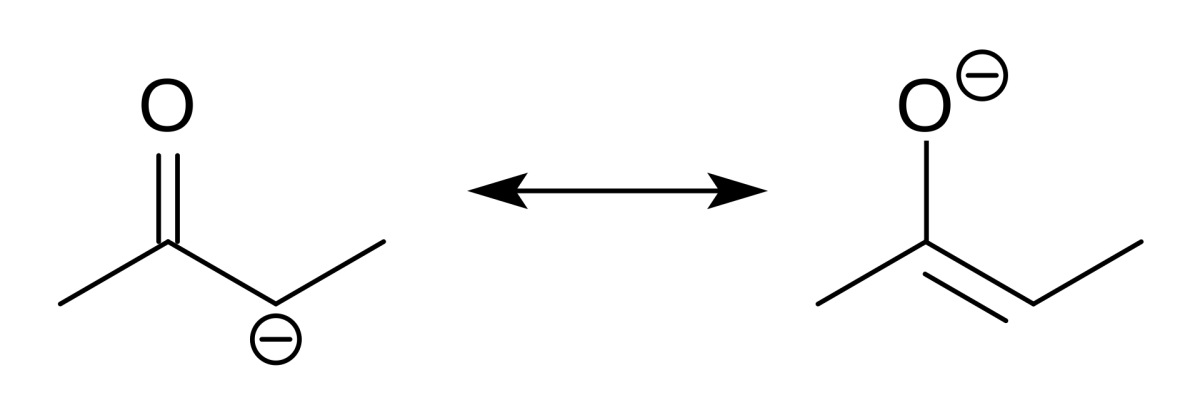
Why? The conjugate base after deprotonation (the enolate) has its negative charge delocalized from carbon onto oxygen via resonance. The oxygen lone-pair contributor stabilizes the anion enormously, because charge on O is much lower-energy than charge on C.
pKa Values You Should Memorize
Substrate
Alpha-H pKa
Notes
Alkane (R-CH₂-R’)
~50
Essentially not acidic
Nitrile (R-CH₂-CN)
25
One alpha-acidifying group
Ester (R-CH₂-COOR’)
25
One alpha-acidifying group
Ketone / aldehyde (R-CH₂-COR’)
20
One alpha-acidifying group, slightly more acidifying than ester
Nitro (R-CH₂-NO₂)
10
Very strong activator
1,3-dicarbonyl (R-CH₂ between two C=O)
10-13
Two alpha-acidifying groups
Malonate diester
13
Two ester groups
Acetoacetate (ester + ketone)
11
One ester, one ketone
Cyanoacetate
9
CN + ester
Nitroalkane + carbonyl
5-6
Very acidifying
These values match the ARIO framework from Chapter 4. Resonance stabilization onto carbonyl oxygens dominates - more carbonyls next door means more resonance delocalization means more acidic alpha-H.
The ester has an OR group attached to the carbonyl. This OR donates a lone pair by resonance, stabilizing the starting ester carbonyl and partially “using up” the carbonyl’s electrophilic character. When the alpha-H is removed, the resulting enolate has the negative charge delocalized onto the carbonyl oxygen - but the OR’s resonance donation has made this oxygen less eager to accept charge. The enolate is therefore less stable in an ester than in a ketone.
Net: ketone alpha-H is about 5 pKa units (100,000×) more acidic than ester alpha-H.
Choosing a Base for Deprotonation
The base must have a conjugate acid with pKa HIGHER than the target alpha-H pKa (Chapter 4.2 rule). Common base choices:
Target pKa
Sufficient bases
Sufficient?
10-13 (1,3-dicarbonyl)
NaOH (water pKa 15.7), NaOEt (ethanol pKa 16), K₂CO₃ (carbonic acid pKa 6.4, so not enough for pKa 10 - but its sodium salt is basic enough for some 1,3-dicarbonyls)
Hydroxide and alkoxide are NOT strong enough to fully deprotonate a simple ketone (pKa 20). They would only generate a small equilibrium fraction of enolate (~101,000). For clean enolate chemistry on simple ketones, you need NaH, LDA, or organolithium.
For 1,3-dicarbonyls (pKa 10-13), hydroxide and ethoxide work fine because the target pKa is well above the conjugate acid’s pKa.
Enolate resonance: after deprotonation of the alpha-H, the negative charge delocalizes between the alpha-carbon (carbanion form) and the carbonyl oxygen (enolate form). The O-centered form is the major contributor because negative charge is more stable on oxygen than on carbon. Credit: Wikimedia Commons, CC BY-SA
Stereochemistry Alert
Deprotonation of an alpha-carbon can create a new stereocenter (the alpha-carbon becomes sp² in the enolate, then sp³ again after protonation or alkylation). Reprotonation from either face gives a racemic mixture. This is how racemization of alpha-chiral carbonyls can happen in base - the molecule interconverts enolate and ketone forms repeatedly, equilibrating the stereochemistry.
Alpha-Acidity Is Substrate-Dependent Within One Molecule
If a ketone has two different alpha-carbons (one with more substituted C, one less), both are acidic but to slightly different degrees. The more hindered one usually gives the thermodynamic enolate; the less hindered one gives the kinetic enolate (covered in Section 7.4).
Why is the alpha-H of ethyl acetoacetate (CH₃COCH₂COOEt) much more acidic (pKa ~11) than the alpha-H of a simple ketone like 2-butanone (pKa ~20)?
Click to reveal answer
Ethyl acetoacetate has TWO carbonyl groups flanking the central alpha-carbon. After deprotonation, the resulting carbanion can delocalize its negative charge onto BOTH carbonyl oxygens via resonance. Charge over two oxygens vs. one oxygen is much more stable - about 10⁹ more acidic. 2-butanone has only one carbonyl to delocalize onto, so its conjugate base is less stabilized and the pKa is much higher.
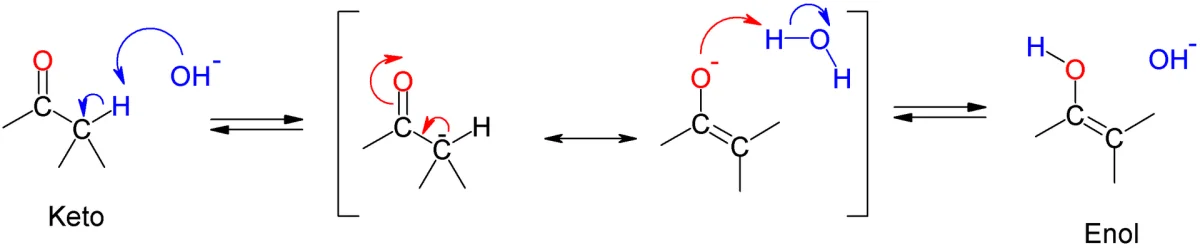
Every carbonyl with an alpha-hydrogen exists in equilibrium between two tautomeric forms: the keto form (C=O with alpha-CH) and the enol form (C-OH with alpha C=C). Tautomers are structural isomers that interconvert by the movement of a hydrogen AND a double bond - they are more than conformers but less than constitutional isomers.
For simple ketones, the keto form dominates overwhelmingly (>99.99%). For some special substrates (1,3-dicarbonyls, phenols, aromatic systems), the enol form is significant or even favored.
Flip between substrates and watch the equilibrium bar update: acetone lives almost entirely in the keto form, pentane-2,4-dione sits around 15% enol, and phenol is essentially “all enol” because the keto tautomer would break aromaticity.
Keto-enol tautomerization
Interactive
Equilibrium distribution for 2,4-Pentanedione:
keto 85.00%
15.00% enol
1,3-diketones have substantially enol: ~15% in protic solvent.
Keto-enol tautomerism: the keto form has C=O + alpha-CH; the enol form has C-OH + C=C-adjacent. The two interconvert by migration of a hydrogen. Equilibrium lies far toward keto for simple substrates. Credit: Wikimedia Commons, CC BY-SA
The Two Tautomers
Starting from a simple ketone like acetone (CH₃COCH₃), the two tautomers are:
Keto form: CH₃-CO-CH₃. C=O is intact. Alpha-C has 3 H’s.
Enol form: CH₃-C(OH)=CH₂. The C=O has become C-OH; one alpha-H has migrated to the oxygen; a new C=C double bond links alpha-C and the original carbonyl C.
For acetone, the equilibrium ratio is about 10⁻⁶ (one enol per million keto). The keto form wins because:
The C=O bond is stronger than the C=C (~750 vs ~610 kJ/mol).
A C-H bond is stronger than an O-H bond (~410 vs ~460 kJ/mol for this position).
Overall, the keto form has lower energy.
Substrates That Favor the Enol
Some molecules prefer the enol form:
1,3-dicarbonyls (like 2,4-pentanedione, ethyl acetoacetate) have enol fractions around 15% at equilibrium because the enol form has an intramolecular H-bond AND a conjugated C=C-C=O system (resonance stabilization).
Phenol exists essentially 100% as the enol form (the aromatic benzene ring is much more stable than the hypothetical cyclohexadienone keto form).
Cyclohexanedione and similar 1,3-diones have enol percentages up to 80% or more.
Indole, imidazole, and similar aromatic heterocycles exist as tautomers where one form is aromatic.
Mechanism of Interconversion
Keto and enol interconvert through two proton transfers. Under acid catalysis:
Carbonyl oxygen is protonated.
Alpha-H is removed by a base (water, conjugate base of catalyst).
Result: enol (with C=C and OH).
Under base catalysis:
Alpha-H is removed by base, giving the enolate.
Enolate is protonated on the oxygen to give the enol.
Acid-catalyzed route converts keto → enol; base-catalyzed route does the same via the enolate.
Why Tautomerism Matters
Racemization of alpha-stereocenters in water: if the alpha-carbon is a stereocenter, passage through the enol (where the alpha-C is sp²) loses the stereochemistry. Reprotonation gives a racemic mixture. This happens readily in aqueous acidic or basic conditions.
Enol/enolate chemistry drives most reactions in this chapter: aldol, Claisen, alkylation, Michael all need the alpha-C to become nucleophilic, which is exactly what the enol/enolate provides.
Biological ketoses and aldoses: glucose and fructose interconvert through the enediol form (an enol-like intermediate). Similarly, many biosynthetic steps go through enol intermediates.
Tautomerism in Sugar Chemistry
Glucose (aldohexose, aldehyde + 5 OH) and fructose (ketohexose, ketone + 5 OH) can interconvert via an enediol intermediate in the Lobry de Bruyn-Alberda van Ekenstein transformation. In biology, this isomerization is catalyzed by phosphoglucose isomerase in glycolysis. The enzyme stabilizes the cis-enediol transition state using its active-site lysine.
Sugar tautomerism also explains mutarotation: when pure alpha-glucose is dissolved in water, it slowly equilibrates to a 36:64 mixture of alpha and beta anomers (with a trace of open-chain aldehyde). The interconversion goes through the open-chain form, which has a free aldehyde that can re-close to either anomer.
The Enol as a Precursor to Other Reactions
In enol form, the alpha-C is partially nucleophilic (it has some electron density from the C=C). This explains why certain reactions happen preferentially at the alpha-C under acidic conditions - the enol attacks electrophiles like halogens (alpha-halogenation) or carbonyls (aldol). Under base, the more nucleophilic enolate does the same.
Explain why the enol form of 2,4-pentanedione is present at about 15% at equilibrium, while acetone’s enol form is only about 10⁻⁶% at equilibrium.
Click to reveal answer
2,4-pentanedione’s enol form benefits from two special features that acetone’s enol lacks: (1) an intramolecular hydrogen bond between the OH and the remaining C=O (a 6-membered ring H-bond), and (2) a conjugated C=C-C=O system that provides resonance stabilization. Acetone’s enol has neither - the alpha-C=C is not conjugated to anything, and there is no second carbonyl to form an intramolecular H-bond. These stabilizations make the 1,3-dicarbonyl enol much more energetically competitive with its keto form.
An enolate is the conjugate base of a carbonyl compound after alpha-H deprotonation. Its structural feature is the negative charge delocalized over both the alpha-carbon and the carbonyl oxygen. Knowing which end attacks in a given reaction - and why - is essential to predicting products.
The Two Resonance Contributors
After a base removes an alpha-H, the resulting anion has two resonance forms:
C-centered enolate (carbanion form): the negative charge is on the alpha-carbon. Formal structure: R-C⁻H-C(=O)-R’.
O-centered enolate (O-anion form): the negative charge is on the carbonyl oxygen. Formal structure: R-CH=C(O⁻)-R’. A new C=C double bond connects alpha-C and the carbonyl C.
The O-centered form is the major contributor because negative charge is much more stable on oxygen than on carbon (oxygen is more electronegative). But the minor contributor (C-centered) is the reactive form for many C-alkylation and aldol reactions.
Which Carbon Attacks?
Enolates can attack electrophiles at either end:
C-alkylation (via C-centered form): alpha-carbon attacks, forming a new C-C bond. This is the predominant pathway for hard alkylating electrophiles like methyl iodide.
O-alkylation (via O-centered form): oxygen attacks, forming a new C-O bond. This is the minor pathway with most electrophiles but becomes dominant with certain soft electrophiles or specific conditions.
For MCAT purposes, C-alkylation dominates for most enolate + alkyl halide reactions. O-alkylation is a specialized side reaction that occurs under particular conditions.
Why the O-Centered Form Is More Stable
Resonance structure stability rules from Chapter 3.8:
Oxygen holds negative charge better than carbon (more electronegative → lower energy when bearing negative charge).
The O-centered form has the same total number of bonds as the C-centered form (both have one C=C or C=O double bond and one single bond in the key positions).
The O-centered form has the negative charge on a more electronegative atom.
Net: O-centered resonance contributor is the MAJOR structural representation, but both contribute to the real anion.
The Enolate Is Nucleophilic at BOTH Ends
Even though the O-centered form is major in terms of electron density distribution, the C-end is what most MCAT reactions use. The reason: when a new bond forms, the enolate’s carbon end attacks an electrophile (usually a sp³ carbon or a sp² carbonyl carbon). The carbon-on-carbon bond is the productive one for building carbon chains. O-alkylation gives an enol ether, which is not usually the desired product.
Stereochemistry of the Enolate
The alpha-carbon in the enolate is sp² (planar) because the C=C and the C-O⁻ require sp² hybridization around the former carbonyl carbon and the adjacent alpha-carbon. Reprotonation (or alkylation) can occur from either face of this planar system, giving a mixture of stereoisomers.
Enzymatic enolate reactions can control facial selectivity by using a chiral active site, but classical laboratory enolate reactions usually produce racemic or near-racemic products at new stereocenters.
Counterion Effects
The counterion (Li⁺, Na⁺, K⁺) affects enolate reactivity:
Lithium enolates (from LDA): the Li⁺ coordinates tightly to the O-end, which makes the C-end more reactive. Li enolates give clean C-alkylation.
Sodium/potassium enolates: looser ion pairing, slightly different reactivity profile.
For MCAT purposes, do not worry about the counterion specifics - know that the O-end usually gets the counterion while the C-end attacks electrophiles.
Enolate vs Enol: Related but Different
Enol = neutral alcohol with C=C (C-OH + alpha C=C). Exists naturally via tautomerism. Attacks electrophiles slowly.
Enolate = anion with negative charge delocalized (C⁻ ↔ O⁻). Generated by deprotonation with strong base. Attacks electrophiles much faster.
Acid-catalyzed reactions typically use the enol form. Base-catalyzed reactions use the enolate. Aldol can happen via either pathway.
Reactions the Enolate Drives
Aldol condensation (Sec 7.5): enolate attacks another carbonyl’s electrophilic carbon.
Claisen condensation (Sec 7.7): ester enolate attacks another ester’s carbonyl (with ester alkoxide as leaving group).
Alpha-alkylation (Sec 7.9): enolate attacks an alkyl halide (SN2).
Michael addition (Sec 7.10): enolate attacks an alpha-beta unsaturated carbonyl at the beta-C.
Alpha-halogenation: enolate attacks X₂ or X-source at the alpha-C.
Five reactions, all starting with the same enolate. Once you know how to form the enolate, you can follow every reaction in this chapter.
Draw the two resonance contributors of the enolate of acetaldehyde (CH₃CHO) after deprotonation of its alpha-H. Which contributor is the major one, and why?
Click to reveal answer
Contributor 1 (C-centered, minor): ⁻CH₂-CHO - negative charge on the alpha-carbon. Contributor 2 (O-centered, major): CH₂=CH-O⁻ - negative charge on the oxygen; a new C=C double bond between alpha-C and the former carbonyl-C. The O-centered form is major because oxygen is more electronegative and holds negative charge better than carbon. However, in reactions the C-end (alpha-C) is usually where new bonds form, because C-C or C-alkyl bonds are what build up the carbon framework.
An asymmetric ketone - one with two different alpha-carbons - gives two possible enolates depending on which alpha-H is removed. The choice between them is controlled by conditions: low-temperature, bulky-base conditions give the kinetic enolate; higher-temperature, equilibrium conditions give the thermodynamic enolate. This regioselectivity is critical for directing where subsequent reactions happen.
The Two Enolates of 2-Methylcyclohexanone
Consider 2-methylcyclohexanone. There are two different alpha-carbons:
C1’s alpha is at the C2 position, which also has a methyl substituent. The C2-H is “more hindered” because C2 is a stereocenter with a methyl.
C1’s other alpha is at C6. The C6-H is “less hindered” because C6 has no substituent.
Removing the C2-H gives the MORE SUBSTITUTED enolate (C=C between C1 and C2, with a methyl substituent on the C=C). This enolate is more stable thermodynamically because the C=C is more substituted (more hyperconjugation → more stable).
Removing the C6-H gives the LESS SUBSTITUTED enolate (C=C between C1 and C6, with no methyl on the C=C). This enolate is less stable but the deprotonation is faster (less steric hindrance at C6).
LDA at -78°C → Kinetic Enolate
LDA (lithium diisopropylamide, Li⁺ ⁻N(iPr)₂) is a bulky strong base. It cannot easily reach the hindered alpha-H - it preferentially removes the less hindered alpha-H, giving the less substituted (kinetic) enolate. At low temperature (-78°C), there is not enough energy to equilibrate the enolates, so whichever one forms first is trapped.
Net: LDA at -78°C → kinetic enolate (less substituted alpha-C deprotonated) → C=C on the LESS substituted side.
NaH or KH at Higher Temperature → Thermodynamic Enolate
NaH or KH (sodium or potassium hydride) are smaller bases that can reach either alpha-H. At higher temperature (0°C to room temperature), deprotonation is reversible on practical timescales. The system equilibrates to the more stable (thermodynamic) enolate, which has the more substituted C=C.
Net: NaH at room temp → thermodynamic enolate (more substituted alpha-C deprotonated) → C=C on the MORE substituted side.
Trapping the Enolate
To preserve the kinetic enolate’s regiochemistry, you often trap it as a silyl enol ether (TMS enol ether) or alkylate it immediately:
Later, regenerate the enolate (with TBAF or similar fluoride source) and react with an electrophile.
This two-step “trap-and-use” sequence preserves the kinetic regiochemistry without letting the system equilibrate to the thermodynamic enolate.
Why This Matters for Synthesis
If a chemist needs to alkylate at a specific alpha-carbon of an asymmetric ketone, they must choose the right base and conditions to form the correct enolate:
Want to alkylate the less substituted alpha-C? Use LDA at -78°C → kinetic enolate → alkyl halide → alkylation at the less substituted position.
Want to alkylate the more substituted alpha-C? Use NaH or NaOEt at higher temperature → thermodynamic enolate → alkyl halide → alkylation at the more substituted position.
Choosing the wrong conditions gives the wrong product, and the MCAT tests this choice.
A Second Form of Selectivity: Hydroxide vs LDA
For 1,3-dicarbonyls (pKa 10-13), ordinary hydroxide is enough to deprotonate. For simple ketones (pKa 20), you need LDA, NaH, or organolithium. This is the pKa-matching rule from Chapter 4.2.
Combining regioselectivity (kinetic vs thermodynamic) with acid-base strength gives two axes of control:
Acid-base strength: determines IF the enolate forms at all.
Regioselectivity: determines WHICH alpha-H is removed.
Stereoselectivity
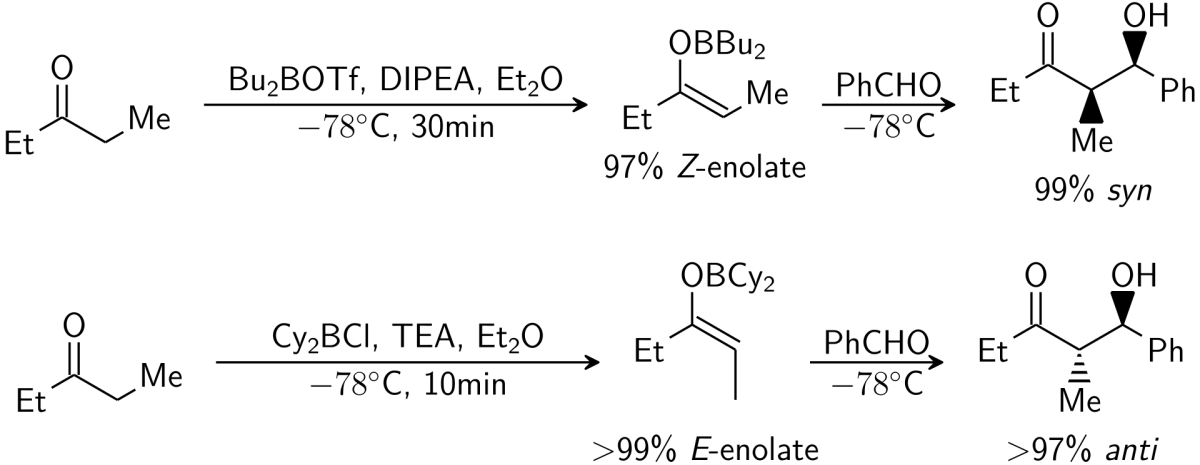
The kinetic enolate of a ketone often forms with a specific E/Z geometry (depending on the ketone’s structure and the base’s steric profile). LDA on certain ketones gives mostly the Z-enolate; LDA on others gives the E-enolate. This stereoselectivity carries over into subsequent aldol reactions, controlling the syn/anti diastereochemistry of the aldol product. This level of detail is beyond MCAT scope but useful to recognize in research-level passages.
2-methylcyclohexanone is treated with (a) LDA at -78°C, or (b) NaH at room temperature. Which enolate forms in each case, and what is the product if each is then treated with methyl iodide?
Click to reveal answer
(a) LDA at -78°C → kinetic enolate (less hindered alpha-H at C6 removed; C=C between C1 and C6). Methyl iodide alkylates at C6 → 6-methyl-2-methylcyclohexanone (now 2,6-dimethylcyclohexanone). (b) NaH at higher T → thermodynamic enolate (more hindered alpha-H at C2 removed; C=C between C1 and C2). Methyl iodide alkylates at C2 → 2,2-dimethylcyclohexanone. Same substrate, opposite products - the base and temperature choice decide everything.
The aldol reaction joins two aldehyde or ketone molecules into a single larger carbonyl compound. The mechanism has two phases: aldol addition (the alpha-C of one carbonyl attacks the carbonyl-C of another, giving a beta-hydroxy carbonyl) and, optionally, aldol condensation (dehydration of the beta-hydroxy product to give an alpha-beta unsaturated carbonyl, or enone).
Aldol chemistry is the foundational C-C bond-forming reaction of this chapter and a key tool in both laboratory synthesis and biochemistry (e.g., the aldolase step in glycolysis).
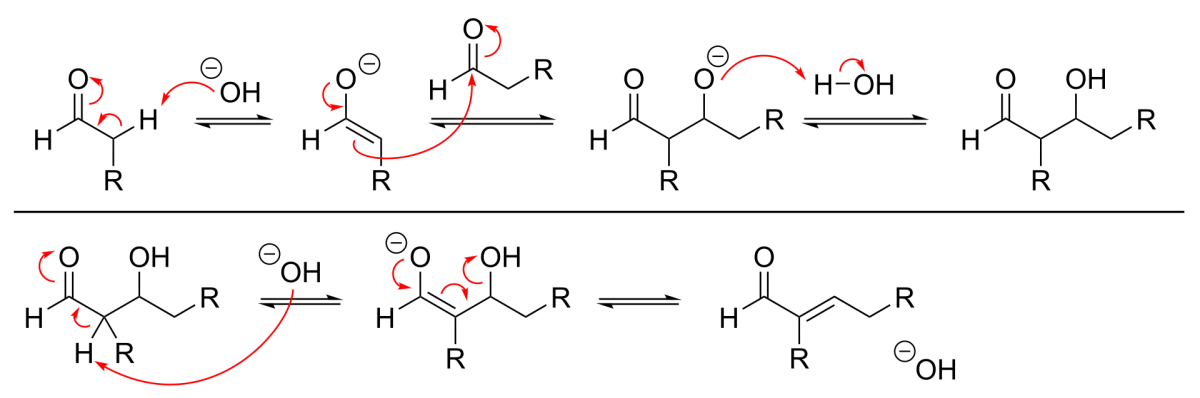
Base-catalyzed aldol condensation: enolate of one aldehyde attacks the carbonyl carbon of another, giving a beta-hydroxy aldehyde; subsequent dehydration produces the alpha-beta unsaturated carbonyl (enone). Credit: Wikimedia Commons, CC BY-SA
Base-Catalyzed Mechanism
Starting with acetaldehyde (CH₃CHO) as the simplest example:
Step 1: Enolate formation. Hydroxide (or alkoxide) removes an alpha-H to give the acetaldehyde enolate (CH₂=CHO⁻).
Step 2: Nucleophilic addition. The enolate’s C-end attacks the C=O carbon of a second acetaldehyde molecule. The pi bond of the target carbonyl breaks; electrons flow onto the oxygen.
Step 3: Alkoxide protonation. The resulting tetrahedral alkoxide is protonated by water to give the aldol - a beta-hydroxy aldehyde (3-hydroxybutanal).
Walk through the mechanism one step at a time below. Toggle between the self-aldol (acetone × acetone) and crossed aldol (acetone + benzaldehyde, which cannot enolize), and choose whether to stop at the addition product or continue through E1cb dehydration to the α,β-unsaturated enone.
Aldol step-through
Interactive
Step 1 — Enolate formation
NaOH removes the acidic α-hydrogen (pKa ~20). The resulting enolate is resonance-stabilized — negative charge delocalizes onto the carbonyl oxygen.
Net aldol addition: 2 CH₃CHO → CH₃CH(OH)-CH₂-CHO.
Step 4 (condensation, heat required): dehydration. Under heating or more concentrated base, the aldol loses water to form an alpha-beta unsaturated carbonyl (an enone or enal). For this example: CH₃CH(OH)-CH₂-CHO → CH₃-CH=CH-CHO (but-2-enal, crotonaldehyde).
The dehydration step (often via E1cb mechanism: deprotonate the alpha-H, then lose hydroxide) requires higher temperature because the simple alkoxide intermediate does not spontaneously lose water at room temperature.
Acid-Catalyzed Mechanism
Under acid catalysis (e.g., HCl):
Carbonyl is protonated, activating it as an electrophile.
Enol of one carbonyl (from acid-catalyzed tautomerization) attacks the protonated carbonyl.
Deprotonation and further proton transfers give the beta-hydroxy carbonyl.
Dehydration (loss of water) gives the enone.
Acid catalysis is useful when the substrate has both electrophilic and enolizable carbonyls, but base catalysis is more common on exam questions.
Product: Beta-Hydroxy Carbonyl or Enone?
The balance between aldol addition and condensation depends on conditions:
For MCAT purposes, most questions assume the condensation product (enone) unless they specify otherwise.
Intramolecular Aldol: Rings
If a single molecule has two carbonyls on the same chain (like 2,6-heptanedione), intramolecular aldol condensation gives a ring. The alpha-H of one carbonyl attacks the other carbonyl carbon, closing the ring. The resulting product is a cyclic enone. Five- and six-membered rings form most easily (favorable enthalpy and entropy).
Intramolecular aldol is how rings get built from open-chain precursors. The Robinson annulation combines a Michael addition with an intramolecular aldol (although this is no longer on the AAMC outline).
Aldol in Biology: Glycolysis
In glycolysis, the enzyme aldolase cleaves fructose-1,6-bisphosphate (FBP) into two trioses: dihydroxyacetone phosphate (DHAP) and glyceraldehyde-3-phosphate (G3P). The mechanism is a retro-aldol (reverse aldol) - the enzyme breaks the C3-C4 bond of FBP by reversing the aldol addition.
Class I aldolases (in animals) use a Schiff base with a lysine side chain to stabilize the iminium intermediate.
Class II aldolases (in bacteria) use a zinc metal center to stabilize the enolate-like intermediate.
This biological aldol cleavage is the exact chemistry you just learned, happening in reverse.
Driving Force and Equilibrium
Simple aldol addition is moderately exothermic but reversible. Forming the enone (condensation) is very favorable because:
Loss of water drives equilibrium forward (Le Chatelier).
The conjugated enone is more stable than the disconnected beta-hydroxy carbonyl.
The dehydration is entropically favorable (one molecule becomes two).
For this reason, when heating an aldol mixture, the enone almost always dominates in the final product mix.
Draw the product of base-catalyzed (NaOH, heat) aldol condensation of two molecules of acetaldehyde.
Click to reveal answer
2-butenal (crotonaldehyde), CH₃-CH=CH-CHO. Step 1: NaOH removes alpha-H of CH₃CHO to give the enolate CH₂=CHO⁻. Step 2: The enolate’s C-end attacks the C=O carbon of another acetaldehyde, giving the tetrahedral intermediate. Step 3: Protonation gives the aldol: 3-hydroxybutanal CH₃CH(OH)CH₂CHO. Step 4: Heat drives dehydration (E1cb via enolate intermediate) to give the enone: 2-butenal CH₃CH=CHCHO. This is the “crotonaldehyde” that is a common synthetic building block.
Mixing two different aldehydes or ketones under classical aldol conditions is usually a mess. With a random mixture, each carbonyl can form its own enolate AND serve as the electrophile - giving four possible products: two self-aldols and two crossed aldols. To get a single clean crossed product, chemists use one of three strategies: choose a non-enolizable aldehyde partner, form one enolate in advance with LDA, or use a special reactive enolate type.
The Problem: Four Possible Products
If you mix acetaldehyde (A) and propanal (B) with hydroxide:
A can deprotonate → A enolate → attack A → self-aldol of A.
A can deprotonate → A enolate → attack B → crossed aldol (A+B).
B can deprotonate → B enolate → attack A → crossed aldol (B+A).
B can deprotonate → B enolate → attack B → self-aldol of B.
Without control, you get a statistical mixture of all four. Not useful for synthesis.
General aldol scheme: enolate of one carbonyl attacks the electrophilic C=O of a second carbonyl, forming a new C-C bond. Dehydration then gives the enone (condensation product). The key to crossed aldol is controlling which partner is the nucleophile (enolate) and which is the electrophile. Credit: Wikimedia Commons, CC BY-SA
Strategy 1: Use a Non-Enolizable Electrophile
Some aldehydes have no alpha-H and therefore cannot enolize:
Formaldehyde (HCHO): no alpha-H.
Benzaldehyde (C₆H₅CHO): the alpha is an aromatic ring C-H, which is not acidic.
Pivaldehyde ((CH₃)₃CCHO): the alpha is a quaternary carbon with no H.
Cinnamaldehyde (C₆H₅CH=CHCHO): alpha C-H is vinyl, not acidic.
If only one partner has alpha-Hs, only that partner can enolize. The enolizable carbonyl becomes the nucleophile; the non-enolizable one becomes the electrophile. Only one crossed product forms.
Example: acetone (enolizable) + benzaldehyde (non-enolizable) + NaOH/heat → 4-phenylbut-3-en-2-one (an enone from crossed aldol + condensation). Clean single product.
Use LDA at -78°C to completely deprotonate one carbonyl BEFORE adding the second. Now the first carbonyl is fully converted to its lithium enolate, and it cannot further deprotonate or re-form. Add the second carbonyl: the only enolate present (from the first ketone) attacks the newly-added second carbonyl. Single product results.
Sequence:
Ketone 1 + LDA at -78°C → lithium enolate of ketone 1.
Add ketone 2 (as the electrophile).
Aldol addition: enolate 1 attacks carbonyl of 2.
Quench and isolate the crossed aldol product.
This directed aldol strategy gives excellent control over regiochemistry and is widely used in pharmaceutical synthesis.
Strategy 3: Use Special Enolate Equivalents
Silyl enol ethers (Mukaiyama aldol) and lithium enolates of 1,3-dicarbonyls (from soft base conditions) can give clean crossed aldol products without interference from the electrophile’s own enolization. These are beyond MCAT scope for specifics but recognized if a passage mentions them.
NaOH removes an alpha-H of acetone (the only alpha-acid available; benzaldehyde has no alpha-H).
The acetone enolate attacks benzaldehyde’s carbonyl carbon.
Alkoxide protonation gives the aldol: 4-hydroxy-4-phenylbutan-2-one.
Heat drives dehydration → benzalacetone (4-phenylbut-3-en-2-one), a classic enone.
This reaction can continue: the remaining alpha-H of benzalacetone can be removed, and a SECOND benzaldehyde can add, giving dibenzalacetone (1,5-diphenylpenta-1,4-dien-3-one). Dibenzalacetone is a beautiful crystalline yellow compound often used in undergraduate lab demonstrations.
Why This Matters Biologically
Enzymes solve the crossed aldol selectivity problem the same way: one substrate is bound in a nucleophile-oriented position (its alpha-H is deprotonated by an active-site base), while the other is bound in an electrophile-oriented position (its carbonyl is activated by an active-site acid). The enzyme’s active site acts as a “directed aldol” reactor, ensuring only the desired crossed product forms. Aldolase in glycolysis is a perfect example.
Predict the major product when a mixture of propanal and benzaldehyde is treated with NaOH and heat. Why does this give a clean product, and what is it?
Click to reveal answer
The major product is 2-methyl-3-phenylprop-2-enal (an alpha-methyl cinnamaldehyde analog). Reasoning: benzaldehyde has NO alpha-H (no acidic position to enolize). Propanal has alpha-H's. So propanal becomes the nucleophile (forms the enolate at its alpha-C), and benzaldehyde becomes the electrophile. The enolate attacks benzaldehyde's C=O; the aldol dehydrates to give the enone. Only one crossed product is possible because only one species can enolize. This is the clean-control pattern for crossed aldol.
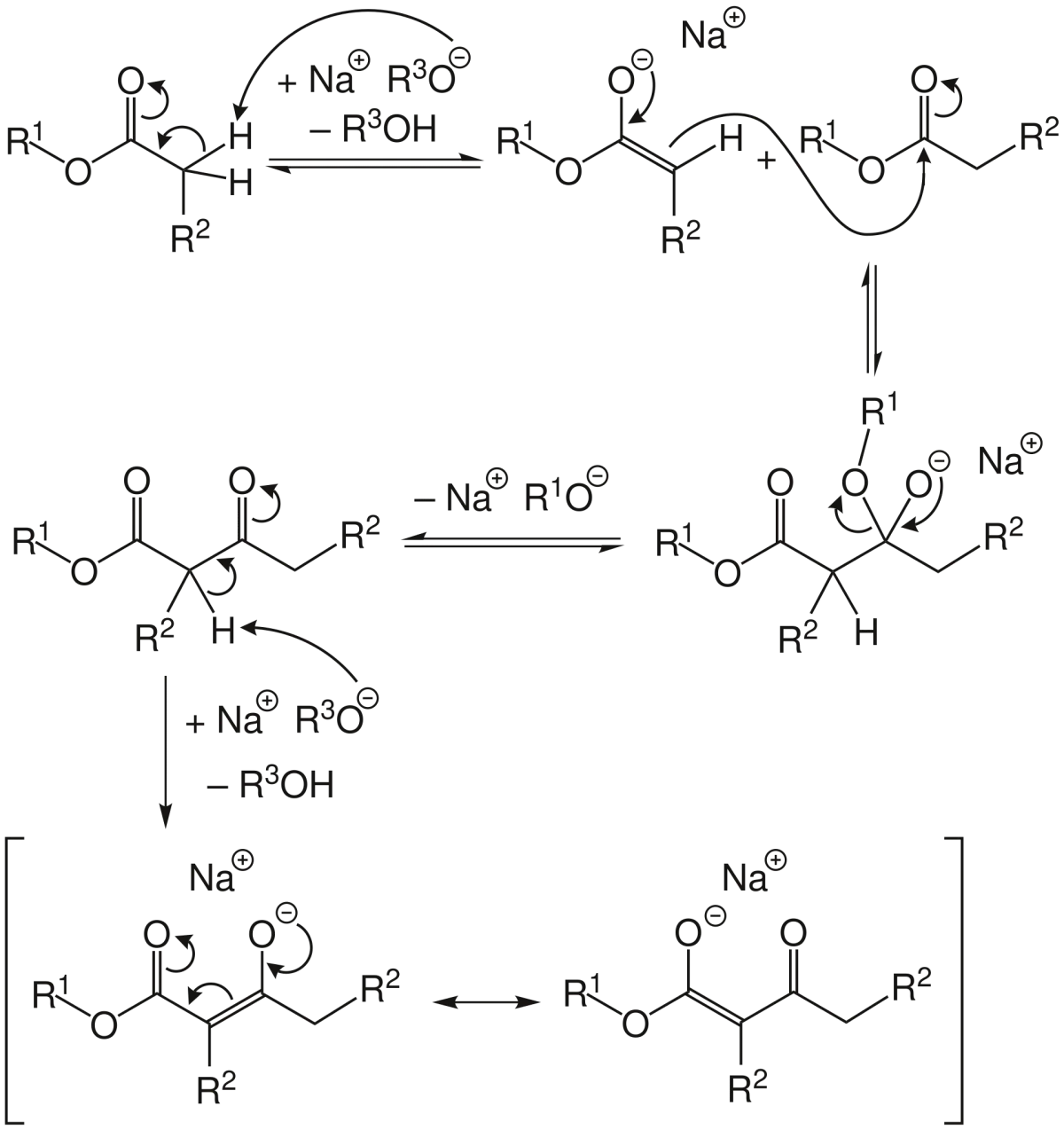
The Claisen condensation is the ester analog of the aldol: an ester enolate attacks another ester’s carbonyl carbon, and the tetrahedral intermediate collapses by kicking out an alkoxide leaving group. The product is a beta-keto ester - a structure with a ketone carbonyl and an ester carbonyl separated by one alpha-carbon. This beta-keto ester is the hallmark of the Claisen and the precursor for many synthetic and biosynthetic reactions.
Claisen condensation mechanism: ester enolate attacks a second ester's carbonyl; the tetrahedral intermediate ejects an alkoxide leaving group, producing a beta-keto ester. Credit: Wikimedia Commons, CC BY-SA
The Mechanism
Using ethyl acetate (CH₃COOEt) as the substrate (self-condensation):
Step 1: Enolate formation. Sodium ethoxide (NaOEt) in ethanol removes the alpha-H of ethyl acetate to give the enolate: CH₂=C(OEt)O⁻.
Note: esters have pKa ~25, which is higher than ethanol’s pKa (16). So this deprotonation is unfavorable at equilibrium (only about 10⁻⁹ of the ester exists as enolate). The reaction still works because the next steps pull the equilibrium forward.
Step 2: Enolate attacks another ester. The enolate’s C-end attacks the carbonyl carbon of a second molecule of ethyl acetate. Tetrahedral alkoxide intermediate forms.
Step 3: Loss of alkoxide. Unlike aldol, where the tetrahedral intermediate is stable (no good leaving group), the Claisen’s tetrahedral intermediate HAS a leaving group: the OEt group. The alkoxide collapses by kicking out OEt⁻, reforming a C=O (now part of a ketone, not an ester).
Step 4: Deprotonation / irreversibility. The beta-keto ester product has an alpha-H flanked by two carbonyls (pKa ~11). This alpha-H is much more acidic than the starting ester’s alpha-H (pKa 25). Under the basic conditions, the beta-keto ester gets deprotonated to its (very stable) enolate. This second deprotonation drives the equilibrium forward - it is the “thermodynamic sink” that makes the whole reaction work.
Step 5: Workup. After the reaction, acidic workup protonates the beta-keto ester enolate to give the neutral beta-keto ester.
The key thermodynamic insight: the overall reaction is unfavorable in the first three steps. It only becomes favorable because the beta-keto ester product can be deprotonated, and that anion is very stable. So you need stoichiometric (or excess) base to drive the reaction to completion. On workup, the anion is reprotonated to the neutral beta-keto ester.
Why Use Sodium Ethoxide Specifically?
Sodium ethoxide works with ethyl esters because its conjugate acid (ethanol) matches the ester’s OEt group. If you use NaOMe (sodium methoxide) with an ethyl ester, transesterification can scramble the groups. Matching the base’s alkyl group to the ester’s alkyl group prevents this side reaction.
For a methyl ester, use NaOMe. For an ethyl ester, use NaOEt. For a tert-butyl ester, use NaOtBu (rarely, since tert-butyl esters are bulky and slow to condense).
Product Uses: Ethyl Acetoacetate as a Synthetic Precursor
Ethyl acetoacetate (CH₃COCH₂COOEt), the Claisen self-condensation product of ethyl acetate, is a famous synthetic building block. It can:
Undergo alpha-alkylation (Section 7.9) - the central alpha-H (pKa 11) is acidic enough to deprotonate with NaOEt, and the resulting anion can alkylate with alkyl halides.
Saponify to the beta-keto acid, which decarboxylates on heating (beta-keto acids lose CO₂ easily via a 6-membered TS). The result is a methyl ketone with a new substituent from the alkylation step.
This is the acetoacetic ester synthesis - a classic route to substituted methyl ketones.
Biological Parallel: Fatty Acid Biosynthesis
Fatty acid biosynthesis in cells uses a Claisen-like condensation. The acetyl-CoA (Claisen donor) condenses with malonyl-CoA (an activated beta-keto acid derivative) to form a new C-C bond, elongating the fatty acid chain by two carbons. The enzyme is fatty acid synthase, and the chemistry is basically a Claisen with a built-in “malonate trick” (CO₂ loss provides extra driving force).
Crossed Claisen
Just like crossed aldol, mixing two different esters can give multiple products unless one is non-enolizable. Ethyl formate (HCOOEt), ethyl carbonate (CO(OEt)₂), and aryl esters have no alpha-H and serve as good electrophilic partners. Ethyl formate is especially useful because the formyl group becomes the ketone of the product.
Why does the Claisen condensation require stoichiometric base (at least one equivalent), while the aldol reaction can work with catalytic base?
Click to reveal answer
The Claisen's product is a beta-keto ester with a highly acidic alpha-H (pKa ~11). Under the basic reaction conditions, this alpha-H gets deprotonated, consuming one equivalent of base. Without this deprotonation, the equilibrium would favor the starting esters. The deprotonation provides the thermodynamic driving force. The aldol's product (beta-hydroxy carbonyl) has an alpha-H with pKa ~20-25 - not acidic enough to be deprotonated by the base, so the base is released after each cycle and catalytic amounts are sufficient.
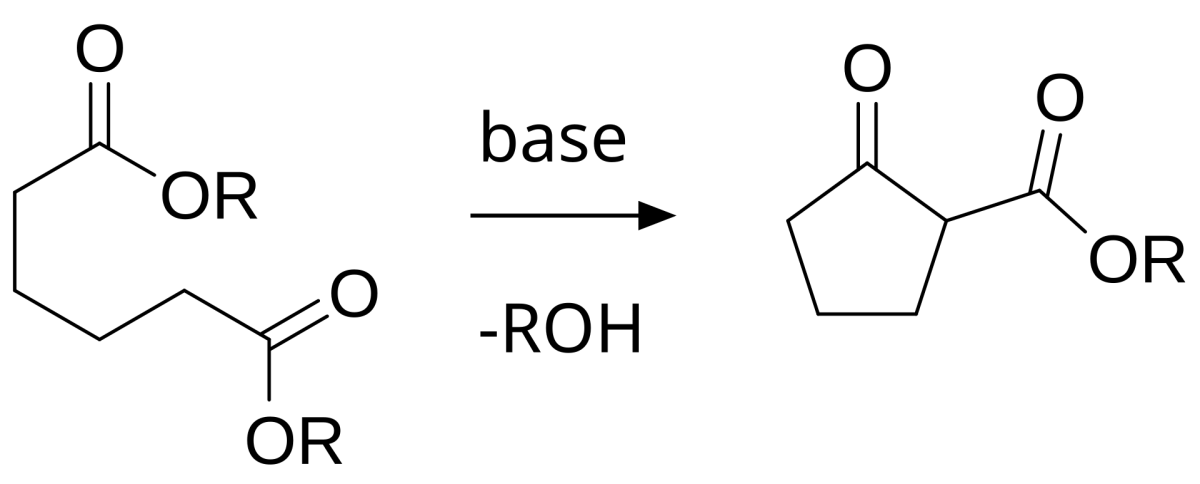
The Dieckmann cyclization is the intramolecular version of the Claisen condensation. When a diester has two ester groups on the same chain, base can form an enolate of one ester that attacks the other ester’s carbonyl intramolecularly, forming a cyclic beta-keto ester. Dieckmann is the most common way to synthesize 5- and 6-membered cyclic beta-keto esters.
The Mechanism
Identical to the Claisen mechanism, just happening within one molecule:
Base (NaOEt) removes an alpha-H of one ester group.
The resulting enolate attacks the OTHER ester’s carbonyl carbon (within the same molecule).
Tetrahedral intermediate kicks out an alkoxide (OR).
The resulting cyclic beta-keto ester is deprotonated by base (providing the thermodynamic driving force).
Workup protonates the anion to give the neutral cyclic beta-keto ester.
Dieckmann cyclization: an intramolecular Claisen condensation of a diester closes a 5- or 6-membered ring, forming a cyclic beta-keto ester with loss of one alkoxide. Credit: Wikimedia Commons, CC BY-SA
Substrate Requirements
For Dieckmann to form a good ring size (5- or 6-membered), the two ester groups must be on carbons 5 or 6 atoms apart along the chain:
Diethyl adipate (dimethyl hexanedioate equivalent) has two ester groups on a 6-carbon backbone. Dieckmann cyclization closes a 5-membered ring (5 C’s between the two C=O’s, after losing one carbon as OR): cyclopentanone-2-carboxylic acid ethyl ester.
Diethyl pimelate (7-carbon diester) closes a 6-membered ring: 2-ethoxycarbonylcyclohexanone.
Longer chains (8+ carbons) can in principle form larger rings, but entropy disfavors the cyclization because the two ends must find each other. Medium-size rings (8-11 members) are difficult by classical Dieckmann.
Regiochemistry: Which Ester Gets Deprotonated?
If the diester is symmetric (both ester groups identical), it does not matter which ester enolizes - they are equivalent. If the diester is asymmetric (different alpha-carbons on each ester), the more acidic alpha-H is removed preferentially. This regioselectivity determines which ring is formed.
Workup Note: Decarboxylation
The cyclic beta-keto ester from Dieckmann can be further processed:
Saponify the ester (NaOH hydrolysis) → beta-keto carboxylic acid.
Heat → decarboxylation (loss of CO₂) via the 6-membered cyclic transition state characteristic of beta-keto acids.
Result: simple cyclic ketone (without the ester group).
This three-step sequence (Dieckmann → saponify → decarboxylate) converts a diester into a cyclic ketone - a powerful synthetic move for building ring systems.
Driving Force Review
Same as the Claisen: the product’s beta-keto ester has an acidic alpha-H (pKa 11) that gets deprotonated under the reaction conditions, providing the thermodynamic sink. Acidic workup at the end recovers the neutral cyclic beta-keto ester.
Diethyl adipate (EtOOC-CH₂CH₂CH₂CH₂-COOEt) is treated with NaOEt in ethanol. What is the main product, and what type of ring forms?
Click to reveal answer
The product is 2-(ethoxycarbonyl)cyclopentan-1-one (a cyclopentanone with an ester at C2) - a 5-membered ring beta-keto ester. Mechanism: NaOEt removes an alpha-H of one ester; the resulting enolate attacks the OTHER ester's carbonyl carbon (intramolecularly); tetrahedral intermediate kicks out OEt⁻. The product cyclizes to a 5-membered ring because the original 6-carbon diester has 4 carbons between the two ester carbons, which closes to a 5-membered ring (4 C's + 1 new C-C bond + 1 C from the original ester = 5 atoms in the ring).
Alpha-alkylation uses an enolate as a nucleophile to attack an alkyl halide (SN2), forming a new C-C bond at the alpha-position. It is one of the most direct ways to install a new substituent on a ketone or ester without changing the carbonyl oxidation state.
The Mechanism
Generate the enolate. A strong base (LDA for simple ketones; NaOEt for 1,3-dicarbonyls) removes the alpha-H.
Enolate attacks the alkyl halide (SN2). The C-end of the enolate attacks the electrophilic carbon of the alkyl halide; the halide leaves.
Product: alpha-alkylated carbonyl. A new C-C bond has been formed at the original alpha-carbon; the new substituent is the R group from the alkyl halide.
Net: R₂C=O + LDA → enolate → R-X → R₂C(R’)-CO-R. The alpha-carbon now has one more substituent.
Substrate Constraints for the Alkyl Halide
The alkyl halide must be SN2-compatible:
Methyl or 1° (unhindered): best. Fast SN2, clean product.
Allylic or benzylic: fast SN2 (resonance-stabilized transition state).
2°: slow, often gives elimination side products.
3°: does not work. E2 elimination dominates - the enolate acts as a base, removing a beta-H instead.
This substrate constraint means alpha-alkylation is great for installing methyl, ethyl, propyl, allyl, or benzyl groups but poor for installing tertiary alkyl groups (which would have to be made by a different route).
Over-Alkylation Problem
Once the enolate attacks an alkyl halide, the product is a ketone with a new substituent at the alpha-position. But this product still has an alpha-H that can be deprotonated by remaining base, giving a new enolate that can attack ANOTHER alkyl halide - giving a di-alkylated product.
To minimize over-alkylation:
Use one equivalent of alkyl halide (no excess).
Use LDA at low temperature (kinetic enolate forms, no equilibration).
Add alkyl halide slowly.
Use a single-charge-alpha substrate like a 1,3-dicarbonyl where decarboxylation can remove the extra group later.
The Acetoacetic Ester Synthesis
Ethyl acetoacetate (CH₃COCH₂COOEt, pKa ~11) is easily deprotonated by NaOEt. Alpha-alkylation with an alkyl halide gives 2-R-ethylacetoacetate. Repeating the process adds a second R group.
After the desired alkyl groups are installed:
Saponification with NaOH gives the beta-keto carboxylic acid.
Heating drives decarboxylation (loss of CO₂ via 6-membered TS) giving a methyl ketone.
Net: ethyl acetoacetate + R-X (then R’-X) → alkylated beta-keto ester → saponification → decarboxylation → methyl ketone with R and R’ on the alpha-carbon.
This is the acetoacetic ester synthesis - the classic way to make substituted methyl ketones.
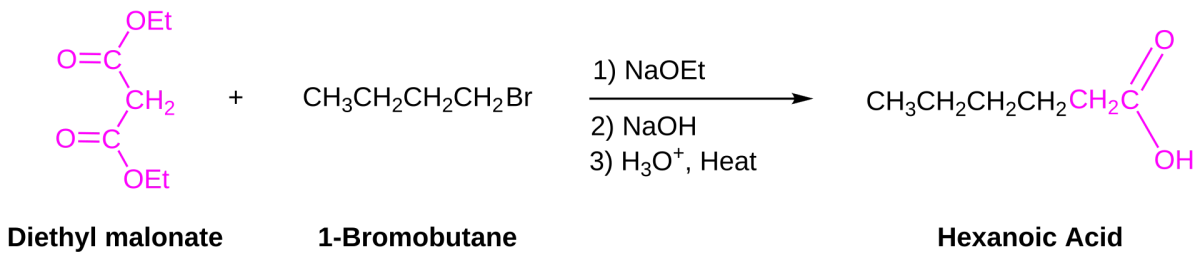
The Malonic Ester Synthesis
Diethyl malonate (EtOOC-CH₂-COOEt, pKa ~13) is another readily-deprotonated 1,3-dicarbonyl. Similar alkylation sequence:
NaOEt + diethyl malonate → malonate enolate.
Alkyl halide → alpha-alkylated malonate.
(Optional) repeat for a second alkylation.
Saponification → malonic acid with alkyl group(s).
Heating → decarboxylation (loss of CO₂) giving a monocarboxylic acid.
This is the malonic ester synthesis - the classic way to make substituted carboxylic acids with defined alkyl groups.
Malonic ester synthesis: deprotonate the 1,3-dicarbonyl; alkylate with R-X (optionally twice); saponify to the diacid; heat to decarboxylate. Net transformation: alkyl halide → substituted acetic acid with a defined alkyl group at the alpha-position. Credit: Wikimedia Commons, CC BY-SA
Why 1,3-Dicarbonyls Are Preferred for Alkylation
Two advantages over simple ketones:
Milder base suffices. Hydroxide or ethoxide can deprotonate a 1,3-dicarbonyl (pKa 10-13); simple ketone alpha (pKa 20) requires LDA/NaH.
Decarboxylation removes an “extra” group. In the acetoacetic/malonic ester syntheses, the ester or carboxylate that was needed for acidity can be removed later by decarboxylation, leaving only the desired alkyl-substituted product.
This is why acetoacetic and malonic ester syntheses are so powerful - they use a 1,3-dicarbonyl as a temporary scaffolding that enables clean alkylation, then removes itself at the end.
Biological Analog: Fatty Acid Alpha-Modification
While cells do not perform alpha-alkylation on acetyl-CoA directly, the Claisen-like chain elongation in fatty acid synthesis is a related process: a malonyl-CoA (the biological equivalent of malonate ester) condenses with acetyl-CoA, with CO₂ loss providing the driving force. The net effect is a two-carbon elongation at the alpha-position of the growing chain.
Design a synthesis of 2-hexanone (CH₃COCH₂CH₂CH₂CH₃) starting from ethyl acetoacetate and an alkyl halide.
Click to reveal answer
Step 1: Deprotonate ethyl acetoacetate with NaOEt. Step 2: React with 1-bromobutane (CH₃CH₂CH₂CH₂Br) to alpha-alkylate, giving ethyl 2-butylacetoacetate: CH₃CO-CH(Bu)-COOEt. Step 3: Saponify with NaOH, then acidify to give the beta-keto carboxylic acid: CH₃CO-CH(Bu)-COOH. Step 4: Heat to drive decarboxylation (loss of CO₂) - the beta-keto acid loses CO₂ via a 6-membered cyclic TS, leaving a methyl ketone. Net product: CH₃CO-CH₂-CH₂-CH₂-CH₃ = 2-hexanone. This is the classic acetoacetic ester synthesis.
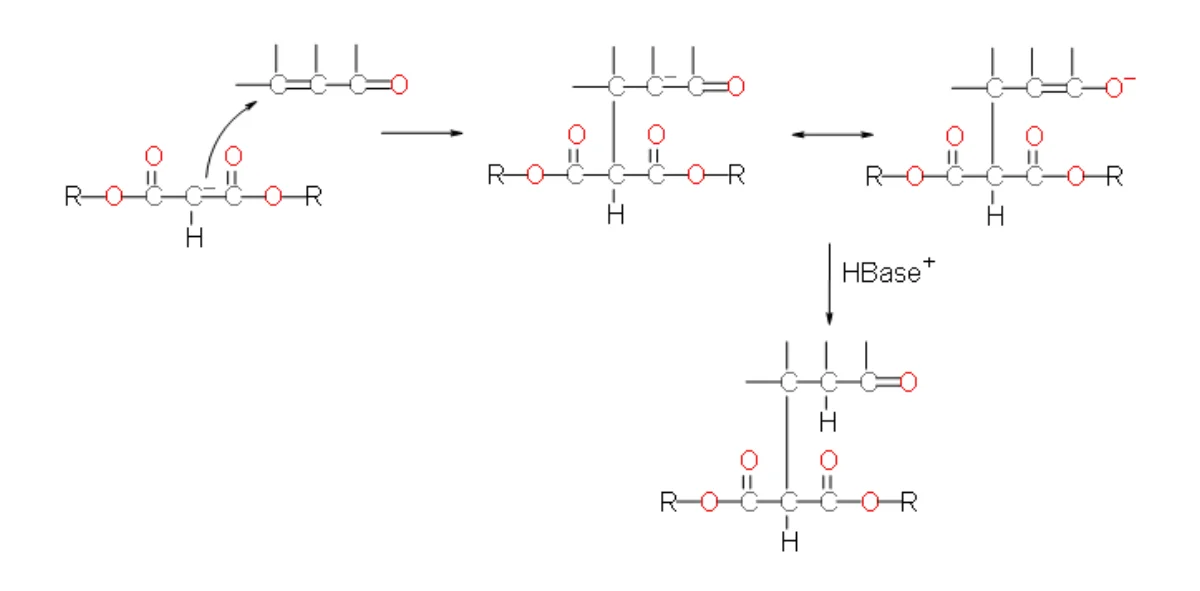
The Michael addition (also called conjugate addition or 1,4-addition) is the addition of a nucleophile to the beta-carbon of an alpha-beta unsaturated carbonyl. It is the “soft” alternative to Grignard-style 1,2-addition: instead of attacking the carbonyl C, the nucleophile attacks the farther beta-C, giving a saturated carbonyl product with a new substituent at the beta-position.
Toggle between hard and soft nucleophiles in the selector to see the two possible addition sites — and the very different products each gives.
Michael addition: 1,2 vs 1,4
Interactive
Hard nucleophile
RLi, RMgX, LiAlH₄
Hard nucleophiles are charge-controlled — they go for the most electron-poor (highest δ+) carbon, which is the carbonyl C. Result: 1,2-addition, giving an allylic alcohol after workup.
Product: Allylic alcohol (1,2-adduct)
Michael donors are typically stabilized enolates (1,3-dicarbonyls, nitroalkanes, sulfones). Michael acceptors are alpha-beta unsaturated carbonyls (enones, enals, nitroalkenes, alpha-beta-unsaturated esters).
Michael addition: a stabilized nucleophile (like a 1,3-dicarbonyl enolate) adds to the beta-carbon of an alpha-beta unsaturated carbonyl. Pi electrons flow onto the carbonyl oxygen, forming an enolate that is protonated on workup to give the saturated beta-substituted product. Credit: Wikimedia Commons, CC BY-SA
The Mechanism
Using diethyl malonate as the Michael donor and methyl vinyl ketone (MVK, CH₂=CH-CO-CH₃) as the Michael acceptor:
Generate the donor’s enolate. NaOEt removes an alpha-H of diethyl malonate to form the stabilized malonate anion.
Enolate attacks the beta-C of the acceptor. The C-end of the anion adds to the beta-C of MVK (the carbon farther from the carbonyl). The pi electrons of the C=C flow onto the alpha-C and then onto the carbonyl O, making a new enolate.
Enolate protonation. The resulting enolate is protonated (by solvent or during workup) to give the saturated beta-substituted ketone.
Net: diethyl malonate + MVK + NaOEt → diethyl 2-(3-oxobutyl)malonate (a beta-substituted product with a new alpha-C attached to the malonate’s alpha-C).
Why It’s Called 1,4-Addition
If you number the enone’s atoms 1 (O), 2 (C=O carbon), 3 (alpha-C), 4 (beta-C), the nucleophile adds to C4 and the proton (from workup) adds to O1. So the net addition is “1,4” across the enone system - a conjugate addition that uses the full conjugated C=C-C=O unit.
Contrast with Grignard 1,2-addition: Grignard attacks at C2 (the carbonyl carbon) and the O at position 1 gets a proton on workup.
Hard vs Soft Donor Matters
Hard donors (Grignards, organolithiums, hydride from LiAlH₄) prefer 1,2-addition to the carbonyl carbon. Tight, charge-dense nucleophiles go where the charge is most concentrated.
Soft donors (stabilized enolates like malonate, cyanide, thiolates, Gilman reagents) prefer 1,4-addition to the beta-carbon. Polarizable, delocalized nucleophiles match the polarizability of the soft beta-C electrophile.
This is the HSAB (hard-soft acid-base) principle applied to nucleophilic addition.
Stork enamine synthesis uses an enamine (neutral nucleophile made from a secondary amine + ketone, Section 6.8) as a Michael donor. The enamine attacks the beta-C of a Michael acceptor at its alpha-carbon; hydrolysis of the resulting iminium gives a 1,5-dicarbonyl product.
Stork’s route lets you do Michael additions without needing a strong base (the enamine is neutral). Useful when basic conditions would cause side reactions.
Stork enamine synthesis: ketone + 2° amine → enamine; enamine’s alpha-C attacks a Michael acceptor; hydrolysis of the resulting iminium regenerates the ketone and delivers the alpha-alkylated product. Neutral conditions, no strong base needed. Credit: Wikimedia Commons, CC BY-SA
Biological Relevance: Nucleophilic Addition in Metabolism
Michael additions appear in biology:
Fumarase adds water to fumarate in a Michael-like 1,4-addition. The result is malate.
Some enzyme active sites do conjugate addition to electrophilic substrates as part of the catalytic cycle.
Glutathione can do Michael addition to electrophilic xenobiotics as part of detoxification.
The organic mechanism you just learned appears in these biological contexts, just catalyzed and positioned by enzyme machinery.
Predict the product when diethyl malonate is treated with NaOEt and methyl vinyl ketone (MVK).
Click to reveal answer
The product is diethyl 2-(3-oxobutyl)malonate: (EtOOC)₂CH-CH₂-CH₂-CO-CH₃. Mechanism: NaOEt removes an alpha-H of malonate to give the soft, stabilized malonate anion. The anion’s C-end attacks the beta-C of MVK (the terminal CH₂ of CH₂=CH-CO-CH₃). The pi electrons shift onto the carbonyl O, giving an enolate. Workup protonates the enolate to give the saturated ketone. A new C-C bond has formed between the malonate’s alpha-C and MVK’s beta-C. This is a classic MCAT-style Michael addition.
Every reaction in Chapter 7 has a biological counterpart. Enzymes use enolate chemistry to do clean carbon-carbon bond formation, racemization, decarboxylation, and chain elongation. The mechanism is exactly what you just learned in the lab version - the enzyme just provides positioning, acid-base catalysis, and sometimes a cofactor.
Aldolase in Glycolysis
Glycolysis breaks fructose-1,6-bisphosphate (FBP) into two three-carbon units (DHAP and G3P). The enzyme aldolase performs a retro-aldol - the reverse of the aldol condensation:
Forward direction (in liver gluconeogenesis): DHAP + G3P → FBP. An aldol condensation joining two trioses.
Reverse direction (in glycolysis): FBP → DHAP + G3P. A retro-aldol splitting a hexose.
Class I aldolases (in animals, plants, higher organisms) use a lysine side-chain to form a Schiff base with the C2 carbonyl of the substrate. This turns the ketone into an iminium, which amplifies the alpha-acidity for easier enolate formation. Then the retro-aldol cleaves the C3-C4 bond, giving an iminium-stabilized enamine (the DHAP-lysine complex) and G3P.
Class II aldolases (in bacteria, fungi) use a zinc(II) cofactor that serves a similar role: it coordinates to the C2 oxygen and polarizes the C=O, promoting enolate formation.
Both mechanisms recapitulate the retro-aldol chemistry you learned with a mechanistic twist (Schiff base or metal coordination) for additional acceleration.
Fatty Acid Synthesis: The Claisen in Biology
Fatty acid biosynthesis extends a growing fatty-acyl chain by two carbons per cycle. The key C-C bond-forming step is a Claisen-like condensation:
Acetyl-CoA (CH₃-CO-S-CoA) and malonyl-CoA (HOOC-CH₂-CO-S-CoA) are loaded onto acyl carrier protein (ACP).
The beta-ketoacyl-ACP synthase (KS) forms a Claisen-like bond between the acetyl alpha-carbon and the malonyl carbonyl carbon.
Malonyl’s carboxylate is released as CO₂ (decarboxylation during the condensation, providing thermodynamic drive).
Product: 3-ketobutyryl-ACP (a beta-keto thioester).
This is a Claisen with a “malonate trick”: the malonate donor has an extra COOH that leaves as CO₂, making the reaction exergonic. Without the CO₂ loss, the Claisen equilibrium would not be favorable at physiological conditions.
PLP Chemistry: Schiff Bases with Amino Acids
Pyridoxal phosphate (PLP, vitamin B6) uses Schiff base chemistry (Chapter 6.8) to catalyze transamination, racemization, and decarboxylation reactions of amino acids.
Mechanism of transamination (the classic example):
Amino acid’s -NH₂ forms a Schiff base with PLP’s -CHO.
The resulting PLP-imine is a quinone-like electron sink that activates the alpha-H of the amino acid.
A base in the active site removes the alpha-H, forming a resonance-stabilized carbanion (the “quinonoid intermediate”).
Reprotonation at a different carbon gives a different tautomer (ketimine), which then hydrolyzes to release the amino acid as an alpha-keto acid + PLP-NH₂ (PMP).
This is basically enolate chemistry on a Schiff-base-activated alpha-carbon, with the PLP ring providing the electron sink.
Alanine racemase (found in bacteria) uses PLP the same way but reprotonates from the opposite face, giving the opposite enantiomer. This is how bacteria make D-alanine for their cell walls.
Acetaldehyde in Ethanol Metabolism
Ethanol metabolism: ethanol → acetaldehyde → acetate, catalyzed by alcohol dehydrogenase (ADH) and aldehyde dehydrogenase (ALDH). Both steps use NAD⁺ as the hydride acceptor.
The acetaldehyde intermediate is potentially toxic. Its alpha-H is acidic (pKa ~17), and it can undergo aldol-like reactions with itself or with proteins’ amines, forming DNA adducts and protein crosslinks that contribute to alcohol-related tissue damage.
Ketone Bodies
Beta-hydroxybutyrate and acetoacetate are the ketone bodies produced in the liver during fasting. Their synthesis from acetyl-CoA involves a Claisen-like condensation of two acetyl-CoA molecules (forming acetoacetyl-CoA), followed by another acetyl-CoA addition (forming HMG-CoA), and cleavage to give acetoacetate + acetyl-CoA.
These ketone bodies are shipped to peripheral tissues (including the brain during prolonged fasting), where they are broken back down to acetyl-CoA via reverse aldol-like cleavage. The reversibility and compatibility with physiological conditions (near neutral pH, 37°C) reflect the generally reversible nature of aldol-Claisen chemistry.
Alpha-Keto Acid Decarboxylation
Beta-keto carboxylic acids decarboxylate via a 6-membered cyclic transition state, with the carbonyl oxygen abstracting a proton from the carboxylic acid. This is the same chemistry that drives the acetoacetic ester synthesis’s decarboxylation step (Section 7.9). In biology, pyruvate decarboxylation (by pyruvate dehydrogenase, PDH) involves this chemistry with thiamine pyrophosphate (TPP) as a cofactor.
Explain why fatty acid biosynthesis uses malonyl-CoA (instead of another acetyl-CoA) as the donor in the KS-catalyzed Claisen condensation.
Click to reveal answer
Malonyl-CoA's extra carboxylate (-COOH) is lost as CO₂ during the condensation, providing a large thermodynamic driving force. If two acetyl-CoA molecules just condensed together (as in a regular Claisen), the reaction would be thermodynamically unfavorable at physiological conditions (cellular pH and temperature are not extreme). The "malonate trick" - using a carboxylate that will leave as CO₂ - converts an unfavorable Claisen into a strongly exergonic one. This is why malonyl-CoA is the true substrate for fatty acid elongation, not two acetyl-CoAs.