
Alpha-Alkylation
Alpha-alkylation uses an enolate as a nucleophile to attack an alkyl halide (SN2), forming a new C-C bond at the alpha-position. It is one of the most direct ways to install a new substituent on a ketone or ester without changing the carbonyl oxidation state.
The Mechanism
- Generate the enolate. A strong base (LDA for simple ketones; NaOEt for 1,3-dicarbonyls) removes the alpha-H.
- Enolate attacks the alkyl halide (SN2). The C-end of the enolate attacks the electrophilic carbon of the alkyl halide; the halide leaves.
- Product: alpha-alkylated carbonyl. A new C-C bond has been formed at the original alpha-carbon; the new substituent is the R group from the alkyl halide.
Arrows: enolate lone pair → alkyl C; C-X bond → X⁻.
Net: R₂C=O + LDA → enolate → R-X → R₂C(R’)-CO-R. The alpha-carbon now has one more substituent.
Substrate Constraints for the Alkyl Halide
The alkyl halide must be SN2-compatible:
- Methyl or 1° (unhindered): best. Fast SN2, clean product.
- Allylic or benzylic: fast SN2 (resonance-stabilized transition state).
- 2°: slow, often gives elimination side products.
- 3°: does not work. E2 elimination dominates - the enolate acts as a base, removing a beta-H instead.
This substrate constraint means alpha-alkylation is great for installing methyl, ethyl, propyl, allyl, or benzyl groups but poor for installing tertiary alkyl groups (which would have to be made by a different route).
Over-Alkylation Problem
Once the enolate attacks an alkyl halide, the product is a ketone with a new substituent at the alpha-position. But this product still has an alpha-H that can be deprotonated by remaining base, giving a new enolate that can attack ANOTHER alkyl halide - giving a di-alkylated product.
To minimize over-alkylation:
- Use one equivalent of alkyl halide (no excess).
- Use LDA at low temperature (kinetic enolate forms, no equilibration).
- Add alkyl halide slowly.
- Use a single-charge-alpha substrate like a 1,3-dicarbonyl where decarboxylation can remove the extra group later.
The Acetoacetic Ester Synthesis
Ethyl acetoacetate (CH₃COCH₂COOEt, pKa ~11) is easily deprotonated by NaOEt. Alpha-alkylation with an alkyl halide gives 2-R-ethylacetoacetate. Repeating the process adds a second R group.
After the desired alkyl groups are installed:
- Saponification with NaOH gives the beta-keto carboxylic acid.
- Heating drives decarboxylation (loss of CO₂ via 6-membered TS) giving a methyl ketone.
Net: ethyl acetoacetate + R-X (then R’-X) → alkylated beta-keto ester → saponification → decarboxylation → methyl ketone with R and R’ on the alpha-carbon.
This is the acetoacetic ester synthesis - the classic way to make substituted methyl ketones.
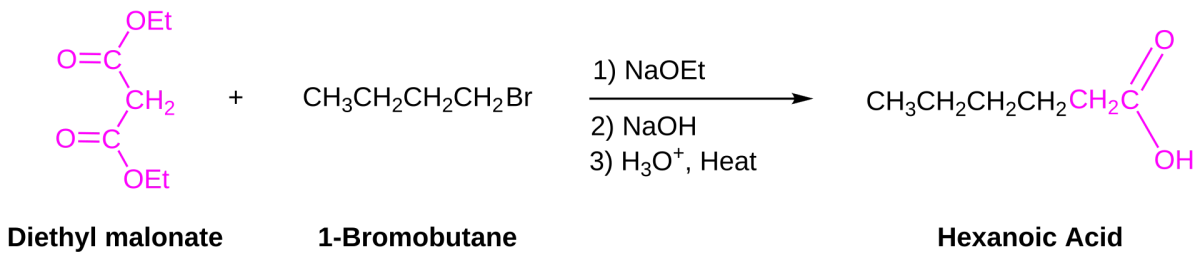
The Malonic Ester Synthesis
Diethyl malonate (EtOOC-CH₂-COOEt, pKa ~13) is another readily-deprotonated 1,3-dicarbonyl. Similar alkylation sequence:
- NaOEt + diethyl malonate → malonate enolate.
- Alkyl halide → alpha-alkylated malonate.
- (Optional) repeat for a second alkylation.
- Saponification → malonic acid with alkyl group(s).
- Heating → decarboxylation (loss of CO₂) giving a monocarboxylic acid.
Net: diethyl malonate + R-X (then R’-X) → substituted acetic acid derivative.
This is the malonic ester synthesis - the classic way to make substituted carboxylic acids with defined alkyl groups.
Why 1,3-Dicarbonyls Are Preferred for Alkylation
Two advantages over simple ketones:
- Milder base suffices. Hydroxide or ethoxide can deprotonate a 1,3-dicarbonyl (pKa 10-13); simple ketone alpha (pKa 20) requires LDA/NaH.
- Decarboxylation removes an “extra” group. In the acetoacetic/malonic ester syntheses, the ester or carboxylate that was needed for acidity can be removed later by decarboxylation, leaving only the desired alkyl-substituted product.
This is why acetoacetic and malonic ester syntheses are so powerful - they use a 1,3-dicarbonyl as a temporary scaffolding that enables clean alkylation, then removes itself at the end.
Biological Analog: Fatty Acid Alpha-Modification
While cells do not perform alpha-alkylation on acetyl-CoA directly, the Claisen-like chain elongation in fatty acid synthesis is a related process: a malonyl-CoA (the biological equivalent of malonate ester) condenses with acetyl-CoA, with CO₂ loss providing the driving force. The net effect is a two-carbon elongation at the alpha-position of the growing chain.