
Keto-Enol Tautomerism
Every carbonyl with an alpha-hydrogen exists in equilibrium between two tautomeric forms: the keto form (C=O with alpha-CH) and the enol form (C-OH with alpha C=C). Tautomers are structural isomers that interconvert by the movement of a hydrogen AND a double bond - they are more than conformers but less than constitutional isomers.
For simple ketones, the keto form dominates overwhelmingly (>99.99%). For some special substrates (1,3-dicarbonyls, phenols, aromatic systems), the enol form is significant or even favored.
Flip between substrates and watch the equilibrium bar update: acetone lives almost entirely in the keto form, pentane-2,4-dione sits around 15% enol, and phenol is essentially “all enol” because the keto tautomer would break aromaticity.
Keto-enol tautomerization
1,3-diketones have substantially enol: ~15% in protic solvent.
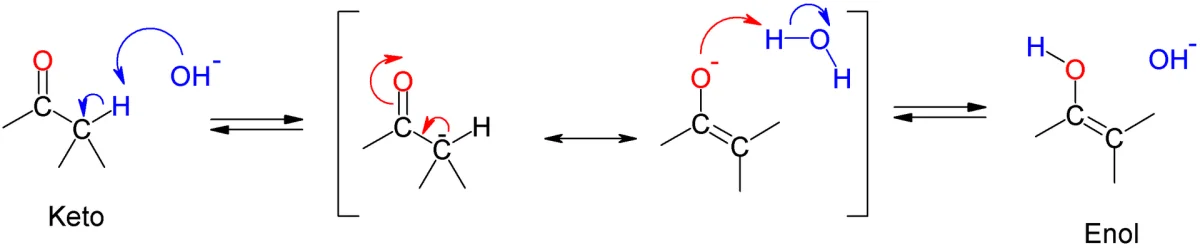
The Two Tautomers
Starting from a simple ketone like acetone (CH₃COCH₃), the two tautomers are:
- Keto form: CH₃-CO-CH₃. C=O is intact. Alpha-C has 3 H’s.
- Enol form: CH₃-C(OH)=CH₂. The C=O has become C-OH; one alpha-H has migrated to the oxygen; a new C=C double bond links alpha-C and the original carbonyl C.
For acetone, the equilibrium ratio is about 10⁻⁶ (one enol per million keto). The keto form wins because:
- The C=O bond is stronger than the C=C (~750 vs ~610 kJ/mol).
- A C-H bond is stronger than an O-H bond (~410 vs ~460 kJ/mol for this position).
- Overall, the keto form has lower energy.
Substrates That Favor the Enol
Some molecules prefer the enol form:
- 1,3-dicarbonyls (like 2,4-pentanedione, ethyl acetoacetate) have enol fractions around 15% at equilibrium because the enol form has an intramolecular H-bond AND a conjugated C=C-C=O system (resonance stabilization).
- Phenol exists essentially 100% as the enol form (the aromatic benzene ring is much more stable than the hypothetical cyclohexadienone keto form).
- Cyclohexanedione and similar 1,3-diones have enol percentages up to 80% or more.
- Indole, imidazole, and similar aromatic heterocycles exist as tautomers where one form is aromatic.
Mechanism of Interconversion
Keto and enol interconvert through two proton transfers. Under acid catalysis:
- Carbonyl oxygen is protonated.
- Alpha-H is removed by a base (water, conjugate base of catalyst).
- Result: enol (with C=C and OH).
Under base catalysis:
- Alpha-H is removed by base, giving the enolate.
- Enolate is protonated on the oxygen to give the enol.
Acid-catalyzed route converts keto → enol; base-catalyzed route does the same via the enolate.
Why Tautomerism Matters
-
Racemization of alpha-stereocenters in water: if the alpha-carbon is a stereocenter, passage through the enol (where the alpha-C is sp²) loses the stereochemistry. Reprotonation gives a racemic mixture. This happens readily in aqueous acidic or basic conditions.
-
Enol/enolate chemistry drives most reactions in this chapter: aldol, Claisen, alkylation, Michael all need the alpha-C to become nucleophilic, which is exactly what the enol/enolate provides.
-
Biological ketoses and aldoses: glucose and fructose interconvert through the enediol form (an enol-like intermediate). Similarly, many biosynthetic steps go through enol intermediates.
Tautomerism in Sugar Chemistry
Glucose (aldohexose, aldehyde + 5 OH) and fructose (ketohexose, ketone + 5 OH) can interconvert via an enediol intermediate in the Lobry de Bruyn-Alberda van Ekenstein transformation. In biology, this isomerization is catalyzed by phosphoglucose isomerase in glycolysis. The enzyme stabilizes the cis-enediol transition state using its active-site lysine.
Sugar tautomerism also explains mutarotation: when pure alpha-glucose is dissolved in water, it slowly equilibrates to a 36:64 mixture of alpha and beta anomers (with a trace of open-chain aldehyde). The interconversion goes through the open-chain form, which has a free aldehyde that can re-close to either anomer.
The Enol as a Precursor to Other Reactions
In enol form, the alpha-C is partially nucleophilic (it has some electron density from the C=C). This explains why certain reactions happen preferentially at the alpha-C under acidic conditions - the enol attacks electrophiles like halogens (alpha-halogenation) or carbonyls (aldol). Under base, the more nucleophilic enolate does the same.
2,4-pentanedione’s enol form benefits from two special features that acetone’s enol lacks: (1) an intramolecular hydrogen bond between the OH and the remaining C=O (a 6-membered ring H-bond), and (2) a conjugated C=C-C=O system that provides resonance stabilization. Acetone’s enol has neither - the alpha-C=C is not conjugated to anything, and there is no second carbonyl to form an intramolecular H-bond. These stabilizations make the 1,3-dicarbonyl enol much more energetically competitive with its keto form.