
Claisen Condensation
The Claisen condensation is the ester analog of the aldol: an ester enolate attacks another ester’s carbonyl carbon, and the tetrahedral intermediate collapses by kicking out an alkoxide leaving group. The product is a beta-keto ester - a structure with a ketone carbonyl and an ester carbonyl separated by one alpha-carbon. This beta-keto ester is the hallmark of the Claisen and the precursor for many synthetic and biosynthetic reactions.
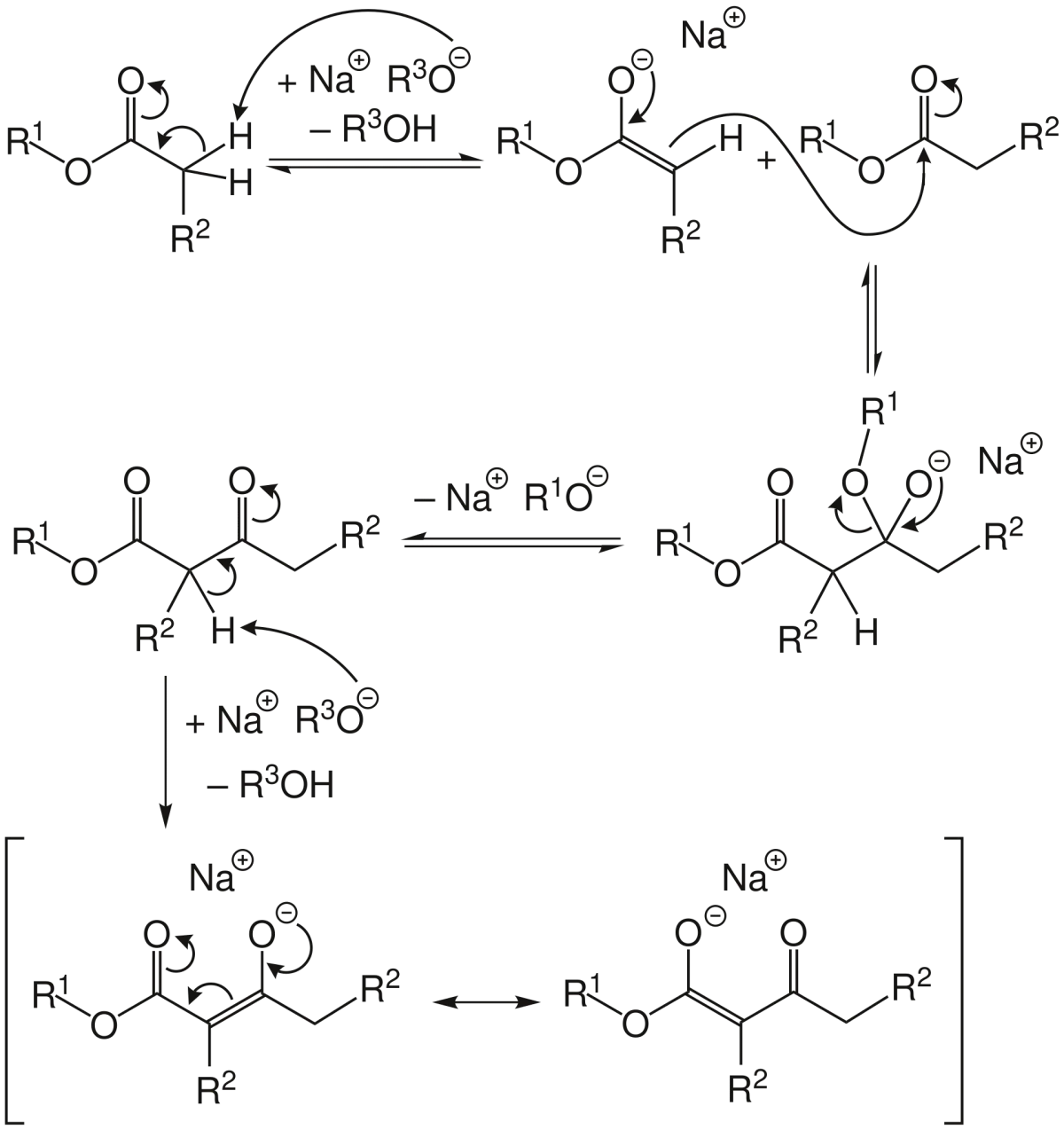
The Mechanism
Using ethyl acetate (CH₃COOEt) as the substrate (self-condensation):
Step 1: Enolate formation. Sodium ethoxide (NaOEt) in ethanol removes the alpha-H of ethyl acetate to give the enolate: CH₂=C(OEt)O⁻.
Note: esters have pKa ~25, which is higher than ethanol’s pKa (16). So this deprotonation is unfavorable at equilibrium (only about 10⁻⁹ of the ester exists as enolate). The reaction still works because the next steps pull the equilibrium forward.
Step 2: Enolate attacks another ester. The enolate’s C-end attacks the carbonyl carbon of a second molecule of ethyl acetate. Tetrahedral alkoxide intermediate forms.
Step 3: Loss of alkoxide. Unlike aldol, where the tetrahedral intermediate is stable (no good leaving group), the Claisen’s tetrahedral intermediate HAS a leaving group: the OEt group. The alkoxide collapses by kicking out OEt⁻, reforming a C=O (now part of a ketone, not an ester).
Step 3 product: ethyl 3-oxobutanoate ANION (ethyl acetoacetate enolate, CH₃-CO-CH⁻-COOEt).
Step 4: Deprotonation / irreversibility. The beta-keto ester product has an alpha-H flanked by two carbonyls (pKa ~11). This alpha-H is much more acidic than the starting ester’s alpha-H (pKa 25). Under the basic conditions, the beta-keto ester gets deprotonated to its (very stable) enolate. This second deprotonation drives the equilibrium forward - it is the “thermodynamic sink” that makes the whole reaction work.
Step 5: Workup. After the reaction, acidic workup protonates the beta-keto ester enolate to give the neutral beta-keto ester.
Net: 2 ethyl acetate + NaOEt + workup → ethyl acetoacetate (CH₃-CO-CH₂-COOEt).
Why You Need Two Equivalents of Base
The key thermodynamic insight: the overall reaction is unfavorable in the first three steps. It only becomes favorable because the beta-keto ester product can be deprotonated, and that anion is very stable. So you need stoichiometric (or excess) base to drive the reaction to completion. On workup, the anion is reprotonated to the neutral beta-keto ester.
Why Use Sodium Ethoxide Specifically?
Sodium ethoxide works with ethyl esters because its conjugate acid (ethanol) matches the ester’s OEt group. If you use NaOMe (sodium methoxide) with an ethyl ester, transesterification can scramble the groups. Matching the base’s alkyl group to the ester’s alkyl group prevents this side reaction.
For a methyl ester, use NaOMe. For an ethyl ester, use NaOEt. For a tert-butyl ester, use NaOtBu (rarely, since tert-butyl esters are bulky and slow to condense).
Product Uses: Ethyl Acetoacetate as a Synthetic Precursor
Ethyl acetoacetate (CH₃COCH₂COOEt), the Claisen self-condensation product of ethyl acetate, is a famous synthetic building block. It can:
- Undergo alpha-alkylation (Section 7.9) - the central alpha-H (pKa 11) is acidic enough to deprotonate with NaOEt, and the resulting anion can alkylate with alkyl halides.
- Saponify to the beta-keto acid, which decarboxylates on heating (beta-keto acids lose CO₂ easily via a 6-membered TS). The result is a methyl ketone with a new substituent from the alkylation step.
This is the acetoacetic ester synthesis - a classic route to substituted methyl ketones.
Biological Parallel: Fatty Acid Biosynthesis
Fatty acid biosynthesis in cells uses a Claisen-like condensation. The acetyl-CoA (Claisen donor) condenses with malonyl-CoA (an activated beta-keto acid derivative) to form a new C-C bond, elongating the fatty acid chain by two carbons. The enzyme is fatty acid synthase, and the chemistry is basically a Claisen with a built-in “malonate trick” (CO₂ loss provides extra driving force).
Crossed Claisen
Just like crossed aldol, mixing two different esters can give multiple products unless one is non-enolizable. Ethyl formate (HCOOEt), ethyl carbonate (CO(OEt)₂), and aryl esters have no alpha-H and serve as good electrophilic partners. Ethyl formate is especially useful because the formyl group becomes the ketone of the product.