
Michael Addition
The Michael addition (also called conjugate addition or 1,4-addition) is the addition of a nucleophile to the beta-carbon of an alpha-beta unsaturated carbonyl. It is the “soft” alternative to Grignard-style 1,2-addition: instead of attacking the carbonyl C, the nucleophile attacks the farther beta-C, giving a saturated carbonyl product with a new substituent at the beta-position.
Toggle between hard and soft nucleophiles in the selector to see the two possible addition sites — and the very different products each gives.
Michael addition: 1,2 vs 1,4
RLi, RMgX, LiAlH₄
Hard nucleophiles are charge-controlled — they go for the most electron-poor (highest δ+) carbon, which is the carbonyl C. Result: 1,2-addition, giving an allylic alcohol after workup.
Michael donors are typically stabilized enolates (1,3-dicarbonyls, nitroalkanes, sulfones). Michael acceptors are alpha-beta unsaturated carbonyls (enones, enals, nitroalkenes, alpha-beta-unsaturated esters).
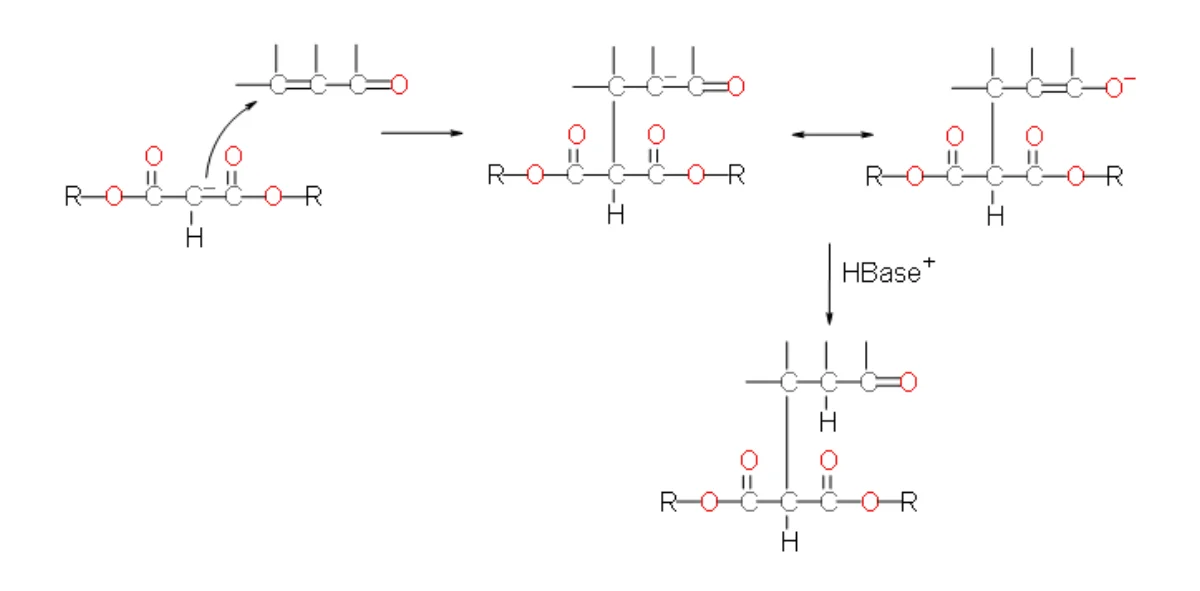
The Mechanism
Using diethyl malonate as the Michael donor and methyl vinyl ketone (MVK, CH₂=CH-CO-CH₃) as the Michael acceptor:
- Generate the donor’s enolate. NaOEt removes an alpha-H of diethyl malonate to form the stabilized malonate anion.
- Enolate attacks the beta-C of the acceptor. The C-end of the anion adds to the beta-C of MVK (the carbon farther from the carbonyl). The pi electrons of the C=C flow onto the alpha-C and then onto the carbonyl O, making a new enolate.
- Enolate protonation. The resulting enolate is protonated (by solvent or during workup) to give the saturated beta-substituted ketone.
Net: diethyl malonate + MVK + NaOEt → diethyl 2-(3-oxobutyl)malonate (a beta-substituted product with a new alpha-C attached to the malonate’s alpha-C).
Why It’s Called 1,4-Addition
If you number the enone’s atoms 1 (O), 2 (C=O carbon), 3 (alpha-C), 4 (beta-C), the nucleophile adds to C4 and the proton (from workup) adds to O1. So the net addition is “1,4” across the enone system - a conjugate addition that uses the full conjugated C=C-C=O unit.
Contrast with Grignard 1,2-addition: Grignard attacks at C2 (the carbonyl carbon) and the O at position 1 gets a proton on workup.
Hard vs Soft Donor Matters
- Hard donors (Grignards, organolithiums, hydride from LiAlH₄) prefer 1,2-addition to the carbonyl carbon. Tight, charge-dense nucleophiles go where the charge is most concentrated.
- Soft donors (stabilized enolates like malonate, cyanide, thiolates, Gilman reagents) prefer 1,4-addition to the beta-carbon. Polarizable, delocalized nucleophiles match the polarizability of the soft beta-C electrophile.
This is the HSAB (hard-soft acid-base) principle applied to nucleophilic addition.
Common Michael Donors
| Donor | pKa of alpha-H | Notes |
|-------|---------------|-------|
| Diethyl malonate | 13 | Classic soft nucleophile |
| Ethyl acetoacetate | 11 | Also classic |
| Nitromethane | 10 | Forms nitronate anion |
| Cyanoacetate | 9 | Very easy to deprotonate |
| Thiolate (RS⁻) | N/A (direct) | Soft sulfur nucleophile |
| Gilman reagent (R₂CuLi) | N/A | Soft organometallic |
| Enamine | N/A | Neutral Michael donor (Stork synthesis) |
Common Michael Acceptors
| Acceptor | Example | Notes |
|----------|---------|-------|
| alpha-beta unsaturated ketone | MVK (methyl vinyl ketone) | Classic acceptor |
| alpha-beta unsaturated aldehyde | Acrolein (CH₂=CHCHO) | Very reactive |
| alpha-beta unsaturated ester | Methyl acrylate (CH₂=CH-COOMe) | Good acceptor |
| alpha-beta unsaturated nitrile | Acrylonitrile (CH₂=CHCN) | Good acceptor |
| alpha-beta unsaturated nitro | Nitroethene (CH₂=CHNO₂) | Exceptional acceptor |
Enamine Michael Additions (Stork)
Stork enamine synthesis uses an enamine (neutral nucleophile made from a secondary amine + ketone, Section 6.8) as a Michael donor. The enamine attacks the beta-C of a Michael acceptor at its alpha-carbon; hydrolysis of the resulting iminium gives a 1,5-dicarbonyl product.
Stork’s route lets you do Michael additions without needing a strong base (the enamine is neutral). Useful when basic conditions would cause side reactions.

Biological Relevance: Nucleophilic Addition in Metabolism
Michael additions appear in biology:
- Fumarase adds water to fumarate in a Michael-like 1,4-addition. The result is malate.
- Some enzyme active sites do conjugate addition to electrophilic substrates as part of the catalytic cycle.
- Glutathione can do Michael addition to electrophilic xenobiotics as part of detoxification.
The organic mechanism you just learned appears in these biological contexts, just catalyzed and positioned by enzyme machinery.
The product is diethyl 2-(3-oxobutyl)malonate: (EtOOC)₂CH-CH₂-CH₂-CO-CH₃. Mechanism: NaOEt removes an alpha-H of malonate to give the soft, stabilized malonate anion. The anion’s C-end attacks the beta-C of MVK (the terminal CH₂ of CH₂=CH-CO-CH₃). The pi electrons shift onto the carbonyl O, giving an enolate. Workup protonates the enolate to give the saturated ketone. A new C-C bond has formed between the malonate’s alpha-C and MVK’s beta-C. This is a classic MCAT-style Michael addition.