
Wolff-Kishner and Clemmensen
Regular hydride reductions (NaBH₄, LiAlH₄) convert a C=O to a C-OH - the oxygen stays, just becomes an alcohol. But sometimes you want to remove the oxygen entirely, converting the C=O to a -CH₂- methylene group. Two classic methods do this: Wolff-Kishner (basic conditions) and Clemmensen (acidic conditions). The choice depends on whether your substrate survives acid or base.
Wolff-Kishner Reduction: Basic Conditions
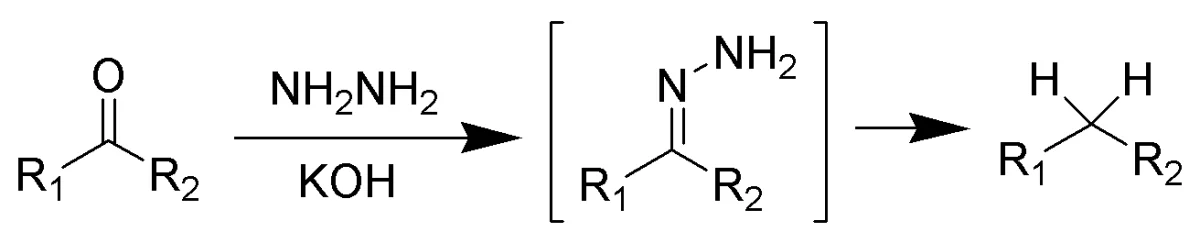
Wolff-Kishner uses hydrazine (H₂N-NH₂), strong base (KOH), and high temperature (often in a high-boiling solvent like triethylene glycol or diethylene glycol).
Sequence:
- The carbonyl reacts with hydrazine to form a hydrazone (C=N-NH₂) - a type of imine with an extra NH₂ on the nitrogen.
- Base deprotonates the hydrazone NH₂.
- Heat drives a concerted elimination: the C=N bond breaks, N₂ gas escapes, and the resulting carbanion picks up a proton to give the CH₂ group.
Net: R₂C=O + H₂N-NH₂ + KOH/heat → R₂CH₂ + N₂ + H₂O.
The byproducts (N₂ gas and water) leave the reaction mixture easily, driving it forward.
Wolff-Kishner is ideal when:
- The substrate contains acid-sensitive groups (esters, acetals) that would not survive Clemmensen’s HCl.
- You need mild basic conditions.
Clemmensen Reduction: Acidic Conditions
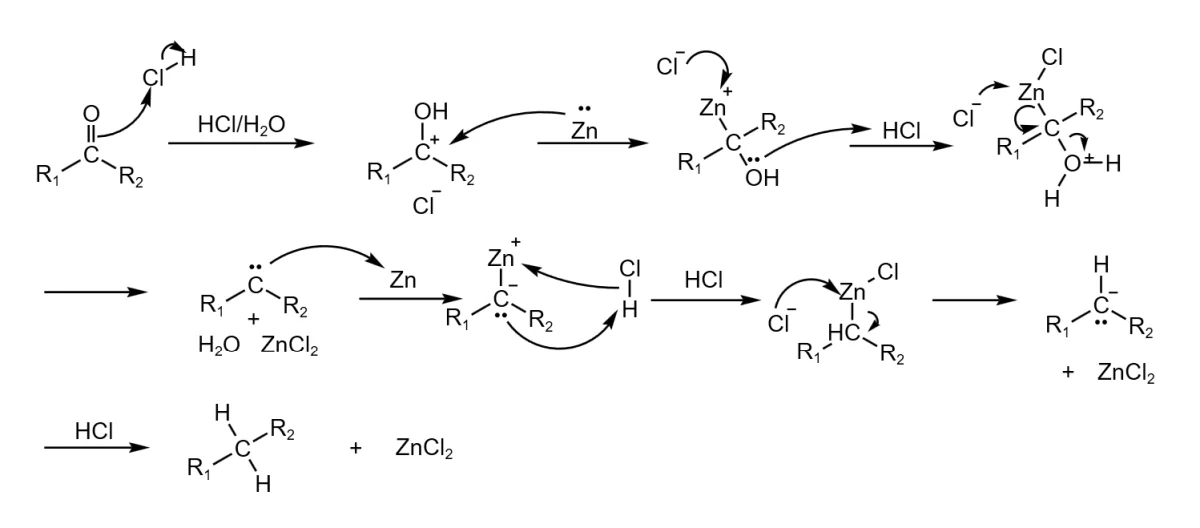
Clemmensen uses zinc amalgam (Zn-Hg alloy) and concentrated HCl at elevated temperature.
The exact mechanism is not fully understood (it involves Zn-carbenoid or carbanion intermediates), but the net effect is the same: C=O → CH₂.
Net: R₂C=O + Zn-Hg / HCl / heat → R₂CH₂.
Clemmensen is ideal when:
- The substrate has base-sensitive groups (phenolic -OH, amine N-H) that would not survive Wolff-Kishner’s KOH.
- You need acidic conditions.
Compared to Catalytic Hydrogenation (H₂ / Pd)
H₂/Pd does NOT reduce carbonyls cleanly to methylene. It reduces alkenes/alkynes to alkanes, reduces some nitriles, but simple ketones and aldehydes survive H₂/Pd at ordinary conditions.
For carbonyl-to-methylene, the two canonical methods are Wolff-Kishner and Clemmensen. On the MCAT, these are the only two reductions that give -CH₂- from -C(=O)-.
Why Remove the Oxygen at All?
Common scenarios where C=O to -CH₂- conversion matters:
- Friedel-Crafts alkylation is messy, but Friedel-Crafts acylation is clean. So to put an alkyl chain on a benzene ring, you often do acylation first (which installs a -CO-R) then reduce the C=O to -CH₂- (giving the alkylated ring).
- Synthesizing saturated hydrocarbons with a specific branching pattern that is easier to make via ketone intermediate.
- Steroid and natural-product synthesis where a ketone was needed for an earlier step but must be removed in the final product.
Alternative: Thioacetal + Raney Nickel Desulfurization
Another route to C=O → CH₂ is:
- Convert the carbonyl to a thioacetal using 1,3-propanedithiol (two -SH groups) under acid catalysis, removing water (analogous to acetal formation but with sulfur).
- Reduce the thioacetal with Raney nickel, which desulfurizes the C-S bonds to give C-H bonds, resulting in -CH₂-.
This three-step sequence (ketone → thioacetal → alkane) is sometimes used when neither Wolff-Kishner nor Clemmensen conditions are tolerated. For MCAT purposes, it is not a high-frequency topic, but recognize it if a passage mentions “desulfurization” near a carbonyl.
Summary of Carbonyl Reduction Options
| Reagent | Product from RCHO | Product from R₂CO |
|---|---|---|
| NaBH₄ (mild) | R-CH₂OH (1° alcohol) | R₂CHOH (2° alcohol) |
| LiAlH₄ (strong) | R-CH₂OH (1° alcohol) | R₂CHOH (2° alcohol) |
| H₂ / Pd (on alkene, not usual on C=O) | (no reaction usually) | (no reaction usually) |
| Wolff-Kishner (H₂NNH₂/KOH/heat) | R-CH₃ (methylene) | R₂CH₂ (methylene) |
| Clemmensen (Zn-Hg / HCl / heat) | R-CH₃ (methylene) | R₂CH₂ (methylene) |
| NaBH₃CN (with amine) | R-CH₂-NR’₂ (reductive amination) | R₂CHNR’₂ (reductive amination with ketone + amine) |
Aromatic Substrates Specifically
For an aryl ketone (Ph-CO-R from Friedel-Crafts acylation), both Wolff-Kishner and Clemmensen work to reduce to Ph-CH₂-R. This is the standard workaround for Friedel-Crafts alkylation’s limitations, turning the acylated product into the alkylated one.