
SN1 Reactions
The SN1 reaction is a substitution where the rate depends on only ONE substrate concentration - hence the name (substitution, nucleophilic, unimolecular). The mechanism has two steps: first the leaving group departs to form a carbocation, then the nucleophile attacks. Because the cation intermediate is planar and can be attacked from either face, SN1 reactions cause racemization at the reacting carbon.
SN1 is the mechanism of choice for tertiary substrates under mild conditions with weak nucleophiles. It appears constantly in MCAT mechanism questions involving alcohols, alkyl halides, and alcohol-derived reactions like Fischer esterification (indirectly).
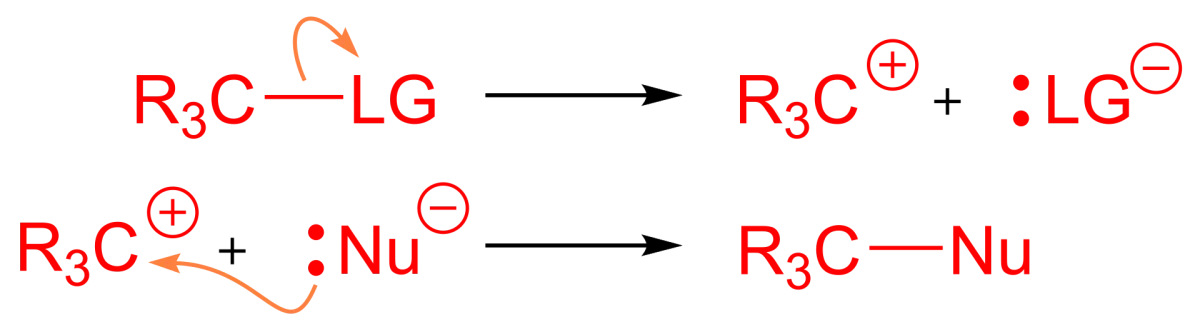
The Two-Step Mechanism
Step 1 (rate-limiting): ionization. The C-LG bond breaks heterolytically; the leaving group walks off with both bond electrons, leaving a carbocation behind. This step is slow because it requires overcoming the C-LG bond energy without any help from a nucleophile.
Arrows: one curved arrow from the C-LG bond to the leaving group.
Step 2 (fast): nucleophile attack. The carbocation (planar, sp²) is attacked by a nucleophile. Because the cation is planar, the nucleophile can approach from either face with roughly equal probability.
Arrows: one curved arrow from the nucleophile’s lone pair to the cationic carbon.
If the nucleophile is a neutral species (water, alcohol), a third step follows: deprotonation of the new O-H bond by any nearby base.
Rate Law: First Order
The rate law for SN1 is:
Rate = k [substrate]
The rate is INDEPENDENT of nucleophile concentration because the nucleophile is not involved in the rate-limiting step. Doubling nucleophile concentration does nothing to the rate. This is the kinetic signature of SN1 and an easy way to distinguish it from SN2 (which is second order).
Substrate Preference: 3° Dominates
Since the rate-limiting step is carbocation formation, SN1 depends strongly on carbocation stability. The trend is inverse to SN2:
3° >> 2° > 1° > methyl (SN1 essentially never happens for 1° or methyl)
- 3° substrate: forms a stable tertiary carbocation. SN1 is the preferred mechanism.
- 2° substrate: borderline. May be SN1 or SN2 depending on conditions; typically mixtures.
- 1° and methyl substrates: carbocation too unstable to form. SN1 does not happen; only SN2.
Resonance-stabilized substrates (allyl, benzyl) can do SN1 even at the primary level because the cation is stabilized by the adjacent pi system. Allyl bromide (CH₂=CH-CH₂-Br) does SN1 readily despite being a primary carbon.
Stereochemistry: Racemization
Because the carbocation intermediate is planar, the nucleophile can attack from either face. For a chiral substrate, the product is a roughly 50:50 mixture of R and S - a racemate.
In practice, perfect racemization is rare. Often there is a slight preference for attack from the face opposite to the departed leaving group (which is still partially shielding the other face just after ionization). This gives a slightly higher proportion of inverted product. The deviation from perfect racemization is called “partial racemization” or “preference for inversion.”
On the MCAT, “SN1 gives racemization” is the default expectation. If the product is not racemic, the mechanism might not be pure SN1.
Solvent Effects: Polar Protic Solvents Help
SN1 needs to stabilize the ionic intermediate (both the carbocation and the departed anion). Polar protic solvents (water, alcohols, carboxylic acids) do this via hydrogen bonding and dipole-dipole interactions. They dramatically speed up SN1 compared to nonpolar solvents.
Polar aprotic solvents (DMSO, DMF) can also stabilize cations via their oxygen lone pairs, but they do not stabilize anions as well (no H-bond donor). So SN1 is faster in protic solvents; SN2 prefers polar aprotic solvents.
Carbocation Rearrangements
Because the carbocation intermediate is a real, discrete species with a microsecond lifetime, it has time to rearrange if a more stable cation is accessible. Hydride shifts and methyl shifts are common.
Example: 3-chloro-2,2-dimethylbutane under SN1 conditions first ionizes to a 2° cation on C3, then immediately rearranges via a methyl shift from the adjacent quaternary C2, producing a 3° cation on C2 (and moving the methyl onto C3). The nucleophile then attacks the rearranged cation, not the original.
If the MCAT asks where the product ends up, always check for rearrangement when the initial cation is less than 3° and a shift is possible.
Common SN1 Examples
- tert-Butyl bromide + water → tert-butanol + HBr. Classic SN1 hydrolysis.
- 3° alcohol + HCl → 3° alkyl chloride + H₂O. The acid protonates the alcohol, then SN1 ionization and chloride attack.
- Benzyl chloride + methanol → benzyl methyl ether. Benzyl cation is stabilized by resonance, so SN1 is fast even in a primary substrate.
- Solvolysis reactions (the solvent itself is the nucleophile) are often SN1 because they use polar protic solvents and any substrate that can form a stable cation.