Imagine you have a box of LEGO bricks - say, four red bricks, ten blue bricks, and one yellow brick. You could build a house with those exact bricks. Or you could tear it apart and build a car using the same pieces. Same bricks, completely different structure. That is what isomers are: molecules that share the same molecular formula but differ in how those atoms are arranged.
The MCAT will hand you two molecules, and you need to classify their relationship instantly. Are they constitutional isomers? Enantiomers? Diastereomers? Conformational isomers? This section gives you the decision tree.
The Isomer Family Tree
Every pair of isomers falls into one of two major branches:
Constitutional (structural) isomers - same molecular formula, different connectivity. The atoms are bonded to different partners. Think of “listen” and “silent” - same letters, completely rearranged.
Stereoisomers - same molecular formula AND same connectivity, but different spatial arrangement. The atoms are bonded to the same partners, but the 3D layout differs. Think of your left and right hands - same fingers connected the same way, but arranged differently in space.
Constitutional Isomers
Constitutional isomers have different bonding patterns. Given the molecular formula C4H10, you could draw butane (a straight chain of four carbons) or isobutane (a three-carbon chain with a methyl branch). Same formula, different connectivity. These molecules have different physical properties - different boiling points, different melting points, different reactivities.
The key test: if you need to break and re-form covalent bonds to convert one molecule into the other, they are constitutional isomers.
Stereoisomers
Stereoisomers have identical connectivity - every atom is bonded to the same partners. The only difference is how those bonds are oriented in three-dimensional space. Stereoisomers break down into further subcategories:
Enantiomers - non-superimposable mirror images (like left and right hands)
Diastereomers - stereoisomers that are NOT mirror images of each other
Meso compounds - molecules with stereocenters but an internal mirror plane that makes them achiral
Geometric (cis/trans or E/Z) isomers - differ in arrangement around a double bond or ring
Conformational isomers - differ by rotation around a single bond (same molecule, different rotational snapshot)
The Decision Flowchart
When the MCAT shows you two molecules with the same molecular formula, run through this checklist:
Question
If YES
If NO
Same molecular formula?
Could be isomers - continue
Not isomers at all
Same connectivity (same bonding partners)?
Stereoisomers
Constitutional isomers
Non-superimposable mirror images?
Enantiomers
Diastereomers (or other subtype)
Internal mirror plane despite having stereocenters?
Meso compound (achiral)
Chiral molecule
Differ only by rotation around a single bond?
Conformational isomers
Configurational isomers
Enantiomers — non-superimposable mirror images, just like left and right hands — sit in the stereoisomer branch of the full classification above. The table lays out every split: constitutional isomers differ in connectivity; stereoisomers share connectivity and split further into enantiomers, diastereomers, and meso compounds. Credit: Wikimedia Commons, CC BY-SA
Configurational vs. Conformational Isomers
One distinction that trips up students: configurational isomers require bond breaking to interconvert, while conformational isomers interconvert by simple rotation around single bonds without breaking anything.
Enantiomers, diastereomers, and geometric isomers are all configurational - you cannot convert one into the other without breaking bonds. Conformational isomers (like anti-butane and gauche-butane) are really just different rotational snapshots of the same molecule. They interconvert freely at room temperature.
Why Isomers Matter in Biology
Your body is a chiral environment. Enzymes are chiral. Receptors are chiral. When a molecule interacts with a biological target, shape determines everything. This is why:
(S)-Ibuprofen is the active pain reliever; (R)-ibuprofen is inactive.
(S)-Thalidomide treats morning sickness; (R)-thalidomide causes severe birth defects.
D-glucose is the fuel your cells burn; L-glucose passes through your body unmetabolized.
The MCAT loves these examples because they show that isomer classification is not an abstract exercise - it has real consequences.
Quick Reference: Isomer Types at a Glance
Isomer Type
Same Formula?
Same Connectivity?
Mirror Images?
Interconvert Freely?
Constitutional
Yes
No
N/A
No (bond breaking needed)
Enantiomers
Yes
Yes
Yes (non-superimposable)
No (bond breaking needed)
Diastereomers
Yes
Yes
No
No (bond breaking needed)
Meso
Yes
Yes
Has internal mirror plane
No (single compound, achiral)
Geometric (E/Z)
Yes
Yes
No
No (double bond restricts rotation)
Conformational
Yes
Yes
Varies
Yes (free rotation)
What is the fundamental difference between constitutional isomers and stereoisomers?
Click to reveal answer
Constitutional isomers differ in connectivity - the atoms are bonded to different partners. Stereoisomers have identical connectivity - the same atoms are bonded to the same partners, but they differ in their three-dimensional spatial arrangement. The first question to ask: "Are the bonding partners the same or different?"
How do conformational isomers differ from configurational isomers?
Click to reveal answer
Conformational isomers interconvert by rotation around single bonds without breaking any bonds - they are the same molecule in different poses. Configurational isomers (enantiomers, diastereomers, geometric isomers) require bond breaking to interconvert. At room temperature, conformational isomers freely interconvert; configurational isomers do not.
Take the letters A, T, C. You can spell “cat,” “act,” or “tac.” Same letters, completely different words with different meanings. Constitutional isomers work the same way - same atoms, but connected in a different order, creating entirely different molecules.
Constitutional isomers (also called structural isomers) share the same molecular formula but differ in how their atoms are bonded together. This is the most fundamental type of isomerism. If the connectivity is different, every property can be different: boiling point, melting point, solubility, reactivity, and biological activity.
Three Flavors of Constitutional Isomers
Constitutional isomers come in three subcategories. The MCAT will not usually ask you to name the subcategory, but understanding them helps you quickly identify isomeric relationships.
Chain (Skeletal) Isomers
Chain isomers have the same molecular formula but differ in the arrangement of the carbon skeleton - one might be a straight chain while another is branched.
Example: C5H12 has three chain isomers:
Pentane - five carbons in a straight chain
Isopentane (2-methylbutane) - four-carbon chain with a methyl branch at carbon 2
Neopentane (2,2-dimethylpropane) - three-carbon chain with two methyl branches at carbon 2
All three have the formula C5H12, but their carbon skeletons are arranged differently. Pentane has the highest boiling point (36 C) because its longer, unbranched shape allows more surface area for London dispersion forces. Neopentane has the lowest boiling point (9.5 C) because its compact, spherical shape minimizes intermolecular contact.
Positional Isomers
Positional isomers have the same carbon skeleton and the same functional group, but the functional group is attached at a different position on the chain.
Example: C3H8O has two positional isomers (among its alcohol forms):
1-propanol - OH group on carbon 1 (primary alcohol)
2-propanol - OH group on carbon 2 (secondary alcohol)
Both are alcohols with the same carbon chain, but the hydroxyl group sits at a different position. This changes their reactivity: primary alcohols can be oxidized to aldehydes and then carboxylic acids, while secondary alcohols oxidize to ketones.
Functional Group Isomers
Functional group isomers have the same molecular formula but contain entirely different functional groups. This is the most dramatic type of constitutional isomerism.
Example: C2H6O can be:
Ethanol (CH3CH2OH) - an alcohol with a boiling point of 78 C
Dimethyl ether (CH3OCH3) - an ether with a boiling point of -24 C
Same formula, but one is an alcohol and the other is an ether. Their properties are wildly different. Ethanol is a liquid at room temperature, forms hydrogen bonds, dissolves in water, and can make you drunk. Dimethyl ether is a gas at room temperature, cannot hydrogen-bond with itself, and is used as an aerosol propellant.
More functional group isomer pairs to know:
Molecular Formula
Isomer 1
Isomer 2
C3H6O
Propanal (aldehyde)
Acetone (ketone)
C2H4O2
Acetic acid (carboxylic acid)
Methyl formate (ester)
C3H6O2
Propanoic acid (carboxylic acid)
Methyl acetate (ester)
Degrees of Unsaturation (Index of Hydrogen Deficiency)
When you see a molecular formula on the MCAT, calculating degrees of unsaturation helps you quickly determine how many rings and/or pi bonds the molecule contains. This narrows down which constitutional isomers are possible.
The formula for a molecule with C, H, N, and O:
How to use it:
DoU = 0 means the molecule is fully saturated (no rings, no double bonds)
DoU = 1 means one ring OR one double bond
DoU = 4 usually signals a benzene ring (three double bonds + one ring)
Example: Benzene (C6H6): DoU = (2(6) + 2 - 6) / 2 = 28 = 4. That accounts for three C=C double bonds and one ring.
How Many Constitutional Isomers Exist?
The number of constitutional isomers increases dramatically with molecular size:
Molecular Formula
Number of Constitutional Isomers
C4H10
2
C5H12
3
C6H14
5
C7H16
9
C10H22
75
C20H42
366,319
You don’t need to memorize these numbers, but appreciate the pattern: as the number of carbons grows, the number of possible arrangements explodes. This is why systematic naming (IUPAC nomenclature) exists - common names would be impossibly ambiguous.
Identifying Constitutional Isomers on the MCAT
Here is a reliable strategy for determining whether two molecules are constitutional isomers:
Check the molecular formula. If the formulas are different, they are not isomers of any kind.
Check the connectivity. Trace the bonds. Are the atoms connected to the same partners? If not, they are constitutional isomers.
Don’t be fooled by rotation. If you can convert one drawing into the other just by rotating it (without breaking bonds), they are the same molecule, not isomers.
Ethanol (CH3CH2OH) and dimethyl ether (CH3OCH3) have the same molecular formula C2H6O. What type of isomers are they?
Click to reveal answer
Functional group isomers (a type of constitutional isomer). They share the same molecular formula but contain different functional groups - one is an alcohol and the other is an ether. Their connectivity is different, so they are constitutional isomers, not stereoisomers.
What is the degree of unsaturation for a molecule with formula C4H6? What structural features could this represent?
Click to reveal answer
DoU = (2(4) + 2 - 6) / 2 = 24 = 2 degrees of unsaturation. This could be: two double bonds (like 1,3-butadiene), one triple bond (like 1-butyne), one double bond + one ring (like cyclobutene), or two rings (like bicyclo[1.1.0]butane).
Imagine two houses built from the same blueprint, with the same rooms connected by the same hallways. But one is the original, and the other is its mirror image - the front door is on the left instead of the right, the kitchen and living room are swapped. Same floor plan, same connections, but a mirror-reversed layout. That is stereoisomerism: same connectivity, different spatial arrangement.
Stereoisomers share the same molecular formula AND the same atom-to-atom connectivity. If you list which atom is bonded to which, the lists are identical. The difference is entirely in how those bonds are oriented in three-dimensional space.
Why 3D Arrangement Matters
In general chemistry, you could often get away with thinking of molecules as flat drawings. In organic chemistry, and especially on the MCAT, three-dimensional shape is everything. Here is why:
Biological molecules are three-dimensional. Enzymes have active sites shaped like specific 3D pockets. Receptors on cell surfaces have binding grooves with precise geometries. When a molecule approaches a biological target, it is not the molecular formula or even the connectivity that determines whether it fits - it is the exact 3D shape.
A molecule with the right formula and the right connections but the wrong 3D arrangement will not fit into the active site. It is like having the right key blank cut with the wrong pattern - same metal, same size, but it won’t turn the lock.
The Two Major Categories of Stereoisomers
Stereoisomers divide into two categories based on their mirror-image relationship:
1. Enantiomers - non-superimposable mirror images of each other. Just like your left and right hands, enantiomers are exact mirror reflections, but you cannot overlay one perfectly on top of the other no matter how you rotate it.
2. Diastereomers - stereoisomers that are NOT mirror images of each other. They differ at some stereocenters but not all. Diastereomers have different physical properties (different melting points, boiling points, solubilities).
Sources of Stereoisomerism
Stereoisomers arise whenever a molecule has a feature that restricts its geometry in 3D. The three main sources:
Chiral centers (stereocenters): A carbon bonded to four different groups can be arranged in two different ways that are mirror images. This is the most common source of stereoisomers on the MCAT.
Restricted rotation around double bonds: C=C double bonds cannot rotate freely like single bonds. Groups can be arranged on the same side (cis/Z) or opposite sides (trans/E) of the double bond, creating geometric isomers.
Ring structures: In cyclic compounds, substituents can be on the same side or opposite sides of the ring plane, creating cis and trans isomers even without a double bond.
Stereocenters and the 2n Rule
A stereocenter (also called a chiral center or asymmetric center) is typically a carbon atom bonded to four different substituents. The maximum number of stereoisomers for a molecule with n stereocenters is:
Identifying Stereocenters
To find stereocenters in a molecule:
Look at each carbon atom in the structure.
Ask: “Is this carbon bonded to four DIFFERENT groups?” (Different means non-identical when you trace out to the end of each branch.)
If yes, that carbon is a stereocenter.
Common pitfalls:
CH2 groups are never stereocenters (two identical H atoms)
CH3 groups are never stereocenters (three identical H atoms)
A carbon in a double bond is never a traditional stereocenter (it only has three groups attached, using sp2 hybridization)
Atoms other than carbon can be stereocenters (nitrogen, phosphorus, sulfur), but carbon is by far the most common on the MCAT
Stereoisomers vs. Constitutional Isomers - The Critical Distinction
The dividing line is connectivity:
Feature
Constitutional Isomers
Stereoisomers
Same molecular formula
Yes
Yes
Same connectivity
No
Yes
Same physical properties
No
Sometimes (enantiomers share most)
Require bond breaking to interconvert
Yes
Yes (except conformational)
Different biological activity
Yes
Often yes
If two molecules have the same formula and you can trace identical connectivity in both, they are stereoisomers. If the connectivity differs at any point, they are constitutional isomers. This is always your first question.
The Thalidomide Example
The most infamous example of stereoisomer significance involves thalidomide, a drug prescribed in the late 1950s for morning sickness. The drug was sold as a racemic mixture (equal parts of both enantiomers). One enantiomer effectively treated nausea. The other caused severe birth defects. The two molecules had identical formulas, identical connectivity, and identical physical properties in a test tube. But in the chiral environment of the human body, they behaved completely differently.
A molecule has 3 stereocenters. What is the maximum number of stereoisomers it can have?
Click to reveal answer
23 = 8 stereoisomers maximum. The actual number may be less if the molecule has internal symmetry that produces meso compounds. But the maximum is always 2n, where n is the number of stereocenters.
What three structural features can give rise to stereoisomers?
Click to reveal answer
1) Chiral centers - a carbon bonded to four different groups. 2) Restricted rotation around double bonds - creating E/Z or cis/trans isomers. 3) Ring structures - substituents can be cis or trans relative to the ring plane. All three create situations where the same connectivity produces different 3D arrangements.
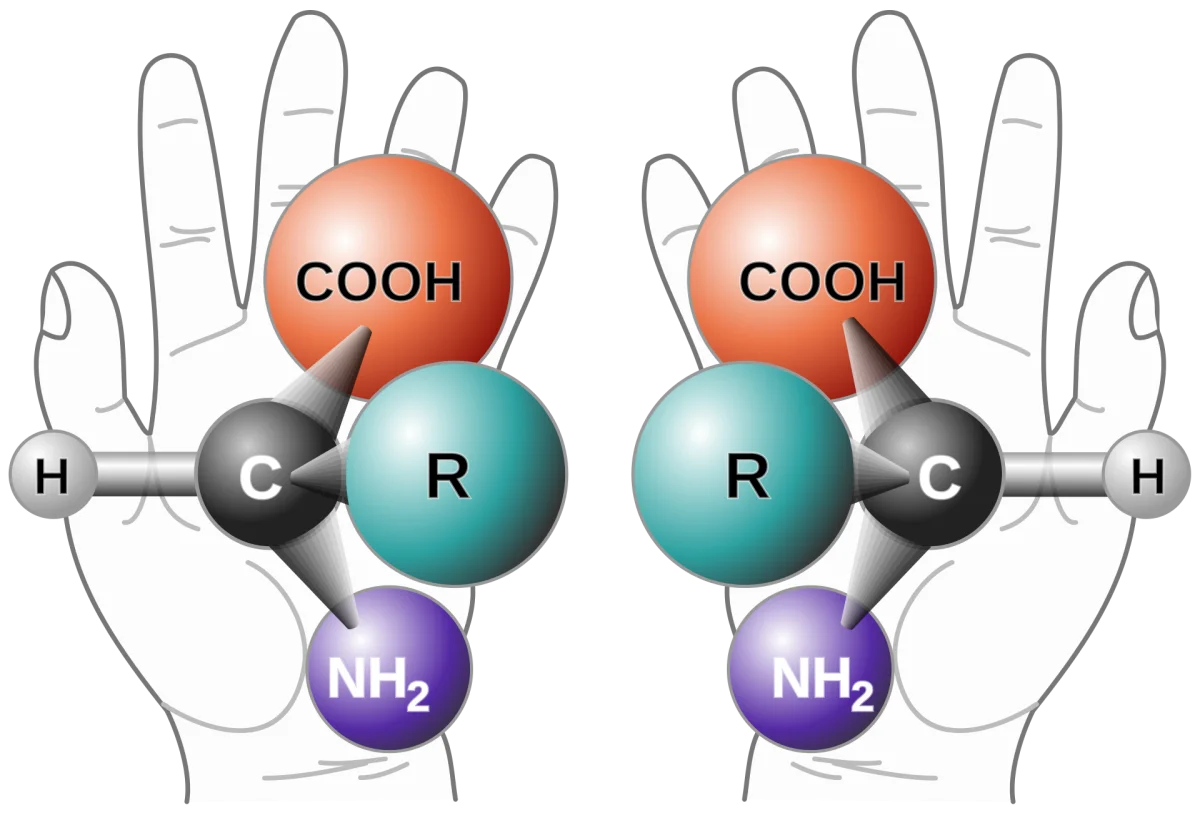
Look at your hands. They are mirror images of each other. But no matter how you rotate your left hand, you cannot make it look identical to your right hand. If you place your left hand flat on a table, palm down, your thumb points right. If you place your right hand palm down, your thumb points left. Same fingers, same connections, but not stackable. This property - being non-superimposable on your mirror image - is called chirality.
A molecule is chiral if it cannot be superimposed on its mirror image. A molecule is achiral if it CAN be superimposed on its mirror image.
Chirality illustrated with hands: your left hand is the mirror image of your right hand, but no rotation can make one stack perfectly on the other. Chiral molecules behave the same way - they have non-superimposable mirror images called enantiomers. Credit: Wikimedia Commons, CC BY-SA
The Requirements for Chirality
The most common cause of chirality is a chiral center (stereocenter) - a carbon atom bonded to four different substituents. But chirality is actually a property of the whole molecule, not just individual atoms. Here is the complete picture:
A molecule is chiral if:
It has no internal plane of symmetry (no mirror plane that divides the molecule into two identical halves)
It is non-superimposable on its mirror image
A molecule is achiral if:
It has an internal plane of symmetry, OR
It is superimposable on its mirror image
The plane of symmetry test is usually the fastest way to determine chirality on the MCAT.
Identifying Chiral Centers Step by Step
To find chiral centers in a molecule, examine each carbon and check whether it is bonded to four different groups:
Step 1: Look at a carbon atom.
Step 2: Identify the four groups attached to it. Trace each group outward from the carbon - you need to follow the entire chain, not just the immediately attached atom.
Step 3: Compare all four groups. If all four are different, the carbon is a chiral center. If any two are identical, it is not.
Example: 2-bromobutane (CH3CHBrCH2CH3)
Carbon 2 is bonded to: H, Br, CH3 (going one direction), and CH2CH3 (going the other direction). All four groups are different, so carbon 2 is a chiral center.
Example: 2-propanol (CH3CHOHCH3)
Carbon 2 is bonded to: H, OH, CH3 (going left), and CH3 (going right). Two of the groups are identical (both CH3), so carbon 2 is NOT a chiral center. This molecule is achiral.
A chiral center requires four different substituents at a single carbon. Once identified, those substituents are ranked by priority (R/S assignment, covered in the next section). If any two substituents are identical, the carbon is not a chiral center. Credit: Wikimedia Commons, CC BY-SA
Superimposability - The Definitive Test
The word “superimposable” means you can place one molecule on top of the other so that every atom in molecule A lines up perfectly with the corresponding atom in molecule B. If you can do this (even after rotating the molecule), the two are identical - the same compound. If you cannot, they are different compounds (enantiomers).
Think of it this way: take a transparency of molecule A and lay it on top of molecule B. Can you rotate and flip the transparency until every atom matches? If yes, they are superimposable (identical). If no amount of rotation works, they are non-superimposable (enantiomers).
Chirality Without a Stereocenter
While a chiral center is the most common source of chirality on the MCAT, molecules can be chiral without having a traditional four-different-groups carbon. Two less common examples:
Allenes: Molecules with cumulated double bonds (C=C=C) can be chiral if the two ends have different substituents. The two pi bonds are perpendicular, creating a 3D arrangement that can be non-superimposable on its mirror image.
Atropisomers: Molecules where rotation around a single bond is restricted by steric hindrance (bulky groups blocking rotation). Substituted biphenyls are the classic example.
These are rare on the MCAT, but you should know they exist so you don’t assume that “no stereocenter = not chiral.”
Planes of Symmetry and Chirality
The fastest way to determine chirality on an exam is the plane of symmetry test:
If you can draw a plane through the molecule that divides it into two halves that are exact mirror reflections of each other, the molecule is achiral (even if it has stereocenters - this is the meso situation, covered in Section 2.8).
If no such plane exists, the molecule is chiral.
Examples of achiral molecules with symmetry planes:
Methane (CH4) - multiple planes of symmetry
2-propanol - the plane through the OH, H, and the central C divides the two CH3 groups symmetrically
cis-1,2-dimethylcyclohexane (in certain conformations)
Chirality in Biological Systems
Life on Earth is homochiral - it uses almost exclusively L-amino acids and D-sugars. This means your enzymes, receptors, and transport proteins are all built from chiral building blocks with a specific handedness.
When a chiral molecule enters your body, it interacts with chiral biological machinery. The two enantiomers of a drug will interact differently with the same receptor, just as your left hand interacts differently with a right-handed glove versus a left-handed glove.
This is why the pharmaceutical industry cares deeply about chirality. A racemic mixture (50:50 mix of both enantiomers) means half your drug dose could be inactive or even harmful.
What is the difference between a chiral molecule and an achiral molecule?
Click to reveal answer
A chiral molecule is non-superimposable on its mirror image - it has no internal plane of symmetry. An achiral molecule IS superimposable on its mirror image - it has at least one internal plane of symmetry. The quick test: look for a plane of symmetry. If one exists, the molecule is achiral.
Can a molecule with stereocenters be achiral? Explain.
Click to reveal answer
Yes. A meso compound has stereocenters but is achiral because it possesses an internal plane of symmetry. The stereocenters effectively cancel each other out. For example, (2R,3S)-tartaric acid has two stereocenters but an internal mirror plane, making it achiral and optically inactive.
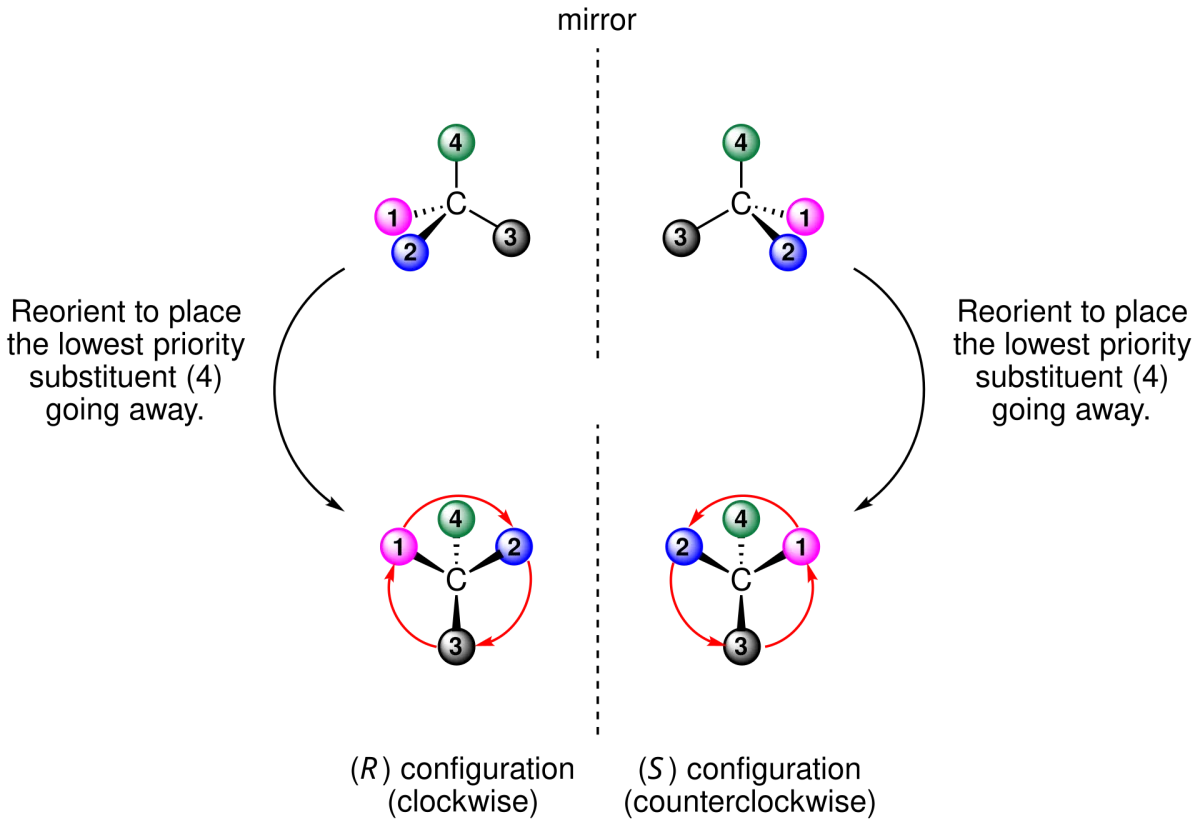
You have identified a chiral center. Now what? You need a way to name which specific arrangement is present - to distinguish the “left hand” from the “right hand.” The Cahn-Ingold-Prelog (CIP) system assigns each chiral center a label: R (rectus, Latin for “right”) or S (sinister, Latin for “left”). This is called the absolute configuration.
Think of it like giving directions. You are standing at an intersection (the chiral center) with four roads going in different directions (the four substituents). The CIP rules tell you to rank the roads by importance, point the least important road away from you, and then look at which direction the other three roads circle - clockwise or counterclockwise.
Cahn-Ingold-Prelog priority rules. Rank the four substituents by atomic number (1 = highest). Point priority 4 away from you. Trace 1 → 2 → 3: clockwise = R (rectus), counterclockwise = S (sinister). Credit: Wikimedia Commons, CC BY-SA
Step-by-Step: Assigning R or S
Step 1: Assign priorities (1 through 4) to the four substituents.
Look at the atom directly attached to the chiral center. Higher atomic number = higher priority.
Priority 1: highest atomic number
Priority 4: lowest atomic number (usually hydrogen)
If two atoms directly attached to the chiral center are the same element, move outward along each chain until you find a difference. The first point of difference determines priority.
Step 2: Orient the molecule so that priority 4 points away from you.
Imagine holding the molecule like a steering wheel, with the lowest-priority group (usually H) pointing straight back, behind the carbon.
Step 3: Trace a path from priority 1 to 2 to 3.
If the path goes clockwise (like turning a steering wheel to the right): the configuration is R
If the path goes counterclockwise (like turning left): the configuration is S
CIP Priority Rules in Detail
Rule 1: Atomic number wins.
Compare the atoms directly bonded to the chiral center. Higher atomic number gets higher priority.
Atom
Atomic Number
Priority Rank (if all four present)
I (iodine)
53
Highest
Br (bromine)
35
High
Cl (chlorine)
17
Medium-high
O (oxygen)
8
Medium
N (nitrogen)
7
Medium-low
C (carbon)
6
Low
H (hydrogen)
1
Lowest (almost always priority 4)
Rule 2: If the first atoms are the same, keep going outward.
When two substituents start with the same atom (e.g., both start with carbon), move to the next atom in each chain. Compare the sets of atoms at the next level. The first point of difference determines the winner.
Example: -CH2CH3 vs. -CH3
Both start with C. Move outward: -CH2CH3 has (C, H, H) at the next level. -CH3 has (H, H, H). C > H, so -CH2CH3 gets higher priority.
Rule 3: Double and triple bonds are “expanded.”
A double bond to an atom counts as two single bonds to that atom. A triple bond counts as three.
C=O is treated as if carbon is bonded to two O atoms (and each O is bonded back to a “phantom” C)
C=C is treated as if each carbon is bonded to two C atoms
This means an aldehyde group (-CHO) outranks a simple alcohol (-CH2OH) because the carbonyl carbon appears to have two bonds to oxygen.
The “Priority 4 Is Toward You” Shortcut
On the MCAT, the lowest-priority group is not always drawn pointing away from you. When priority 4 faces toward you (represented by a wedge in a dash-wedge drawing), use this shortcut:
Assign priorities 1-4 as normal.
Trace 1 to 2 to 3 as if priority 4 were pointing away.
The direction you see (clockwise or counterclockwise) gives you the opposite configuration.
Why? Because you are looking at the molecule from the wrong side. If you see clockwise with priority 4 coming toward you, the actual configuration is S (counterclockwise from the correct viewing angle), and vice versa.
Common MCAT Pitfalls
Pitfall 1: Confusing R/S with (+)/(-).
R and S describe the arrangement of groups around a chiral center. (+) and (-) describe the direction a compound rotates plane-polarized light. There is NO predictable relationship between them. R does not mean (+), and S does not mean (-). An R compound can be (+) or (-), and you can only determine the sign experimentally with a polarimeter.
Pitfall 2: Forgetting to expand double bonds.
Students often rank -CH2OH above -CHO because they see “more atoms.” But -CHO has a C=O double bond, which expands to two C-O bonds, giving it higher priority than -CH2OH at the first point of difference.
Pitfall 3: Not going far enough outward.
When two substituents start with the same atom, you must keep tracing outward until you find a difference. Sometimes the difference is three or four atoms away from the chiral center.
Worked Example
Assign R or S to (S)-alanine:
Alanine’s chiral center (the alpha carbon) is bonded to: -NH2, -COOH, -CH3, and -H.
Step 1 - Assign priorities:
Priority 1: N (atomic number 7) from -NH2
Priority 2: C from -COOH. This C has a double bond to O, expanded to two C-O bonds. Higher than the C in -CH3.
Priority 3: C from -CH3 (only bonded to H atoms beyond the first C)
Priority 4: H
Step 2 - Orient with #4 away from you.
Step 3 - Trace 1 to 2 to 3. If the path is counterclockwise, the assignment is S.
Practice: Quick Priority Ranking
Rank these substituents from highest to lowest CIP priority:
-OH, -CH3, -NH2, -H
Answer: -OH (O, atomic number 8) > -NH2 (N, atomic number 7) > -CH3 (C, atomic number 6) > -H (H, atomic number 1)
Rank these: -CH2Cl, -CH2OH, -CH2CH3, -CH3
Answer: -CH2Cl (Cl at second position, atomic number 17) > -CH2OH (O at second position, atomic number 8) > -CH2CH3 (C at second position, atomic number 6) > -CH3 (H at second position, atomic number 1)
A chiral center has substituents -Br, -OH, -CH3, and -H. With priority 4 pointing away from you, the trace from 1 to 2 to 3 goes clockwise. What is the configuration?
Click to reveal answer
R (rectus). Priorities: Br (1, atomic number 35) > OH (2, atomic number 8) > CH3 (3, atomic number 6) > H (4, atomic number 1). With H pointing away, clockwise 1-2-3 = R. Remember: "R is for Right turn" (clockwise).
If priority 4 is on a wedge (pointing toward you) and you trace 1-2-3 clockwise, what is the actual configuration?
Click to reveal answer
S (sinister). When priority 4 faces toward you, you are viewing the molecule from the wrong side. The apparent clockwise direction is reversed to counterclockwise when viewed correctly. So apparent clockwise with #4 toward you = S. Always flip your answer when #4 is on a wedge.
Identical twins look exactly alike - same height, same features, same bone structure. If you put one twin in front of a mirror, the reflection would look like the other twin. They are mirror images of each other. Now think about regular siblings. They share a family resemblance - same parents, similar features - but they are clearly not mirror images. One might be taller, one might have different eye color.
Enantiomers are the identical twins of stereochemistry: exact mirror images at every stereocenter. Diastereomers are the siblings: related by stereochemistry, but different at some positions while the same at others.
Enantiomers: Mirror-Image Partners
Definition: Enantiomers are stereoisomers that are non-superimposable mirror images of each other. They have opposite configurations at EVERY stereocenter.
If a molecule has stereocenters with configurations (R,R), its enantiomer is (S,S). If it is (R,S,R), its enantiomer is (S,R,S). Every single stereocenter is flipped.
Properties of enantiomers:
Enantiomers share nearly all physical properties:
Property
Same or Different?
Melting point
Same
Boiling point
Same
Density
Same
Solubility (in achiral solvents)
Same
IR spectrum
Same
NMR spectrum
Same
Refractive index
Same
Optical rotation magnitude
Same (but opposite sign)
Reaction with achiral reagents
Same rate
Reaction with chiral reagents
Different rate
Biological activity
Often different
The one measurable physical difference between enantiomers in an achiral environment is the direction of optical rotation: one rotates plane-polarized light clockwise (+), the other rotates it counterclockwise (-), by exactly the same magnitude. We will cover this in detail in Section 2.7.
Diastereomers: Non-Mirror Stereoisomers
Definition: Diastereomers are stereoisomers that are NOT mirror images of each other. They differ at some stereocenters but are the same at others.
If a molecule has stereocenters with configurations (R,R), the possible stereoisomers are:
(S,S) - enantiomer of (R,R)
(R,S) - diastereomer of (R,R)
(S,R) - diastereomer of (R,R)
Notice that (R,S) and (S,R) are enantiomers of each other, but both are diastereomers of (R,R).
Properties of diastereomers:
Unlike enantiomers, diastereomers have DIFFERENT physical properties:
Property
Same or Different?
Melting point
Different
Boiling point
Different
Density
Different
Solubility
Different
Optical rotation
Different (both magnitude and sign)
Reaction rates
Different
This is crucial for the MCAT: because diastereomers have different physical properties, they can be separated by standard techniques like distillation, crystallization, or chromatography. Enantiomers cannot be separated by these methods because their physical properties are identical in achiral environments.
Epimers: A Special Case of Diastereomers
Epimers are diastereomers that differ at exactly ONE stereocenter. This term comes up most often in carbohydrate chemistry.
Example: D-glucose and D-galactose are epimers - they differ only at carbon 4. All other stereocenters are identical. D-glucose and D-mannose are also epimers, differing only at carbon 2.
Epimers are a subset of diastereomers, so they have different physical properties and can be separated by standard methods.
Anomers: Another Special Case
Anomers are a type of epimer that differ specifically at the anomeric carbon (carbon 1 in aldoses, carbon 2 in ketoses) of cyclic sugars. When glucose cyclizes, the hydroxyl on the anomeric carbon can point either down (alpha anomer) or up (beta anomer) in a Haworth projection. Anomers are diastereomers of each other.
Relationships Between Multiple Stereocenters
For a molecule with two stereocenters, there are up to four stereoisomers (22 = 4):
Stereoisomer
Configuration
Relationship to (R,R)
Compound A
(R,R)
- (itself)
Compound B
(S,S)
Enantiomer
Compound C
(R,S)
Diastereomer
Compound D
(S,R)
Diastereomer
Note: Compounds C and D are enantiomers of each other, but both are diastereomers of A and B.
How to Quickly Classify Two Stereoisomers
When the MCAT gives you two structures and asks for their relationship:
Verify they have the same molecular formula and connectivity (if not, they are constitutional isomers or not isomers at all).
Assign R/S at every stereocenter in both molecules.
Compare the configurations:
Opposite at ALL stereocenters = enantiomers
Opposite at SOME, same at others = diastereomers
Same at ALL stereocenters = identical compound (not isomers)
Biological Significance
In an achiral environment (a test tube with ordinary solvents), enantiomers behave identically. But the body is a chiral environment - every enzyme, receptor, and transport protein is built from L-amino acids, making them inherently chiral.
This means enantiomers of a drug can have:
The same therapeutic effect (both active)
Only one enantiomer active, the other inert
One enantiomer active, the other toxic
Both enantiomers active but for different conditions
The MCAT tests this concept because it connects organic chemistry to biology and pharmacology.
Compound X has the configuration (R,S,R). What is the configuration of its enantiomer? What about a diastereomer?
Click to reveal answer
Enantiomer: (S,R,S) - every stereocenter is inverted. Diastereomer: any configuration where SOME but not ALL are flipped, such as (S,S,R) or (R,R,R). Enantiomers = all flipped. Diastereomers = some flipped, some unchanged.
Can enantiomers be separated by simple distillation? Why or why not?
Click to reveal answer
No. Enantiomers have identical boiling points (and all other physical properties in achiral environments), so distillation cannot separate them. Separating enantiomers requires chiral methods: a chiral column, a chiral resolving agent (to form diastereomeric salts with different solubilities), or enzymatic resolution. Diastereomers, on the other hand, CAN be separated by distillation because they have different boiling points.
Normal light vibrates in every direction at once - up-down, left-right, and every angle in between. Now pass that light through a special filter (called a polarizer) that blocks everything except one plane of vibration. You are left with plane-polarized light - light waves that all vibrate in a single direction, like a jump rope shaking only side to side.
When plane-polarized light passes through a solution of a chiral compound, something remarkable happens: the plane of polarization rotates. The light comes out vibrating at a different angle than it went in. This is called optical activity, and it is the one physical property that distinguishes enantiomers in the lab.
The Polarimeter
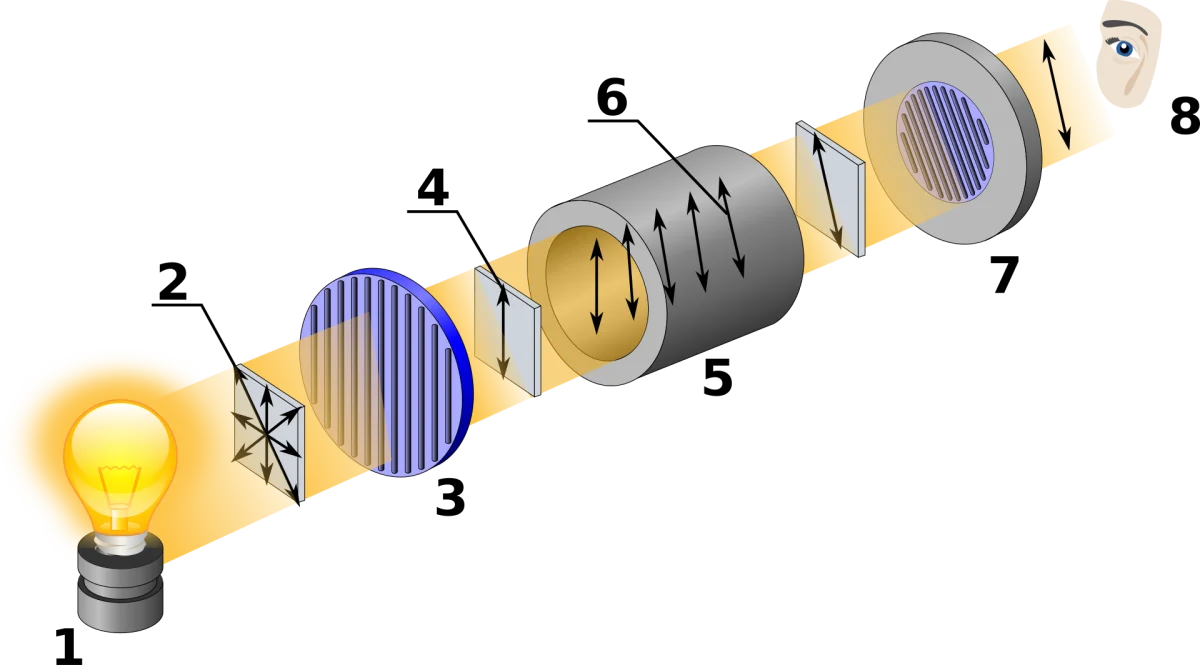
A polarimeter is the instrument that measures optical rotation. Here is how it works:
A light source produces ordinary (unpolarized) light.
The light passes through a polarizer, creating plane-polarized light.
The polarized light passes through a tube containing a solution of the compound being tested.
A second polarizer (the analyzer) at the other end is rotated until maximum light intensity passes through.
The angle between the initial polarization direction and the analyzer position is the observed rotation (alpha).
A polarimeter measures optical rotation. Plane-polarized light passes through the sample tube; the analyzer detects how much the plane has been rotated by the chiral solution. The direction (+/-) and magnitude depend on the molecule and its concentration. Credit: Wikimedia Commons, CC BY-SA
Dextrorotatory vs. Levorotatory
(+) or d (dextrorotatory): rotates plane-polarized light clockwise (to the right as you face the light)
(-) or l (levorotatory): rotates plane-polarized light counterclockwise (to the left)
These labels come from experimental measurement only. You cannot predict the sign from the structure.
Specific Rotation
The observed rotation depends on several factors: the concentration of the solution, the length of the sample tube, the temperature, and the wavelength of light used. To standardize measurements, chemists report specific rotation, which accounts for these variables:
Key point: Specific rotation is an intrinsic property of a compound, like melting point or boiling point. It does not change with concentration or tube length. The observed rotation changes with these variables, but specific rotation is constant for a given compound under standard conditions.
Enantiomers have equal but opposite specific rotations. If (R)-2-bromobutane has a specific rotation of +23.1 degrees, then (S)-2-bromobutane has a specific rotation of -23.1 degrees. Same magnitude, opposite sign. Always.
Racemic Mixtures
A racemic mixture (also called a racemate) is a 50:50 mixture of both enantiomers. Because the two enantiomers rotate light by equal amounts in opposite directions, their rotations cancel perfectly. A racemic mixture has an observed rotation of zero - it is optically inactive.
Racemic mixtures are denoted with the prefix (+/-) or (d,l) or (rac).
Important: A racemic mixture is optically inactive, but it is NOT the same as a meso compound. A racemic mixture is a mixture of two different compounds. A meso compound is a single compound that is intrinsically achiral.
Enantiomeric Excess (ee)
When a mixture is not exactly 50:50, it will be optically active. The enantiomeric excess (ee) tells you how much of the mixture is “excess” of one enantiomer over the other:
Example calculation:
Pure (S)-2-bromobutane has [alpha] = -23.1 degrees. A sample has an observed specific rotation of -11.55 degrees. What is the enantiomeric excess?
ee = (11.55 / 23.1) x 100% = 50%
This means 50% of the mixture is excess (S) enantiomer. The remaining 50% is a racemic pair (25% S + 25% R). Total composition: 75% S, 25% R.
Working backward from ee to composition:
If ee = 50% and the major enantiomer is S:
% S = (100 + ee) / 2 = (100 + 50) / 2 = 75%
% R = (100 - ee) / 2 = (100 - 50) / 2 = 25%
Optically Active vs. Optically Inactive
Condition
Optically Active?
Pure (R) enantiomer
Yes (+)
Pure (S) enantiomer
Yes (-)
Racemic mixture (50:50 R and S)
No (rotations cancel)
Meso compound
No (internal symmetry)
Non-chiral compound (no stereocenters)
No
Unequal mixture of enantiomers
Yes (net rotation from excess)
D/L vs. d/l vs. R/S - Clearing Up the Confusion
Students often mix up these labeling systems. Here is the distinction:
Label
System
What It Describes
R, S
CIP (Cahn-Ingold-Prelog)
Absolute configuration at a stereocenter (assigned by priority rules)
+, - (or d, l)
Optical rotation
Direction of rotation of plane-polarized light (measured experimentally)
D, L
Fischer convention
Configuration relative to D-glyceraldehyde (used mainly for amino acids and sugars)
Critical: D/L (capital letters, Fischer convention) is NOT the same as d/l (lowercase, optical rotation). D-glucose happens to be dextrorotatory (+), but D-fructose is levorotatory (-). The D/L system is based on structural comparison to glyceraldehyde, not optical rotation.
A pure compound has a specific rotation of +45 degrees. A mixture of this compound and its enantiomer shows an observed specific rotation of +15 degrees. What is the enantiomeric excess, and what is the composition of the mixture?
Click to reveal answer
ee = (4515) x 100% = 33.3%. The (+) enantiomer is in excess. Composition: % (+) = (100 + 33.3)/2 = 66.7%. % (-) = (100 - 33.3)/2 = 33.3%. So the mixture is approximately 32 (+) enantiomer and 31 (-) enantiomer.
What is the difference between a racemic mixture and a meso compound? Both are optically inactive.
Click to reveal answer
A racemic mixture is a 50:50 mixture of two different enantiomers whose rotations cancel externally. A meso compound is a single molecule that is achiral due to an internal plane of symmetry, despite having stereocenters. The racemic mixture contains two different compounds; the meso compound is one compound. They are optically inactive for different reasons.
The word “racecar” is a palindrome - it reads the same forward and backward. There is a mirror point right in the middle, and the second half is a perfect reflection of the first half. Meso compounds work the same way. They have stereocenters, but an internal mirror plane divides the molecule into two halves that are exact reflections of each other. The chirality of one half cancels the chirality of the other.
The result is a molecule that has stereocenters but is achiral - it is superimposable on its mirror image and does NOT rotate plane-polarized light. This is one of the trickiest concepts in stereochemistry, and the MCAT tests it frequently.
What Makes a Compound Meso?
A compound is meso when it meets ALL of these criteria:
It has at least two stereocenters.
It has an internal plane of symmetry (a mirror plane that divides the molecule into two mirror-image halves).
It is achiral (superimposable on its mirror image).
It is optically inactive (does not rotate plane-polarized light).
The internal mirror plane is the key. If you can draw a line through the molecule so that the top half is the exact mirror reflection of the bottom half (or left mirrors right), the molecule is meso.
The Classic Example: Tartaric Acid
Tartaric acid (2,3-dihydroxybutanedioic acid) has two stereocenters (carbons 2 and 3). Using the 2n rule, we would expect 22 = 4 stereoisomers. But there are actually only 3, because one of them is meso.
The three forms of tartaric acid:
Stereoisomer
Configuration
Optically Active?
Relationship
(R,R)-tartaric acid
R at C2, R at C3
Yes (+)
Enantiomer of (S,S)
(S,S)-tartaric acid
S at C2, S at C3
Yes (-)
Enantiomer of (R,R)
meso-tartaric acid
R at C2, S at C3
No
Diastereomer of both
The meso form has one R and one S stereocenter. The R stereocenter rotates light one way, and the S stereocenter rotates it the opposite way by exactly the same amount. They cancel internally. The molecule is optically inactive - not because it lacks stereocenters, but because its stereocenters neutralize each other.
The defining feature of a meso compound is an internal mirror plane: one half of the molecule is the mirror image of the other half. The hands analogy captures the same idea — two halves that are perfect mirror images. For meso-tartaric acid, this internal symmetry is why the R and S stereocenters cancel each other and the molecule is optically inactive. Credit: Wikimedia Commons, CC BY-SA
Finding the Internal Mirror Plane
To identify a meso compound, look for a plane that divides the molecule into two halves where:
The atoms on one side are mirror reflections of the atoms on the other side.
The stereocenters on one side have opposite configurations from the stereocenters on the other side (one R, one S).
Shortcut: If a molecule has two stereocenters with the same four substituents, and the configurations are opposite (one R and one S), it is likely meso. Check for the internal mirror plane to confirm.
Meso Compounds Reduce the Stereoisomer Count
Remember the 2n rule? It gives the MAXIMUM number of stereoisomers. When meso compounds exist, the actual count is less than 2n.
Example: A molecule with 2 stereocenters:
Without meso: 22 = 4 stereoisomers (two pairs of enantiomers)
With meso: only 3 stereoisomers. The meso form replaces one enantiomeric pair - the (R,S) and (S,R) forms are actually the SAME molecule (they are superimposable), giving one meso compound instead of two enantiomers.
Meso vs. Racemic - Don’t Confuse Them
Both meso compounds and racemic mixtures are optically inactive. But they are fundamentally different:
Feature
Meso Compound
Racemic Mixture
What is it?
One single molecule
A 50:50 mix of two enantiomers
Why optically inactive?
Internal symmetry (one half cancels the other)
External cancellation (one enantiomer cancels the other)
Number of compounds
1
2
Can be separated?
N/A (it is one compound)
Yes, with chiral methods
Has stereocenters?
Yes
Yes (both enantiomers do)
Has a mirror plane?
Yes (internal)
No (individual molecules are chiral)
How to Spot Meso Compounds on the MCAT
Follow these steps:
Count the stereocenters. If there is only one, the compound cannot be meso (you need at least two).
Check if the stereocenters have the same substituents. If the groups attached to the stereocenters are identical sets, meso is possible.
Check the configurations. If one stereocenter is R and the other is S, AND the molecule has a mirror plane, it is meso.
Look for the mirror plane. Draw the molecule in an extended (zig-zag or Fischer projection) form and look for a horizontal or vertical line of symmetry.
Common meso structures on the MCAT:
meso-tartaric acid (the classic example)
cis-1,2-dimethylcyclohexane (in certain representations)
2,3-dibromobutane (R,S form)
Any compound with two identical stereocenters bearing opposite configurations
Meso and the 2n Rule on the MCAT
If an MCAT question asks “How many stereoisomers does this molecule have?” and you calculate 2n but one of the forms is meso, you need to subtract:
The meso form is one compound, not two.
It replaces what would have been a pair of enantiomers.
So the actual count is 2n - 1 when one meso form exists.
For tartaric acid: 22 = 4 maximum, but one pair is meso, so the actual count is 3.
Why is meso-tartaric acid optically inactive even though it has two stereocenters?
Click to reveal answer
Internal compensation. Meso-tartaric acid has one R and one S stereocenter. The R center rotates light in one direction, and the S center rotates it by the same magnitude in the opposite direction. They cancel each other within the same molecule. An internal plane of symmetry makes the molecule achiral and superimposable on its mirror image.
A molecule has two stereocenters with identical substituents. One is R and the other is S. Is this molecule chiral or achiral? What is this type of compound called?
Click to reveal answer
Achiral. This is a meso compound. When two stereocenters with the same substituents have opposite configurations (one R, one S), the molecule has an internal mirror plane. The chirality of the two centers cancels, making the molecule superimposable on its mirror image and optically inactive.
Imagine a fence running across your yard. You and your neighbor both have dogs. If both dogs are on the same side of the fence, they can play together - that is the cis (or Z) arrangement. If the dogs are on opposite sides, they are separated - that is the trans (or E) arrangement. The fence is the double bond, and the dogs are the substituents. Because you cannot rotate around a fence post without tearing it down, the dogs stay where they are.
Double bonds do not rotate freely the way single bonds do. The pi bond locks the two carbons in place, preventing rotation. This means groups attached to a double bond are trapped on one side or the other. If two groups can be on the same side or on opposite sides, you have geometric isomers.
Why Double Bonds Restrict Rotation
A C=C double bond consists of one sigma bond (head-on overlap) and one pi bond (side-by-side overlap of p orbitals). The pi bond can only exist when the p orbitals are parallel. Rotating around the bond would break the pi bond, requiring roughly 250 kJ/mol of energy. At room temperature, molecules do not have enough energy to do this, so geometric isomers are stable and do not interconvert.
This is fundamentally different from single bonds, where rotation is essentially free (the energy barrier is only about 12-25 kJ/mol).
The Cis/Trans System
The cis/trans naming system is simple but limited:
Cis - identical (or similar) substituents are on the same side of the double bond
Trans - identical (or similar) substituents are on opposite sides of the double bond
Example: 2-butene (CH3CH=CHCH3)
cis-2-butene: Both methyl groups are on the same side of the double bond
trans-2-butene: Methyl groups are on opposite sides
Limitation: Cis/trans only works when each carbon of the double bond has one hydrogen and one non-hydrogen substituent (or two identical substituents). If a double bond carbon has two different non-hydrogen groups, cis/trans becomes ambiguous - you need the E/Z system instead.
The E/Z System
The E/Z system uses CIP priority rules (the same rules from R/S assignment) and works for ALL substituted alkenes, including those where cis/trans is ambiguous.
Step 1: For each carbon of the double bond, rank its two substituents by CIP priority (higher atomic number = higher priority).
Step 2: Determine whether the two higher-priority groups are on the same side or opposite sides of the double bond.
Z (zusammen, German for “together”): Higher-priority groups are on the same side
E (entgegen, German for “opposite”): Higher-priority groups are on opposite sides
Worked Example: Assigning E or Z
Consider 2-bromo-1-chloropropene: ClCH=CBrCH3
Carbon 1 of the double bond has two substituents: Cl (atomic number 17) and H (atomic number 1). Higher priority: Cl.
Carbon 2 of the double bond has two substituents: Br (atomic number 35) and CH3 (C, atomic number 6). Higher priority: Br.
Now compare the positions of Cl and Br (the two higher-priority groups). If they are on the same side of the double bond, the isomer is Z. If on opposite sides, it is E.
When Cis = Z and When It Doesn’t
For simple disubstituted alkenes (one substituent and one H on each carbon), cis and Z typically correspond, and trans and E correspond. But this is NOT always true for more complex alkenes.
Example where cis does not equal Z:
Consider (Z)-1-bromo-2-chloroethene: BrCH=CHCl
On carbon 1: Br (priority 1), H (priority 2). On carbon 2: Cl (priority 1), H (priority 2).
If Br and Cl are on the same side, this is the Z isomer. But Br and Cl are different groups, so calling this “cis” is ambiguous. The E/Z system resolves the ambiguity.
Stability of Geometric Isomers
Trans (E) alkenes are generally more stable than cis (Z) alkenes because of steric strain. In the cis arrangement, the two larger groups are on the same side, bumping into each other. In the trans arrangement, they are on opposite sides, minimizing steric interactions.
Evidence: Trans-2-butene has a lower heat of hydrogenation (-115.5 kJ/mol) than cis-2-butene (-119.7 kJ/mol). Since both give the same product (butane), the difference in energy released reflects the difference in starting energy. Cis-2-butene starts at higher energy (less stable), so it releases more energy when hydrogenated.
Property
cis (Z)
trans (E)
Stability
Less stable
More stable
Heat of hydrogenation
Higher (releases more energy)
Lower (releases less energy)
Boiling point
Often higher (dipole moment)
Often lower (symmetrical, less dipole)
Dipole moment
Larger (substituents on same side)
Smaller (substituents cancel)
Geometric Isomers in Rings
Cyclic compounds can also show cis/trans isomerism. In a ring, “cis” means two substituents are on the same face of the ring (both pointing up or both pointing down). “Trans” means they are on opposite faces (one up, one down).
This is particularly important for cyclohexane derivatives, which we will explore in detail in Section 2.11.
Geometric Isomers in Biological Molecules
Geometric isomerism has major biological consequences:
Fatty acids: Naturally occurring unsaturated fatty acids are almost always cis. The cis double bond creates a “kink” in the chain, preventing tight packing and keeping cell membranes fluid. Trans fats (artificial) pack more tightly, increasing rigidity and cardiovascular risk.
Vision: Retinal, the light-absorbing molecule in your eyes, switches from 11-cis-retinal to all-trans-retinal when it absorbs a photon. This cis-to-trans isomerization triggers a conformational change in the rhodopsin protein, initiating the signal cascade that lets you see.
In the E/Z naming system, what does Z stand for and what does it mean?
Click to reveal answer
Z stands for "zusammen" (German for "together"). It means the two higher-priority groups (assigned by CIP rules) are on the same side of the double bond. Remember: "Z = Zame Zide."
Which is generally more stable, a cis or trans alkene? How can you determine relative stability experimentally?
Click to reveal answer
Trans (E) alkenes are generally more stable because the larger groups are on opposite sides, minimizing steric strain. Relative stability is determined by heats of hydrogenation: the more stable isomer has a LOWER heat of hydrogenation (it releases less energy because it starts at lower energy). Trans-2-butene releases 4.2 kJ/mol less energy than cis-2-butene upon hydrogenation.
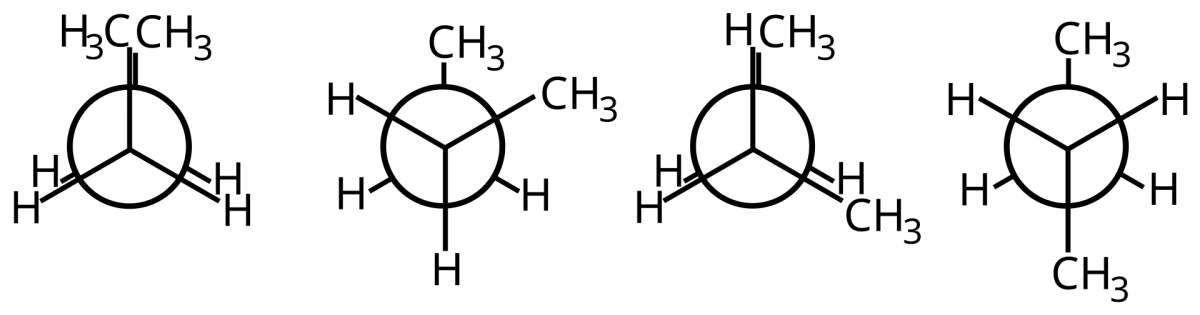
Stand at one end of a narrow hallway and look straight down toward the other end. The person standing right in front of you (the front carbon) blocks most of your view, but you can see the arms and legs of someone standing behind them (the rear carbon) poking out from the sides. That is exactly what a Newman projection shows: you are looking straight down the carbon-carbon bond, and the two carbons are stacked on top of each other from your point of view.
Conformational isomers (conformers) are different spatial arrangements of the same molecule created by rotation around a single bond. Unlike constitutional isomers or stereoisomers, conformers do NOT require bond breaking to interconvert. They are the same molecule in different poses, like a person standing with their arms at their sides versus their arms outstretched.
Newman projections of butane showing the anti (180°), gauche (60°), and eclipsed (0°) conformations around the C2-C3 bond. The anti conformation is the lowest-energy arrangement. Credit: Wikimedia Commons, CC BY-SA
Drawing Newman Projections
A Newman projection uses a specific visual convention:
Front carbon: Represented by the center point of a circle. Its three substituents radiate outward from the center like spokes.
Rear carbon: Represented by the circle itself. Its three substituents radiate outward from the edge of the circle.
Dihedral angle: The angle between substituents on the front and rear carbons, measured as you look down the bond.
The Conformations of Ethane
Ethane (CH3-CH3) is the simplest molecule for understanding conformational analysis. As you rotate around the C-C bond, the molecule passes through an infinite number of conformations, but two extremes matter:
Staggered conformation (dihedral angle = 60 degrees): Each hydrogen on the front carbon is positioned between two hydrogens on the rear carbon. Maximum separation. Lowest energy. Most stable.
Eclipsed conformation (dihedral angle = 0 degrees): Each hydrogen on the front carbon lines up directly with a hydrogen on the rear carbon. Minimum separation. Highest energy. Least stable.
The energy difference between staggered and eclipsed ethane is about 12 kJ/mol. This energy penalty comes from torsional strain - the resistance to having bonds on adjacent carbons line up directly with each other. Torsional strain arises from electron-electron repulsion between the bonding electrons of eclipsed substituents.
The Conformations of Butane
Butane (CH3CH2CH2CH3) is where conformational analysis gets interesting, because the methyl groups on C2 and C3 create steric interactions. Looking down the C2-C3 bond, there are four named conformations:
Anti (dihedral angle = 180 degrees):
The two methyl groups are on opposite sides, as far apart as possible. This is the global energy minimum - the most stable conformation. No torsional strain, no steric strain.
Gauche (dihedral angle = 60 degrees):
The two methyl groups are 60 degrees apart. This is a local energy minimum - more stable than eclipsed, but less stable than anti. There is minor steric strain because the methyl groups are close enough to bump into each other (gauche interaction, about 3.8 kJ/mol above anti).
Eclipsed (dihedral angle = 120 degrees):
A methyl group on the front carbon lines up with a hydrogen on the rear carbon. This is a local energy maximum. Both torsional and steric strain are present.
Totally eclipsed (syn-periplanar, dihedral angle = 0 degrees):
The two methyl groups are directly behind each other. This is the global energy maximum - the least stable conformation. Maximum torsional strain and maximum steric strain. About 19 kJ/mol above anti.
The Energy Diagram
As you rotate 360 degrees around the C2-C3 bond of butane, the energy traces a wave pattern:
Dihedral Angle
Conformation
Energy Level
0 degrees
Totally eclipsed (CH3 behind CH3)
Global maximum
60 degrees
Gauche
Local minimum
120 degrees
Eclipsed (CH3 behind H)
Local maximum
180 degrees
Anti
Global minimum
240 degrees
Eclipsed (CH3 behind H)
Local maximum
300 degrees
Gauche
Local minimum
360 degrees
Totally eclipsed
Global maximum
The diagram repeats every 360 degrees. There are two gauche minima (at 60 degrees and 300 degrees), two eclipsed maxima (at 120 degrees and 240 degrees), and one totally eclipsed maximum (at 3600 degrees).
A parallel example of conformational energy. Cyclohexane's chair is the lowest-energy ring conformation (analogous to butane's anti), with axial and equatorial positions that swap via chair flip. The same energy-vs-conformation reasoning used for butane's C2-C3 rotation generalizes to the ring conformations covered in the next section. Credit: Wikimedia Commons, CC BY-SA
Types of Strain
Three types of strain destabilize certain conformations:
Torsional strain: Resistance to having bonds on adjacent atoms aligned in the same plane (eclipsed). Arises from electron-electron repulsion in eclipsed bonds. Present in ALL eclipsed conformations, even in ethane where there is no steric issue.
Steric strain: Repulsion between electron clouds of bulky groups that are too close together. This is why gauche butane is higher energy than anti butane - the methyl groups are close enough to push against each other. Steric strain increases with the size of the groups.
Angle strain: Deviation from ideal bond angles. Not a factor in acyclic conformational analysis, but critically important in ring systems (Section 2.11).
Conformational Analysis Strategy for the MCAT
When given a Newman projection question:
Identify the two key substituents (usually the largest groups on the front and rear carbons).
Measure their dihedral angle (the angle between them as you look down the bond).
Rank the energy: Anti < gauche < eclipsed < totally eclipsed.
Identify strain types: Eclipsed = torsional strain. Large groups close together = steric strain.
Free Rotation at Room Temperature
An important concept: at room temperature, rotation around single bonds is essentially free. The energy barriers between conformations (12-19 kJ/mol for butane) are small enough that molecules constantly rotate through all conformations. A sample of butane is not “stuck” in the anti conformation; it is rapidly interconverting among all conformations but spending the most time in the lowest-energy ones (anti and gauche).
The Boltzmann distribution determines the population of each conformation. At room temperature, butane spends roughly 70-80% of its time in the anti conformation and the remainder in gauche conformations. It passes through eclipsed conformations but does not linger there.
In a Newman projection of butane looking down the C2-C3 bond, which conformation is the most stable and why?
Click to reveal answer
Anti conformation (180-degree dihedral angle). The two methyl groups are as far apart as possible, minimizing both torsional strain (no eclipsing) and steric strain (maximum distance between bulky groups). Anti is the global energy minimum for butane.
What is the difference between torsional strain and steric strain?
Click to reveal answer
Torsional strain is the energy penalty from eclipsed bonds on adjacent atoms, caused by electron-electron repulsion. It occurs even with small substituents (like H in ethane). Steric strain is the energy penalty from bulky groups being forced too close together. It depends on the size of the groups. Both contribute to the instability of eclipsed conformations, but only steric strain distinguishes gauche from anti.
Picture a lawn chair - the kind that reclines with a headrest at one end and a footrest at the other. The seat does not lie flat; it angles up to the headrest and down to the footrest. That zigzag shape is remarkably close to what cyclohexane looks like in its most stable form: the chair conformation. Now imagine every other person at a dinner table. Some are sitting bolt upright (axial), and others are leaning back casually (equatorial). Where you sit matters, because the upright people keep bumping elbows with their neighbors, while the reclining people have plenty of room.
Cyclohexane is the most important ring system in organic chemistry. Its conformational analysis shows up on nearly every MCAT, and the concepts of axial/equatorial positioning and 1,3-diaxial strain apply to sugars, steroids, and countless pharmaceutical molecules.
Why Cyclohexane Is Not Flat
If cyclohexane were a flat hexagon, all C-C-C bond angles would be 120 degrees - significantly larger than the ideal tetrahedral angle of 109.5 degrees. This would create severe angle strain. Additionally, all adjacent C-H bonds would be eclipsed, creating torsional strain.
To escape both types of strain, cyclohexane puckers into the chair conformation, which achieves:
Bond angles of approximately 109.5 degrees (no angle strain)
All adjacent bonds in a staggered arrangement (no torsional strain)
The chair is virtually strain-free, making it the dominant conformation
The Chair Conformation
In the chair form, the six carbons sit at alternating heights - three up and three down, creating the characteristic “chair” shape. Each carbon has two types of positions for its substituents:
Axial positions: Point straight up or straight down, perpendicular to the “seat” of the chair. On any given carbon, one axial position points up and the next carbon’s axial position points down, alternating around the ring.
Equatorial positions: Point outward from the ring at an angle, roughly in the plane of the “seat.” Like axial positions, they alternate - one slightly up-angled, the next slightly down-angled.
Every carbon in the chair has exactly one axial and one equatorial position. The six axial bonds alternate up-down-up-down around the ring. The six equatorial bonds also alternate, angled slightly up then slightly down.
1,3-Diaxial Strain
When a substituent occupies an axial position, it is parallel to and directly above (or below) the axial substituents on carbons two positions away (the 1,3 positions). These groups are close enough to experience steric repulsion - this is called 1,3-diaxial strain (or 1,3-diaxial interaction).
For hydrogen atoms, this strain is negligible. But for larger groups like methyl, ethyl, or tert-butyl, the 1,3-diaxial interaction is significant. The larger the group, the more it “bumps elbows” with the axial hydrogens at the 1,3 positions, and the more the molecule prefers the equatorial position.
The tert-butyl group has such a massive preference for equatorial that it effectively “locks” the chair - the ring almost never flips when a tert-butyl group is present, because putting it axial would be overwhelmingly unfavorable.
The Chair Flip (Ring Flip)
Cyclohexane can undergo a chair flip - a conformational change where the “headrest” of the chair flips down to become the “footrest,” and vice versa. During a chair flip:
Every axial substituent becomes equatorial
Every equatorial substituent becomes axial
No bonds are broken - this is a conformational change, not a chemical reaction
Critical point: A chair flip does NOT change the configuration (R/S) at any stereocenter. It does not change cis/trans relationships. It only swaps axial and equatorial positions.
The animation below walks through the full flip. Watch the substituent start axial in chair A, climb through the half-chair transition states, pass through the twist-boat intermediate, and settle equatorial in chair B. Swap in a bulkier group (isopropyl, tert-butyl) and the energy diagram shows the equatorial minimum drop correspondingly — that gap is the A-value.
Cyclohexane chair flip
Interactive
For monosubstituted cyclohexane:
The chair flip gives two conformations. In one, the substituent is axial. In the other, it is equatorial. The equatorial conformation is more stable (lower energy) due to reduced 1,3-diaxial strain. At equilibrium, the molecule spends more time in the equatorial conformation.
For methylcyclohexane, approximately 95% of molecules are in the equatorial conformation at room temperature.
Disubstituted Cyclohexane
When cyclohexane has two substituents, the analysis becomes more interesting. You need to consider both the cis/trans relationship and the axial/equatorial preferences.
cis-1,2-dimethylcyclohexane:
In a cis arrangement, both methyl groups are on the same face of the ring. In one chair, one is axial and one is equatorial (ax/eq). In the flipped chair, they swap: the other is axial and the first is equatorial (eq/ax). Both chairs have the same energy (one axial methyl each), so neither is preferred.
trans-1,2-dimethylcyclohexane:
In a trans arrangement, the methyl groups are on opposite faces. One chair puts both groups equatorial (eq/eq) - the most stable arrangement. The flipped chair puts both groups axial (ax/ax) - the least stable. The diequatorial conformation is overwhelmingly preferred.
Conformational Preferences Summary
| Substitution Pattern | Most Stable Chair Has | Least Stable Chair Has |
|---|---|---|
| Monosubstituted | Substituent equatorial | Substituent axial |
| trans-1,2 or trans-1,4 | Both equatorial | Both axial |
| cis-1,3 | Both equatorial | Both axial |
| cis-1,2 or cis-1,4 | One axial, one equatorial | One axial, one equatorial |
| trans-1,3 | One axial, one equatorial | One axial, one equatorial |
When two groups compete and cannot both be equatorial, the larger group wins - it takes the equatorial position, and the smaller group is forced axial.
The Boat Conformation
The boat conformation is an alternative to the chair, but it is significantly less stable due to:
Flagpole interactions: Two hydrogens on opposite sides of the “boat” point inward toward each other, creating steric strain.
Eclipsing strain: Four pairs of adjacent C-H bonds are eclipsed along the sides of the boat.
The boat is approximately 30 kJ/mol higher in energy than the chair. A slightly twisted version (the twist-boat) is about 5 kJ/mol lower than the perfect boat, making it the second most stable conformation after the chair. However, even the twist-boat is far less stable than the chair.
For the MCAT, the key takeaway: the chair conformation dominates. The boat is a transition state during chair flips and is not significantly populated at room temperature.
Drawing Cyclohexane Chairs
Practice drawing chairs correctly. The angles matter:
Draw two parallel lines slanting slightly - one from upper left to middle, one from middle to upper right.
Add a point above and below these lines to create the headrest and footrest.
Axial bonds are perfectly vertical (up or down).
Equatorial bonds are slightly angled, roughly following the slope of the adjacent ring bonds.
Alternate up/down around the ring for both axial and equatorial bonds.
During a chair flip of cyclohexane, what happens to axial and equatorial substituents?
Click to reveal answer
Every axial substituent becomes equatorial, and every equatorial substituent becomes axial. No bonds are broken - this is a conformational change. The cis/trans relationship and R/S configurations remain unchanged. A substituent that was “up” (on the same face) stays “up” - only its axial/equatorial designation changes.
Cycle through common substituents in the comparator below to see how the A-value translates directly into an equilibrium constant. Halogens barely favor equatorial (A < 0.5 kcal/mol, ~70% eq); methyl sits around 95% equatorial; tert-butyl is locked >99.9% equatorial because its 4.9 kcal/mol A-value gives Keq ≈ 4000.
A ring flip does not move the group to another carbon. It stays on C1 throughout. What changes is the pucker of the ring, and so whether that one carbon's bond points straight up (axial) or out along the rim (equatorial). An axial group has to share its space with the axial hydrogens on C3 and C5, and the A-value is simply the energy price of that crowding. It is why larger groups sit equatorial, and why a tert-butyl group effectively pins a ring in one conformer.
Why does the tert-butyl group essentially “lock” the cyclohexane ring into one chair conformation?
Click to reveal answer
The tert-butyl group has an extremely large 1,3-diaxial strain penalty (22.8 kJ/mol) when axial. This energy cost is so large that the ring is overwhelmingly favored in the chair conformation with tert-butyl equatorial. The equilibrium constant is approximately 10,000:1 in favor of the equatorial tert-butyl, effectively “locking” the ring.
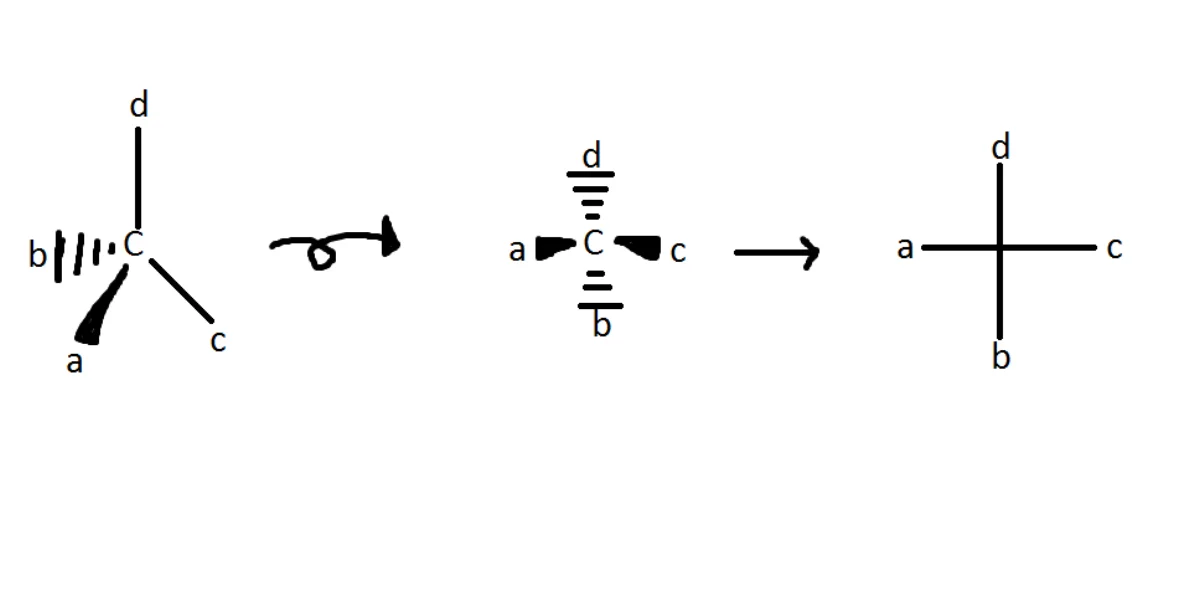
Trying to draw a three-dimensional molecule on a two-dimensional page is like trying to describe a sculpture with a flat photograph - you lose information. Fischer projections are a clever shortcut that lets you represent 3D stereochemistry on a flat page using a simple cross pattern. The convention was invented by Emil Fischer in the 1890s for carbohydrate chemistry, and it remains essential for sugars and amino acids on the MCAT.
The key rule is this: imagine pressing a 3D molecular model flat against a wall, like squashing a spider. The horizontal lines come toward you (out of the page), and the vertical lines go away from you (into the page). That single convention encodes all the 3D information.
Fischer projection convention: horizontal lines come out of the page (toward you); vertical lines go behind the page (away from you). Each crossing represents a tetrahedral carbon center. Credit: Wikimedia Commons, CC BY-SA
The Fischer Projection Convention
Every cross (+) in a Fischer projection represents a tetrahedral carbon:
Horizontal lines point toward the viewer (equivalent to wedge bonds)
Vertical lines point away from the viewer (equivalent to dash bonds)
The carbon itself sits at the intersection
For a standard Fischer projection of a sugar or amino acid:
The most oxidized carbon (aldehyde, ketone, or carboxyl group) goes at the top
The carbon chain runs vertically
Each horizontal position shows the substituents that point toward you
Drawing a Fischer Projection from a 3D Structure
Orient the molecule so the carbon chain is vertical, with the most oxidized end at the top.
For each chiral center, arrange substituents so that the chain continues vertically (going into the page) and the other two groups point horizontally (coming toward you).
Draw each chiral center as a cross: the vertical line continues the chain, and the horizontal line shows the groups projecting toward you.
Manipulation Rules
Fischer projections follow strict rules about what you can and cannot do:
Allowed:
Rotate the entire projection 180 degrees in the plane of the paper (this keeps all relationships intact)
Make an even number of pairwise swaps of substituents on a single carbon (this preserves configuration)
NOT allowed:
Rotate 90 degrees (this inverts all stereocenters - turns R into S and vice versa)
Lift the projection off the page and flip it over (this also inverts configuration)
Make an odd number of swaps (this inverts configuration)
Assigning R/S from Fischer Projections
You can assign R/S directly from a Fischer projection without converting to a 3D drawing. Here is the shortcut:
Step 1: Assign CIP priorities (1-4) to the four substituents on the stereocenter, just as you normally would.
Step 2: Check where priority 4 (the lowest-priority group, usually H) is located.
If priority 4 is on the vertical (going away from you):
Trace 1 to 2 to 3 directly.
Clockwise = R, Counterclockwise = S.
This is the standard assignment because #4 is already pointing away from you.
If priority 4 is on the horizontal (coming toward you):
Trace 1 to 2 to 3.
The answer you get is REVERSED: Clockwise = S, Counterclockwise = R.
This is because #4 is toward you instead of away, so you are looking from the wrong side (the same flip rule from Section 2.5).
The D/L System
The D/L system is an older naming convention that is still used extensively for amino acids and sugars. It is based on comparison to the reference compound glyceraldehyde.
D-glyceraldehyde has the OH group on the RIGHT side of the Fischer projection (at the bottom-most stereocenter). L-glyceraldehyde has the OH on the LEFT.
For sugars:
Look at the highest-numbered stereocenter (the bottom-most chiral center in the Fischer projection).
If the OH on that carbon is on the RIGHT, the sugar is D.
If the OH is on the LEFT, the sugar is L.
For amino acids:
Look at the alpha carbon in the Fischer projection (with the carboxyl group at the top and the R group at the bottom).
If the NH2 group is on the LEFT, the amino acid is L.
If the NH2 is on the RIGHT, the amino acid is D.
Critical: Almost all naturally occurring amino acids are L, and almost all naturally occurring sugars are D. This is one of the most commonly tested facts in MCAT biochemistry.
D/L vs. R/S vs. (+)/(-)
These three systems are completely independent. There is no consistent relationship between them:
System
What It Describes
How It Is Assigned
R/S
Absolute configuration at a stereocenter
CIP priority rules
D/L
Configuration relative to glyceraldehyde
Position of OH or NH2 in Fischer projection
(+)/(-)
Direction of optical rotation
Experimental measurement with a polarimeter
Examples that prove they are independent:
D-glucose is dextrorotatory (+). D-fructose is levorotatory (-). Both are D-sugars.
L-alanine has the (S) configuration. L-cysteine has the (R) configuration. Both are L-amino acids. (Cysteine is R because the sulfur-containing side chain has higher CIP priority than the carboxyl group, rearranging the priority order.)
Fischer Projections and Enantiomers/Meso Compounds
To find the enantiomer from a Fischer projection: swap left and right on every stereocenter (mirror the entire projection along the vertical axis).
To identify a meso compound from a Fischer projection: look for an internal horizontal line of symmetry. If the top half of the Fischer projection is the mirror image of the bottom half, the compound is meso.
Example: For tartaric acid in a Fischer projection:
If the OH groups are both on the right (or both on the left), it is one of the optically active enantiomers.
If one OH is on the right and one is on the left, with the molecule symmetric about a horizontal midline, it is the meso form.
Common MCAT Applications
Sugars: Fischer projections are the standard way to draw monosaccharides. D-glucose, D-galactose, D-mannose, and D-fructose are drawn as Fischer projections to show the configuration at each stereocenter. Epimers (sugars differing at one stereocenter) are easily compared by looking at which OH groups point left vs. right.
Amino acids: The alpha carbon of amino acids is commonly shown in a Fischer projection. L-amino acids have NH2 on the left, COOH at the top, R group at the bottom, and H on the right.
Converting Between Representations
You should be comfortable converting between three representations:
3D perspective drawing (wedge-dash) - shows bonds coming toward and away from you explicitly
Fischer projection - uses the horizontal/vertical cross convention
Newman projection - views down a specific bond axis
The MCAT may give you a molecule in one representation and ask you to identify it in another. Practice converting between all three formats. The key is always knowing which bonds point toward you and which point away.
In a Fischer projection, which direction do horizontal bonds point? What about vertical bonds?
Click to reveal answer
Horizontal bonds come toward the viewer (equivalent to wedge bonds in a 3D drawing). Vertical bonds go away from the viewer (equivalent to dash bonds). Think of a bowtie: the wings come toward you, and the string goes behind your neck.
In the D/L system, how do you determine if a sugar is D or L from its Fischer projection?
Click to reveal answer
Look at the OH on the highest-numbered stereocenter (the bottom-most chiral center in the Fischer projection). If the OH points to the right, the sugar is D. If it points to the left, the sugar is L. Most naturally occurring sugars are D-sugars.